Smart water management using the Internet of Things (IoT) connects sensors and meters to software that can monitor water conditions, reveal unusual changes and help people decide when to act. Four practical examples are water-quality monitoring, reservoir-level monitoring, precision irrigation, and smart meters that can flag unusual consumption or possible leaks.
The important part is not simply putting a sensor online. A useful system must collect a meaningful measurement, move it reliably, interpret it in context and present it to the person or system responsible for the next decision.
How IoT Smart Water Management Works
Imagine a flow meter recording water use in a building. A high reading has little value by itself. The system becomes useful when that reading is linked to the right meter, time and location, transmitted to software, compared with expected usage and turned into a dashboard update or alert.
This wider process is IoT data tracking: sensors or connected devices measure physical conditions, a network carries the readings, and software stores, analyzes or presents the information so that someone can respond.
Some systems send every reading to a remote platform, while others use a gateway, which is a device that receives sensor data and passes it to another network or application. The system may then display measurements, compare them with a threshold or generate an alert when something looks unusual.
Organizations can build these layers internally or use external IoT development services to integrate sensors, device software, communications, data processing and operator dashboards.
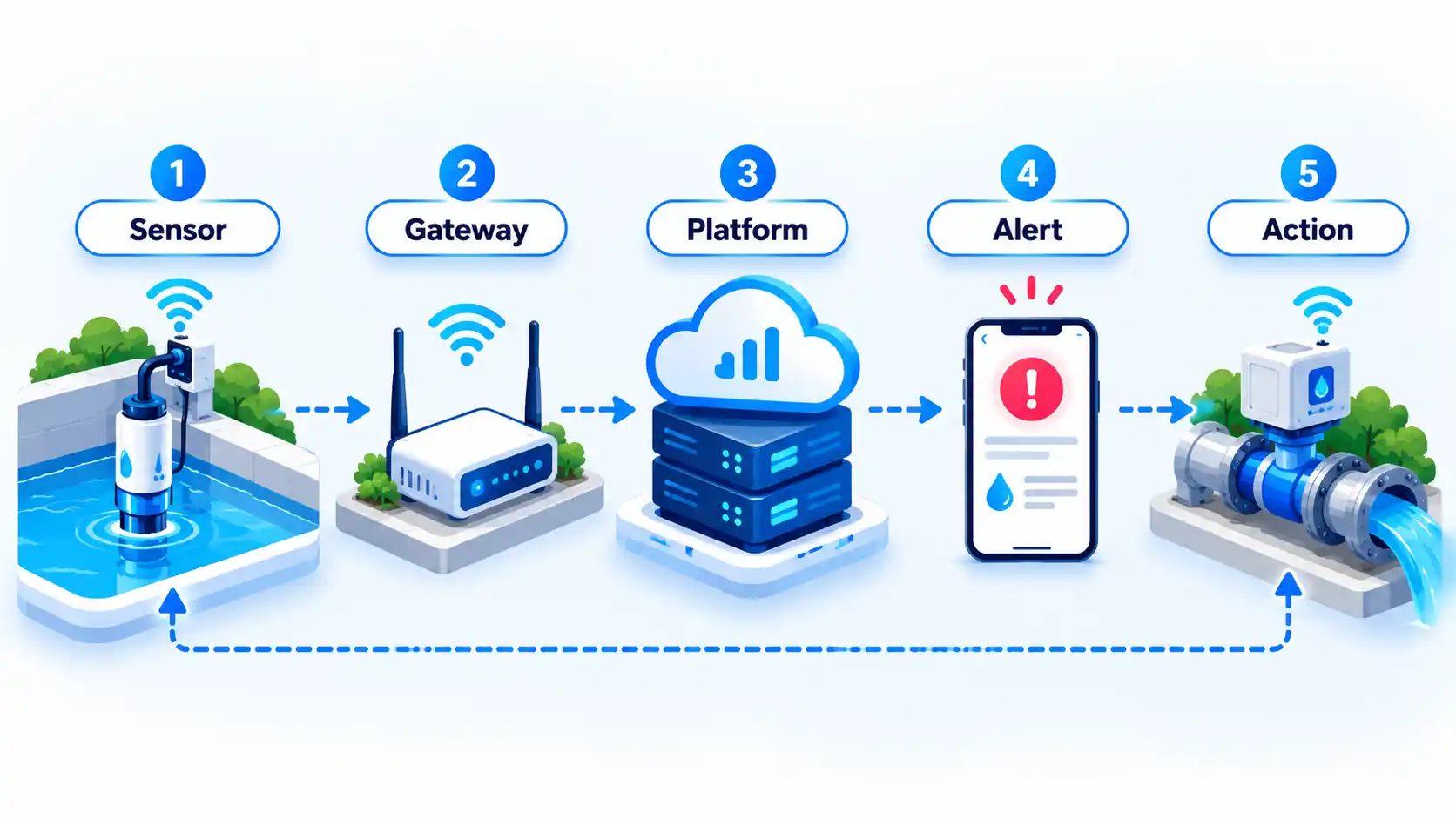
The four examples below use the same basic idea but solve different water-management problems.
| Application | What is measured | What the data can support | Important limitation |
|---|---|---|---|
| Water quality monitoring | Properties such as temperature, pH, conductivity, dissolved oxygen or turbidity | Frequent monitoring, trend analysis and alerts for unusual readings | A sensor reading does not replace every laboratory or regulatory test |
| Reservoir and water level monitoring | Water level and related hydrologic conditions | Remote visibility, threshold awareness and planning | Level data alone does not establish structural dam safety |
| Precision irrigation | Soil moisture and related field conditions | Irrigation scheduling based on actual root-zone conditions | Placement, calibration, soil conditions and maintenance affect readings |
| Smart meters and leak detection | Water consumption and flow patterns | Usage tracking and alerts for abnormal consumption | An unusual pattern does not automatically identify the cause or exact leak location |
Water Quality Monitoring
Water can look normal while important properties are changing. Connected water-quality sensors allow operators to measure selected characteristics repeatedly instead of depending only on occasional manual observations.
The U.S. Geological Survey uses continuous monitors to assess surface-water quality. A common configuration measures temperature, specific conductance, dissolved oxygen and pH, while other sensors can measure properties such as turbidity.
Turbidity describes how cloudy water is because of suspended particles. Specific conductance is related to the water’s ability to conduct electricity and can help show changes in dissolved material. Dissolved oxygen measures oxygen available in the water. Together with temperature, pH and other measurements, these readings can show that conditions are changing and deserve attention.
The IoT advantage is frequency and reach. A sensor at a remote site can report measurements without requiring a person to travel there for every reading. Operators can compare current values with earlier data, watch trends and respond when a measurement moves outside an expected range.
That does not mean a connected sensor can certify water as safe on its own. Some determinations still require samples, laboratory analysis or prescribed regulatory methods. Continuous monitors also require maintenance because cleaning, calibration and data review are part of producing reliable records.
Smart monitoring therefore works best as a faster source of operational information, not as a blanket replacement for every form of water-quality testing.
Reservoir and Water Level Monitoring
A reservoir, lake or river can change considerably between manual site visits. Remote level monitoring gives operators a way to see those changes as measurements arrive rather than waiting for the next inspection.
A useful real-world example is the U.S. Geological Survey’s National Water Dashboard. It combines real-time stream, lake and reservoir, precipitation and groundwater information from more than 13,500 USGS observation stations.
For a water manager, frequent level information can answer practical questions. Is a reservoir rising quickly after heavy rain? Has a river fallen below a level relevant to operations? Is the available water moving outside an expected seasonal range? A connected system can make those changes visible without requiring someone to obtain every reading manually.
Thresholds can also help focus attention. If a measured level reaches a predefined point, software can alert staff so they can review the wider situation and follow the appropriate operating or emergency procedure.
The distinction between monitoring and control matters. A water-level sensor measures a condition. It does not, by itself, establish whether a dam is structurally safe, and a level threshold alone is not enough evidence for every decision about gates, flood response or infrastructure safety. Those decisions may depend on engineering assessments, weather information, operating rules and other measurements.
Precision Irrigation
A fixed irrigation timer waters on a schedule whether the soil is already wet or becoming too dry. Soil-moisture sensing adds information about the conditions around the crop roots, allowing irrigation decisions to respond to the field rather than the clock alone.
Research by the U.S. Department of Agriculture’s Agricultural Research Service tested soil-moisture sensors installed at several depths and transferred their readings wirelessly for remote access. The system used measured root-zone moisture and a threshold to trigger irrigation events.
In practice, a connected irrigation system can collect moisture readings from the field and make them available to a farmer or irrigation controller. When the measured soil water content reaches the chosen trigger level, the system can signal that irrigation is due. When enough moisture remains, irrigation does not have to begin merely because a fixed time has arrived.
This can improve the information behind watering decisions, but sensors still have to represent the field accurately. A probe in an unusually wet or dry spot may not describe the wider root zone. Different soil conditions also affect how moisture readings should be interpreted.
Installation depth, calibration and maintenance therefore matter as much as connectivity. A sensor that sends an inaccurate measurement quickly is still sending an inaccurate measurement.
Smart Meters and Urban Leak Detection
A leak is not always visible. Sometimes the first sign is water use continuing when little or no consumption is expected. Connected meters make those patterns easier to see because readings can be collected more frequently and delivered without waiting for a manual meter check.
Singapore’s national water agency, PUB, uses smart water meters that provide near real-time usage information and suspected-leak notifications. Customers can view consumption data and receive alerts for unusual or high water use.
The same general principle applies to utility advanced metering infrastructure, often shortened to AMI. AMI combines meters with communications systems so usage data can be collected more frequently and transferred to the utility or another authorized application. More frequent meter data can help facility managers understand water use and identify possible leaks.
Consider a building that normally uses almost no water overnight. If its meter starts recording persistent flow during those hours, software can flag the pattern for investigation. That gives the operator an earlier signal than waiting for a visibly damaged wall or an unexpectedly high monthly bill.
The alert is evidence of an unusual pattern, not a complete diagnosis. High use might come from a leaking pipe, a malfunctioning fixture, legitimate activity or another cause. The next step is to investigate the abnormal consumption rather than assume the alert has already identified the fault.
What IoT Water Systems Can and Cannot Automate
IoT can shorten the time between a physical change and someone learning about it. It cannot guarantee that every incoming measurement is correct.
Water-quality sensors can suffer from fouling or calibration drift, which is why continuous-monitoring procedures include cleaning, calibration checks and data review. Smart-meter data can also be delayed in transmission; PUB notes that such delays may result in blank or estimated values appearing in its customer dashboard.
Those examples show why a normal-looking data stream is not proof that every measurement is dependable. For irrigation, sensors must be installed and maintained so that their readings represent field conditions. For smart meters, an unusual consumption pattern needs investigation before its cause is known. Reservoir-level measurements likewise have to be interpreted alongside the wider operational and safety information relevant to the site.
Automation is most useful when the action is well defined and the input is trustworthy. Software may notify an operator that a threshold has been crossed. More consequential physical actions may require additional measurements, operating rules, fail-safe controls or human approval.
Connected water management should therefore be judged by the quality of the full chain: what the sensor measures, how reliable the measurement is, whether the data reaches the application, how the software interprets it and what happens next.
What the Four Examples Show
Water-quality monitors, reservoir sensors, soil-moisture probes and smart meters measure different things, but they solve the same information problem: they make important water conditions visible sooner and from farther away.
The strongest systems connect trustworthy measurements to a clear operational purpose. A quality reading can prompt investigation, a reservoir level can improve situational awareness, soil moisture can inform irrigation timing, and an abnormal meter pattern can trigger a leak check. IoT adds speed and visibility to those decisions, but reliable sensors, sensible thresholds, maintenance and appropriate human judgment remain part of effective water management.

💬 Comments