No online casino strategy can guarantee a profit, but some decisions can reduce the mathematical disadvantage built into certain games while others simply control how much money you expose to risk. The useful distinction is whether a choice changes expected value, changes only volatility or spending, or changes neither.
That distinction matters because casino advice often mixes genuine mathematical decisions with staking systems and behavioral habits as though they all improve the chance of winning. They do not. A better approach is to understand the game rules first, compare the underlying probabilities, and use financial limits to control exposure rather than trying to predict random outcomes.
First, Know What a Casino Strategy Can Actually Change
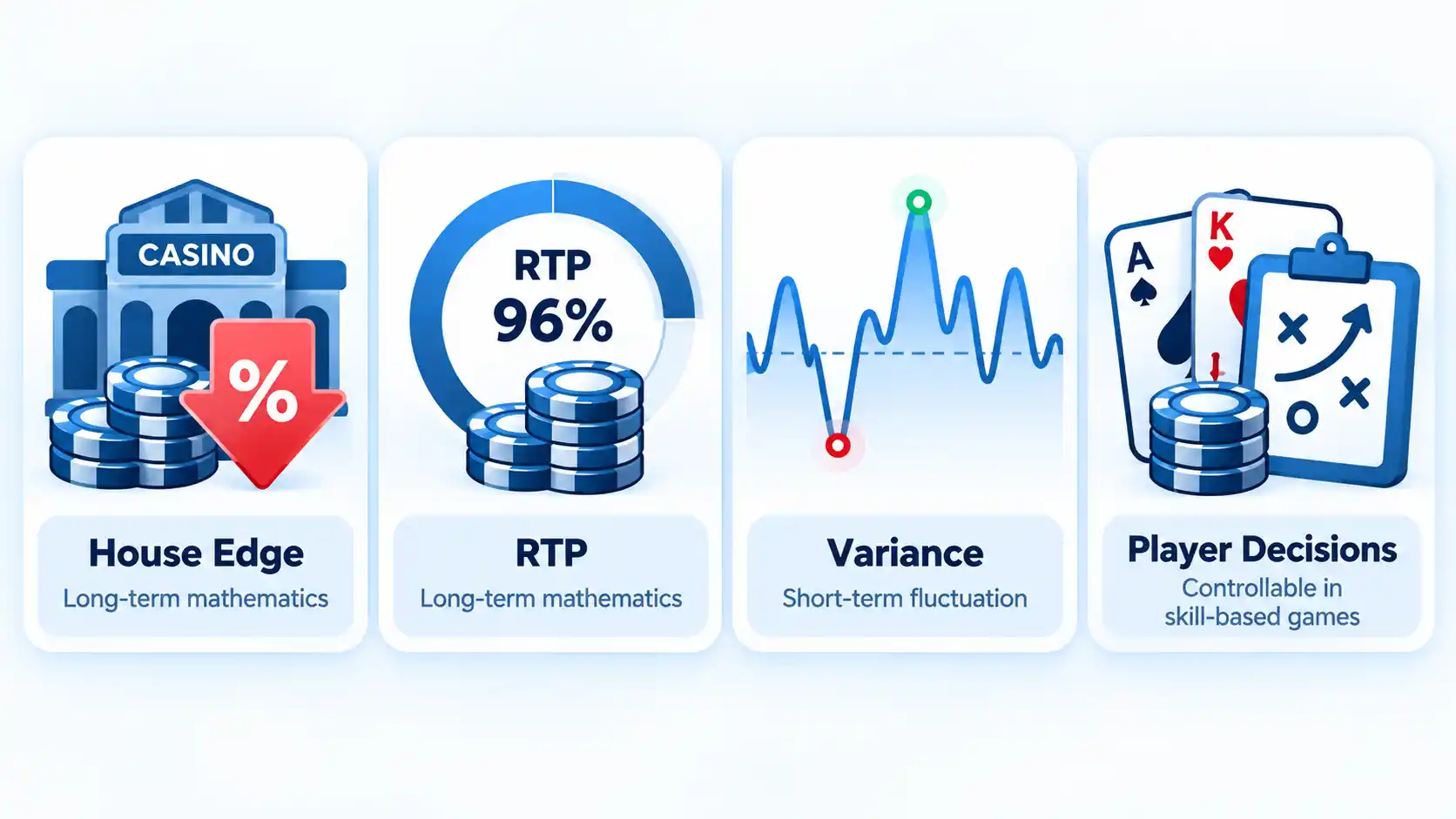
Casino results are influenced by several different concepts that are easy to mix together. House edge describes the operator’s expected advantage under a particular set of rules and assumptions. Return to Player (RTP) describes the percentage of wagers that a game is expected to return to players over the long run. Variance describes how widely short-term results can move around that long-run expectation.
The UK Gambling Commission defines RTP as the expected percentage of wagers returned to players in the long run. That does not mean a game advertised with a 96% RTP gives you a 96% chance of winning a session or guarantees that every $100 wagered produces $96 back. The Commission’s September 2026 informed-choice glossary makes the long-run nature of RTP explicit.
House edge approaches the same subject from the other side. It measures expected player loss relative to the initial wager under the stated rules and strategy assumptions. For example, mathematical analysis from Wizard of Odds places the standard baccarat Banker wager at about a 1.06% house edge and the Tie wager at about 14.36%. Those percentages describe long-run mathematical disadvantage, not what will happen during one short session.
Understanding RTP and house edge is therefore more useful than trying to identify a game that appears “hot.” A mathematically better rule or wager can affect expected value. A betting progression normally changes only the size and pattern of gains and losses.
1. Verify the Operator and the Exact Site
Before comparing RTP or game strategy, verify that the casino itself is the operator you think it is. A copied logo, familiar game catalogue, HTTPS connection, or displayed licence number does not independently prove that the website belongs to a licensed operator.
Check the exact domain against the relevant regulator or independently verified operator record. A cloned gambling site can reproduce another company’s design and licence details while using a different domain, application publisher, payment recipient, or login destination.
If anything about the operator identity is unclear, compare the legal company, licence number, exact domain, application publisher, and payment route before depositing or uploading identity documents. The detailed process for checking whether an online casino website is a clone covers those verification points and the edge cases created by regional domains, redirects, and third-party payment providers.
Licensing rules also vary by country. A licence that is valid in one jurisdiction does not automatically mean the operator is authorized to accept customers everywhere, so verify the rules that apply where you are located.
2. Compare House Edge, RTP, and the Actual Rules
Game names alone are not enough to compare value. Two versions of blackjack, roulette, slots, or another casino game can operate under different rules and therefore produce different long-run mathematical results.
For UK-regulated remote games, Remote Gambling and Software Technical Standard 3 requires information that allows customers to understand the rules and their likelihood of winning. Depending on the game, that information may be expressed through house edge, RTP, probabilities, or an explanation of how winners are determined.
Use that information before placing a wager. Check the rules screen, pay table, RTP information where supplied, and any conditions that affect payouts. Do not assume that two tables carrying the same basic game name use identical mathematics.
Roulette gives a straightforward example. Under conventional double-zero roulette rules, most standard wagers have a house edge of about 5.26%, while the five-number 0-00-1-2-3 wager carries a higher 7.89% edge. The underlying roulette probability table shows why choosing a different-looking bet does not necessarily produce better mathematical value.
When the published information is incomplete or unclear, that uncertainty is itself useful. Do not fill missing probabilities with assumptions based on recent wins, visual presentation, jackpot size, or how frequently other players appear to win.
3. Use Correct Strategy When Player Decisions Matter
Some casino games allow decisions that affect expected return. Others largely ask you to place a wager and wait for a random outcome. Strategy matters most in the first category.
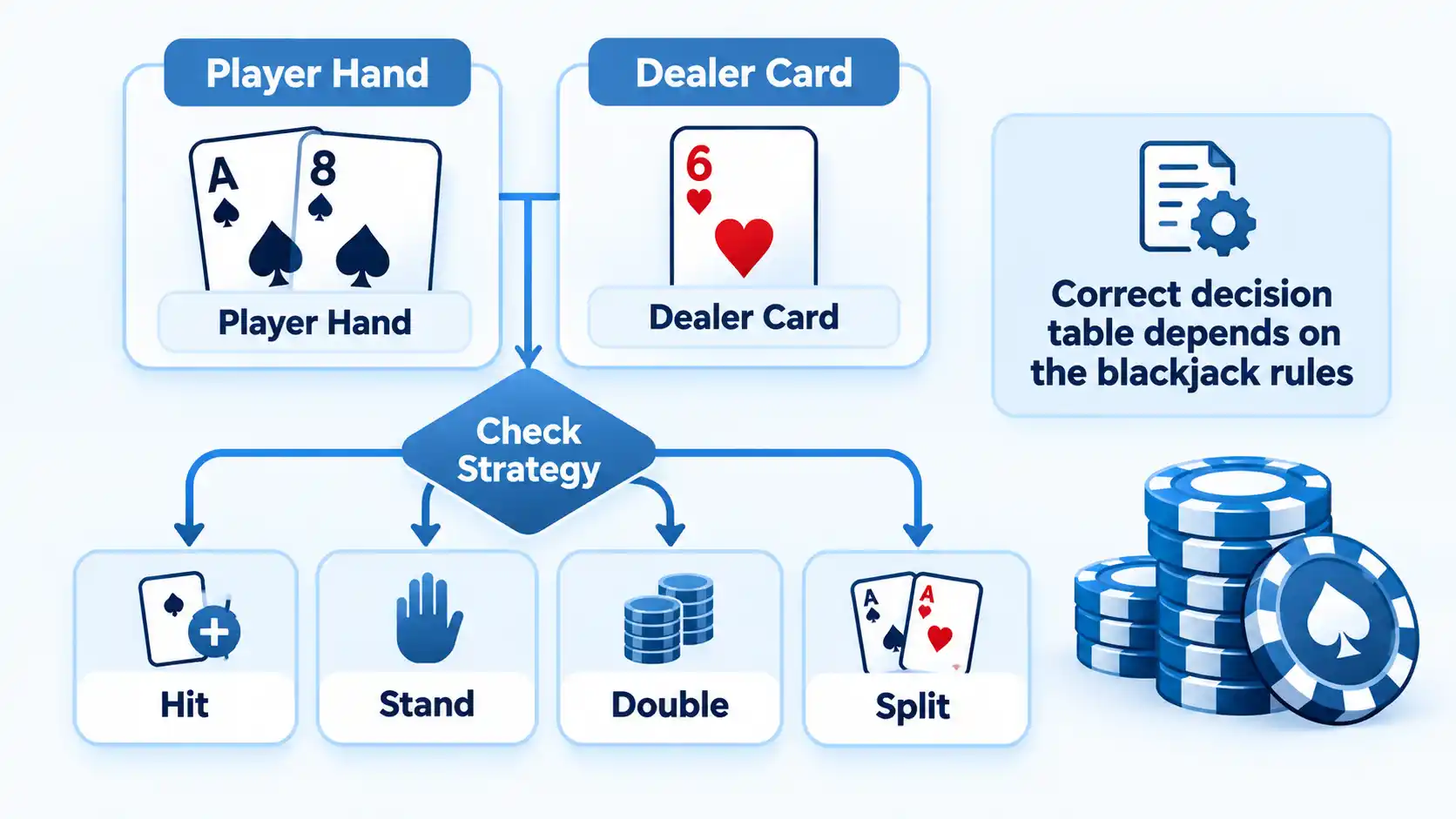
Blackjack is the clearest example. Whether to hit, stand, double, or split depends on your cards, the dealer’s visible card, and the table rules. A basic strategy is a mathematically derived set of decisions intended to minimize avoidable disadvantage under a particular rule set.
The important qualification is that blackjack rules vary. The number of decks, whether the dealer hits or stands on soft 17, whether doubling after a split is allowed, and the payout for a natural blackjack can all affect expected return. Blackjack rule-variation analysis shows that rule changes can materially affect the player’s expected return.
That means “learn blackjack strategy” is incomplete advice. The strategy needs to correspond to the actual rules being played. Basic-strategy charts change with factors such as deck count, soft-17 rules, doubling after splits, and surrender, so using a chart for a different rule set can introduce decision errors.
This principle does not transfer to every casino game. In a random slot round, for example, changing your stake because of the previous result does not create the kind of decision advantage available in blackjack. Similarly, RNG games and live dealer games can generate outcomes differently without making previous outcomes a reliable predictor of the next one.
4. Avoid High-Edge Bets and Side Bets
A large payout can make a wager look attractive even when the probability of receiving that payout makes its expected value comparatively poor. Compare the underlying house edge rather than judging a wager only by its possible prize.
The roulette example above illustrates the point: the five-number wager pays more than an even-money red or black bet when it wins, but its house edge is also higher. Baccarat provides another example. Under standard rules, mathematical comparisons commonly show a much larger house edge on the Tie wager than on Banker or Player.
Side bets deserve the same scrutiny. A side bet may provide a much larger headline payout for a rare combination, but that does not establish that it has good expected value. Treat each wager as a separate mathematical proposition and check its pay table and probability rather than assuming that a higher maximum prize is an advantage.
This also explains why simply choosing a progressive jackpot game is not, by itself, a strategy for improving your chances. A changing jackpot amount affects the prize available if the relevant outcome occurs. It does not automatically establish that the game has a lower house edge or a higher probability of winning.
5. Do Not Confuse Betting Progressions With an Advantage
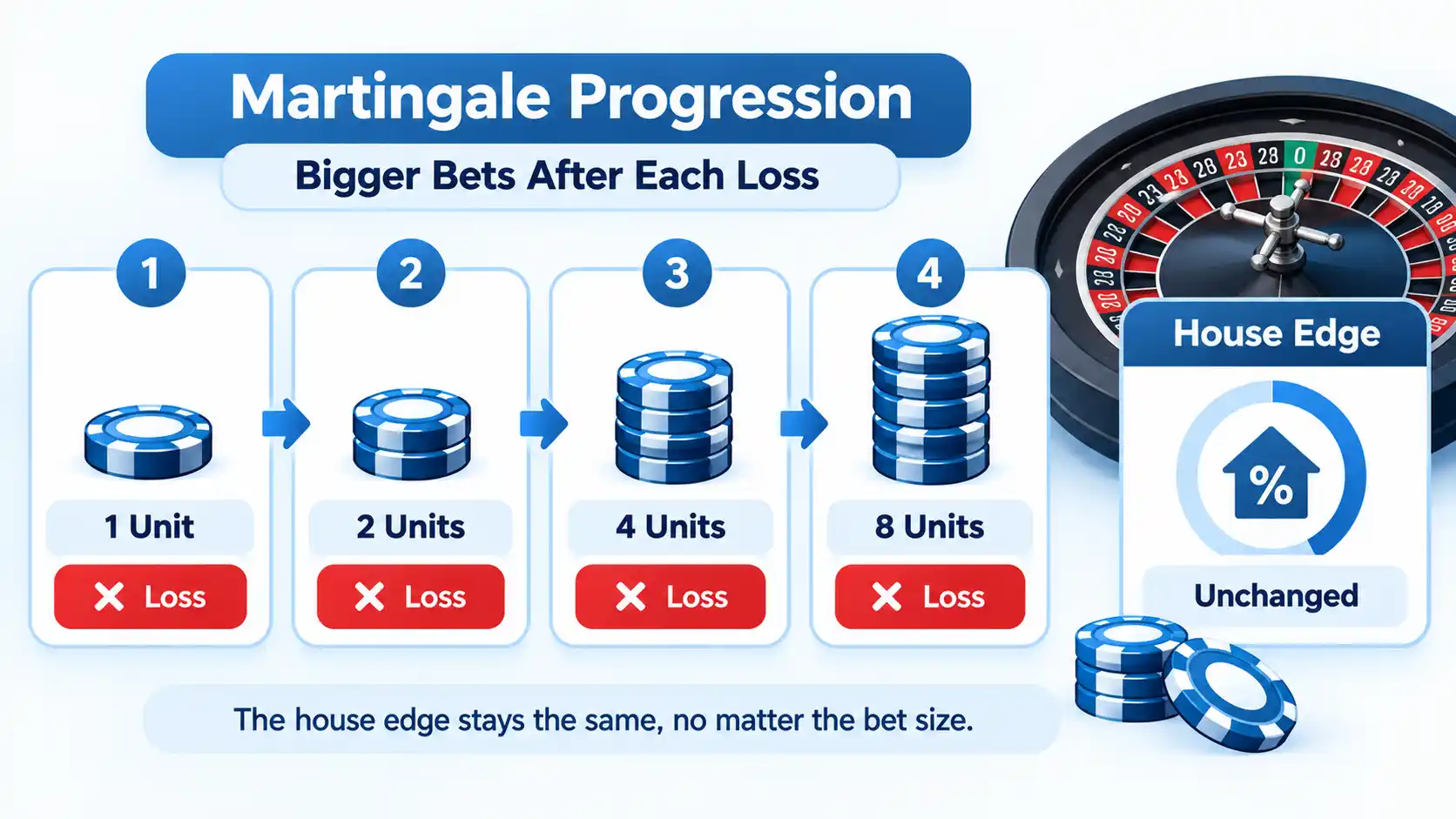
Martingale, Fibonacci, Paroli, and similar staking systems change how much you bet after wins or losses. They do not change the probability mechanism underneath an ordinary negative-expectation wager.
Consider the classic Martingale pattern on an even-money roulette wager. After a loss, the player doubles the next stake in an attempt to recover previous losses plus one unit of profit. Starting with one unit, consecutive losses can produce stakes of 1, 2, 4, 8, 16, 32, and so on.
The stake grows, but the roulette wheel does not become more likely to produce the player’s chosen color because the previous spins lost. UK Gambling Commission requirements for regulated random-number generation require random outcomes to be acceptably random and prohibit adaptive behavior that changes outcome probabilities according to previous payouts.
Likewise, mathematical analysis of betting systems shows that Martingale changes the distribution of session outcomes but does not remove the house edge.
The practical risk is asymmetry. A Martingale user may experience many sessions with small gains, then encounter a losing sequence that demands rapidly increasing stakes. Table limits, account limits, or a finite bankroll eventually prevent another doubling. The strategy has therefore changed the shape of the risk rather than created a mathematical edge.
6. Evaluate Bonuses by Their Terms, Not Their Headline Amount
A casino bonus can affect the economics of an offer, but the headline amount alone does not tell you its usable value. The important details are the wagering requirement, eligible games, game-contribution rules, maximum permitted stake, expiry period, withdrawal conditions, and any restrictions on bonus winnings.
A wagering requirement states how much qualifying play must occur before bonus funds or related winnings become withdrawable. For example, a 10x wagering requirement applied to $20 of bonus funds would require $200 of qualifying wagers under a simple bonus-only calculation. Actual promotions can define the calculation differently, so the terms control.
In Great Britain, UK Gambling Commission Social Responsibility Code 5.1.1 prohibits wagering requirements above 10 times bonus funds and requires applicable incentive terms to be clear, transparent, fair, and readily accessible. The 10x cap came into force on January 19, 2026. This is a British regulatory requirement, not a global rule.
Elsewhere, promotional rules and consumer protections can differ. Before treating a bonus as part of your available bankroll, determine whether you can realistically satisfy its conditions without exceeding the amount you were prepared to risk anyway. If bonus withdrawal restrictions are unclear, do not assume the displayed promotional balance is equivalent to withdrawable cash.
Verify the result
- The terms state the exact wagering requirement and identify which balance it applies to.
- Eligible and excluded games, including any reduced contribution rates, are clearly listed.
- Any maximum stake, expiry period, or withdrawal restriction is identifiable before you accept the promotion.
- The promotion does not require you to exceed the spending limit you had already set.
7. Set Financial and Stake Limits Before Play
Bankroll management does not make a negative-expectation game profitable. Its purpose is to control exposure and reduce the chance that one session expands into spending you did not intend.
In this context, a bankroll means the predetermined amount you have chosen to make available for gambling, not your savings, available credit, emergency money, or the amount you could theoretically afford to transfer into the account.
Decide that amount before play begins. Depending on the operator and jurisdiction, you may also have access to deposit limits, loss limits, stake limits, session reminders, or other financial controls.
The distinction from a betting system is important. Reducing stake size can lower the amount exposed to each result. A deposit limit can restrict account funding. A session limit can reduce total wagering time. None of those controls changes the probability that the next roulette spin, slot round, or random draw will produce a winning result.
British remote-gambling rules are continuing to change in this area. The Gambling Commission says that from September 30, 2026, operators must offer gross deposit limits and give them at least equal prominence with other financial-limit types. Because this article’s reference date is September 22, 2026, that requirement is still upcoming rather than already in force.
Do not borrow money, increase deposits, or abandon a predetermined limit because previous bets lost. Doing so increases financial exposure without creating an advantage in the next game.
8. Treat Chasing Losses as a Stop Signal
Chasing losses means continuing or escalating gambling specifically to recover money already lost. It is not a strategy for improving expected value because previous losses do not make an independent random outcome more favorable.
The same logic that invalidates Martingale as an odds-changing system applies here. Five consecutive losing roulette spins do not make your chosen color “due.” Properly regulated random games are expected to produce unpredictable outcomes consistent with their underlying probabilities rather than compensating the player after a losing sequence.
Chasing also changes the decision objective. Instead of deciding whether the next wager is acceptable on its own terms, the player begins treating previous losses as money that the next wager must recover. That can encourage larger deposits, larger stakes, longer sessions, and abandonment of earlier limits.
If you are gambling primarily to recover previous losses, feel unable to stop, or are spending more time or money than intended, stop the session rather than increasing the stake. Gambling-blocking tools, payment blocks, self-exclusion, and confidential support can create distance from further gambling.
GamCare’s gambling-harm guidance lists spending more time or money than intended, difficulty stopping, and chasing losses among warning signs. It recommends stepping away from gambling and creating distance when losses are being chased or gambling feels out of control.
What These Strategies Can and Cannot Do
The most useful way to compare casino strategies is to ask what part of the problem they actually change. Some choices affect expected value, while others affect only exposure, volatility, or decision quality.
| Action | Effect on expected value | Effect on volatility or exposure | Primary purpose |
|---|---|---|---|
| Choose better game rules or lower-edge wagers | Can improve expected value relative to worse available rules or bets | May also change variance | Reduce mathematical disadvantage |
| Use correct strategy in decision-based games | Can reduce avoidable losses caused by poor decisions | May change short-term outcome patterns | Make mathematically stronger decisions |
| Use Martingale or another staking progression | Does not remove the underlying house edge | Yes, sometimes substantially | Changes stake and risk distribution |
| Set bankroll, deposit, or session limits | Does not change game probability | Yes | Control financial exposure |
| Evaluate bonus terms before accepting | Can affect the practical value of a promotion | Can affect required wagering and exposure | Avoid unfavorable or misunderstood conditions |
This distinction also explains why there is no universal “best betting system.” A genuine mathematical improvement comes from better rules, better wager selection, or better decisions where skill affects return. A risk-control measure can still be valuable, but it should be described as risk control rather than an advantage over the game.
Bottom Line
No online casino method can guarantee more winnings, and a staking progression cannot turn an unfavorable random wager into a favorable one. The defensible strategies are narrower: verify the operator, understand the rules and probabilities, choose lower-disadvantage options where available, use correct strategy when decisions genuinely matter, evaluate promotional conditions carefully, and limit the money exposed to gambling.
Most importantly, do not interpret past losses as evidence that a future win is due. When the goal shifts from making a deliberate wager to recovering money already lost, stopping is more useful than changing the size of the next bet.

💬 Comments