What the Data Says About Online Casino Use
Popularity is easier to understand when measurable use is separated from advertising claims. In Great Britain, the 2025 Gambling Survey for Great Britain found that 38% of adults had gambled online in the previous four weeks, compared with 28% who had gambled in person.
That headline needs an important qualification. Much of the difference came from lottery tickets bought online. Once people who only played lottery draws were excluded, 16% had gambled online and 17% had gambled in person. Online access is clearly significant, but the data does not show that digital casino-style gambling has simply replaced physical gambling.
A separate March 2026 operator dataset covers businesses representing about 70% of the British online market and reports active players and betting activity by gambling vertical. The same person can appear in more than one product category, so the active-player figures cannot be added together as a unique-player total.
| Signal | What it shows | What it does not prove |
|---|---|---|
| 38% gambled online in the previous four weeks | Online gambling is a common way to access gambling among adults represented in the survey. | It does not mean 38% played online casino games; the figure includes activities such as online lottery purchases. |
| 16% gambled online after lottery-draw-only players were excluded | Non-lottery online gambling still accounts for substantial participation. | It does not show that online play is more common than comparable in-person gambling, which measured 17% on the same basis. |
| 4,975,670 active slot players in March 2026 | Slots generated activity across a large customer base within the operators covered by the dataset. | It is not a count of every British player or a measure of how much individual players enjoyed the games. |
| 2,638,918 active players in other gaming, including casino | Casino-style products beyond slots also attracted substantial online use. | The figure cannot be added to the slots figure because the same person may appear in both categories. |
| 8.73 billion slot bets or spins in March 2026 | Digital slots support very high volumes of repeated game cycles. | The volume does not show how many unique people generated those spins or whether individual sessions were profitable. |
Taken together, the survey and operator data show two different things: online gambling is widely accessible, and some digital casino products support large volumes of repeated play. Neither dataset, by itself, establishes why a particular person chooses to gamble.
Convenience and Mobile Access Lower the Barrier to Play
A physical casino requires a journey, a venue, opening hours, and enough available tables or machines. Remote gambling such as Slotoro online casino removes many of those practical barriers. A person with an eligible account and internet-connected device can access a gambling service without travelling to a casino floor.
This lower-friction access is one of the clearest differences between online and land-based gambling. Starting another round can require only a few taps rather than moving to a new table, waiting for a seat, handling chips, or visiting another venue.
Convenience should not be confused with evidence that online play is universally preferred. The British survey figures above show why that distinction matters: once lottery-only participation is removed, online and in-person gambling participation are similar. The stronger claim is that digital delivery makes gambling easier to access in situations where travelling to a venue would add time and effort.
That reduced friction also changes when gambling can fit into everyday life. The same accessibility that makes online games convenient can make it easier to start another session, which is why access and playing intensity need to be considered separately from entertainment value.
Game Variety and Digital Formats Expand the Choice
Online casinos can present several kinds of gambling through the same interface. A player might encounter digital slots, roulette, blackjack, poker-style games, live-dealer tables, and newer game-show formats without moving between physical areas of a casino.
The games are not all built the same way. Many digital casino games generate or process outcomes through software, while live-dealer formats stream a real studio or table and connect it to an online betting interface. For example, live dealer game shows combine a broadcast, betting window, outcome process, and software settlement. That produces a different experience from a conventional digital slot even though both can appear inside the same casino platform.
A random number generator, usually shortened to RNG, is software used to produce unpredictable outcomes according to a game’s mathematical rules. For British-regulated remote casino games that use random outcomes, random number generation and game results must meet standards for acceptable randomness and unpredictability. That does not make every game mechanically identical; it provides a technical framework within which developers can build different themes, bonus structures, interfaces, and mathematical models.
Digital distribution also avoids some of the physical constraints of a casino floor. Adding another software title does not require installing another full-size cabinet or reserving another table. That makes it practical for an online service to offer many formats and themes through a single account.
The distinction between software-driven and streamed games is useful enough to merit deeper comparison. Online slots and live dealer games differ in how rounds are produced, paced, and presented, even when both are offered through the same website or app.
Money, Excitement, and Promotions Shape the Appeal
The possibility of receiving a payout is part of the attraction of gambling, but it is not the only reason people participate. In the 2025 Gambling Survey for Great Britain, the most commonly reported reasons for gambling at least sometimes included the chance to win big money at 84%, fun at 69%, making money at 57%, and excitement at 53%.
Those percentages describe gambling broadly rather than online casinos alone. They should therefore be read as evidence about general gambling motivations, not as a precise breakdown of why someone chooses an online slot instead of another gambling product.
The combination still helps explain the appeal. A casino game can provide uncertainty about the next result, an immediate visual or financial outcome, and the possibility of a larger reward. Themes, animation, sound, bonus rounds, live presentation, and interactive interfaces can add entertainment around that underlying wager.
Promotions add another incentive, but a bonus is not automatically free money. A wagering requirement is a condition that requires qualifying bonus funds or related winnings to be wagered before eligible funds can be withdrawn. In Great Britain, bonus wagering requirements have been capped at 10 times since January 19, 2026, and operators may not make one promotional offer conditional on gambling across multiple product types.
The rules illustrate why promotional headline values should not be considered in isolation. The conditions determine what a customer actually has to do before money connected with a bonus can be withdrawn. Casino bonus terms and wagering requirements can change the practical value of an offer even when two promotions advertise the same nominal bonus amount.
Game Design Can Increase Engagement and Playing Intensity
Online casino games can repeat decisions quickly. Each completed slot spin, card hand, or other gambling round creates another opportunity to stop or place another wager. The shorter and smoother that cycle feels, the more rounds can potentially fit into the same period.
Regulators describe speed, frequency, audiovisual effects, rewards, and information provision as examples of a gambling product’s structural characteristics. A structural characteristic is simply a feature of how the game works or presents play. The Gambling Commission identifies these characteristics as factors relevant to product risk, while emphasizing that products, providers, environments, and individual behaviour interact. No single animation, sound, or timing feature explains gambling-related harm by itself.
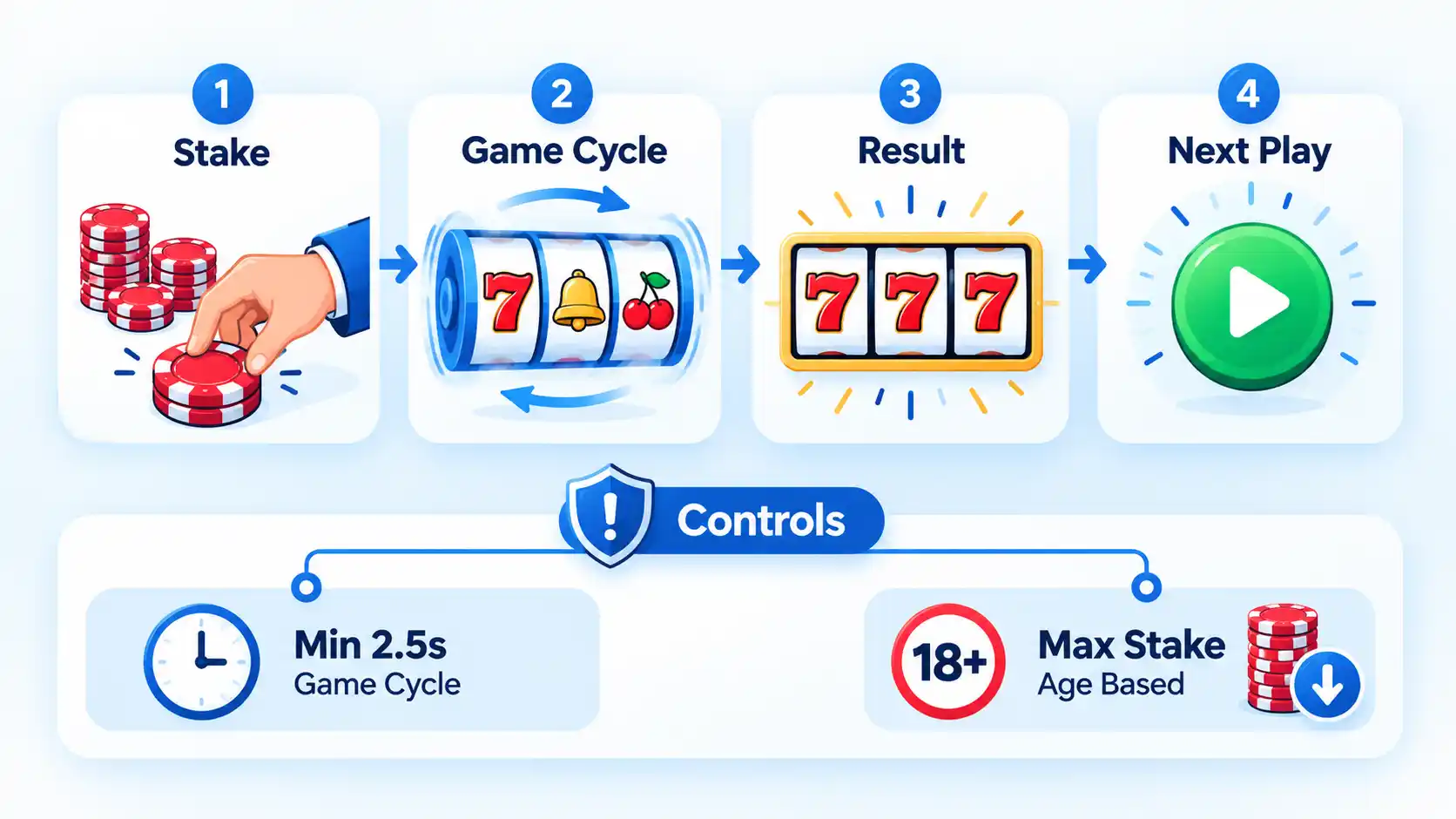
Online slots provide a concrete example. In Great Britain, at least 2.5 seconds must pass from the start of one online-slot game cycle before the next can begin. The maximum stake per game cycle is £2 for customers aged 18 to 24 and £5 for customers aged 25 or older.
Other design restrictions predate those stake caps. Changes introduced in 2021 removed autoplay, prohibited features that accelerate play or create an illusion of control, and restricted celebratory sounds or imagery for results where the return is no greater than the stake. The Commission’s later evaluation found reduced play-intensity indicators after those design changes without an increase in staking activity in response to the spin-speed limit.
That evaluation does not prove that one design control caused every observed change. The Commission notes limitations in attributing outcomes to measures introduced together and in separating them from other market changes. The narrower conclusion is that playing speed and interface design are consequential enough to be regulated and evaluated rather than treated as purely cosmetic features.
Popularity Does Not Mean Better Odds or Lower Risk
A game’s popularity says nothing by itself about whether its mathematical odds favor the player. Millions of people can play the same game while the operator still retains a long-run statistical advantage.
Return to player, or RTP, expresses the theoretical percentage of wagered money a game is designed to return to players over a very large number of plays. House edge describes the expected operator advantage under the relevant game rules and assumptions. Neither figure predicts what will happen during one person’s evening, deposit, or short sequence of rounds.
British remote-gambling rules require applicable information about how a game works and its likelihood of winning to be available before a customer commits to gamble. Depending on the game, that information can include the house edge, RTP, or probability of winning events.
Licensed remote gambling software is also subject to technical testing requirements. Game and RNG testing must be completed by an approved test house before a game is released for play. That testing helps establish compliance with technical and fairness requirements; it does not turn gambling into a positive-expectation activity for the customer.
A random result also does not become more likely simply because a player has recently lost several rounds. For independent events, previous losses do not create a debt that the next spin or hand must repay. Increasing a stake can increase the money at risk without changing that basic principle.
For a deeper explanation of the mathematics, RTP, house edge, and variance describe different parts of gambling risk. Understanding how RTP and house edge work over the long run is more useful than treating a maximum jackpot, bonus feature, or recent losing streak as evidence that a win is due.
The central distinction is between features that help explain why people engage with online casino games and the mathematics that determine the wager itself. Convenience, variety, presentation, promotions, and rapid feedback can change the experience around gambling; they do not erase the house advantage, make independent outcomes predictable, or turn repeated play into a dependable route to profit.

💬 Comments