Gambling can feel compelling because it combines uncertain rewards with anticipation, emotional reactions and predictable ways people sometimes misread chance. Research links gambling behavior with reward uncertainty, near-misses and cognitive biases such as the gambler’s fallacy and illusion of control, but no single mechanism explains every person or every gambling decision.
Quick Take
The psychology of gambling is not simply a story about winning or dopamine. Uncertain rewards can hold attention, near-misses can feel more significant than ordinary losses, and biases can make random events appear predictable or controllable. These reactions can affect decisions, but they do not change the underlying mathematics of a game.
Gambling means risking money or something else of value on an uncertain outcome for the possibility of receiving a larger return. The World Health Organization’s gambling overview also makes an important distinction: gambling-related harm exists on a spectrum and is not limited to people who meet the criteria for gambling disorder.
Why Gambling Can Feel Rewarding Even When Winning Is Uncertain
Imagine placing a small bet on a football match. Part of the appeal may be the chance of winning money, but the bet can also make the match feel more important, uncertain or exciting. Another person might gamble mainly as a social activity, while someone else may be attracted mostly by the possibility of a financial reward.
That variation matters because there is no single reason that people gamble. Research commissioned by the UK Gambling Commission found that financial reward was a major motivation among the British adults it studied, while enjoyment, social context and the type of gambling activity also affected motivation. The study covered 1,693 adults in Great Britain who had gambled during the previous four weeks, so its findings describe that population rather than proving a universal pattern for everyone who gambles. The Commission’s research on why people gamble also found that the same person could have different motivations on different gambling occasions.
One feature shared by gambling activities is reward uncertainty. You know that a reward is possible, but you do not know whether a particular wager will produce it. That uncertainty can make the outcome worth watching closely because the result has not yet been resolved.
This does not mean uncertainty is automatically enjoyable or that everyone responds to it in the same way. The amount at stake, the type of game, a person’s expectations and their wider circumstances can all change the experience.
What Dopamine Actually Does in Gambling
Dopamine is often described as a simple “pleasure chemical,” but that description is too narrow. Dopamine is a chemical messenger involved in processes that include motivation, learning and responding to potentially important rewards.
A peer-reviewed review of dopamine signaling and reward uncertainty identifies uncertainty as an important feature of gambling and examines how dopamine-related processes may respond while an uncertain reward is anticipated and resolved. In practical terms, the brain can pay attention not only to receiving a reward but also to signals that a potentially important outcome is approaching.
Info
Dopamine should not be read as a simple meter for pleasure or as proof that gambling automatically causes addiction. It is one part of a wider system involved in motivation, learning and attention to rewards.
This distinction also explains why saying “a win releases dopamine, so people keep gambling” is incomplete. Anticipation, uncertainty, previous experience, emotional state and beliefs about the game can all influence what a person does next. Neuroscience can help explain part of the process without reducing every gambling decision to brain chemistry.
Four Psychological Effects That Can Distort Gambling Decisions
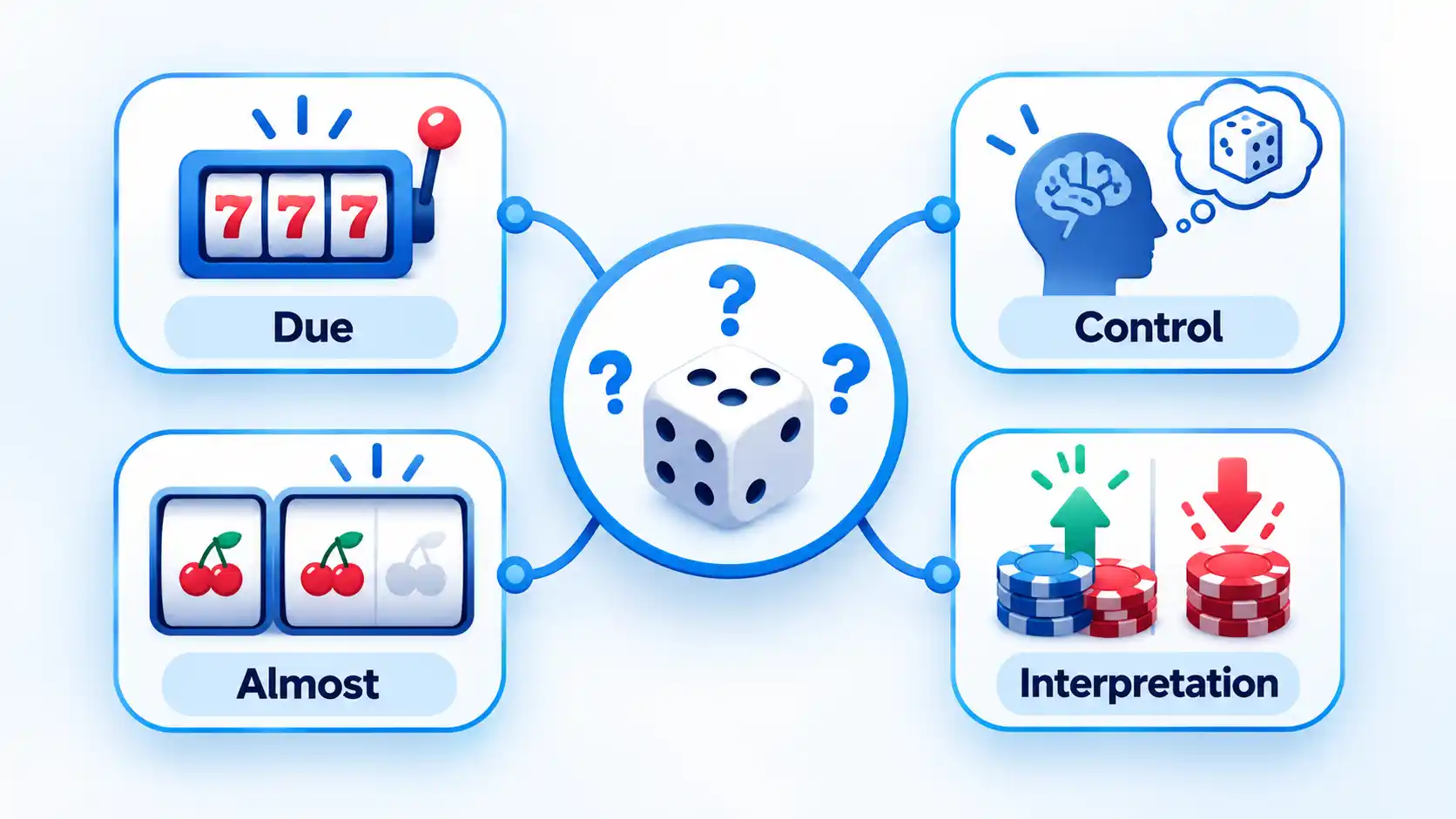
Gambling creates situations where people have to interpret uncertainty quickly. Several psychological effects can make those judgments less accurate. They overlap, but they are not the same thing.
| Psychological effect | What it can feel like | What is actually happening | Example |
|---|---|---|---|
| Gambler’s fallacy | The opposite result now feels due. | A previous independent result does not make the opposite result more likely on the next independent trial. | Expecting black because roulette has landed on red several times. |
| Illusion of control | A personal choice or action feels as though it improves the chance of winning. | The action may provide no real influence over a chance-determined outcome. | Feeling that personally choosing lottery numbers makes those numbers more likely to be drawn. |
| Near-miss effect | A loss can feel unusually close to success. | The outcome is still a loss, although some experiments find that near-misses produce different reactions from clear misses. | Two jackpot symbols appear and the third stops just outside the winning line. |
| Biased outcome interpretation | Some outcomes seem to confirm a belief more strongly than others disprove it. | People can give uneven attention or meaning to wins, losses and streaks. | Remembering the times a “lucky” choice won while overlooking the times it lost. |
Gambler’s Fallacy: When a Result Feels “Due”
Suppose an independent roulette outcome has produced red several times in a row. It can start to feel as though black must be getting closer. That feeling is the gambler’s fallacy: treating an independent random process as though recent outcomes have created a debt that the next outcome needs to repay.
A meta-analysis of gambling-related cognitive distortions identifies the gambler’s fallacy as one of the major recurring distortions studied in gambling research.
The important word is independent. An independent event is one where a previous result does not by itself alter the probability of the next result. The principle should not be applied blindly to every activity because some real-world events do have changing conditions or dependencies. Where a gambling system genuinely produces independent random trials, however, a losing streak does not make the next win mathematically due.
This same misconception appears in electronic games when a player assumes that a machine must soon compensate for a long losing run. The distinction between random outcomes, pay tables and player decisions is examined in more detail in common video poker myths about randomness and strategy.
Illusion of Control: When Choice Feels Like Influence
Choice can make an uncertain outcome feel more personal. Someone who chooses six lottery numbers themselves, for example, may feel more confidence in those numbers than if a machine assigned the exact same combination.
This is called the illusion of control: perceiving more influence over a chance-based outcome than the situation actually allows. A review of illusion-of-control research in gambling describes choice, involvement and familiarity as factors that can contribute to perceived control, while also emphasizing that the psychological mechanisms are more complicated than a single universal effect.
There is an important boundary here. Some gambling activities include genuine skill. A poker decision, for example, can involve information and strategy. Sports betting can also involve judgments about teams, prices and probabilities. That does not mean every uncertain part of those activities can be controlled, nor does the presence of skill remove chance or guarantee positive returns.
The useful question is therefore not simply, “Is this a skill game?” It is, “Which part of this outcome can this particular decision actually influence?”
Near-Misses: Why “Almost” Winning Can Feel Different
A near-miss happens when a losing result looks close to a winning one. On a slot-style display, for example, two desired symbols may line up while another appears immediately beside the winning position.
Mathematically, the result is still a loss. Psychologically, it may not feel like an ordinary loss. In a laboratory slot-machine experiment, researchers found that near-misses produced different motivational and neural responses from full misses. In that experiment, near-misses were rated as less pleasant than wins but could increase the desire to continue under particular conditions.
That finding should not be turned into a universal rule. An experimental response does not prove that every person who experiences a near-miss will gamble longer. It does show why “almost winning” deserves to be separated from the mathematical question of whether anything was actually won.
The near-miss effect helps explain why a losing result can still feel unusually meaningful even though it provides no partial mathematical credit toward the next independent outcome.
Why Wins and Losses Can Be Interpreted Unevenly
People also look for patterns when results are noisy. A win after wearing a particular shirt may feel memorable, while several losses in the same shirt are easier to dismiss. A successful prediction can seem like evidence of skill, while an unsuccessful one may be blamed on bad luck.
Researchers use the broad term cognitive distortions for beliefs or interpretations that systematically misrepresent probability, control or gambling outcomes. The important point is not that every gambler believes every distortion. Different people, situations and gambling products can produce different patterns.
Why Losing Can Lead to More Gambling
After losing $50, a person may decide that another bet offers a chance to “get back to even.” If the next bet loses too, the goal can shift from making a new decision to recovering the previous money.
This behavior is called loss chasing. A 2023 systematic scoping review of loss chasing found that researchers use the term for several related behaviors. Within one session, it can mean continuing to gamble, increasing stakes, taking greater risks or playing faster after losses. Between sessions, it can include returning later specifically to recover earlier losses.
Loss chasing should not be treated as another name for loss aversion. Loss aversion is the broader idea that losses and equivalent gains may not be experienced equally when people make decisions. Chasing is a specific gambling behavior in which previous losses influence continued or intensified gambling. They can be discussed together, but one does not automatically explain the other.
This distinction matters because recovering previous money is not the same as evaluating a new wager on its own terms. Earlier losses have already happened. Increasing the next stake may increase the amount exposed to further loss without changing the underlying advantage of the game.
Loss chasing can happen during the same session or after returning later, so it is better recognized by the purpose and pattern of continued gambling than by one particular bet size.
How Bonuses and Promotions Affect the Decision Environment
A promotion can change how a gambling offer feels without necessarily changing the underlying probability of the game. Words such as “free,” boosted or bonus may make the immediate cost feel smaller, while wagering conditions can require additional play before any promotional value can be withdrawn.
The UK Gambling Commission’s research into online gambling promotions found that some participants used offers to continue beyond their usual stopping point, placed bets they otherwise might not have considered, or engaged with gambling products outside their usual pattern. The study used a quantitative survey of 1,002 British adults who had gambled online within the previous four weeks, followed by qualitative research with frequent users of promotional offers, so its findings should be read in that specific research context.
Commercial casino sites such as Gclub present promotions alongside gambling products, but the existence of a bonus does not by itself improve the underlying probability of a game outcome. The practical value of any offer depends on its actual terms as well as the rules and mathematics of the associated game.
This is why the psychology and the mathematics need to stay separate. An offer may affect attention, perceived value or willingness to continue. Those effects do not automatically turn a negative-expectation wager into a favorable one.
Psychology Does Not Change the Mathematics
A result can feel meaningful without changing what happens next. A near-miss can feel closer to success than a clear loss. A personally chosen number can feel more promising than an assigned one. A long run of losses can make a win feel overdue. None of those feelings alone changes the probability rules used to generate an independent outcome.
Casino mathematics uses concepts such as expected value, which describes the average result a wager would tend toward across many repetitions under stated assumptions. Other measures, including house edge, the casino’s expected mathematical advantage under stated rules, and return to player (RTP), the percentage of wagers a game is expected to return over the long run, describe long-run properties of particular games or wagers. They do not predict what one person will win or lose in a short session.
The practical distinction is whether a decision changes the game’s expected value, changes only how much money is exposed, or changes neither. That distinction is covered in online casino strategies and their effect on expected value.
Some decisions really can affect mathematical outcomes within the rules. Choosing a lower-house-edge wager instead of a higher-house-edge one can matter. Correct decisions in a game with a genuine skill component can also matter. By contrast, increasing a stake because a win feels due changes the amount at risk rather than forcing the random process to compensate for earlier results.
The gambler’s fallacy is therefore best understood as an error about what previous independent outcomes can tell you about the next one, not as evidence that random systems never produce streaks.
When Gambling Psychology Becomes a Warning Sign
Enjoying uncertainty or occasionally thinking about a previous result does not by itself establish a gambling disorder. The more important question is whether gambling is becoming difficult to control or is causing meaningful harm.
The World Health Organization describes gambling disorder using three core requirements: impaired control over gambling, gambling taking increasing priority over other activities, and continued gambling despite negative consequences. WHO also stresses that gambling-related harm can occur below the threshold for a clinical disorder.
Warning signs can include:
- spending more money or time gambling than intended;
- repeatedly trying to recover losses by continuing or returning to gamble;
- finding it increasingly difficult to stop or reduce gambling;
- giving gambling priority over important work, family or other responsibilities;
- continuing despite serious financial, relationship or health consequences.
These signs are reasons to take the situation seriously, not a do-it-yourself diagnosis. Professional assessment considers a wider pattern and the person’s circumstances. The UK’s NICE guideline on gambling-related harms also warns that stigma, shame and fear of disclosure can prevent people experiencing harm from seeking support.
Recognizing the psychology behind a gambling decision can be useful, but information alone does not guarantee that a difficult pattern will stop. When gambling is causing significant financial, emotional or relationship harm, creating distance from further gambling and seeking appropriate support can be more important than trying to outthink the next wager.
Bottom Line
The psychology of gambling cannot be reduced to a single dopamine response or a simple desire to win. Uncertain rewards can attract attention, near-misses can feel different from clear losses, cognitive biases can make chance appear more predictable or controllable, and previous losses can influence later decisions. Those psychological effects are real areas of research, but they do not rewrite the mathematics of an independent random outcome. Understanding both sides makes it easier to separate what a gambling situation feels like from what the probabilities actually support.

💬 Comments