Most video poker myths come from mixing up three different things: random card selection, player decisions, and the pay table that determines payouts. A losing streak, near miss, or larger wager does not make future cards become “due,” although strategy and the exact pay table can affect a game’s theoretical return.
Why Video Poker Creates So Many Convincing Myths
Video poker looks simple because the interface resembles a five-card poker hand: cards appear, you decide which ones to hold, and the others are replaced. Underneath that sequence, however, several separate mechanisms are operating.
A random number generator, usually shortened to RNG, supplies random inputs used to determine outcomes. A pay table states what each winning hand pays. Your hold-or-discard decision can also affect the mathematical value of the hand because keeping different cards leaves different possible final outcomes.
The distinctions become easier to understand when video poker RNGs, pay tables and RTP are treated as separate layers rather than as one system. Randomness determines the available cards, the pay table determines the payout for a completed hand, and strategy determines which available draw you choose.
The broader concept of random number generators in digital casino games also appears in other game categories, although each game’s rules determine how random inputs are converted into outcomes.
Warning
Do not assume that every product labelled “video poker” uses identical mechanics. Regulated conventional video poker, centrally determined products, video lottery systems, unusual variants, and unregulated games may operate under different rules. Check the rules and regulatory context of the specific game before applying a technical claim to it. Some gambling systems also use provably fair verification, which is a different transparency model from conventional regulator-tested game implementations.
Another important term is return to player, or RTP. Theoretical RTP is the designed average percentage returned as winnings over a sufficiently large amount of play under the assumptions used to calculate it. It is not a prediction of what one person will receive during a particular session. The UK Gambling Commission distinguishes theoretical RTP from actual RTP and notes that short samples can deviate more widely because of game volatility.
1. Myth: A Machine Is “Due” After a Long Losing Run
A long losing run does not create a debt that the next hand must repay. In a regulated random game, previous outcomes do not automatically increase the probability of a favorable outcome on the next independent play.
This misconception is a version of the gambler’s fallacy: seeing a run of one type of result and assuming the opposite result must now be more likely. Random sequences can naturally contain surprisingly long clusters of wins, losses, or ordinary non-winning hands.
The UK Gambling Commission’s random-outcome technical standard requires applicable remote games to produce acceptably random results and prohibits adaptive behavior that changes outcome probabilities during play. In that regulatory context, a machine is not permitted to improve the next result merely because it has recently paid little, nor worsen it because it has recently paid more.
Expected frequencies become meaningful when studying many trials collectively. They do not create a countdown that forces a particular result to occur on the next hand.
2. Myth: Hot and Cold Streaks Predict What Happens Next
Calling a machine “hot” or “cold” describes what has already happened. It does not establish that the underlying probability of the next random hand has changed.
Suppose a player experiences five losing hands in a row. A sixth loss can still occur without anything being wrong. A win can also occur. The streak itself does not provide evidence that the machine has entered a special state unless the game’s published rules explicitly define a feature that changes probabilities or payouts.
The same UK Gambling Commission standard permits defined bonus or special features with different rules while prohibiting adaptive interventions that change outcome probabilities during play. A disclosed feature is therefore different from a machine secretly becoming “hot” or “cold.”
3. Myth: Several Near Misses Mean a Jackpot Is Getting Closer
A near miss can feel more meaningful than an ordinary losing hand, but previous near misses do not push a future independent hand closer to a rare result.
There is an important distinction between the probability within the current hand and beliefs carried from one hand to the next. If you are currently holding four cards to a royal flush, there is a real calculable probability of completing it on that draw. Once the hand ends, however, that failed attempt does not make a royal on a later independent hand more likely simply because you “almost” hit one earlier.
The UK Gambling Commission also prohibits game designs that misleadingly substitute losing outcomes with false near-miss results. The practical lesson is to evaluate the cards and probabilities that exist now rather than treating previous close calls as stored progress toward a future prize.
4. Myth: The Machine Has Already Chosen Your Replacement Cards Before You Hold Anything
This claim is not accurate for the conventional Nevada-regulated video poker model described in the state’s technical standard. The documented standard states that video poker games must not determine replacement cards before the player selects the cards to hold and initiates the draw.
That means the sequence matters. An initial hand is presented, you choose which cards to retain, you initiate the draw, and replacement cards are then determined according to the game’s approved random-selection process.
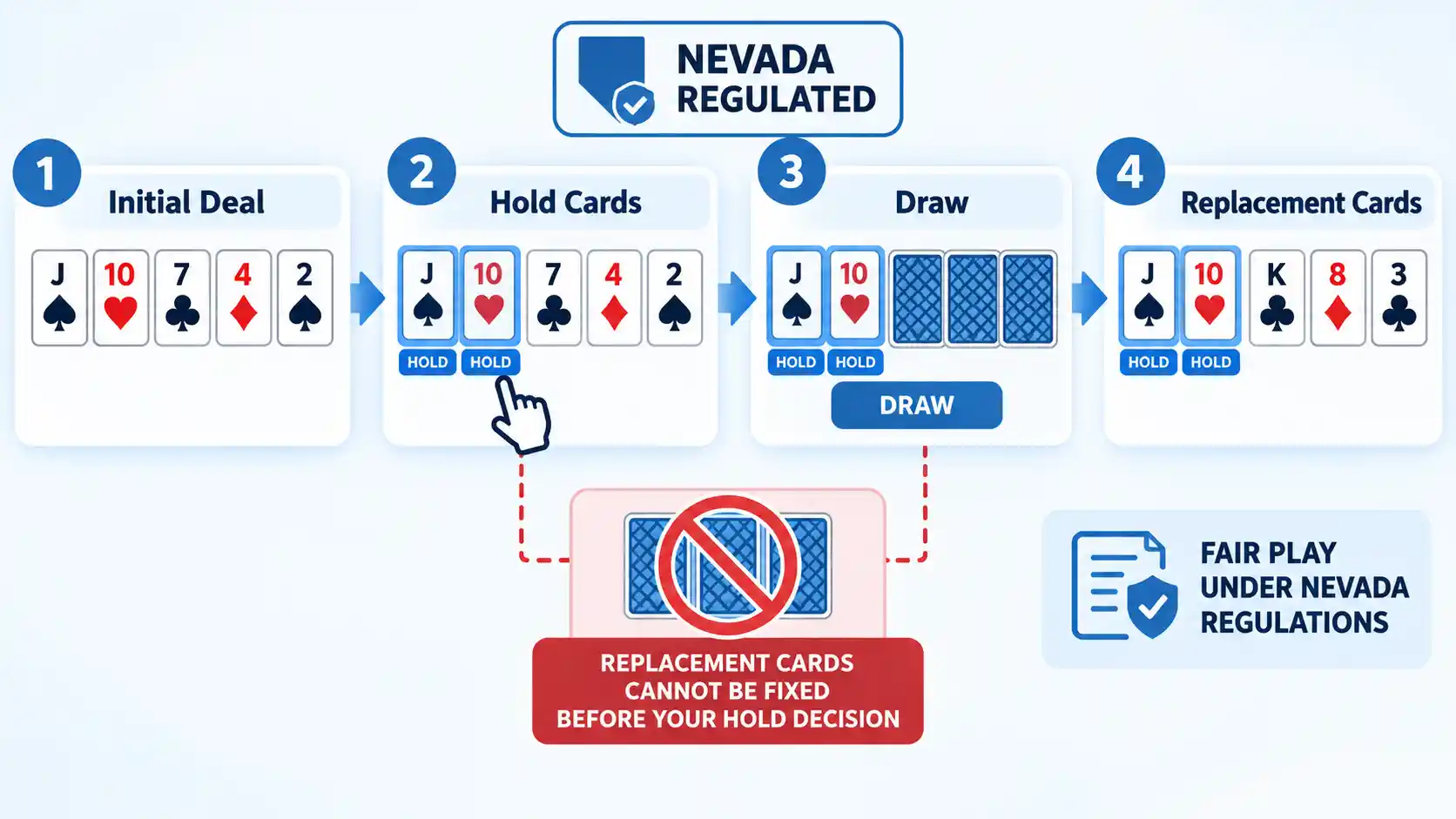
The Nevada Gaming Control Board’s documented Technical Standard 1 for gaming-device integrity also requires protection of the random selection process from outside influence.
This should not be expanded into a claim about every video-poker-style product in every jurisdiction. Different systems can use different technical architectures. The defensible point is narrower: the common claim that Nevada-style video poker has already fixed your replacement cards before you choose what to hold conflicts with the cited standard.
5. Myth: Strategy Does Not Matter Because the Cards Are Random
Random cards and meaningful player decisions can exist at the same time. You cannot choose which replacement card the RNG supplies, but you can choose which cards remain in your hand before the draw.
That choice changes the set of possible final hands. For example, keeping a low pair and drawing toward a flush leave different possible outcomes, and the better mathematical decision depends on the exact cards and pay table.
Expected value is the average mathematical value of a decision across many repetitions of the same situation. A higher expected-value hold does not guarantee that the next draw will win. It means that, under the model’s assumptions, the choice produces a better average result across repeated equivalent situations.
For example, the specialist mathematical analysis for 9/6 Jacks or Better optimal strategy calculates an approximately 99.54% theoretical return for the stated full-pay schedule when optimal strategy is used. That percentage is conditional on that particular pay table and strategy. It is not a guarantee that a player’s session will return 99.54% of the money wagered.
6. Myth: One Video Poker Strategy Works for Every Variant
A strategy that is mathematically appropriate for one video poker game can be wrong for another. Changing a payout or introducing wild cards can change the expected value of competing hold decisions.
Jacks or Better, Double Double Bonus, Bonus Poker, and Deuces Wild may look similar because the interaction still involves holding and drawing cards, but their payout structures and rules are not interchangeable.
An analysis of strategy mismatches across video poker variants shows that applying a strategy designed for one pay table to another can reduce expected return. The size of the mismatch depends on the games and decisions involved.
The useful rule is to match any published strategy to the exact variant and pay table being analyzed. If those do not match, the advertised theoretical return may no longer describe the strategy actually being used.
7. Myth: Every Version of the Same Game Has the Same RTP
A game name does not uniquely determine its return. Two machines can both say “Jacks or Better” while using different pay tables.
The shorthand “9/6 Jacks or Better,” for example, refers to a conventional schedule that pays 9 units for a full house and 6 for a flush per unit wagered under the referenced schedule. Wizard of Odds lists an approximately 99.54% optimal-strategy return for its full-pay 9/6 schedule, while other Jacks or Better payout schedules produce different theoretical returns.
This is why reading a video poker pay table matters more than relying on the title printed above the game. Even familiar shorthand should not replace checking the entire schedule because other payout rows can also be modified.
The UK Gambling Commission likewise requires applicable remote games to make relevant rules and likelihood-of-winning information available before a customer commits to gamble. Its RTS 3 rules and likelihood-of-winning standard states that where a non-peer-to-peer game involves an element of skill, RTP should be calculated using either an auto-play strategy or a standard or published strategy.
8. Myth: A 99.54% RTP Means You Get $99.54 Back From Every $100
A theoretical RTP percentage is not a session refund rate. If a game has a theoretical RTP of 99.54% under stated assumptions, that figure describes a long-run mathematical average, not what must happen to each $100 wagered by each player.
A player can lose most or all of a short session’s bankroll. Another can finish ahead. Neither short-term result, by itself, disproves the theoretical calculation.
The UK Gambling Commission distinguishes theoretical RTP, the game’s designed percentage, from actual RTP, which is calculated from real wins and turnover over a measured period. Its RTP calculation guidance explains that volatility creates wider tolerances when only a limited amount of play has occurred, while larger samples narrow the expected deviation from theoretical RTP.
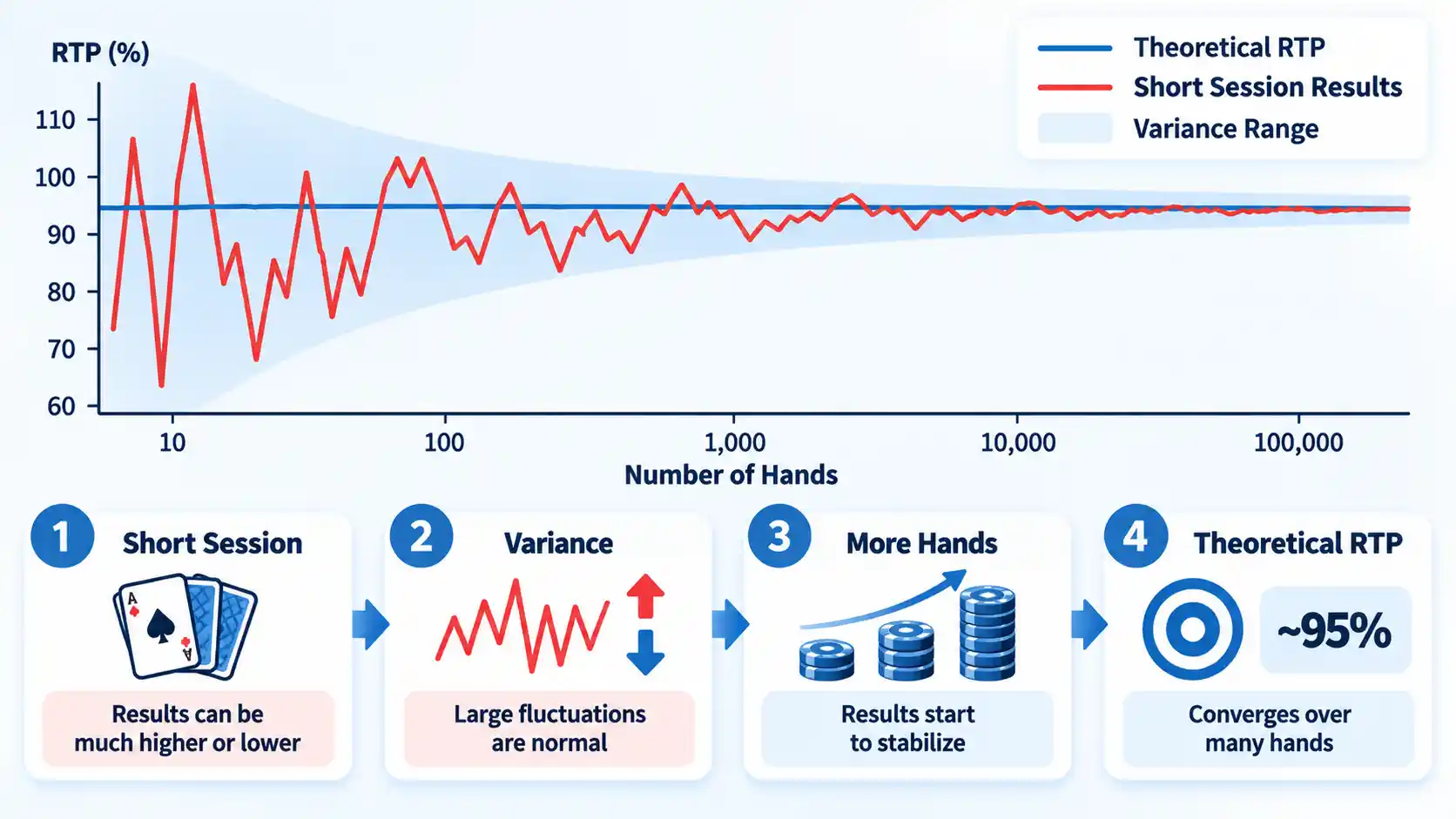
Volatility describes how widely results can vary around an average. Games with rarer, larger prizes can produce wider short-term swings, which is why quoting a theoretical RTP without explaining sample size and volatility can give the wrong impression about what happens during ordinary play.
9. Myth: Betting the Maximum Makes Better Cards More Likely
A larger wager can change the amount a winning hand pays, but that is not the same thing as making favorable cards more likely to appear.
Some conventional video poker schedules give a disproportionately larger payout for the highest hand at the maximum number of credits. Standard video poker guidance and pay tables document this structure in conventional games. The mechanism is a payout difference, not evidence that the RNG begins dealing stronger cards because the wager is larger.
This distinction prevents a costly leap in reasoning. A pay table can make one stake level mathematically different from another without making it sensible to exceed a predetermined spending limit. The correct comparison is between the game’s stated wager and payout rules, not between imagined “luck levels.”
There is also no universal rule that every video poker product uses the same maximum-wager bonus structure. Check the specific pay table rather than assuming that advice developed for one conventional schedule applies everywhere.
10. Myth: Multi-Hand Video Poker Gives You Better Odds for Free
Seeing more hands at once can create more opportunities for different outcomes, but those extra hands are not automatically free. In conventional multi-hand formats, wagers are commonly stated on a per-hand basis.
For example, multi-hand video poker rules describe selecting the number of coins wagered per hand. If one play expands from one separately wagered hand to several, total exposure increases with the number of hands.
Sponsored link disclosure: The following commercial link is a paid placement and is not used as evidence for any mathematical or regulatory claim in this article.
Commercial libraries may offer multi-hand video poker games, but when additional hands are separately wagered, they also add wagered action; they do not create extra chances at no additional exposure.
Exact implementations can differ, including how replacement cards or optional features work. The useful general point is narrower: the number of visible hands should not be confused with a cost-free mathematical advantage.
11. Myth: If You Keep Playing After a Loss, the Game Will Eventually Pay You Back
A random game does not remember how much an individual player has lost and then become obligated to return it. Extending a losing session does not make the next independent hand favorable merely because earlier hands consumed more money.
Trying to recover previous gambling losses by continuing to wager is commonly called chasing losses. The National Council on Problem Gambling identifies chasing losses as one warning sign associated with problem gambling.
This myth is especially important because it turns a statistical misconception into a behavioral risk. A person may interpret losses as evidence that a reversal is becoming more likely, increase the amount or duration of play, and expose more money without changing the probability of the next independent random event in the way they expect.
If gambling is becoming difficult to control or is affecting finances, work, relationships, or wellbeing, stopping play and using appropriate problem-gambling support is more useful than attempting to recover losses through additional gambling.
What Actually Matters More Than Video Poker Superstitions
Video poker is easier to analyze when you separate factors that can change the mathematics from factors that merely feel meaningful.
The exact game rules matter. The pay table matters. The strategy used for that specific pay table can matter. A special maximum-wager payout can matter to the calculation of theoretical return. The regulatory and technical environment matters when deciding what claims can reasonably be made about randomness and outcome generation.
By contrast, a machine’s recent streak, the fact that the last hand was a near miss, or the amount already lost does not create a new mathematical obligation for the next independent random hand.
The distinction is also useful when comparing video poker and slots. Both categories can use random number generation, but video poker gives the player a hold-or-discard decision whose mathematical quality can affect expected return. That does not remove randomness or guarantee profit.
Regulation should also be described carefully. A regulated game can be required to meet technical standards and disclose rules or likelihood-of-winning information without becoming a profitable proposition for the player. The UK Gambling Commission’s standards, for example, separately address random outcome generation and disclosure of rules, payouts, RTP, house edge, or winning probabilities.
Bottom Line
The most persistent video poker myths usually confuse past outcomes with future probabilities or confuse payouts with card generation. Randomness determines the cards available under the game’s rules, the pay table determines what completed hands pay, and the player’s hold decisions can affect expected value in variants where strategy matters.
None of those facts means a short session should follow the theoretical RTP, that a losing machine becomes due, or that continued gambling can force earlier losses to be recovered. The safest way to evaluate a claim is to identify which mechanism it refers to, check the exact game’s rules and pay table, and avoid treating streaks or superstition as evidence.







💬 Comments