The most common conveyor belt problems include mistracking, slippage, carryback, spillage, seized rollers or pulley faults, belt and splice damage, and blockages or stoppages. The right solution depends on finding the underlying cause rather than treating the visible symptom alone.
A conveyor belt is the moving belt within a conveyor system that carries material or products between points. Problems can originate in the belt itself, but they can also come from loading conditions, pulleys, idlers, rollers, belt cleaners, splices, drive components, or the conveyor structure.
Before Troubleshooting a Conveyor Belt: Isolate the Hazard
A stopped conveyor is not automatically a safe conveyor. Stored energy, gravity, connected equipment, electrical power, or an unexpected restart can still create hazards during inspection or repair.
For general-industry work covered by OSHA’s hazardous-energy standard, servicing or maintenance that could expose an employee to unexpected startup, energization, or the release of stored energy must follow an energy-control procedure. OSHA’s definition of servicing includes activities such as adjusting, inspecting, cleaning, maintaining, and unjamming machinery when that exposure exists. The standard also requires an authorized employee to verify isolation and de-energization before covered work begins. See OSHA’s control of hazardous energy requirements.
Different rules can apply in other industries. For construction work, for example, OSHA’s conveyor standard requires conveyors to be locked out or otherwise rendered inoperable and tagged during repairs and when operation would be hazardous to employees performing maintenance. It also addresses stop controls, pre-start warnings, emergency stops, and guarding. The applicable requirements depend on the workplace and task, so maintenance personnel should follow the employer’s documented procedures rather than assume one rule covers every conveyor installation.
The ASME B20.1-2024 safety standard also addresses the design, construction, installation, maintenance, inspection, and operation of conveyors in relation to hazards.
Visual observation during normal operation can help identify a symptom. Hands-on inspection, cleaning, adjustment, unjamming, or component replacement should begin only after the applicable site safety and energy-control procedures have been followed.
The seven categories below separate visible symptoms from the mechanical or operating conditions that can cause them.
| Problem | What you may notice | Check first |
|---|---|---|
| Mistracking | Belt drifts toward one side or rubs the structure | Loading position, buildup, rollers, pulleys, splice, and alignment |
| Slippage | Drive pulley turns while belt movement is reduced or inconsistent | Tension, pulley traction, lagging condition, belt condition, and load |
| Carryback | Material remains on the return side after discharge | Belt cleaners, buildup, material characteristics, and cleaner contact |
| Spillage | Material escapes at loading, transfer, or along the conveyor | Loading position, sealing, support, impact, and mistracking |
| Roller or pulley faults | Noise, flat spots, localized belt damage, or abnormal resistance | Seized rollers, bearings, buildup, pulley condition, and alignment |
| Belt or splice damage | Fraying, cuts, tears, cracking, or repeated splice failure | Tracking, impact, contact points, pulleys, rollers, and splice condition |
| Blockage or stoppage | Belt slows, stops, or material backs up | Obstructions, drive condition, slippage, loading, and mechanical faults |
1. Belt Mistracking or Misalignment
Mistracking occurs when the belt moves away from its intended running path. You may see the belt consistently favor one side, wander from side to side, rub the frame, or begin wearing along one edge.
Mistracking has several possible causes. Metso’s conveyor troubleshooting guidance identifies off-center loading, material buildup on rollers and pulleys, maladjustment, conveyor structure, environmental conditions, and belt tolerances among the factors that can move a belt off its intended path. Flexco likewise identifies roller or pulley misalignment, an incorrect splice, and material buildup as possible causes.
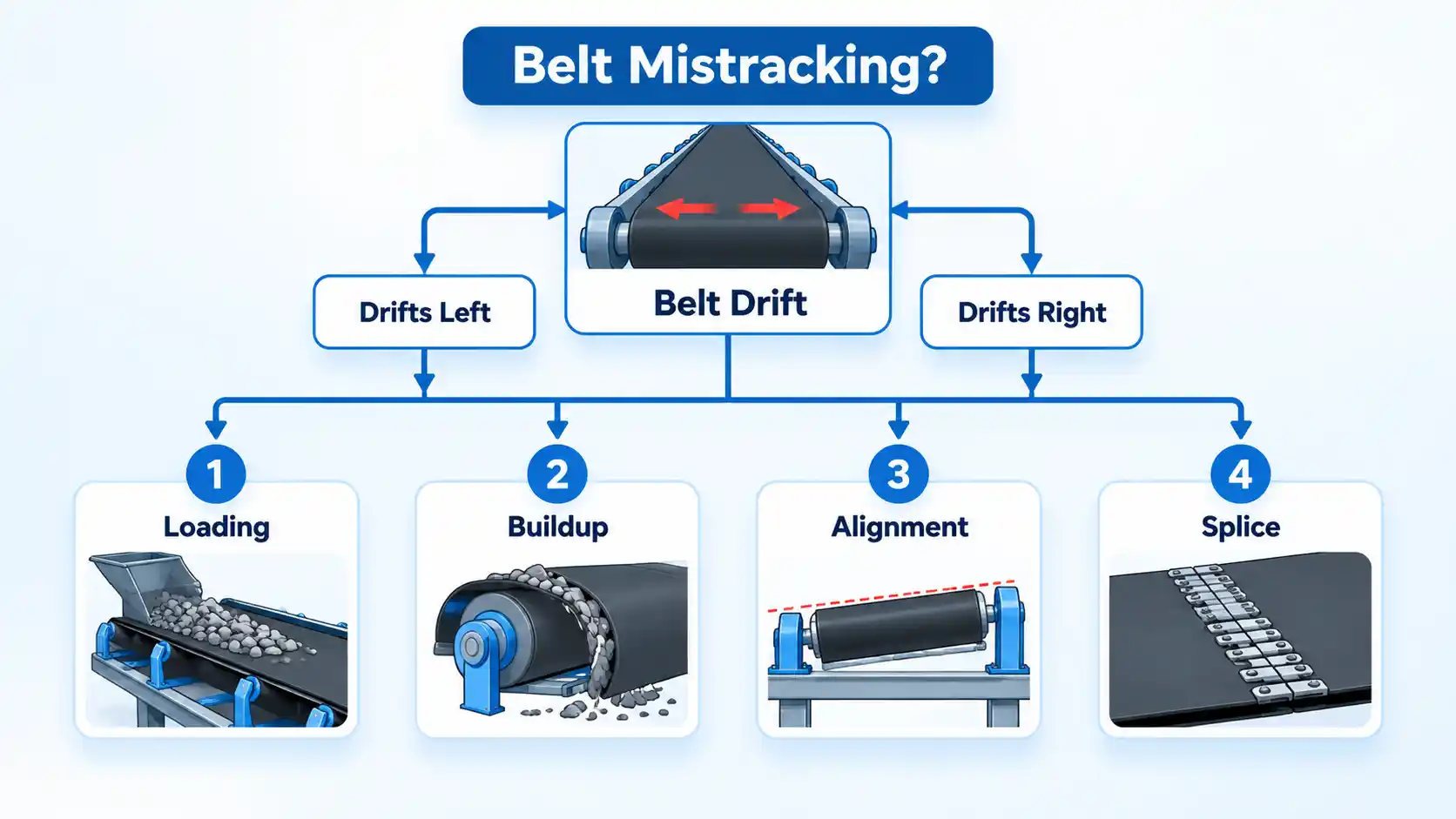
Look for a repeatable pattern. If the belt tracks correctly while empty but shifts sideways after material is loaded, the loading arrangement deserves attention. If the drift repeatedly begins in the same physical area, inspect the components, alignment, and buildup in that area after the conveyor has been safely isolated.
Do not assume that repeatedly adjusting a trainer or one idler solves the problem. If the actual cause is an off-center load, crooked splice, buildup, or pulley alignment problem, the belt can move out of position again after the adjustment.
2. Belt Slippage and Incorrect Tension
Belt slippage occurs when the belt does not move at the same rate as the pulley driving it. You may see the drive pulley continue turning while the belt hesitates, travels too slowly, or slips more noticeably during startup or heavier loading.
Metso identifies inadequate friction between the belt and pulley, belt or pulley wear, environmental conditions, and insufficient belt tension as possible causes. Flexco’s troubleshooting material also points to undersized pulleys and worn or incorrect pulley lagging. Pulley lagging is the material covering a pulley surface to improve traction and protect the pulley.
Simply increasing tension is not a universal fix. Excessive tension can add load to the belt, shafts, bearings, and other components. The more useful approach is to check belt tension against the conveyor or belt manufacturer’s requirements and inspect the drive pulley surface, lagging, belt condition, loading, and drive system before making a major adjustment.
Persistent slippage also deserves prompt attention because the belt can skid against the pulley and generate frictional heat. Metso notes that severe skidding can, in a worst-case scenario, create a fire risk.
3. Material Carryback and Buildup
Carryback is material that remains on the belt after it should have discharged and travels back on the return side. Sticky or cohesive material can make the problem more noticeable, especially when residue begins accumulating below the return run or around rotating components.
This is different from ordinary spillage. With carryback, the material remains attached to the belt beyond the discharge point. Metso describes belt-cleaning systems as a method of removing potential carryback from the material-facing surface as the belt passes around the head pulley.
If carryback persists, inspect the cleaning system after safe isolation. Flexco identifies incorrect cleaner mounting and poor cleaner-to-belt contact as causes of ineffective cleaning. Belt condition and the suitability of the cleaner for the application can also affect performance.
Carryback can contribute to other faults. Material that accumulates on rollers or pulleys can alter their surface and influence tracking, so repeatedly cleaning fallen material without addressing its source may not prevent recurrence.
4. Material Spillage at Loading and Transfer Points
Spillage occurs when transported material escapes from the belt. It commonly develops around loading and transfer points, but material can also leave the belt during transport when tracking or containment is poor.
At a transfer point, examine how material reaches the receiving belt. A centered and controlled material stream is generally easier to contain than one striking the belt toward an edge. Metso identifies loading impact, poor sealing, mistracking, and leakage as contributors to conveyor spillage.
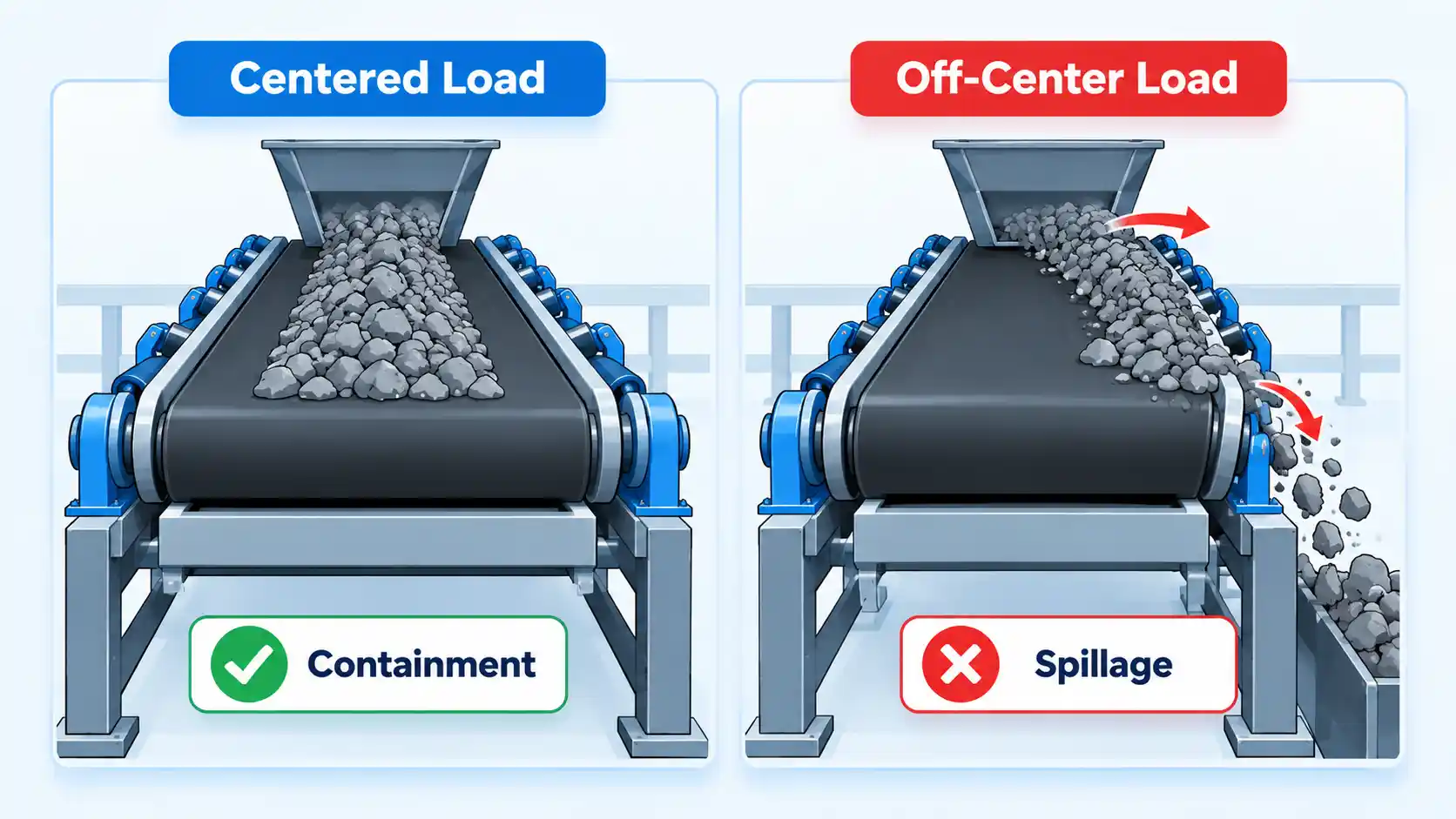
Containment components also matter. Skirting helps contain material around a loading zone, while appropriate support and impact protection help manage the forces created as material lands on the belt. Flexco lists load-zone spillage among conveyor problems associated with conditions around the loading area.
Do not treat every pile beneath a conveyor as the same failure. Material beneath the return run after the discharge point may indicate carryback, while material escaping from the side of a loading zone points more strongly toward loading, containment, support, or tracking.
5. Seized Rollers, Idlers, and Pulley Problems
A belt conveyor depends on rotating components to support, guide, and drive the belt. An idler is a non-powered roller or roller assembly that supports the belt, while pulleys guide, redirect, or drive it at key points in the system.
When a roller stops rotating, the moving belt can slide across its stationary surface. Flexco warns that seized rollers can develop flat spots and sharp edges that damage the belt. Observable signs can include localized scraping, unusual noise, a repeated belt mark, or abnormal resistance.
Pulley problems can present differently. Material buildup can influence the belt path, pulley misalignment can contribute to mistracking, and worn or inappropriate lagging can reduce drive traction.
Vibration is better treated as a symptom than as a diagnosis. Its source may be a roller, bearing, pulley, loading event, buildup, splice, structure, or another rotating component. Identifying where the vibration begins and whether it changes with load or belt movement provides a better diagnostic starting point than assuming the belt itself must be replaced.
6. Belt Wear, Tears, and Splice Damage
All conveyor belts wear, but the location and pattern of damage can help identify the cause. Edge fraying may point toward repeated frame contact or mistracking. Cuts and gouges may indicate impact, sharp material, or contact with damaged conveyor components.
Splice problems also deserve separate attention. Flexco notes that an improperly squared belt can distribute tension unevenly and encourage mistracking. It also warns that using a pulley smaller than the minimum recommended for the belt or mechanical fastener can create excessive bending stresses and increase the possibility of splice failure.
Before replacing a damaged belt, investigate why the damage developed. A new belt installed on the same misaligned, seized, contaminated, or incorrectly configured conveyor can be exposed to the same failure mechanism.
If replacement is necessary, selecting suitable replacement conveyor belts should be based on the conveyor design, loading conditions, pulley arrangement, handled material, and required belt construction. Sponsored link.
The choice between repair and replacement should therefore consider the type and extent of damage, the underlying cause, the belt construction, and the equipment or belt manufacturer’s requirements rather than belt age alone.
7. Blockages, Jams, Stoppage, and Slow Belt Speed
A conveyor that stops or slows has a clear symptom, but the symptom does not identify the failed component. An obstruction at a transfer point, belt slippage, excessive loading, a seized component, a drive-system fault, or a control-system problem can all reduce movement or stop the conveyor.
Begin with observations that do not require entering a hazardous area. Is material backing up at one transfer point? Is the drive pulley moving while the belt is not? Did the conveyor stop immediately after a foreign object entered the material stream? Was unusual noise present before the stoppage? These distinctions can narrow the fault before hands-on work begins.
Do not reach into a jammed conveyor or attempt to clear an obstruction while hazardous energy remains available. Under OSHA’s general-industry rule, unjamming can fall within covered servicing when an employee could be exposed to unexpected startup, energization, or hazardous stored energy.
After the applicable energy-control procedure has been completed, trained maintenance personnel can inspect the affected transfer point, drive components, rollers, pulleys, belt path, and material flow according to the equipment manufacturer’s procedures.
How to Reduce Repeat Conveyor Belt Problems
Recurring conveyor faults are easier to investigate when maintenance records capture where and under what conditions they occur. A note such as “belt mistracked again” provides less diagnostic value than recording whether the problem appeared under load, where the drift began, what component was adjusted, and whether buildup or visible damage was present.
Routine inspection can focus on changes that appear before a shutdown: new edge wear, poor belt-cleaner performance, material buildup, damaged splices, non-rotating rollers, changing tracking behavior, unusual noise, worn lagging, or repeated spillage in the same location.
Preventive work should also address the cause of abnormal wear rather than only the damaged part. Replacing a roller without correcting the condition that repeatedly contaminates or damages it can allow the same problem to return. The same principle applies to broader manufacturing-line maintenance, where changes in equipment condition can affect stability and downtime.
Inspection frequency should follow the conveyor design, operating duty, environment, material handled, manufacturer recommendations, and site experience. A lightly loaded packaging conveyor should not be assumed to require the same maintenance interval as a bulk-material conveyor handling abrasive material.
Conclusion
Conveyor belt problems are easier to solve when the visible symptom is separated from its underlying cause. Mistracking may begin with loading or alignment, slippage can involve traction rather than tension alone, and belt damage may originate in a roller, pulley, splice, transfer point, or operating condition.
The practical approach is to recognize the symptom, apply the required safety procedure before hands-on servicing, inspect the most plausible causes, correct the confirmed fault, and verify that the problem does not return during normal operation.

💬 Comments