No. Bangladesh’s Gambling Prevention Act, 2026 expressly makes involvement in online or remote gambling and online betting offenses. The law also reaches conduct such as using an online gambling account, making gambling-related financial transfers, certain promotional activity, and specified use of technical infrastructure to support or restore gambling access.
Quick Take
- The Gambling Prevention Act, 2026 took effect on July 1, 2026 and replaced the Public Gambling Act, 1867.
- Sections 5 and 6 prohibit involvement in online or remote gambling and online betting.
- The law covers online gambling-account use and gambling-purpose deposits, withdrawals and transfers, not only gambling operators.
- A foreign gambling licence does not create an exception from Bangladesh law simply because the operator is based or licensed abroad.
- The Act also addresses specified gambling-related use of VPNs, proxies and mirror infrastructure, but it does not make ordinary VPN use generally illegal.
This article explains the published law in general terms and is not individualized legal advice. Actual criminal liability, procedure and sentencing depend on the facts of a particular case and the decisions of the relevant authorities and courts.
The Short Answer: Online Gambling and Betting Are Prohibited
Bangladesh now has a dedicated statute dealing expressly with online gambling rather than relying primarily on a nineteenth-century gambling law or a general cybercrime provision. The Gambling Prevention Act, 2026 was enacted as Act No. 98 of 2026 on July 1, 2026 and took effect immediately.
Section 5 states that a person involved in online or remote gambling commits an offense. Section 6 separately makes involvement in online betting an offense.
The distinction matters because the Act defines online betting broadly. It includes sports betting, live betting, exchange betting, casino betting, virtual betting, fantasy betting and esports betting. Online or remote gambling is also defined broadly enough to include more than simply operating a gambling website.
For example, using an online gambling account and placing an online sports bet are both activities the Act addresses, although the offenses and statutory maximum penalties are not identical.
What Changed on July 1, 2026?
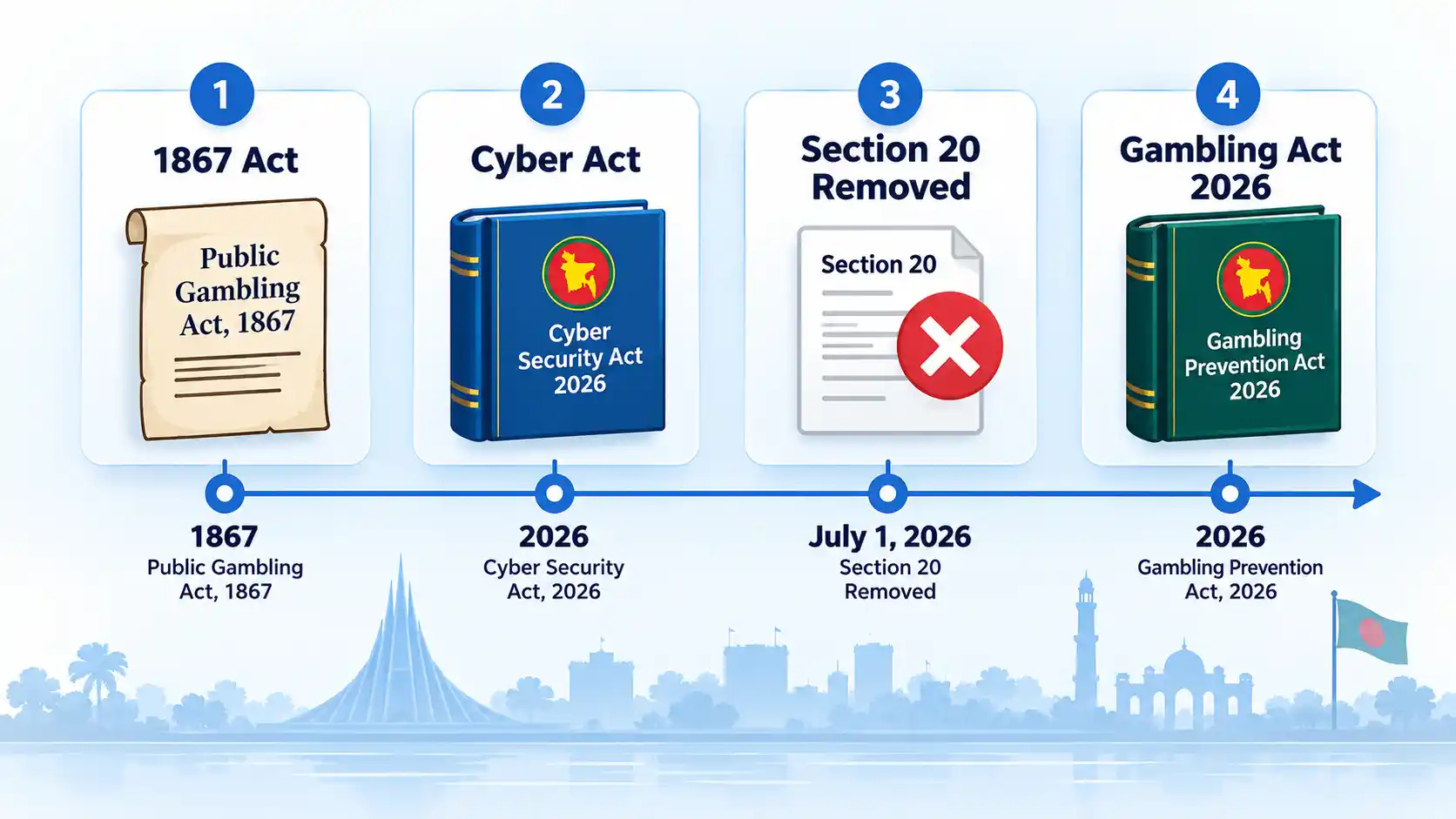
July 1, 2026 was a significant legal transition. Bangladesh introduced a standalone gambling statute and, on the same date, enacted an amendment removing the gambling provision that had appeared in the Cyber Security Act, 2026.
The Gambling Prevention Act replaced the 1867 law
Section 49 of the Gambling Prevention Act expressly repeals the Public Gambling Act, 1867, while preserving specified earlier actions, orders and pending proceedings. The 1867 Act therefore should not be presented as Bangladesh’s current primary gambling statute when explaining the legal position in September 2026.
The change is substantial because the 2026 Act directly defines digital concepts that the 1867 law could not have contemplated, including online gambling accounts, digital gambling platforms, online betting, digital wallets, cryptocurrency and other digital assets.
Cyber Security Act section 20 is no longer the current gambling provision
The chronology is easy to misstate. Bangladesh enacted the Cyber Security Act, 2026 as Act No. 81 of 2026 on April 10, 2026. That law originally contained section 20 dealing with gambling in cyberspace.
However, the current Cyber Security Act records that section 20 was deleted by the Cyber Security (Amendment) Act, 2026. The official 2026 Acts register lists the Gambling Prevention Act as Act No. 98 and the Cyber Security amendment as Act No. 99, both dated July 1, 2026.
An article published before that change may have accurately cited Cyber Security Act section 20 at the time, but that provision should not be presented as the current primary basis for Bangladesh’s online-gambling prohibition.
What Counts as Online Gambling Under the 2026 Law?
The statute does not limit online gambling to running a casino website. Its definitions cover several kinds of conduct involving accounts, platforms, payments and participation.
Using an online gambling account
The Act’s definition of online or remote gambling includes opening, operating or using an online gambling account. It also includes operating online gambling websites, apps, servers or digital platforms and running gambling or betting groups, pages or channels on social media.
That wording matters because the statutory framework is not confined to bookmakers, platform owners or software operators. A person does not need to own the gambling platform for account activity to fall within conduct described by the law.
Casino and sportsbook activity
The Act separately defines online betting as betting conducted online, digitally or electronically on the outcome of a sport, competition, esports event, election, entertainment event or another event in return for money or property.
The listed categories include:
- sports betting;
- live betting;
- exchange betting;
- casino betting;
- virtual betting;
- fantasy betting; and
- esports betting.
The definition therefore reaches more than conventional sportsbook wagers. Casino betting and several newer forms of digital betting are expressly named.
Foreign gambling platforms are not outside the definitions
The definition of online or remote gambling also includes acting as a representative, agent or associate of a foreign online gambling platform. That matters because offshore operation does not place foreign platforms outside the subject matter of the Act.
A foreign gambling licence can regulate an offshore casino in the jurisdiction that issued the licence without changing whether Bangladesh permits residents to participate. Foreign licensing and domestic legality answer different questions.
The reviewed provisions do not create a general exception simply because an operator is based or licensed outside Bangladesh.
Are Deposits, Withdrawals and Crypto Gambling Covered?
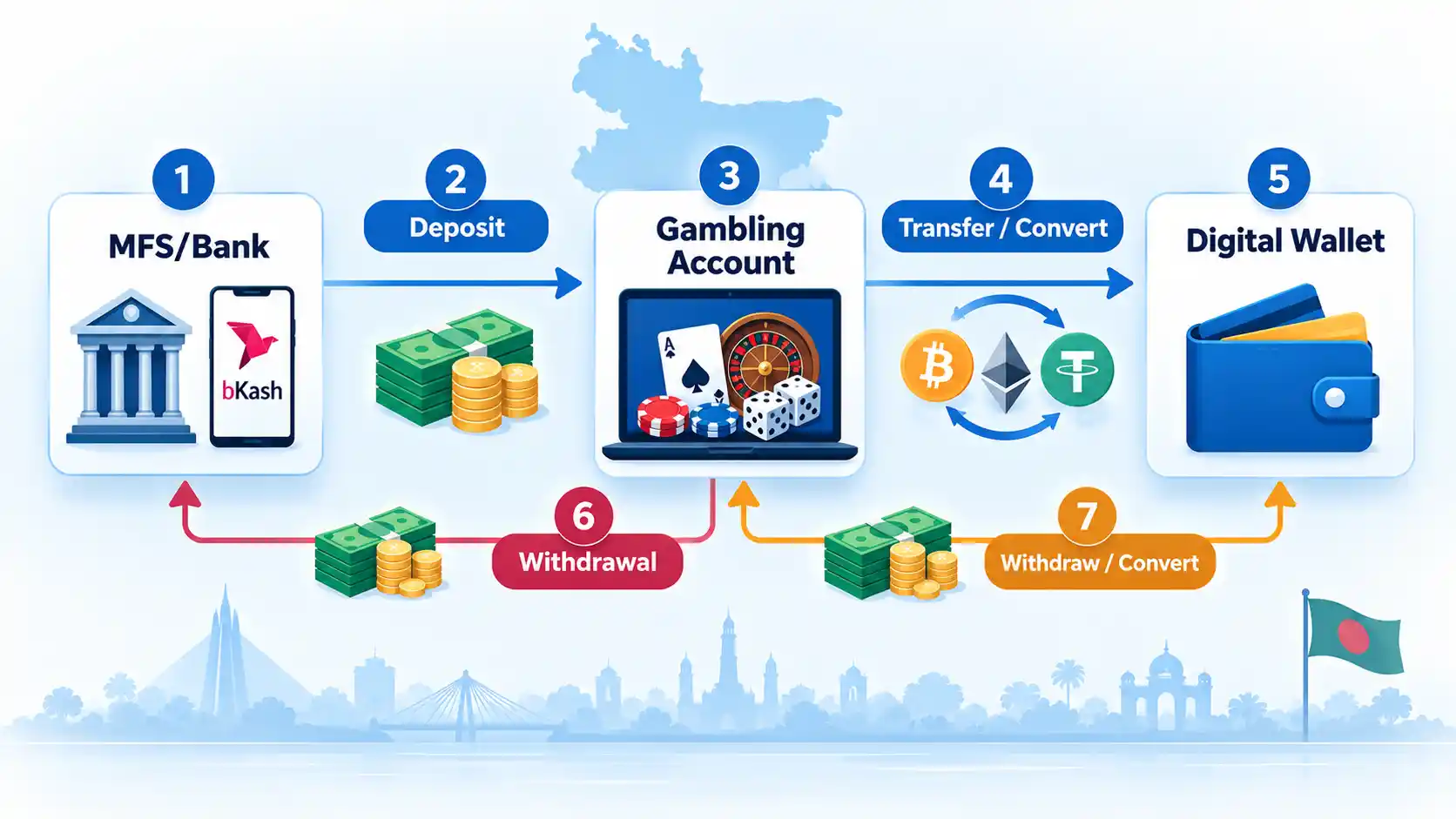
Yes. The law connects gambling activity to its financial flows rather than treating account funding as an unrelated step.
The definitions of online or remote gambling include depositing, withdrawing or transferring money for online-gambling purposes. The Act also defines cryptocurrency and digital assets, including cryptocurrency, tokens, virtual coins, value stored in digital wallets and non-fungible tokens.
Section 14 addresses specified gambling-related use of financial systems, including banks, Mobile Financial Services, digital wallets, hawala, hundi and other financial arrangements. Mobile Financial Service, or MFS, refers here to mobile-linked financial services used for storing or transferring money.
The same section covers converting, storing or transferring gambling money or property through cryptocurrency, virtual assets or other digital assets. Section 25 provides that the section 14 offense is treated as a predicate offense under the Money Laundering Prevention Act, 2012.
A predicate offense is an underlying offense that can support a money-laundering case. This does not mean every bank, wallet or cryptocurrency transaction automatically becomes a money-laundering offense. The gambling connection and the elements of the applicable offenses still matter.
In practical terms, a bank, wallet or mobile-payment service being technically capable of processing a transaction does not make the underlying gambling activity lawful.
Does an Offshore Gambling Licence Make a Site Legal in Bangladesh?
No general foreign-licence exception appears in the reviewed provisions of Bangladesh’s Gambling Prevention Act. An offshore licence and Bangladesh legality operate at different jurisdictional levels.
A licence issued in Curaçao, Malta or another jurisdiction may establish that an operator is authorized or supervised there. It does not itself grant permission to customers in every other country.
This distinction is especially important when a gambling website uses its foreign licence as evidence that it is “legal.” That statement may describe its position in the licensing jurisdiction but does not answer whether the relevant activity is lawful in Bangladesh.
Understanding what a Curaçao gambling licence protects requires separating the regulator’s oversight of the operator from the law governing a customer’s location.
Likewise, comparing offshore and local gambling licences helps separate authorization issued in one jurisdiction from permission to offer or use gambling services in another.
What Does the Law Say About VPNs and Mirror Sites?
The Gambling Prevention Act does not establish a general ban on ordinary Virtual Private Network use. Section 12 instead addresses listed technical infrastructure when it is used for specified gambling-related conduct.
A Virtual Private Network, or VPN, routes network traffic through an intermediary server and can conceal or alter information about a user’s apparent network location. A proxy also acts as an intermediary, while the Act defines a mirror site as an alternative domain, copy or republished version of a previously blocked or prohibited gambling website.
Section 12 addresses using VPNs, proxies, mirror sites, hosting, domain services, cloud infrastructure, Content Delivery Networks or other technical infrastructure to operate gambling, conceal gambling information, assist gambling activity, reactivate a blocked gambling platform or use an alternative domain.
Section 23 provides the penalty for the section 12 offense. The qualification matters: saying simply that “VPNs are illegal in Bangladesh” would be broader than what this gambling provision states.
Likewise, the fact that a blocked or unavailable gambling platform can be reached through a mirror or another technical route does not establish legal permission to use it. Technical reachability and legality are separate questions.
A broader explanation of whether a VPN changes gambling legality must therefore distinguish network access from the law governing the underlying activity.
What Are the Penalties?
The Act does not assign one universal penalty to every gambling-related offense. The table below compares several statutory maximums relevant to online activity. These are maximum penalties written into the statute, not automatic sentences.
| Offense | Penalty section | Statutory maximum |
|---|---|---|
| General gambling offense under section 4 | 15 | Up to 2 years’ imprisonment, a fine of up to Tk 2 lakh, or both |
| Online or remote gambling under section 5 | 16 | Up to 5 years’ imprisonment, a fine of up to Tk 1 crore, or both |
| Online betting under section 6 | 17 | Up to 7 years’ imprisonment, a fine of up to Tk 5 crore, or both |
| Specified gambling promotion, sponsorship, affiliate marketing or referral activity under section 11 | 22 | Up to 3 years’ imprisonment, a fine of up to Tk 50 lakh, or both |
| Specified gambling-related technical-infrastructure conduct under section 12 | 23 | Up to 7 years’ imprisonment, a fine of up to Tk 5 crore, or both |
The official Act should be read for the exact elements of each offense. A statutory maximum is the highest punishment authorized by that provision; it does not mean every allegation or conviction produces that outcome.
Actual liability and sentencing can depend on the facts, evidence, charges, procedure and court findings in an individual case.
Can Gambling Sites or Accounts Be Blocked or Frozen?
The Act provides several enforcement mechanisms, but the existence of those powers should not be confused with proof that they have been used against a particular operator or account.
Section 38 authorizes the government or designated authority to block, remove or prohibit gambling-related websites, applications, servers, domains, IP addresses, URLs, social-media pages, groups, channels and other digital gambling platforms. Mirror sites, clone sites and alternative domains used for gambling activity may also be blocked.
Separate provisions address financial accounts and assets. Section 31 permits an investigating officer, with court permission, to temporarily freeze an accused person’s bank account, MFS account, digital wallet or crypto wallet when needed for an investigation. Section 29 allows a court to order confiscation of specified money, property and digital assets used in or obtained from an offense. Section 39 permits a court to order closure of specified financial accounts used for gambling.
For example, if a betting website suddenly becomes unreachable, blocking is one possible explanation. It would still be incorrect to state that Bangladesh authorities blocked that particular domain without direct evidence.
Likewise, the existence of account-freezing or closure powers does not establish that every gambling-related transaction automatically produces such an order.
What About Advertising, Influencers and Affiliate Links?
The Act also addresses specified gambling promotion rather than focusing only on players and operators.
Section 11 applies to persons and entities including media outlets, digital platforms, influencers, artists, athletes and celebrities when they conduct specified misleading gambling promotion, make false promises of profit, use inducement advertising, sponsorship, affiliate marketing or referral campaigns for gambling purposes. Section 22 sets a maximum penalty of 3 years’ imprisonment, a fine of up to Tk 50 lakh, or both for the section 11 offense.
This does not mean every journalistic mention, academic discussion or neutral reference to a gambling company automatically constitutes prohibited promotion. Whether conduct satisfies an offense depends on the facts and the statutory elements.
The distinction matters for publishers and influencers. A neutral legal explanation performs a different function from material designed to induce gambling participation, promise gambling profits or generate gambling referrals.
Which Law Should You Use for Current Bangladesh Gambling Information?
For the current position in September 2026, the starting point is the Gambling Prevention Act, 2026.
The Public Gambling Act, 1867 remains relevant to historical context and saved proceedings, but the new Act expressly repealed it. Cyber Security Act section 20 is also historical rather than current for this issue because the Cyber Security (Amendment) Act, 2026 deleted that provision on July 1, 2026.
This distinction matters when reading older articles. A page can have been accurate when written yet become outdated after a statutory amendment or replacement.
When evaluating a current claim about Bangladesh online-gambling law, check the publication date, the exact statute and section being cited, and whether a later law has amended, repealed or replaced that provision.
Bottom Line
Online gambling and online betting are expressly prohibited under Bangladesh’s Gambling Prevention Act, 2026. The law reaches more than platform operators: it addresses gambling-account use, online betting, gambling-related money transfers, specified promotional conduct and certain technical methods used to operate, assist or restore gambling access.
The current framework dates from July 1, 2026. The Public Gambling Act, 1867 has been repealed, and Cyber Security Act section 20 should not be presented as the current primary online-gambling offense because that provision was deleted on the same date.
A foreign licence, functioning payment method or technically accessible website does not independently establish that online gambling is lawful in Bangladesh. Anyone facing an actual investigation, charge, frozen account or other legal consequence should obtain advice from a qualified Bangladesh lawyer based on the specific facts.

💬 Comments