SEO for WooCommerce can help a store become easier for search engines and relevant shoppers to discover by improving product and category content, site architecture, structured product information, and technical performance. An agency can organize and execute that work, but it cannot guarantee rankings, traffic, or customers.
WooCommerce SEO is more involved than installing an SEO plugin and adding keywords to product pages. A store may contain category archives, individual products, variations, filters, images, pricing and availability data, and URLs generated through several different paths. Search optimization has to account for how those parts are discovered, understood, indexed, presented in search results, and measured over time.
Google describes search engine optimization as work that helps search engines understand content and helps users decide whether to visit a site through search. Its documentation also makes clear that there is no method that automatically guarantees a first-place ranking. That distinction matters when judging what an SEO provider can realistically promise.
What WooCommerce SEO Actually Covers
WooCommerce runs on WordPress, but an online store introduces search problems that an ordinary publishing site may not have. A merchant might have product pages, product categories, variations for size or color, filtered catalog views, image galleries, stock information, prices, shipping information, and promotional URLs. Each can affect how search engines understand the store.
At the most basic level, WooCommerce SEO tries to make the commercially useful parts of that store easy to discover and understand. That includes clear product and category content, crawlable navigation, sensible URLs, accurate page titles, useful images, appropriate structured product information, and technical controls for pages that should or should not appear in search.
This work is also about prioritization. A store with ten products and two categories has different technical risks from a catalog containing thousands of products, variations, filters, and frequently changing stock. Google notes that site organization can become more consequential as URL counts grow, particularly for large e-commerce sites.
Crawling is the process search engines use to discover and retrieve pages. Indexing is the processing and storage that can make a page eligible to appear in search results. A page can therefore exist for shoppers without necessarily being indexed or useful for organic search.
A broader WooCommerce SEO strategy connects product content, category structure, technical controls, and measurement rather than treating any one plugin setting as the complete solution.
How SEO Can Put WooCommerce Products in Front of Relevant Searchers
Useful SEO starts by matching the right type of store page to the searcher’s purpose. Someone researching how waterproof hiking boots work may need an informational article. Someone searching for men’s waterproof hiking boots is more likely to benefit from a relevant category page. A person searching for a specific boot model may need the individual product page.
This is search intent: the practical goal behind a query. Product and category pages work better when their content, titles, internal links, and page purpose align with the type of search they are meant to satisfy.
Google’s developer SEO guidance explains that making content search-friendly can help more relevant users discover a site. It also recommends crawlable links between pages and textual context that helps Google understand visually heavy pages such as product categories.
Titles and descriptions can also influence how pages are presented in search. They should describe the page accurately rather than repeat a target keyword mechanically. Google may use several page signals when generating title links and snippets, so metadata should not be treated as a simple ranking switch.
Understanding crawling, indexing, and ranking makes it easier to see where SEO improvements affect search visibility and where other business factors take over.
Traffic alone is not a sufficient goal. A store can increase visits without attracting people who are interested in its products. A more useful objective is qualified organic discovery: relevant searches reaching pages that genuinely satisfy the searcher’s need.
What a WooCommerce SEO Agency Should Work On
An agency engagement may cover several workstreams at once. The exact mix should depend on the store rather than on a fixed package of plugin settings.
Product and Category Page Optimization
Product pages need enough accurate information for both shoppers and search engines to understand what is being sold. Depending on the product, useful content can include specifications, materials, compatibility, dimensions, variations, use cases, delivery information, or other details that help someone make a decision.
Category pages serve a different purpose. They group related products and can match broader commercial searches. A waterproof hiking boots category, for example, should help a shopper understand and compare that product group instead of simply repeating the same text used on individual boot pages.
Google’s SEO Starter Guide recommends descriptive titles, logical organization, unique useful content, and URLs that give users meaningful context. That does not mean every category needs a large block of SEO copy. Content should exist because it clarifies the page and supports the searcher’s task.
An agency may therefore map queries and intent to existing products and categories, identify weak or duplicated descriptions, improve page titles, strengthen contextual internal linking, and determine where additional copy would actually help.
A common failure point is forcing the same target phrase onto many closely related products. When several variations or products have overlapping purposes, the agency should decide which page is supposed to satisfy which search intent rather than allowing pages to compete without a clear strategy.
Store Architecture, URLs and Indexation
Store architecture determines how products, categories, and other pages connect to one another. Clear navigation can help shoppers move through the catalog while also giving search engines crawlable paths to important URLs.
WooCommerce provides several product permalink structures. Its permalink documentation warns that changing an established structure changes existing product URLs, so previously shared or indexed links can return 404 errors unless appropriate redirects are set up. URL restructuring should therefore be planned rather than treated as cosmetic cleanup.
E-commerce sites can also produce multiple URLs that lead to identical or closely related content. Google explains in its e-commerce URL structure guidance that URL design can affect how efficiently search engines crawl and understand large stores.
Filters are one example. A store may let shoppers combine size, brand, color, price, material, and sorting options. Those controls are useful to customers, but they may also generate many URL combinations. Stores with extensive filtering therefore need deliberate treatment of WooCommerce filter URLs so that useful navigation does not automatically become an uncontrolled set of search URLs.
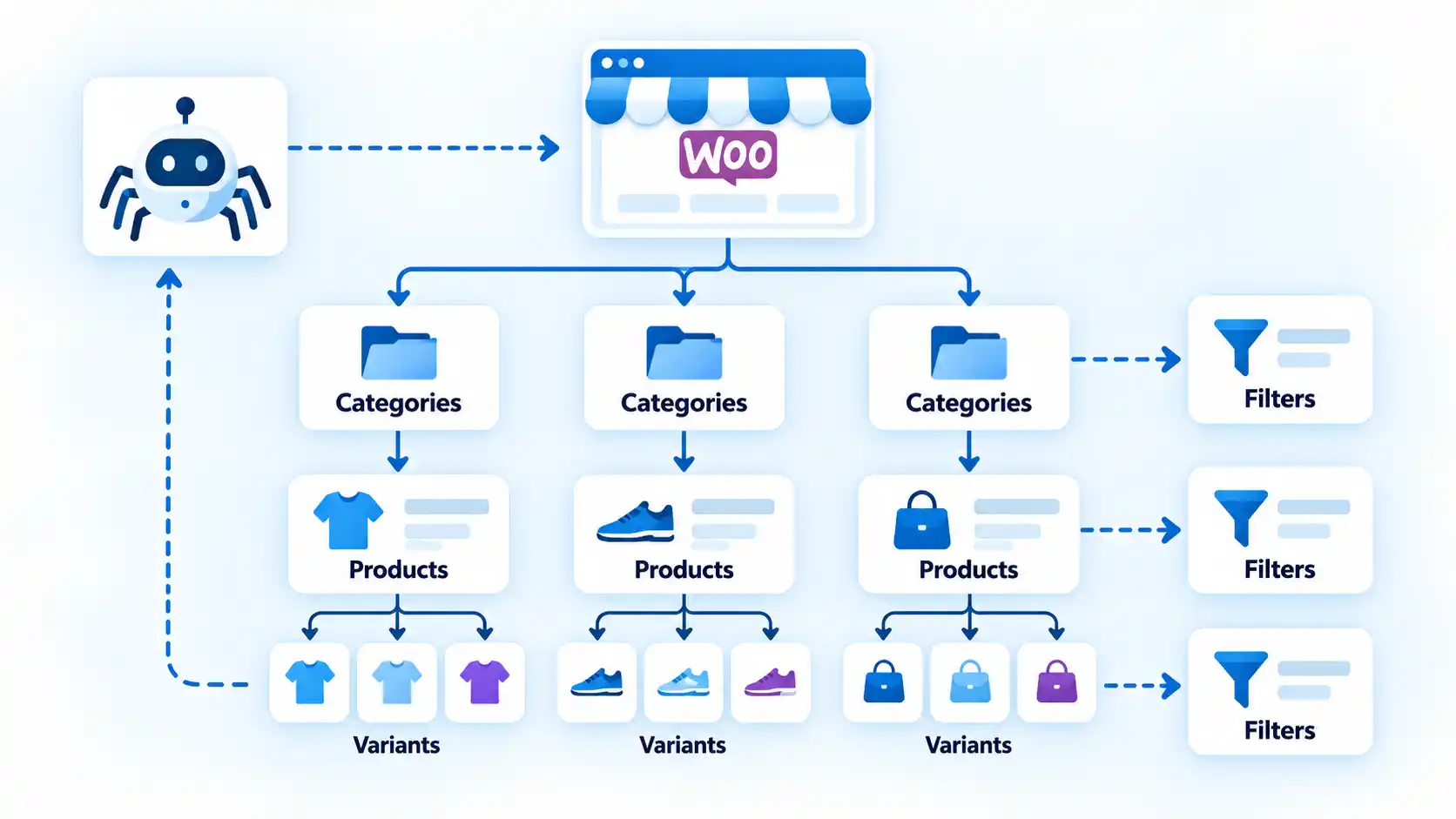
The right treatment varies. Some filtered pages may deserve search visibility because they represent a meaningful product grouping people search for. Others may be temporary combinations with little standalone value. Canonical URLs, indexation controls, internal links, and redirects can all play roles, but they should be chosen from the store’s actual URL behavior rather than applied as blanket rules.
For a large catalog, this is often where an SEO specialist needs to work with a developer. The SEO side can define which URLs are valuable and identify indexing problems, while the developer or platform specialist implements changes safely.
Product Structured Data and Shopping Search Features
Structured data is machine-readable information added to a page so search engines can understand specific entities and attributes more explicitly. For an online store, product information can include details such as price, availability, shipping information, return information, and ratings where the page meets the relevant requirements.
Google’s merchant listing documentation explains how Product and Offer structured data can make eligible merchant pages available for enhanced product experiences. Google distinguishes these merchant listings from product snippets, which have their own eligibility and page requirements.
The important word is eligible. Valid markup does not guarantee that Google will display a particular rich result or shopping treatment.
Variations add another layer. Products that differ by attributes such as size, color, memory capacity, or material can require relationships between individual variants and their product group. Google’s product variant guidance documents requirements involving unique variant identifiers, product-group relationships, and variant URLs.
An agency does not necessarily need to hand-code this information. WooCommerce, themes, extensions, and SEO tools may already generate some markup. The practical job is to determine what the store outputs, validate it, identify conflicts or missing required information, and avoid adding duplicate markup simply because another tool advertises schema support.
Product Images and Store Performance
Images are central to e-commerce, but optimization is broader than inserting keywords into alt attributes. Product images should help customers understand the item and should be delivered in a way that does not create unnecessary performance problems.
Google’s image SEO guidance recommends relevant contextual text, descriptive filenames and alt text, crawlable image elements, and responsive image practices. Alt text should describe the image where that description helps a user or provides meaningful context. It should not become a place to repeat keywords unnaturally.
Large source files or unnecessarily heavy galleries can increase the amount of data a product page must load. WooCommerce’s slow-site troubleshooting documentation identifies image file size as one common cause of slow front-end performance.
Current Core Web Vitals focus on three user-experience measurements: Largest Contentful Paint (LCP), Interaction to Next Paint (INP), and Cumulative Layout Shift (CLS). According to Google’s published Core Web Vitals thresholds, a good experience corresponds to LCP of 2.5 seconds or less, INP of 200 milliseconds or less, and CLS of 0.1 or less at the 75th percentile.
These measurements need context. Passing them does not guarantee stronger rankings or more sales, and failing one metric does not automatically reveal the cause. An agency should identify what is actually slowing or destabilizing the store before recommending a caching plugin, image tool, theme replacement, hosting change, or code modification.
For example, an oversized main product image may contribute to slow loading, while an image or promotional element without reserved dimensions can contribute to layout movement. Google’s CLS optimization guidance</a identifies images without dimensions as one common source of layout shifts.
What an Agency Should Deliver Beyond “SEO Optimization”
A useful engagement should produce work that the store owner can inspect. “Improve SEO” is too vague to function as a deliverable on its own.
Depending on the store, reasonable outputs may include:
- A baseline audit: a documented view of crawlability, indexation, search performance, page types, structured data, and other material issues before changes begin.
- A prioritized issue list: problems ordered by importance, effort, dependency, and expected practical impact rather than one long export from an automated crawler.
- Search-intent mapping: a clear decision about which products, categories, or informational pages should serve important query groups.
- Product and category recommendations: changes to titles, useful content, internal linking, media, or page structure where evidence supports them.
- Technical recommendations: documented treatment for indexing problems, unnecessary URLs, redirects, structured-data errors, or migration risks.
- Implementation ownership: clarity about whether the agency makes changes directly or hands specifications to a developer, content team, or store manager.
- Measurement: a baseline and recurring reporting that shows what changed, when it changed, and which search or business metrics are being monitored.
Some businesses use external WooCommerce SEO experts when the work spans search strategy, product content, and technical implementation rather than a single plugin setting.
That does not mean every recommendation belongs to an SEO agency. A hosting bottleneck may require a hosting provider. A theme defect may need a WordPress developer. Product facts may need a merchandising team. A URL migration can require coordination among SEO, development, analytics, and operations.
The agency’s value is easier to judge when responsibilities are explicit. For example, “fix indexation” is vague. “Identify indexable filter URLs, determine which should remain discoverable, document the required treatment, implement or assign the technical changes, and monitor the affected URLs afterward” describes work that can actually be reviewed.
When Hiring a WooCommerce SEO Agency Can Make Sense
Outsourcing SEO is a resourcing decision, not a requirement for running WooCommerce. A small store with a narrow, understood problem may be able to make the necessary change internally. A larger or technically complicated store may benefit more from specialist support.
Hiring outside help can make sense when:
- the catalog contains large numbers of products, categories, variations, or filter combinations;
- organic visibility has declined or stalled and the cause is unclear;
- the store is being redesigned, migrated, or restructured and existing search URLs need protection;
- the internal team understands the business but lacks technical SEO capacity;
- structured-data, crawling, canonicalization, or indexation issues involve several systems or teams;
- the business needs ongoing search monitoring, prioritization, and reporting rather than a one-time configuration change.
Outside support may be less necessary when the store is small, the issue has already been diagnosed, and the internal team can implement and verify the fix. A developer may also be the more direct choice when the problem is purely a confirmed code, theme, server, or hosting fault with no unresolved search-strategy question.
The trade-off between agency and in-house WooCommerce SEO usually comes down to available expertise, implementation capacity, cost, continuity, and who will be accountable for the work.
When comparing a woocommerce SEO agency with an in-house approach, ask who will implement technical fixes, who owns product-content changes, and how results will be measured.
A useful provider should also distinguish what it controls from what it does not. Search-engine systems, competitors, demand, inventory, pricing, seasonality, site changes, and other factors can affect organic results. A contract can define work and service levels, but it cannot make search outcomes certain.
How to Evaluate a WooCommerce SEO Agency
Judge an SEO provider by the quality and transparency of its method rather than by the confidence of its sales language. The questions below help show whether the proposed engagement is WooCommerce-specific and whether its work can be audited.
| Evaluation area | What to ask | Useful evidence | Warning sign |
|---|---|---|---|
| Technical audit | Which WooCommerce-specific page types and search issues will you inspect? | A defined scope covering relevant products, categories, URLs, indexation, structured data, internal linking, and performance where applicable | A generic automated site report with no explanation of WooCommerce-specific risks |
| Search strategy | How will you decide which pages should target important query groups? | A method that distinguishes product, category, and informational intent | Assigning the same keyword pattern to many pages without explaining page purpose |
| Implementation | Who makes technical and content changes? | Clear ownership among the agency, developer, merchant, content team, or hosting provider | Recommendations are delivered without identifying who can safely implement them |
| Structured data | How will product markup be checked? | Validation of the store’s existing output and documented treatment of errors or conflicts | A promise that adding schema will guarantee rich results or higher rankings |
| Measurement | Which baseline metrics will be captured before work starts? | Relevant Search Console, analytics, indexation, landing-page, and technical measurements with dates | Reporting only keyword positions without showing affected pages, changes, or useful outcomes |
| Reporting | Will reports explain what changed and why? | A change log, completed work, unresolved issues, observations, and next priorities | Activity reports that list tasks without connecting them to a defined objective |
| Promises | What exactly is guaranteed? | Commitments about work, communication, timelines, or deliverables that the provider controls | Guaranteed first-place rankings, guaranteed rich results, or guaranteed customer growth |
For technically sensitive changes, ask about staging, backups, approvals, and rollback responsibility as well. An SEO recommendation can be sound in principle and still cause problems if it is implemented without regard to checkout behavior, analytics, feeds, integrations, or existing URLs.
Access is another practical issue. An agency may need Search Console, analytics, WordPress, WooCommerce, crawling tools, or other systems, but access should match the work being performed. Avoid giving broader administrative privileges than necessary simply because the provider asks for everything at the beginning of the engagement.
Finally, look for explanations that make sense without proprietary language. A practitioner should be able to explain what is wrong, why it matters, what will change, how success or failure will be observed, and what uncertainty remains.
How to Measure Whether WooCommerce SEO Is Working
Rankings can be useful diagnostic data, but they are too narrow to represent the full outcome of an e-commerce SEO program. A store can move upward for queries that produce little useful traffic, while another page can gain commercially relevant clicks without becoming number one.
Measurement should begin with a baseline before major changes are made. Depending on the store and the work being performed, useful measures can include:
- Search impressions: how often relevant pages are shown for queries in Google Search.
- Organic clicks: visits arriving from those search appearances.
- Query relevance: whether impressions and clicks are coming from searches that match the products and categories the business actually wants to sell.
- Landing-page performance: which product, category, and informational pages receive useful organic traffic.
- Indexation: whether important commercial pages are eligible and appearing as expected, and whether unwanted URL patterns are creating problems.
- Structured-data status: errors or warnings affecting supported product search features.
- Core Web Vitals: field measurements showing whether user-facing performance is improving or degrading.
- Organic conversions or revenue: business outcomes attributed to organic sessions when analytics and conversion tracking are configured appropriately.
Changes should also be logged. If category templates, URLs, internal links, product descriptions, structured data, and caching are all changed during the same period, it becomes harder to understand why the results moved.
Google notes in its SEO Starter Guide that some changes may be reflected in search within hours while others can take several months, and that not every change produces a noticeable effect. Short-term certainty is therefore inappropriate.
Conversions also need careful interpretation. A shopper may discover a store through search and buy later through another channel. Promotions, stock, price, brand awareness, email, paid advertising, seasonality, or merchandising can affect the same purchase. SEO reporting should therefore separate what was observed from what can confidently be attributed to SEO work.
The Bottom Line
A WooCommerce SEO agency is most useful when it can connect search intent, product and category content, store architecture, structured product information, technical health, and measurement into a coherent program.
That work should be visible in specific deliverables and changes you can inspect. Installing an SEO plugin, inserting keywords into metadata, or reporting a list of rankings does not by itself demonstrate that the store’s search problems have been addressed.
The strongest engagement also has clear limits. Search visibility cannot be guaranteed, structured data does not guarantee enhanced search appearances, and performance improvements do not guarantee sales. What an agency can control is the quality of its diagnosis, the changes it recommends or implements, how carefully those changes are verified, and how clearly the results are reported.
