Four signals decide the answer, and none of them show up in a career quiz. Watch your energy at the end of a working session. Watch how you react when someone rewrites your copy. Watch whether a dashboard of numbers makes you curious or tired. And watch whether you can stand the repetitive parts: list clean-up, tracking tags, the third revision of the same subject line.
That last one carries more weight than most career advice admits. Marketing work blends research, strategy, creative messaging and measurement: copy, campaign planning, audience segmentation, budgets, conversion tests and performance analysis can all land on the same desk, especially at smaller companies. The people who stay are the ones who find the measurement and the editing tolerable, even interesting, when the glamorous part is over.
Quick Take
- The verdict: run a short, low-cost test with your current job intact. Resign only after the evidence log survives a review.
- Five workstreams: a skills audit, one sandbox campaign capped at 0 dollars or a self-imposed 50 dollars, a weekend tool lab, a few practitioner interviews, and an education decision built on real job ads.
- Test two role families, not “marketing” — content, social, SEO, paid media, email lifecycle, product marketing, or operations and analytics all need different tolerances.
- Stop rule: pause the plan if the boring mechanics repel you, the income stress test fails, or you keep finding reasons to skip the work itself.
Before You Start: What the Test Needs to Be Valid
A career experiment produces evidence only when it has a question, a method, a time limit and a written result. That four-part structure separates a real trial from endless browsing. Set all four before you publish anything or open an ad account.
Prerequisites
- One testable question. Write it in a single sentence, such as “Would I rather write content or manage paid campaigns?” Vague ideas like “something creative” cannot be tested.
- A hard end date. Pick a fixed date for the review, then put the meeting with yourself in your calendar.
- A spending cap. Zero is the default. If you want ad data, set a self-imposed ceiling of 50 dollars and treat it as a lab fee you are willing to lose.
- Weekly hours you can actually protect. A few protected evening hours plus one weekend block beats an ambitious plan you abandon early.
- An evidence log. One document, dated entries, two questions after every session: what did I do, and how did I feel about it?
- Access and permissions. Create fresh accounts with your own email. If you use an employer’s website, CMS or analytics property, get written approval first and never touch customer data.
- Success and stop criteria, written down. Decide now what evidence would make you continue, and what would make you pause.
Warning
Two shortcuts will poison the result. Using your employer’s or a client’s data to build samples risks your job and their privacy. Spending money you cannot lose buys you a bad month instead of information. A local-business landing page needs the owner’s explicit permission before you publish a single word.
Run the Five-Part Marketing Fit Test
Work through these in order. Each stage feeds the next: the audit tells you which role families to test, the sandbox tells you which tools to open, the interviews tell you whether the education route is worth paying for.
- Score the skills marketing actually uses. Take a page and rate yourself from 1 to 5 on six things: data literacy, user empathy, persuasive writing, project tracking, feedback tolerance, and comfort with software interfaces. Add one sentence of evidence under each score — a time you rebuilt a report, talked an unhappy customer down, or shipped something on deadline. Anything at 2 or below is a training target, not a disqualifier. Then pick the two role families you want to test and write one sentence explaining why each one fits the pattern of scores you just produced.
- Ship one small sandbox campaign. Choose a single project from the comparison table below and write a one-paragraph brief: who it serves, what it offers, the one number you will watch, and how often you will publish. Publish for a short, fixed cycle. After each cycle, change exactly one variable — the headline, the send time, the opening line — and log what happened. Expect small numbers. A newsletter with only a handful of subscribers is a valid result, because you are testing your reaction to the work, not market demand.
- Spend one weekend inside three tools. In Google Analytics 4, create an account and a property, add a web data stream, enable enhanced measurement, and install the Google tag through your site builder’s integration field. You need Viewer access or above at account level to create an Analytics account, and Editor access or above at property level to add a data stream. Open Meta Ads Manager and walk the campaign → ad set → ad structure without publishing: read the objective list, the audience and placement options, and the reporting tab. In Mailchimp, start a welcome flow from a template, confirm the signup trigger and send action, and send yourself a test email. Note what bored you and what pulled you in.
- Book a few short conversations with working marketers. Ask for a short call about the daily work, not a job. Send the questions in advance so nobody has to improvise. Look for people one or two steps ahead of you rather than executives: a coordinator, an associate, a specialist. Take notes during the call and write one line afterwards on whether their week sounded survivable to you.
- Price the learning route against your evidence. Pull a batch of job ads for your target role and read the responsibilities until the same core tasks keep repeating. Then compare a degree, a graduate certificate and a self-taught portfolio using the decision table below. Run an income stress test on paper: monthly essentials against savings, plus what happens if your first marketing salary lands lower than today’s. Enrol in nothing until the sandbox and the interviews point the same direction.
Which Role Family Fits the Work You Just Did
Job titles hide the daily reality. A digital marketing specialist at a small company might run paid ads, write the blog and handle the email list in the same week, while an enterprise hire spends a year on one channel. Match yourself to the work, then find the title. If you want a structured starting point before the table, a short self-assessment of analytical, creative and social preferences can help you shortlist two families to test, but it should not settle the question.
| Role family | Daily work you would do | Test this if you… | Watch for this if you… |
|---|---|---|---|
| Content and copywriting | Research, drafting, long-form editing, repeated revision rounds | Enjoy shaping an argument and can rewrite the same paragraph again | Find heavy editing cycles draining |
| Social and community | Posting cadence, comment replies, trend monitoring, short-form video | Want fast feedback and think on your feet | Need quiet, predictable blocks of focus |
| SEO | Keyword research, site architecture, crawl errors, technical clean-up | Like pattern-finding and solitary deep work | Need visible public reaction to feel progress |
| Paid media | Campaign build, budget pacing, audience testing, conversion tracking | Are comfortable being judged on a spend number | Get anxious when money and results are linked |
| Email and lifecycle | Flow building, segmentation, list hygiene, deliverability, send testing | Enjoy systems that run quietly in the background | Want constant creative variety |
| Product marketing | Positioning, launch planning, sales enablement, cross-team coordination | Like translating technical detail into plain language | Prefer working alone with few meetings |
| Marketing operations and analytics | Tracking setup, lead routing, dashboards, attribution and reporting | Get satisfaction from a clean data pipeline | Shut down at the sight of a spreadsheet |
Choose a Sandbox Project That Tests the Right Thing
Your sandbox exists to expose you to the friction of real marketing: low reach, slow lists, and the discipline of writing something you cannot blame a colleague for. Pick the option that puts you closest to the discomfort you want to investigate. If you choose the local-business route, keep the brief small and written; the same clarity matters when a business hires a digital marketing company.
| Project | Setup and cost | What it tests | Main risk |
|---|---|---|---|
| Small newsletter | Free publishing platform such as Substack, a regular issue cadence, audience recruited from people you know | Consistency, drafting, subject-line writing, open-rate curiosity | Low subscriber counts feel discouraging early |
| Landing page for a local business | 0 USD with a free site builder; requires written permission from the owner | Offer writing, audience definition, analytics setup, conversion thinking | Scope creep and expectations from the business owner |
| Organic mini-series on LinkedIn or TikTok | 0 USD; a short series of posts on one narrow topic | Public feedback tolerance, hook writing, rapid iteration | Visible reaction, including indifference |
Info
Define your audience before you write anything. A tight audience makes the metric interpretable; a broad one produces numbers you cannot learn from. If audience definition is the part you keep fumbling, read up on marketing segmentation and come back with a narrower brief.
What the Tool Lab Should Teach You
Analytics, ad buying and email automation are three separate crafts with three separate frustrations. You are checking whether the mechanics interest you at all, and whether you can troubleshoot when nothing appears in the interface.
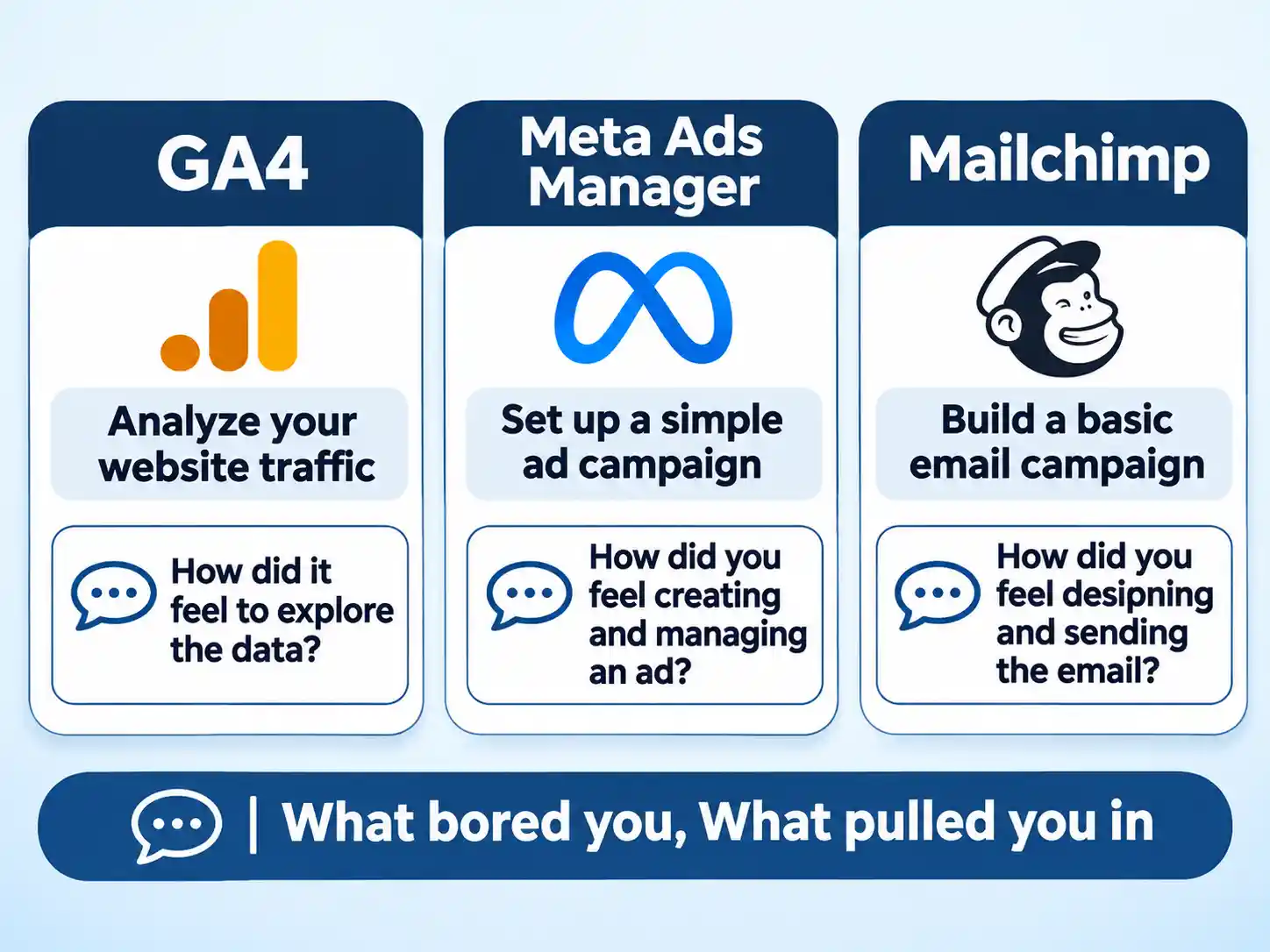
In Google Analytics 4, the honest test is whether watching real traffic register from your own visit feels satisfying. Enable enhanced measurement when you create the stream — it collects page views and common events automatically, and you can switch individual events off later. Set the property’s time zone before you start, because it affects how reports are dated, and leave it alone once you begin. Tracking setup rewards patience with settings.
In Meta Ads Manager, you can explore campaign structure, objectives, audience selection, placements, formats and reporting without spending anything. The platform surfaces an opportunity score that rates how optimised your campaigns, ad sets and ads are, plus recommendations to improve it. Treat that score as an interface feature to understand, and treat every platform-reported number as a channel signal that needs a business question attached.
In Mailchimp, plan access matters: some automation flow tools are not available on every plan, so check what your account includes before you plan a workflow. Build or preview a welcome flow, set the trigger to “signs up for email”, add a send action and use the test email function. If double opt-in is enabled, new contacts do not enter the flow until they confirm. Unconfirmed contacts never arrive. If a new contact never enters the flow, check the confirmation step before assuming the automation is broken.
Questions That Make an Interview Worth the Other Person’s Time
Forget “can I pick your brain”. A busy marketer will give you a short call if you ask something specific and answerable.
| Question | What it reveals |
|---|---|
| “What did your worst week in this job look like?” | The real stress pattern — deadline crunches, public criticism, metric accountability, or nothing unusual |
| “How is your bonus or pay review tied to metrics?” | Whether your income depends on numbers you control, and how much pressure sits under the reporting |
| “Which parts of the work are repetitive?” | The maintenance load you may be underestimating |
| “Who owns reporting and attribution on your team?” | Whether measurement is a shared burden or one specialist’s entire job |
| “What training actually helped you level up?” | Which learning routes returned value for someone doing the work now |
| “If you were switching in from another field, what would you test first?” | A practitioner’s shortlist, and a check on whether your sandbox was the right one |
Degree, Certificate, or Portfolio?
Formal study helps some switchers and slows others down. The deciding factor is what the job ads in your target market actually ask for, weighed against what your sandbox already proved.
| Route | Choose it when | Cost and time reality | Evidence needed first |
|---|---|---|---|
| Degree or graduate certificate | Target job ads consistently list a qualification, or you want structured feedback and a cohort | Highest cost and longest commitment; check employer recruiting patterns before paying | A completed sandbox plus multiple interviews pointing the same way |
| Short course or certificate | You need baseline vocabulary in analytics, paid search and email, and self-directed study keeps stalling | Moderate cost; value depends on whether you actually finish the work | A confirmed gap in your skill audit, not a general feeling of unpreparedness |
| Self-taught portfolio | Job ads emphasise demonstrable work and you can generate samples without client data | Lowest direct cost, highest self-discipline requirement | A few finished samples with a written note on what you would change |
If you are weighing a structured course, check what it actually requires you to finish before you pay for it. Then run the income check before you register for anything. Add up essential monthly expenses, such as phone, internet, minimum debt payments, childcare or family support, and compare that figure with your savings and any expected income during a transition. A low starting salary can be worth it with a plan and a runway. Without one, it is a second problem stacked on the first.
Check the Evidence Before You Decide
Verify the result
- Your evidence log holds dated entries across most of the five workstreams.
- A one-paragraph sandbox brief exists, and you published a small set of pieces or completed a round of iteration.
- Google Analytics reported your own visit in the Realtime report, confirming the tag fired.
- A test welcome email arrived in your inbox and you know whether double opt-in is switched on.
- You have notes from a few conversations with working marketers, each naming one task you did not expect.
- Your log names the role families worth pursuing and the one you are dropping, with a reason for each.
- An income stress test is written down: essential monthly costs, available savings, and the salary floor you can survive.
When the Test Goes Wrong
Almost nobody is reading, watching or subscribing
Low reach is the normal first result and an expected part of the lesson. Check the basics before you change the content: did you promote the thing to anyone at all, was the audience defined narrowly enough to describe in one sentence, and did the first line give a reason to continue? Change one variable per cycle so you can attribute the difference. If the silence makes you want to stop publishing entirely, that reaction belongs in the log — it is data about feedback tolerance.
Google Analytics shows no data at all
Work backwards through permissions and installation. Confirm you are signed into the correct Google account, that the data stream exists for the right URL, and that your role is Editor or above at property level. Copy the measurement ID from the stream details and paste it into your site builder’s Google Analytics field. If your builder has no integration field, the tag must be added through its custom HTML option. Then load the page yourself and check the real-time report.
The welcome email never sends
The usual suspects. Your plan may not include the automation tools the flow requires, so check plan access first. The flow may not be activated. Or double opt-in is enabled and the test contact has not confirmed, in which case they never enter the flow. Send a test email from inside the builder to test the message itself, and add a new contact to test the trigger.
Ad results look promising but you cannot tell what they mean
Small budgets produce small samples, and platform dashboards report on the platform’s own terms. Before you interpret anything, write down the business question the campaign was supposed to answer — a form fill, a sign-up, a reply. Then judge the report against that question. If the numbers stay ambiguous after a couple of cycles, you have learned something useful about how much you enjoy attribution puzzles, and that is the point of the lab.
Nobody is replying to your interview requests
Broad requests get ignored. Narrow the ask: name the role, name the specific question, ask for a short call, and offer to send questions in advance. Approach people one or two steps ahead of you rather than senior leaders. If a direct message goes unanswered, ask a second-degree contact for a warm introduction to a named person. A few conversations are enough to start; you do not need a network.
The income stress test fails
That is a stop signal, not a character flaw. If essential costs outrun your savings and the realistic starting salary, keep the day job and either extend the test or look at adjacent roles that pay closer to your current level from day one. A transition that puts you in financial danger is worth postponing until the runway exists.
Let the Evidence Choose the Next Move
At the end of the test window you have three honest options, and the log will point to one of them.
Continue with a deeper test if you finished the sandbox work without forcing yourself, the interviews described a week you could handle, the boring mechanics stayed tolerable, and the money maths works. Extend to a longer version: a beginner course, a few more portfolio samples, and applications to a handful of realistic entry roles.
Narrow to a related role if the tools interested you but the public-facing work drained you, or the writing thrilled you while the dashboards made you tired. SEO, email lifecycle and marketing operations sit closer to systems work; content and brand sit closer to craft. Either is a real marketing path.
Pause if the actual tasks repel you, the numbers frighten you into avoidance, or you noticed you were finding excuses to skip the work. Pausing costs nothing and protects both your income and your confidence.
If the evidence points forward, get specific about the roles and titles worth chasing. Browsing a current list of marketing careers helps you map your chosen role families onto job titles to research. From there, move into job search strategies for a career switch once your samples and notes are ready to show.
The whole test fits into evenings across a defined window. That is a small price for a decision you would otherwise make on a hunch, and a far cheaper one than a resignation you cannot undo.

💬 Comments