An injured person searching for a lawyer at 11 p.m. wants a name they can trust, an office within reach, and a human who answers. The firm that appears in the map results with recent reviews and picks up the phone usually gets the case.
That reality sets the order of work in 2026. Personal injury keywords can be expensive in Google Ads, and buying more traffic cannot rescue a firm that lets inquiries sit unanswered. The five steps below fix the cheapest leaks first, then add reach. Each one ends with a check you can run without a vendor report.
Quick Take
- Leads leaking? Fix intake first. Pouring traffic into a phone line nobody answers raises the cost of every lost case.
- Thin Google Business Profile? Claim it, verify it, and complete it before funding a broad paid campaign.
- High-value or complex claims? Build one real page per claim type before widening the keyword list.
- Publishing video? Make it answer post-accident questions, and tag the source at intake so you can see whether it produced a call.
- Unclear who approves ad copy? Name the reviewer and get counsel sign-off before any case result or specialty claim goes live.
Before Step 1: set the operating baseline
Five inputs decide whether the protocol holds. Write them into one document before you publish a page or raise a budget.
Prerequisites
- Target case types. Name the claims you want more of and the ones you will decline. A firm chasing traumatic brain injury work needs different pages and proof than one built on slip-and-fall volume.
- Service area. List the counties, cities, and courthouses you actually cover. City pages built outside that footprint create thin content and disappointed callers.
- Budget guardrails. Set a monthly cap per channel and a ceiling on cost per signed case. Lead volume alone says nothing about profit.
- Tracking baseline. Call tracking numbers, form source tags, CRM stages, and a “how did you hear about us” field that intake fills in every time.
- Two named owners. One person owns response times; another signs off on advertising copy. Neither role should sit with a committee.
Do one more thing before spending: confirm at least two people in the firm can access the Google Business Profile and the review response queue. Locked-out listings are a quiet, chronic problem.
| Channel | Best at | Speed to results | Main cost driver | Common failure |
|---|---|---|---|---|
| Local search and Google Business Profile | Capturing “near me” and city searches with visible proof | Slow, steady build over weeks | Staff time for reviews, photos, and listings | Unverified or half-filled profile |
| Paid search and Local Services Ads | Immediate high-intent demand | Same day | Click and lead costs in a crowded auction | Sending clicks to the homepage with no call tracking |
| Claim-specific pages | Complex, high-value claim searches | Slow, then compounding | Writing and review time per page | Near-duplicate pages with no local proof |
| Short-form video and social | Explaining process and showing the people behind the firm | Slow and hard to attribute | Production and compliance review time | Chasing view counts with no intake source tags |
A modest budget should fund two rows well, and intake should be working before either gets a dollar. Firms that spread a small budget across every channel usually end the year unable to say what worked.
Build the client-acquisition system in five ordered steps
Each step has a separate job, a separate trade-off, and a check you can run yourself. Work them in order, because later steps assume the earlier ones hold.
- Claim and complete the Google Business Profile.Verify the listing, set the primary category to Personal Injury Attorney, and add the subcategories that match your actual casework. Fill in hours, services, a plain-language description, and photos of the office, the team, and the entrance. A complete profile is a low-cost source of visibility, and it is also easy to leave half finished.
Reviews carry much of the weight inside the local map pack, often called the Local 3-Pack, and the pace of new reviews matters as much as the total count. Ask at case closing with a direct link, answer every review in ordinary language, and skip anything scripted or purchased. A steady trickle of recent reviews signals an active practice; a burst of old ones signals much less.
Then make the rest of the web agree. Keep the name, address, and phone identical on Google, Avvo, Yelp, Justia, and the bar directories your market uses. Build city pages only for places you practice, and give each one detail a resident can check: the courthouse, the trauma center, the interchange where crashes cluster.
Local search moves slower than paid search because it depends on staff habits. The trade is worth it, since reviews and a complete profile keep working after the ad budget stops.
Dense metros show the stakes. A firm chasing something like personal injury lawyer San Diego searches is competing against dozens of practices with the same category, the same suburbs, and similar review counts. Profile completeness, review recency, and genuine city pages often separate one listing from the next.
This article includes a paid placement.
To confirm the listing is healthy, search your main practice-area term with your city in a private window. Your listing should appear with the right category, the right hours, and recent reviews.
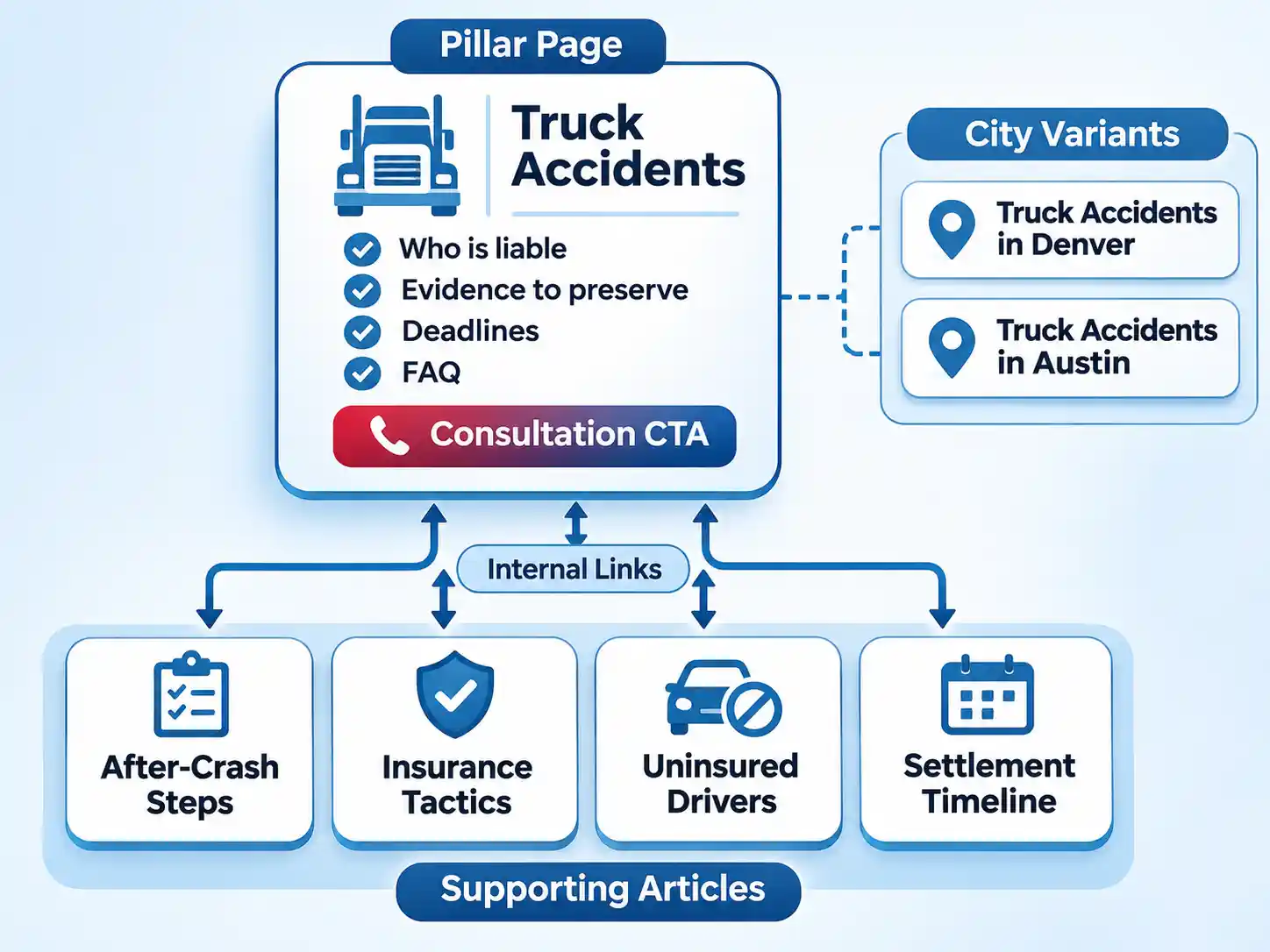
- Build one page per claim type, with real substance.Start with the claims that carry the most value or complexity: truck and commercial vehicle crashes, rideshare collisions, maritime and offshore injuries, rail accidents, construction site injuries, nursing home neglect, product liability, wrongful death. Each page should explain who can be liable, what evidence disappears fastest, and how the process differs from a simple two-car crash.
Support every main page with a cluster of shorter articles answering the questions intake hears each week. Link them to the main page and back again. Avoid generating city variants from a template, because a page that swaps a place name into identical copy reads as filler to search engines and to the person deciding whether to call.
Specificity pays in places with heavy transit traffic. Consider a reader searching for expert representation for train accident victims in NYC. That reader needs rail-specific answers: who can be liable, how quickly evidence must be preserved, and what reporting deadlines apply. A rail claim turns on carrier liability, injury reporting deadlines, and evidence held by the transit authority, and the page has to speak to that work.
Before you publish a new page, read it once as a stranger would and confirm it names the claim type, the counties you actually practice in, and a way to reach your intake team. A page that could describe any firm in any state is not finished.

- Publish short video that answers one question at a time.Pick the questions your intake team answers on repeat: whether to give a recorded statement, how gap insurance interacts with a claim, how to document injuries, what to bring to a consultation, how contingency fees work, what happens in the first weeks. One question per clip for TikTok, Reels, or the platform your clients actually use, with captions burned in, an attorney or paralegal on camera, and no outcome promises anywhere in the frame.
Consent and privacy are the hard limits. Client testimonials need written permission that covers the specific platform, and case results need the same counsel review as a printed ad. Any clip that names a client, shows a recognizable vehicle, or describes a settlement without context should not be published.
Treat social video as trust-building and referral amplification, which is often where the benefit shows up. A viewer rarely calls from the video; a neighbor who remembers your explanation might. To see whether it contributes, add a “how did you hear about us” field at intake, use a dedicated landing page for each campaign, and watch branded search volume alongside it.
Firms that want a steady cadence without pulling attorneys off casework often bring in a specialist TikTok marketing agency for production and scheduling, while keeping final approval in-house. Whoever shoots the footage, the firm owns the compliance decision. Confirm the source question is being tagged before you approve another production cycle.
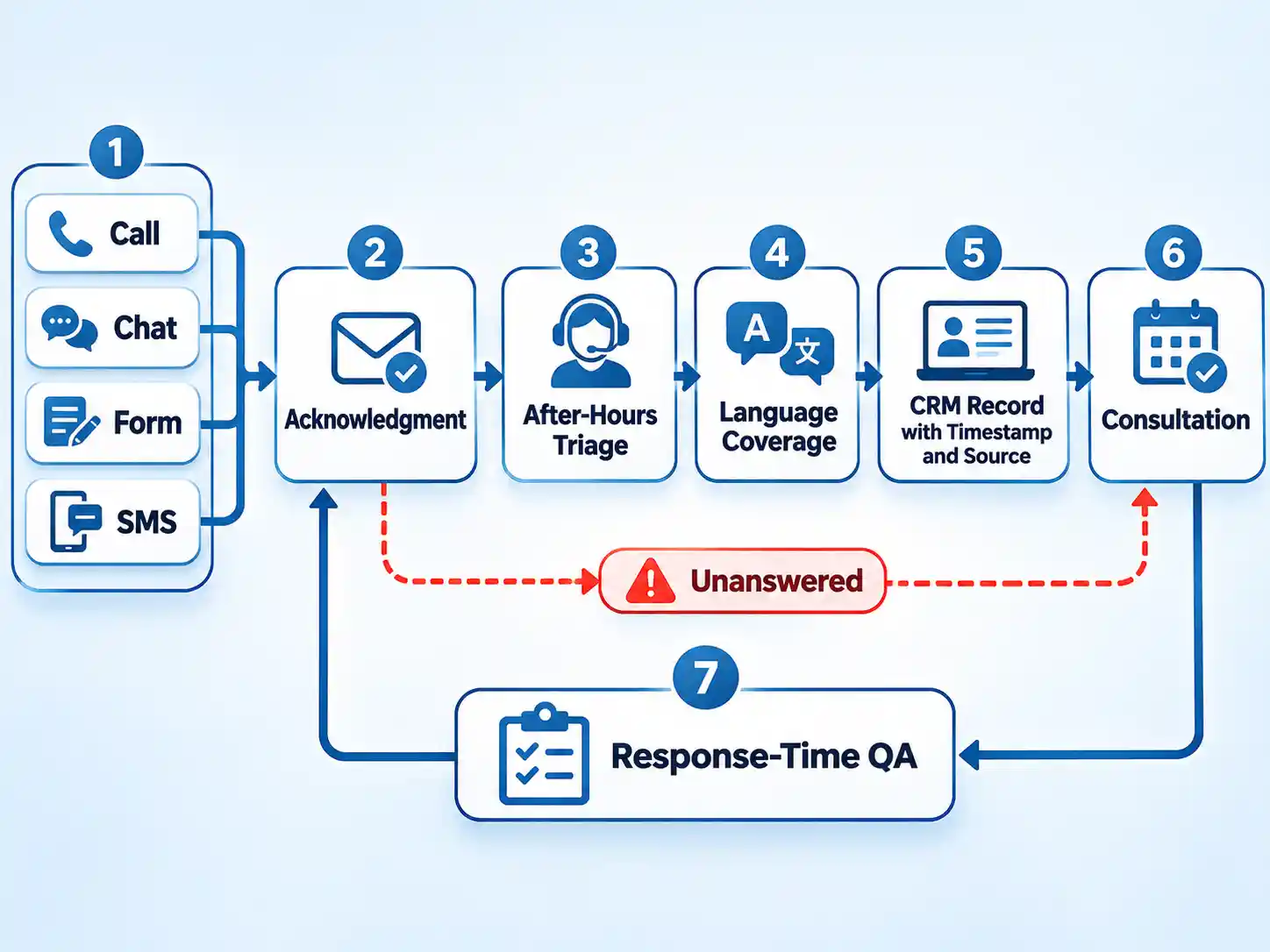
- Answer every inquiry fast, around the clock.Route calls to a live person or a trained answering service with a script for injury triage. Chat and SMS should acknowledge instantly and capture a callback number and a short description. Forms should trigger an immediate reply that sets an expectation, plus a human follow-up while the inquiry is still warm.
After-hours coverage is often where firms lose the night calls that turn into significant cases. Decide who handles 2 a.m. calls, add bilingual coverage, starting with Spanish if your market needs it, and give whoever answers the authority to book a consultation without waiting for approval. Every contact needs a CRM record with a timestamp, a source, and a next action.
Measure missed calls, abandonment on the phone tree, and time to first contact as recurring operating metrics. A firm that answers in minutes and logs the source can beat a firm with a larger budget and a voicemail box. Call your own office after hours and submit a form after dinner; what you experience is what your next client experiences.
- Run every asset through a compliance gate before it goes live.Attorney advertising rules vary by state, and they change. The ABA Model Rules of Professional Conduct address advertising through Rule 7.2, and state bars often add their own requirements on disclaimers, case results, testimonials, and specialization claims. Confirm which version your bar enforces with counsel before publishing anything in those areas.
Ask the same six questions of every page, video, and ad. Is each claim verifiable? Do case results carry the required context and disclaimer? Does each testimonial have written consent? Can the firm defend a word like specialist or expert under state rules? Are deadlines framed as general information? Is the piece identified as advertising where your jurisdiction requires it?
Keep a signed-off asset log with a name and a date for each approval, and re-review when the rules shift or you add a claim type. If a compliance question cannot be answered cleanly, pull the asset and escalate to the managing partner. A held page costs time; a bar complaint costs far more. Check the log before the next asset goes live.
Verify the system and recover when a step slips
Set a fast review rhythm for response times and a slower one for visibility and compliance. The fast check is response time and unanswered contacts, because that is where money disappears in a single night. The broader review covers visibility, page performance, review growth, and compliance sign-off.
Verify the result
- Every call and form in the latest review cycle carries a timestamped first response in the CRM.
- The Business Profile and the major legal directories show the same name, address, and phone number.
- Each claim-type page returns in a site search for your own domain and has its own traffic source tag.
- At least one new review arrived recently from a client who closed earlier.
- Video inquiries appear in the intake source field, not only in platform view counts.
- The compliance log lists a named reviewer and a date for every asset published recently.
When a number moves the wrong way, fix the cause before adding budget.
- Missed calls climbing: audit ring groups and after-hours coverage first. A larger ad budget makes this worse.
- Reviews flat: move the ask into the closing meeting and hand the client a direct link.
- Pages indexed but no calls: check the call button, the form, and the intake script before rewriting the copy.
- Video traffic without inquiries: the source field is missing from intake, so add it before judging the channel.
- Compliance flag on a live asset: pull it, log the reason, and re-review before it returns.
Pick one bottleneck and set a review date
Pick the one bottleneck you can name from your latest logs, change only that, and set a date to review the result. Write down the starting number, the action, the owner, and that review date. At the review, keep the change if the number moved and the compliance gate held; if it did not, fix the cause before adding budget.
Hold the compliance gate over whatever you change, and do not scale paid traffic until intake can answer what it already receives. The sequence is unglamorous and it compounds. If you would rather hand the build to an outside team, read our guide to working with a digital marketing company before you sign anything, then hold the firm to the same checks above.
Firms that win injury cases in 2026 tend to be the easiest to find and the fastest to answer, and they can prove both with a log.

💬 Comments