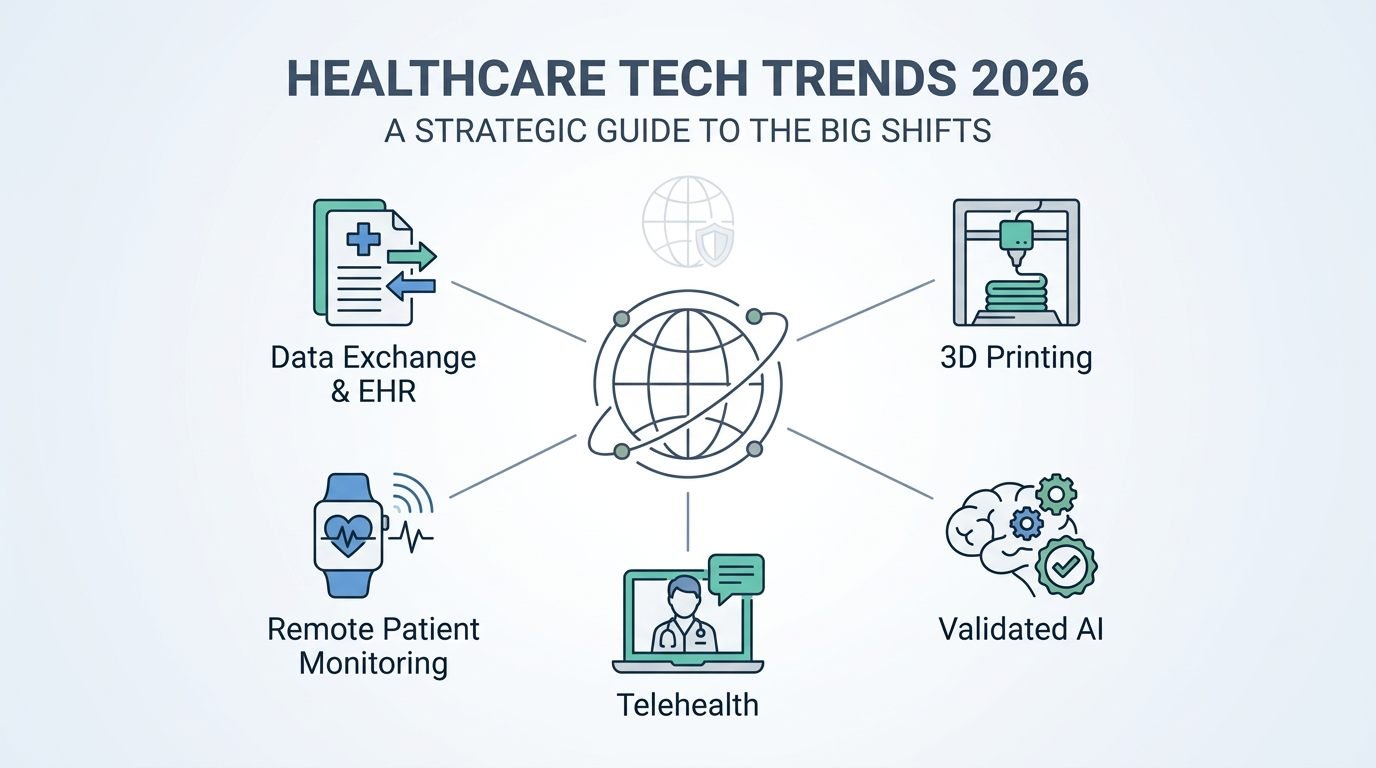
Healthcare technology isn’t “new,” but the pace of adoption is: digital health, data exchange, and automation are reshaping how care is delivered, documented, and monitored. This guide explains the biggest shifts happening now—and how to evaluate them without getting distracted by hype.
At the highest level, the World Health Organization frames digital health as the use of digital technologies to improve health and strengthen health systems, which is useful context for understanding why so many healthcare “tech trends” are really system redesign projects. WHO’s Global strategy on digital health (2020–2025) is a solid starting point for the big-picture view.
Quick take: what’s really changing (and why it matters)
- Care is becoming more distributed: more monitoring and touchpoints happen outside hospitals.
- Data is becoming the product: interoperability and governance determine what’s possible.
- AI is moving from demos to regulated workflows: the winners are the teams that validate, monitor, and manage risk.
A brief origin story (for perspective)
Modern healthcare technology has deep roots: for example, the Nobel Prize highlights Wilhelm Conrad Röntgen’s discovery of X-rays in 1895 as a foundational milestone for medical imaging. That single breakthrough is a good reminder that healthcare tech becomes valuable when it changes clinical decision-making, not just when it looks impressive. NobelPrize.org’s Röntgen facts page covers the historical context.
1) Medical records are shifting from “digital storage” to “exchange networks”
Electronic records (EMRs/EHRs) are no longer just about replacing paper—they’re about moving information across organizations so clinicians, patients, and payers can act on a fuller picture. The hard part is not “having an EHR,” it’s interoperability, identity matching, consent, and data quality.
In the U.S., one concrete example of the interoperability push is the Trusted Exchange Framework and Common Agreement (TEFCA), led by ONC, which aims to support secure health information exchange across networks. If your audience is U.S.-based, use ONC’s official TEFCA overview as your reference point.
Internal process tip: if your team struggles with data hygiene, revisit effective data management basics before you invest in new tooling.
Practical readiness checks
- Define “source of truth”: which system owns demographics, meds, allergies, problem lists.
- Measure the workflow cost: who clicks, who documents, and what slows clinicians down.
- Plan for downtime: include read-only and offline processes (this is operational, not optional).
2) Remote patient monitoring (RPM) is becoming a normal care extension
Remote monitoring and connected devices can help clinicians track trends between visits for selected conditions and patients. The opportunity is earlier intervention and fewer unnecessary in-person touchpoints; the risk is alert fatigue, low adherence, and data that isn’t clinically actionable.
If you’re building out a content cluster, link your existing explainer on telemedicine and remote patient monitoring and update it with a 2026 “what to pilot first” section.
How to verify before adopting RPM
- Clinical protocol: what action will you take when thresholds are exceeded?
- Data quality: how do you handle missing readings, device errors, and patient misuse?
- Ownership: who responds—nurses, care coordinators, or physicians?
3) Telehealth is stabilizing—but policy and scope still change
Telehealth is now a permanent channel for many organizations, but the rules around coverage, practitioner eligibility, and patient location can be time-bound and region-specific. That means telehealth strategy should be built like a product: clear use cases, defined escalation to in-person care, and compliance monitoring.
For U.S. readers, CMS publishes a detailed and time-bound view of Medicare telehealth conditions in its CY 2026 Telehealth FAQ. Use CMS’s Telehealth FAQ (CY 2026) as a primary source when you mention Medicare-related telehealth constraints.
To deepen topical authority on your site, connect this section to how technology transformed healthcare systems (and refresh that piece with post-2024 realities).
Telehealth readiness checklist
- Triage rules: what is telehealth-appropriate vs. must-be-in-person.
- Identity and documentation: avoid “two systems” documentation work.
- Fallback plan: what happens when video fails (phone, reschedule, in-person).
4) AI/ML in healthcare is moving from “automation” to “risk-managed clinical software”
AI in healthcare often starts with admin automation (scheduling, documentation helpers, coding support), then expands into decision support and imaging analysis. The strategic shift is that AI isn’t just an IT project—it’s a lifecycle responsibility: data quality, monitoring, bias checks, and change management.
For an official baseline on safe development practices, the FDA publishes Good Machine Learning Practice (GMLP) guiding principles for medical device development, which is a helpful anchor when discussing validation and quality in AI-enabled tools.
Internal learning path: if your readers need foundational context, point them to how to learn artificial intelligence and then bring them back to healthcare-specific governance.
How to evaluate AI in practice (buyer questions)
- Intended use: what exact task does it support, and what does it explicitly not do?
- Evidence: what data was it trained/validated on, and how close is it to your population?
- Monitoring: how do you detect performance drift after deployment?
5) 3D printing is expanding from prototypes to regulated medical devices
3D printing (additive manufacturing) in healthcare spans models for surgical planning, patient-matched components, and device manufacturing workflows. The key 2026 trend is maturity: more emphasis on validation, materials, repeatability, and quality systems—not just “we can print it.”
For a high-authority, non-hype explanation, the FDA’s guidance on technical considerations for additive manufactured (3D-printed) medical devices outlines what manufacturers should consider (design, testing, characterization).
How to verify a 3D printing claim
- Regulatory pathway: is it a prototype, a tool, or a patient-contacting device?
- Material safety: sterilization, biocompatibility, and traceability.
- Repeatability: can you produce the same results reliably across builds?
6) Robotics, automation, and “non-clinical AI” are changing hospital operations
Not all healthcare tech is clinical. Logistics automation (inventory, routing, delivery), documentation assistance, and patient communication tools can reduce friction—if they fit real workflows.
Where this goes wrong: automation layered on top of broken processes. If a tool adds more alerts, more clicks, or more handoffs, it can decrease quality even if the feature list looks strong.
7) Biometrics and security are becoming healthcare’s “default constraint”
Biometrics (like facial recognition) and stronger access controls are increasingly discussed because healthcare data is sensitive and widely targeted. The practical point for readers: tech adoption must include security requirements up front, not as a retrofit.
If you cover identity tech on your site, link this section once to the basics of facial recognition technology and keep the healthcare angle focused on governance and risk.
For a broader security hub, you can also route readers to your security category without overloading this page with cybersecurity detail.
Practical readiness guide (for leaders and implementers)
- Start with a use case, not a tool: write the “before vs after” workflow in plain language.
- Measure what matters: time-to-document, time-to-triage, missed follow-ups, patient drop-off.
- Govern data: interoperability, quality, retention, access control, audit trails.
- Pilot with constraints: one clinic, one service line, one patient cohort.
- Plan for failure modes: downtime, false positives, alert fatigue, staffing gaps.
FAQ
Is “digital health” just telehealth?
No. Telehealth is one channel, while digital health includes data exchange, monitoring, analytics, and software-enabled workflows across the health system.
What trend usually has the fastest ROI?
Workflow improvements that reduce friction (documentation, scheduling, coordination) often show benefits sooner than clinical AI, because they’re easier to deploy and validate.
What should we be most skeptical about?
Any vendor claim that skips evidence, ignores integration work, or implies “plug-and-play” change in a complex clinical workflow.
Final note
This article is designed as a trend explainer with practical checks, not medical advice. For any technology that affects diagnosis or treatment, validate it with clinicians, compliance, and your local regulatory requirements before rolling it out.

💬 Comments