The strongest career fields in IT right now, by 2025 U.S. Bureau of Labor Statistics pay and growth data, are cybersecurity, cloud computing, data science and AI/ML, software development, web development, and IT support. Which one is “best” depends on which number you’re optimizing for: pay, growth rate, or how fast you can start earning. No single field wins on all three.
Picking a lane on pay alone is a common mistake. A field can look great on a salary chart and still be a bad long-term bet if demand for it is flattening, and a field can look unglamorous and still be the fastest way into the industry. The comparisons below use verified 2025 BLS wage and growth figures for each field, plus the realistic downsides that most “best IT careers” roundups skip, so you can weigh pay against growth against entry difficulty instead of just chasing whichever number is biggest.
Quick Take
Tech occupations broadly are forecast to grow at roughly twice the rate of the overall U.S. job market in 2026, according to CompTIA’s 2026 workforce data, adding an estimated 128,000 net tech jobs a year on top of normal replacement hiring. Within that growth, cybersecurity currently offers the strongest combined pay-and-growth profile among the classic IT fields, data science has the fastest projected growth of any field on this list, and software development still pays the most in raw dollars and has by far the largest number of annual openings. IT support is the one field here with a genuinely mixed outlook. It’s still a real entry point into the industry, but not one to plan a 20-year career around without a path upward.
Cybersecurity
Cybersecurity work covers a wider range than “hacking” implies: security operations center (SOC) monitoring, incident response, vulnerability management, application security reviews, and governance/risk/compliance (GRC) work that has almost nothing to do with writing exploit code. Most analysts specialize into one of those lanes within a year or two rather than doing all of them.
According to the BLS Occupational Outlook Handbook, information security analysts earned a median wage of $129,180 in 2025, and the occupation is projected to grow 21% from 2025 to 2035, which BLS itself frames as “much faster than average,” with roughly 14,100 openings projected each year. That’s the strongest growth-plus-pay combination of any of the long-established IT fields covered here.
The trade-off is real operational stress. Incident response doesn’t run on business hours; a live breach means you’re working it now, not scheduling it for next sprint. Entry credentials like CompTIA Security+ get you in the door, but the credentials that unlock senior pay (CISSP, for one) require years of documented experience before you can even sit the exam, so the ramp to top-tier pay is longer than the entry point suggests. Companies further along their cloud migration also expect security staff to understand cloud-native environments specifically, not just traditional network perimeters. The core security management practices haven’t changed, but where they get applied has, and interviewers increasingly probe for that distinction directly rather than taking a certification list at face value. Given how many specializations now sit under the “cybersecurity” umbrella, from GRC to offensive security, picking one deliberately matters more than collecting generalist knowledge across all of them. The current opportunities across cybersecurity specializations are worth a closer look before you commit to a track.
This field fits people who can stay calm during a live incident and don’t mind that “done” is a moving target, since new vulnerabilities don’t stop appearing because you patched last week’s batch. It’s a poor fit if you want predictable hours or a field where the required certifications stop accumulating once you’re established.
The most common mistake newcomers make is jumping straight to CISSP prep or an expensive boot camp before proving basic fundamentals. A home lab, a CompTIA Security+ certification, and a handful of documented writeups from a platform like TryHackMe tend to get a candidate further in first-round interviews than a stack of unfinished course certificates, because they demonstrate hands-on troubleshooting rather than passive study.
Cloud Computing
Cloud computing work today means designing, migrating, and operating the infrastructure a business actually runs on, not a one-time “move it to AWS” project. A typical week might involve right-sizing a Kubernetes cluster to cut cost, writing infrastructure-as-code in Terraform, and figuring out why a workload that ran fine last month just started hitting a provider rate limit.
There isn’t yet a dedicated BLS category called “cloud engineer,” so the closest official read is computer network architects, who had a 2025 median wage of $134,050 and are projected to grow 8% through 2035, with BLS explicitly naming continued cloud adoption as a driver of that demand. It’s an imperfect proxy, since the occupation also covers traditional on-premises network design, but it’s the most honest official figure available for infrastructure-heavy cloud roles today.
Enterprise teams running distributed applications increasingly manage traffic, retries, and service-to-service security with service mesh products, which has become one more expected line item on cloud job postings, layered on top of core AWS, Azure, or Google Cloud skills. Businesses shifting operations to the cloud are usually doing it as part of a broader digital transformation effort, not a standalone IT project, which is why cloud roles increasingly overlap with automation and release-engineering work. That overlap shows up directly in job postings, not just in theory: a growing share of “cloud engineer” listings now name scripting and pipeline experience as a requirement rather than a nice-to-have. Employers further along that curve tend to want candidates who also understand DevOps practices like CI/CD pipelines and infrastructure automation, not cloud administration in isolation.
The trade-off is a certification treadmill that never fully stops. AWS alone runs more than a dozen credential tracks, and staying credible generally means recertifying every two to three years while the underlying services keep changing under you. Once you’re past entry level, on-call rotations for production infrastructure are standard. A 3 a.m. page for a failed deployment isn’t a hypothetical; it’s a Tuesday. This field suits people who enjoy systems-level thinking and don’t mind reading vendor documentation for fun. It’s a bad fit if you want your day-to-day toolset to stabilize. The realistic starting point is a single foundational certification, AWS Cloud Practitioner or the Azure or Google Cloud equivalent, paired with a small self-built project that actually deploys and tears down real infrastructure, not a slide deck explaining what the cloud is.
Data Science & AI/ML
Data science work is less about building flashy models and more about turning a messy business question into something measurable: cleaning inconsistent data, deciding which metric actually answers the question being asked, and building a pipeline that keeps working after the person who wrote it moves teams. AI/ML engineering roles overlap heavily with this field but lean more toward productionizing models than analyzing them.
Per the BLS Occupational Outlook Handbook for data scientists, the 2025 median wage was $120,230, with the occupation projected to grow 35% from 2025 to 2035, the fastest growth rate of any field on this list, with about 24,800 openings projected per year. That growth lines up with the wider AI hiring surge CompTIA tracked in its 2026 workforce data, where active job postings referencing AI skills topped 275,000 in January alone and dedicated AI engineering roles grew 81% year over year, even though those roles are still a small slice of total tech hiring.
The prerequisite most “learn data science in 12 weeks” pitches gloss over is real statistics and math fluency. You can’t bootcamp your way around understanding what a p-value actually means if you want to be trusted with decisions that affect revenue. There’s also a named failure mode worth knowing before you commit: title inflation is rampant in this field right now, and plenty of postings labeled “data scientist” are really entry-level data analyst work with a fancier title attached, which can make the field look more accessible, and more lucrative, at the entry level than it actually is. If you’re mapping out how to build toward the roles that match the BLS numbers above rather than the inflated job titles, a structured data science career roadmap is worth working from before you start applying.
This field fits people who like translating ambiguity into something quantifiable and don’t mind a heavier academic on-ramp than most IT fields require, coursework demanding enough that plenty of students preparing for it lean on a cheap essay writing service to stay on top of the writing load during the heaviest statistics and methods terms. It’s a poor fit if you want to skip the statistics foundation and go straight to shipping models. A portfolio built on messy, real-world data, a government open dataset or a local business’s actual records, tends to stand out more in hiring conversations than another cleaned-up Kaggle notebook, since it proves you can handle the unglamorous data-cleaning work that makes up most of the job.
Software & App Development
Almost every company past a certain size ships some kind of application now, whether that’s a customer-facing mobile app, an internal tool, or an API other teams build on. Day-to-day work ranges from feature development and code review to the less glamorous reality of maintaining and debugging code someone else wrote three years ago.
The BLS handbook entry for software developers puts the 2025 median wage for software developers specifically at $135,980, the highest raw figure of any field in this article, with 10% projected growth through 2035 and roughly 106,100 combined annual openings across software developers, QA analysts, and testers. That opening volume alone makes this the largest single field covered here.
The honest downside: entry-level hiring has gotten harder to break into, and it’s a live, unsettled debate rather than a solved question. Some engineering leaders report leaning on AI pair-programming tools to handle work that used to go to junior developers, which would compress entry-level headcount if the trend holds broadly. The extent of that shift, and whether it’s permanent, is still being argued out across the industry rather than confirmed. What hasn’t changed is the interview process itself: algorithmic coding interviews remain standard at most mid-size and large employers, and they test a different skill than the day-to-day job does. If you’re choosing where to start, picking an accessible first language matters less than picking one and building real projects with it, since the language itself rarely determines whether you get hired.
This field fits people who like building things incrementally and can tolerate ambiguous, underspecified requirements turning into a spec as they go. It’s a bad fit if you want stable, unchanging tools, since frameworks and best practices in this field turn over faster than almost anywhere else in IT. A small number of complete, deployed personal projects with real, if small, user bases demonstrates more to a hiring manager than a longer list of certificates; most interviewers say project completion and code quality matter more than which specific language or framework was used to build it.
Web Design & Development
Web design and development covers a spectrum from front-end interface work to full-stack application building to accessibility-focused specialization, and the pay and demand differ meaningfully depending on where on that spectrum someone sits. A front-end generalist building marketing sites competes with a much larger, more commoditized talent pool than a specialist who understands performance optimization or accessibility compliance.
The BLS handbook entry for web developers reports a combined 2025 median wage of $99,520 for web developers and digital designers (web developers specifically at $92,650, digital designers at $104,000), with 5% projected growth through 2035 and about 13,600 annual openings: solid, but the slowest growth rate of any field covered in this article.
The trade-off is commoditization at the entry level. No-code and low-code site builders have absorbed a real share of the basic “build me a business website” work that used to go to junior freelancers, which pushes newcomers toward specialization faster than in most other IT fields. Building sites that meet real accessibility guidelines is one of the clearer ways to differentiate, since it’s a genuine legal and business requirement for many organizations, not a nice-to-have, and it’s an area where a lot of developers still have real gaps. Freelance income in this field also tends to be volatile month to month in a way salaried roles in other IT fields generally aren’t.
This field fits people who want a faster, less credential-heavy on-ramp than data science or cybersecurity typically require, and who enjoy work that sits at the intersection of visual design and logical structure. It’s a weaker fit if you want to stay generalist indefinitely, since the generalist end of this market is exactly where the pay pressure is strongest. Picking one differentiator early, accessibility work, performance optimization, or deep expertise in a specific platform like Shopify or WordPress, tends to matter more for long-term pay than broadening general skills further.
IT Support
IT support covers help desk work, hardware/software troubleshooting, user account administration, and network support: the roles most people picture when they imagine “the IT department.” It’s also the field where the honest 2025 data tells a different story than most “best IT careers” content lets on.
Per the BLS handbook entry for support specialists, the 2025 median wage for computer support specialists overall was $62,890 ($61,860 for user support specifically, $76,220 for network support specifically). Overall employment in this occupation is projected to decline 3% from 2025 to 2035, driven by automation and outsourcing, though network support specialists specifically are projected to grow 1%. The roughly 48,700 annual openings BLS projects are driven almost entirely by replacement demand, meaning people leaving the field or retiring, not by the occupation actually growing.
That’s not a reason to avoid it. It remains one of the lowest-barrier entry points into IT (many cybersecurity, cloud, and network engineering professionals started at a help desk), and a high school diploma plus a relevant certification (CompTIA A+ is the common starting point) is often enough to get hired. Read as a first job with a deliberate help desk career path into a growing specialty, this role can be a genuinely smart on-ramp. Read as a 20-year destination, the numbers above say otherwise for most people in the role. Which certification to chase next depends on the target: Security+ if cybersecurity is the goal, a cloud provider’s associate-level certification if that’s the direction, CCNA if networking specifically appeals. Picking one in the first 90 days on the job, rather than drifting, is what actually shortens the time to the next role.
This field fits people who need the fastest possible entry into paid IT work and are willing to treat the first role as a stepping stone rather than a final stop. It’s a poor fit if you’re looking for a field with strong long-term growth on its own merits.
How to Choose Between These Fields
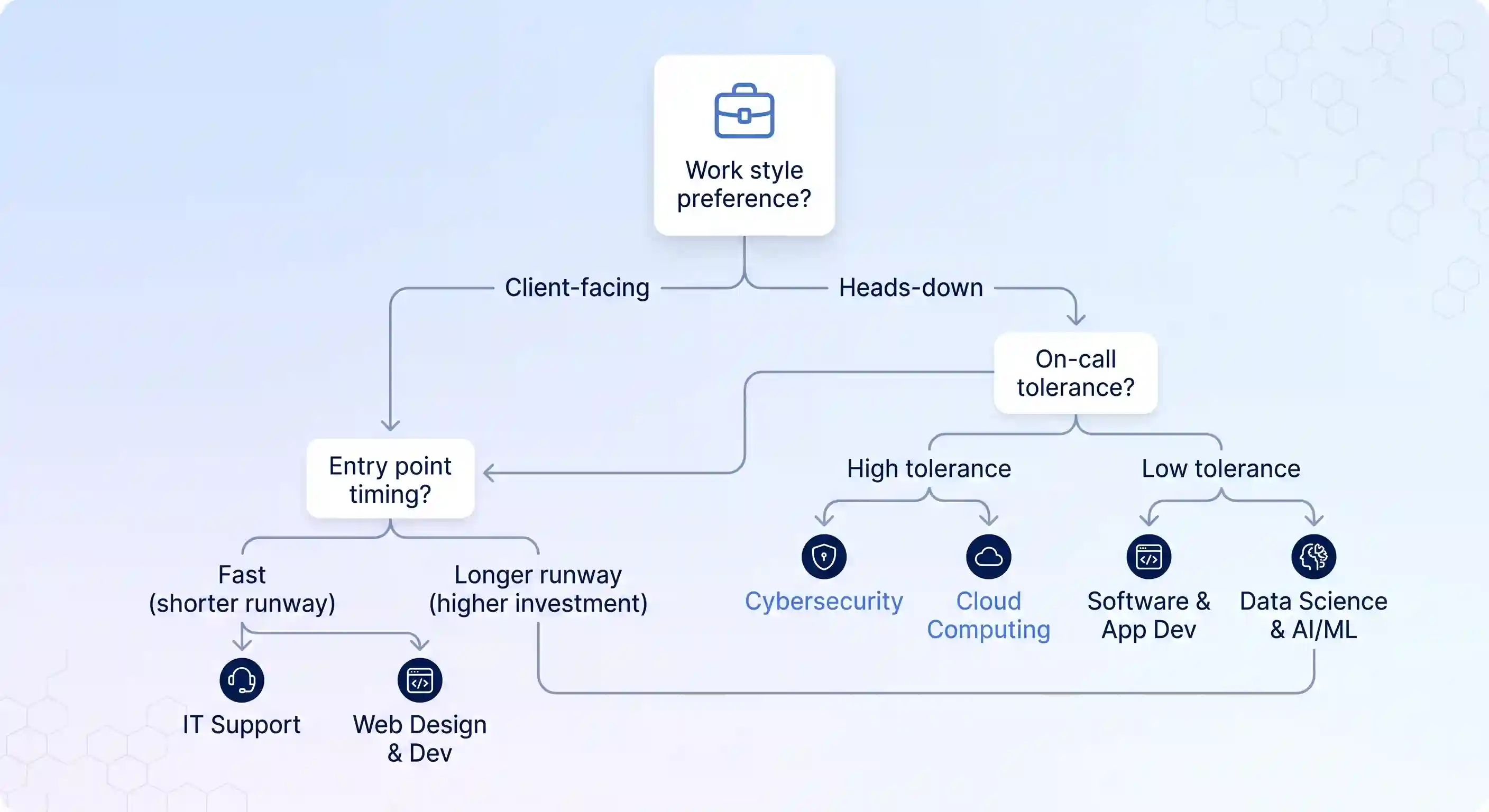
Pay and growth numbers only get you part of the way to a decision. A few practical questions narrow it further: Do you want client-facing or heads-down work? Cybersecurity and IT support involve more stakeholder interaction than most cloud or data science roles. Can you tolerate being on-call? Cloud and cybersecurity both carry real production and incident-response responsibilities; web development and data science, less so as a baseline. Do you need a fast entry point, or can you invest in a longer runway before your first paycheck in the field? IT support and web development have the shortest ramps; data science and cybersecurity’s senior credentials have the longest.
Two mistakes show up constantly in how people pick a field. The first is optimizing for whichever field currently tops a “highest paying jobs” list without checking its growth trajectory, which is how someone ends up training for a shrinking niche because it paid well the year they looked it up. The second is assuming a coding-heavy field automatically pays more than a non-coding one. The table below shows that isn’t consistently true: cybersecurity and cloud computing both pay competitively with software development while involving less continuous, from-scratch coding than a software engineering role typically does.
| Field | 2025 Median Pay (BLS) | 2025–2035 Growth (BLS) | Typical Entry Education | Best Fit If You… |
|---|---|---|---|---|
| Cybersecurity | $129,180 | +21% | Bachelor’s degree (some entry roles accept certs + experience) | Want strong pay and growth, can handle live-incident stress |
| Cloud Computing | $134,050 (network architects, closest proxy) | +8% | Bachelor’s degree | Like infrastructure-level systems work and ongoing recertification |
| Data Science & AI/ML | $120,230 | +35% | Bachelor’s degree, usually in a quantitative field | Are comfortable with statistics and want the fastest-growing field here |
| Software & App Development | $135,980 | +10% | Bachelor’s degree | Want the highest raw pay and the most open roles |
| Web Design & Development | $99,520 | +5% | Ranges from high school diploma to bachelor’s degree | Want a faster, less credential-heavy entry point |
| IT Support | $62,890 overall ($76,220 network support) | -3% overall (+1% network support) | High school diploma plus certification, up to associate’s degree | Need the fastest possible entry and plan to move up, not stay |
If none of these six quite fit, meaning you like tech but genuinely dislike coding, infrastructure work, and analyst-style data work in roughly equal measure, it’s worth knowing the field doesn’t require picking one of these six specifically. Plenty of viable tech careers, like product management, run on stakeholder communication and prioritization rather than any of the technical skills covered above, and succeeding without a coding background is more realistic in those roles than most people assume.
Key Takeaways
- Cybersecurity currently offers the strongest combined pay-and-growth profile among the long-established IT fields: a $129,180 median wage and 21% projected growth through 2035, per BLS.
- Data science and AI/ML have the fastest projected growth of any field covered here (35% through 2035), but the statistics and math prerequisite is real and can’t be skipped with a short bootcamp.
- Software development pays the most in raw dollars ($135,980 median) and has by far the largest number of annual openings (about 106,100), making it the highest-volume field on this list.
- IT support’s overall demand is flat-to-declining (-3% projected through 2035) once you separate it from network support specifically (+1%). Treat it as an entry ramp into IT, not a long-term destination.
- Cloud computing’s growth is explicitly tied by BLS to continued enterprise cloud adoption, but the certification treadmill and on-call responsibilities never really let up.
- How much code you’ll actually write varies more by specialization within a field than it does between fields, so don’t rule a field out solely because you assume it’s coding-heavy or coding-free.
FAQ
Which IT field pays the most without a four-year degree?
IT support offers the clearest path in without a bachelor’s degree. BLS notes a high school diploma plus relevant certifications (commonly CompTIA A+) is often enough for entry-level roles, and network support specifically pays a $76,220 median, well above general user support. Cybersecurity is the next most realistic option: some employers will hire analysts with a CompTIA Security+ certification and relevant experience in place of a degree, though this varies significantly by employer and tends to cap out lower than degree-holding peers until you build a track record.
Do all IT jobs require heavy coding?
No, and the amount varies more than most career guides suggest. Software and app development, plus data science, involve coding as the core daily activity. Cloud computing and cybersecurity involve scripting and automation regularly, but rarely software engineering from scratch. Web development sits in between depending on specialization. IT support requires minimal coding day-to-day. Roles like product management sit outside this spectrum almost entirely, trading code for stakeholder communication and prioritization work instead.
Can you switch between these fields later, or do you have to commit to one?
Lateral moves are common, and some pairings are far easier than others. Cloud computing and cybersecurity share enough infrastructure knowledge that moving between them mid-career is fairly standard. Going from software development into data science usually means adding statistics coursework on top of coding skills you already have, not starting over. The harder jump is into cybersecurity or data science directly from IT support or web development without first picking up the credential or academic groundwork each field expects, which is exactly why the entry-path details above matter more than the six-way comparison alone.

💬 Comments