Growing Threat of AI-Driven Cyberattacks on Businesses
Artificial intelligence is making many cyberattacks faster, more scalable, and more convincing rather than replacing human attackers entirely. Businesses now have to manage both AI-enhanced versions of familiar threats such as phishing and malware and newer risks created by the AI systems they deploy themselves.
Quick Take: What Is Actually Changing?
AI-driven cyberattacks are best understood as attacks in which artificial intelligence materially helps an attacker research targets, create convincing content, automate tasks, manipulate identities, write or modify code, or operate malicious tools.
That does not mean every attack is autonomous. In many cases, AI works as a force multiplier for techniques that already existed.
The UK’s National Cyber Security Centre assessment found that AI was already improving reconnaissance and social engineering and lowering barriers for less-skilled attackers. It also cautioned that sophisticated malware development and exploitation continued to depend heavily on human expertise.
For businesses, the practical changes include:
- More convincing phishing messages that contain fewer obvious writing mistakes.
- Faster research into employees, suppliers, technologies, and exposed systems.
- AI-generated voices, images, and video used for impersonation and fraud.
- Greater automation of repetitive parts of cyberattack campaigns.
- AI assistance with coding, malware development, and vulnerability research.
- New attack surfaces involving enterprise chatbots, AI agents, models, data, and connected tools.
The important distinction is between an attacker using AI to improve an ordinary cyberattack and an attacker directly targeting or embedding AI within a malicious system.
How AI Changes the Cyberattack Lifecycle
A cyberattack normally involves several stages, from identifying a target to obtaining access and eventually stealing information, committing fraud, or disrupting systems. AI can assist at multiple points in that sequence.
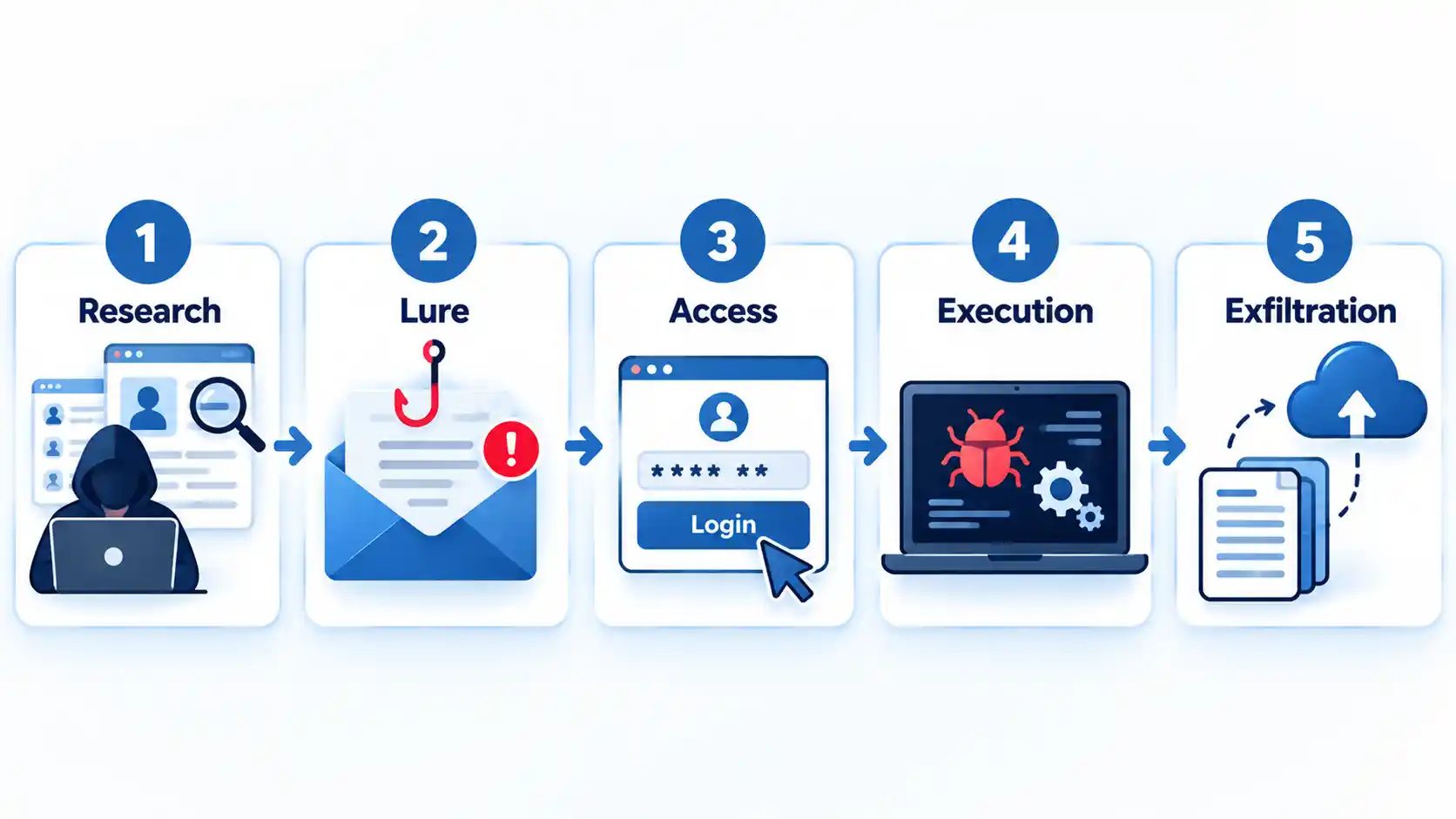
Reconnaissance and target selection
Reconnaissance is the process of collecting information about a potential target before an attack. Attackers may study company websites, employee profiles, job listings, leaked credentials, software documentation, domain records, or public announcements.
AI can speed up this work by summarizing large amounts of public information and helping an attacker identify useful relationships, technologies, job roles, or likely access points.
For example, a criminal preparing an invoice-fraud campaign could use public information to identify people working in finance, determine who appears to approve payments, study current suppliers, and produce messages tailored to each employee.
AI does not automatically discover an unknown security flaw simply because it can process information quickly. Finding and exploiting difficult vulnerabilities still requires technical knowledge, suitable data, access, and testing.
Phishing and social engineering
Social engineering means manipulating a person into revealing information or performing an action that benefits an attacker. Phishing is one common form and may arrive through email, text message, social media, voice calls, or collaboration platforms.
Generative AI can produce polished messages quickly, translate them into different languages, vary wording across thousands of targets, and imitate the tone of a business conversation.
The traditional advice to look for spelling mistakes is therefore less dependable.
The European Union Agency for Cybersecurity reported in its 2025 threat landscape that phishing, including related techniques such as vishing and malicious advertising, remained a major initial intrusion method across the incidents it analyzed.
Businesses should consequently focus less on whether a message “looks professional” and more on whether the request, sender, destination, and authorization process are legitimate.
Malware and attack execution
Attackers can also use AI for scripting, debugging, code translation, malware modification, and research into security controls.
An important distinction is that malware written with AI assistance is not automatically “AI malware.” The malicious program may operate exactly like conventional malware after it is deployed.
A newer category contains AI functionality within the attack itself.
Google Threat Intelligence Group reported in November 2025 that it had observed a shift from adversaries mainly using AI for productivity toward the deployment of AI-enabled malware in active operations, including tools capable of altering aspects of their behavior during execution.
Such findings matter because they suggest that AI use is beginning to move deeper into the technical operation of some malicious tools. They should not, however, be interpreted as evidence that most malware is now autonomous or AI-powered.
The AI-Enabled Attacks Businesses Are Most Likely to Encounter
The most immediate business threats remain recognizable. AI changes how efficiently attackers can prepare, personalize, automate, or disguise them.
The following table separates the underlying attack from the role AI may play.
| Threat | What AI Changes | Typical Business Target | Useful Control |
|---|---|---|---|
| Spear phishing | Faster personalization, translation, and message variation | Employees with account or system access | Strong authentication and independent verification |
| Deepfake and voice fraud | More realistic impersonation of executives, suppliers, or colleagues | Finance, HR, executives, customer support | Out-of-band identity checks and approval procedures |
| Credential theft | More convincing login lures and impersonation | Email, cloud, VPN, and SaaS accounts | Phishing-resistant MFA where practical |
| Malware and ransomware support | Assistance with reconnaissance, scripting, coding, and adaptation | Endpoints, servers, cloud systems | Patching, endpoint controls, segmentation, backups |
| Synthetic identity fraud | Generation of believable text, images, voice, or identity artifacts | Recruitment, finance, onboarding, support processes | Layered identity and transaction verification |
| AI-system exploitation | Creates attack opportunities involving prompts, models, training data, and connected tools | Chatbots, agents, internal AI applications | AI-specific access controls, testing, monitoring, and governance |
Not every entry in this table represents a network intrusion. Deepfake payment fraud, for example, may succeed by deceiving an employee without compromising a company server.
That distinction matters for incident planning because fraud prevention, identity verification, endpoint security, and network defense solve different parts of the problem.
A Second Risk: Attackers Can Target the AI Systems Themselves
Businesses increasingly use AI systems that can read internal documents, answer customer questions, generate code, search databases, send messages, or trigger other software tools. Once an AI system receives access to valuable information or actions, it becomes part of the organization’s attack surface.
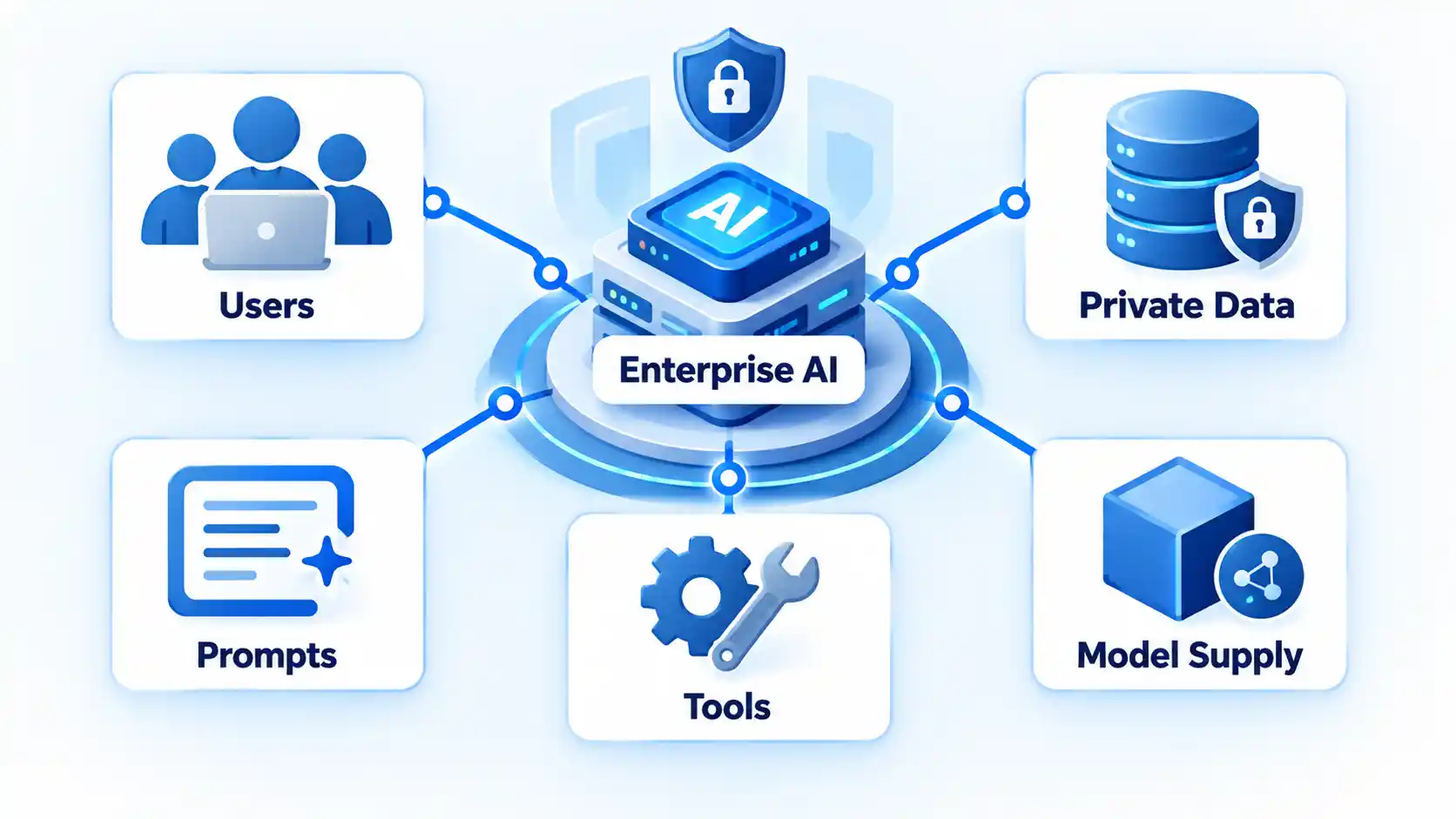
The National Institute of Standards and Technology describes several classes of adversarial machine-learning attacks, including poisoning, evasion, privacy attacks, and misuse of generative AI systems.
For business users, several concepts are particularly important.
Prompt injection occurs when malicious instructions influence an AI system through the content it processes. Those instructions may be entered directly by a user or hidden inside external material the AI reads.
Data poisoning involves manipulating data used to train, fine-tune, or otherwise influence a model so that its behavior becomes unreliable or malicious under certain conditions.
Model or supply-chain manipulation can involve compromised models, dependencies, datasets, or other components used to build an AI application.
Excessive agent permissions create another risk. An AI assistant that can only summarize documents has a very different impact if manipulated than an AI agent that can also send email, delete files, change customer records, or execute software.
Imagine an internal AI agent that reads a web page and then takes actions in a connected business application. If hostile instructions embedded in the page can influence the agent and the agent has broad permissions, the security problem is no longer limited to generating a bad answer.
Prompt injection should not be confused with SQL injection. Both involve malicious input, but the mechanisms, affected systems, and defensive techniques differ.
Why AI-Enhanced Attacks Are Harder to Recognize
Many traditional warning signs were based on weaknesses in the attacker’s ability to communicate convincingly.
A phishing message might contain awkward language. A fraudulent caller might not sound like the person they claimed to be. A generic scam might have little knowledge of the recipient’s organization.
AI reduces some of those weaknesses.
A criminal can generate several versions of the same message, reproduce a professional tone, translate content, summarize publicly available information, and create synthetic media that makes an impersonation attempt more persuasive.
The FBI has documented campaigns involving AI-generated voice messages used while impersonating senior U.S. officials. Its advice emphasizes verifying communications through independently known contact information rather than assuming that a familiar voice or message identity is genuine.
Businesses should apply the same principle to high-impact actions.
A request to transfer money, change supplier banking details, reset a privileged account, disclose credentials, or move a conversation to a new communication channel deserves independent verification even when the sender sounds convincing.
How Businesses Can Reduce AI-Driven Cyber Risk
AI changes attacker efficiency, but it does not eliminate the value of basic cybersecurity. The strongest approach is layered defense so that the failure of one control does not automatically result in compromise.
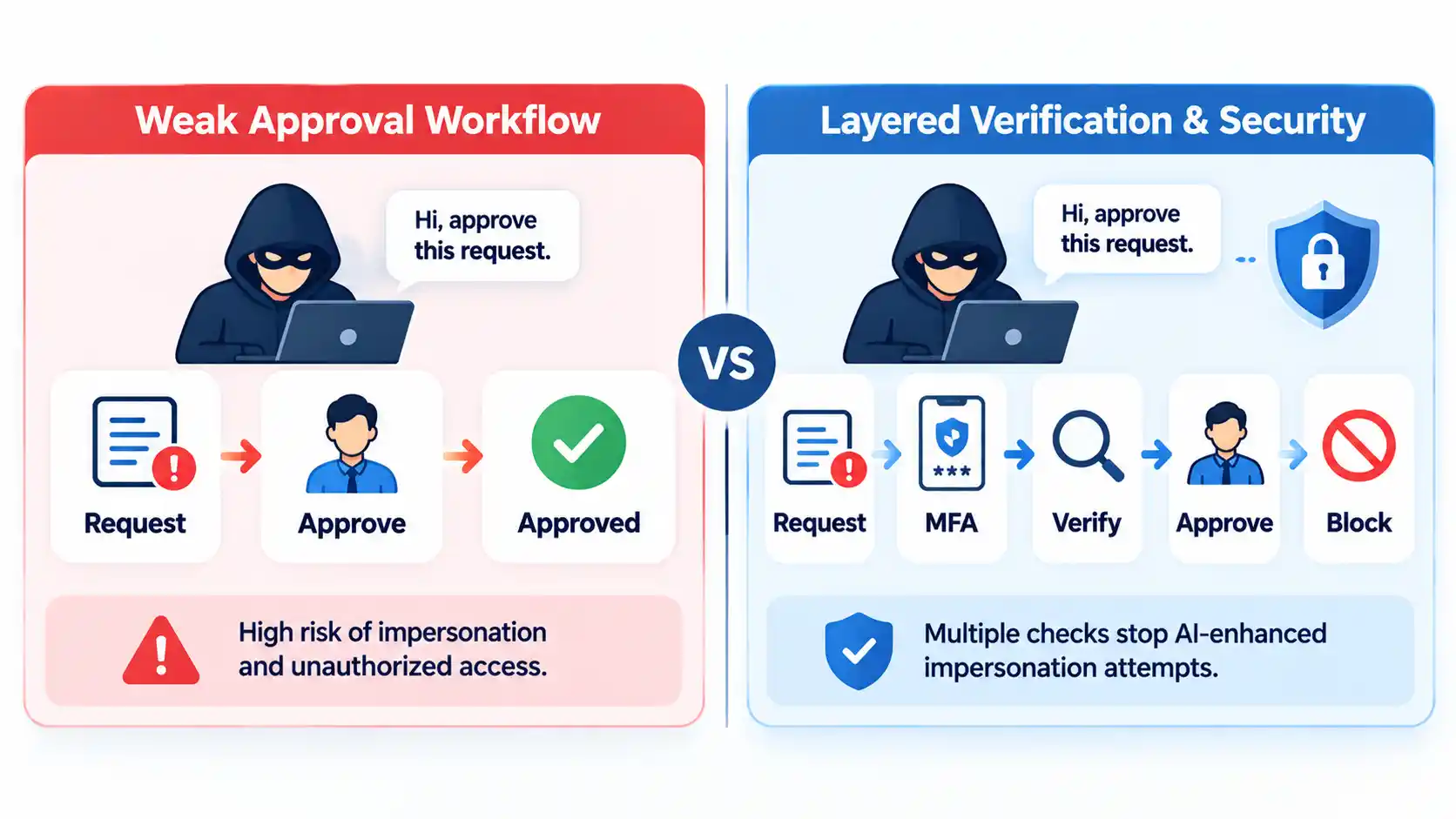
Strengthen identity and authentication
Passwords alone are vulnerable to phishing, reuse, theft, and credential-stuffing attacks.
Multi-factor authentication adds another requirement before an account can be accessed. Where risk and platform support justify it, phishing-resistant authentication methods provide stronger protection than authentication methods that can still be socially engineered.
Privileged administrator accounts deserve additional restrictions because compromising one can give an attacker far greater control than compromising an ordinary user.
Organizations should also monitor unusual sessions, new devices, suspicious authentication patterns, and unexpected privilege changes.
Verify sensitive requests outside the incoming channel
An employee should not verify a suspicious request by replying to the same message that created the suspicion.
Instead, use a previously established phone number, internal directory entry, approval system, or face-to-face process.
This is particularly important for:
- Bank-account changes.
- Large or unusual payments.
- Password resets.
- Requests for authentication codes.
- Changes to supplier details.
- Requests involving confidential data.
- Unexpected instructions from executives.
A convincing voice, video, writing style, or profile picture should be treated as supporting context rather than proof of identity.
Patch exposed systems quickly
AI can accelerate reconnaissance, but attackers still need a usable weakness to exploit in many technical compromises.
Organizations should maintain an accurate inventory of internet-facing systems, apply security updates, retire unsupported software, restrict unnecessary remote services, and prioritize vulnerabilities that are known to be exploited.
The objective is to reduce the number of opportunities an attacker can discover, whether the reconnaissance was performed manually or with AI assistance.
Train employees for modern phishing
Training that focuses mainly on poor spelling is increasingly inadequate.
Employees should learn to evaluate the business context of a request:
- Is the request normal for this person?
- Does it bypass an established approval process?
- Has the sender introduced a new account, number, or communication channel?
- Is there unusual urgency or secrecy?
- Can the request be independently confirmed?
Simulations can help, but training should not turn security into a memory test. Procedures need to make the safe action clear when an employee suspects fraud.
Limit blast radius and preserve recovery options
Network segmentation, least-privilege access, endpoint detection, tested backups, and incident-response planning reduce the impact of successful compromise.
These controls are not uniquely “AI defenses.” Their value is that AI-assisted reconnaissance or phishing still has to overcome multiple barriers before an attacker can reach critical systems.
Businesses can also improve their broader baseline through established business cybersecurity practices, while treating older statistics in related material cautiously.
Govern enterprise AI separately
Traditional cybersecurity controls do not cover every failure mode introduced by AI.
Organizations should know which AI systems are in use, what information they can access, which external services they communicate with, and what actions they are allowed to perform.
Sensitive information should not be supplied to an external AI service simply because the interface makes doing so convenient.
AI agents require particular attention because their risk depends partly on their permissions. An agent that can call APIs, modify files, or send messages should have the minimum access required for its task, with logging and human approval for consequential actions where appropriate.
CISA’s AI cybersecurity collaboration guidance also recommends integrating AI-related incidents and vulnerabilities into existing incident-response and information-sharing processes rather than treating AI security as an isolated discipline.
Where Penetration Testing Fits
Penetration testing is a controlled attempt to identify and demonstrate exploitable weaknesses in a defined environment.
It can help an organization determine whether exposed services, applications, authentication controls, configuration errors, or other weaknesses can realistically be exploited.
Organizations that want an external test of exploitable weaknesses can also incorporate services such as Pentest as a Service (PtaaS) into a broader security-validation program, alongside vulnerability management, configuration review, identity controls, and incident exercises.
Penetration testing should not be treated as a complete answer to AI-related risk.
A technical assessment may identify a vulnerable application but will not necessarily solve executive impersonation, weak payment-approval procedures, oversharing of confidential information with AI services, or excessive permissions granted to an AI agent.
The useful question is therefore not whether a company “does penetration testing,” but whether its testing program covers the systems and attack paths that matter while other operational controls address the risks testing cannot reproduce.
AI Helps Defenders Too
Attackers are not the only people using artificial intelligence.
Security teams can use machine learning and generative AI to help analyze large volumes of security telemetry, summarize alerts, detect anomalous activity, investigate suspicious messages, correlate events, prioritize incidents, and assist with remediation.
Microsoft’s 2025 Digital Defense Report describes both AI-assisted attacks and the use of AI in defensive security operations.
This is why it is misleading to say simply that attackers “benefit more” from AI than defenders.
The balance depends on the attacker, the defender, available data, security maturity, automation, system architecture, and the particular task.
Automated defense also creates trade-offs.
If a detection system incorrectly concludes that a legitimate account is malicious, an automated response could disable access or interrupt business operations. High-impact automation therefore needs appropriate confidence thresholds, permissions, logging, human oversight, and recovery procedures.
The same principle applies to IT automation more generally: automating a process can improve speed, but it also increases the importance of designing the decision rules and failure handling correctly.
AI-Driven vs Traditional Cyberattacks: What Is Different?
The distinction between traditional and AI-enhanced attacks is usually one of capability and efficiency rather than an entirely different objective.
The comparison below shows where the differences are most practical.
| Characteristic | Traditional Attack | AI-Enhanced Attack |
|---|---|---|
| Target research | Manual searches, scripts, databases, and reconnaissance tools | AI can summarize and correlate large amounts of target information quickly |
| Phishing personalization | Often manual or template based | Rapid personalization and language generation across many targets |
| Impersonation | Spoofed addresses, stolen accounts, basic social engineering | May also include synthetic voice, images, or video |
| Malware development | Human-written code, reusable tools, malware kits | AI may assist coding, debugging, modification, or in emerging cases operate within malware |
| Attacker skill | Skill requirements depend heavily on the attack | AI can lower the barrier for some tasks but does not remove the need for expertise in advanced operations |
| Business attack surface | Users, endpoints, servers, applications, networks, cloud services | All traditional surfaces plus models, prompts, AI data flows, agents, and connected tools |
| Defense | Identity, patching, monitoring, segmentation, backup, incident response | The same foundations plus stronger verification and AI-specific governance |
The practical conclusion is that businesses should not discard established cybersecurity controls in search of a special “AI security product.”
The better approach is to strengthen controls that AI makes easier to attack, while adding specific safeguards where AI applications introduce new permissions, data flows, or model-related vulnerabilities.
Key Takeaways
- AI currently acts as a force multiplier for many cyberattacks rather than replacing human attackers completely.
- Social engineering is one of the clearest areas where generative AI can improve attacker scale, personalization, and credibility.
- Some threat actors are moving from using AI as a productivity tool toward deploying AI-enabled malicious software.
- Businesses that deploy AI create additional attack surfaces involving models, prompts, data, agents, and connected tools.
- Multi-factor authentication, patching, least privilege, segmentation, backups, monitoring, and incident response remain important.
- High-risk requests should be independently verified rather than trusted because a message, voice, or video appears authentic.
- AI can also improve defensive detection, investigation, and response, so the technology is not inherently advantageous to attackers alone.
Frequently Asked Questions
Can AI launch a cyberattack without a human hacker?
Parts of an attack can be automated, and some malicious tools can make decisions or change behavior automatically. However, it would be misleading to describe today’s overall threat landscape as one in which fully autonomous AI routinely plans and completes sophisticated attacks without human involvement. Human operators still play an important role in target selection, infrastructure, exploitation, decision-making, and monetization.
Can antivirus software detect AI-generated malware?
Potentially. Security software generally evaluates indicators such as known signatures, behavior, suspicious processes, network activity, memory activity, file characteristics, and endpoint telemetry. Malware does not automatically become invisible because AI helped write it. The difficult cases are those that use new techniques, change behavior, avoid known indicators, or exploit weaknesses that defensive tools do not recognize.
Are small businesses more vulnerable to AI phishing?
There is no universal rule that every small business is more vulnerable. Practical exposure can be higher when an organization has limited security staffing, weak approval procedures, few technical controls, or employees who perform several roles. A small business with strong authentication and payment-verification procedures may be harder to defraud than a larger organization with weak processes.
How can employees verify an AI-generated voice call?
Do not rely on the sound of the voice alone. End the conversation and contact the person through a previously known phone number, internal directory, approved messaging platform, or another independently verified channel. For financial or administrative requests, follow the organization’s normal approval process even when the caller insists that the situation is urgent.
Is a deepfake attack the same as a cyberattack?
Not always. A deepfake may be used as part of cyber-enabled fraud or social engineering without any computer system being technically compromised. In other cases, a deepfake can help an attacker obtain credentials, persuade a user to install malware, or gain account access. The correct classification depends on what the impersonation is used to accomplish.

💬 Comments