There is no single language of hackers. Cybersecurity professionals and attackers use different programming languages, scripting environments, command shells, query languages, and markup technologies depending on the system they are working with and the task they need to perform.
Python is one of the most versatile starting points, but it is only part of the picture. JavaScript matters in browser security, SQL matters around database-backed applications, PowerShell is important in Windows environments, Bash is common on Linux and Unix-like systems, and C or Assembly becomes more relevant when work reaches native software and low-level program behavior.
Quick Answer: There Is No Single Hacker Language
The phrase “hacker language” is convenient, but technically it combines several different types of technology. A cybersecurity professional may write Python code, run Bash commands, use PowerShell to administer Windows, inspect JavaScript in a browser, read SQL queries, or analyze C code. These tools are not interchangeable.
The best choice depends on the target. For example, someone investigating a web application may spend more time with JavaScript, HTML, HTTP behavior, and SQL than with C++. A security engineer working across Linux servers may rely heavily on Bash and Python. A reverse engineer examining a compiled desktop program may need C, C++, and Assembly instead.
This target-based view also matches the way the MITRE ATT&CK framework describes command and scripting interpreters. It separates technologies such as PowerShell, Unix shells, Python, JavaScript, network-device command-line interfaces, and cloud application programming interfaces rather than treating them as one universal hacking language.
If you are learning programming more broadly, understanding the strengths of different programming languages makes it easier to see why security practitioners choose different tools for different environments.
Programming Language vs Script, Shell, Query Language, and Markup
Before comparing individual technologies, it helps to separate the categories. They overlap in everyday conversation, but they do different jobs.
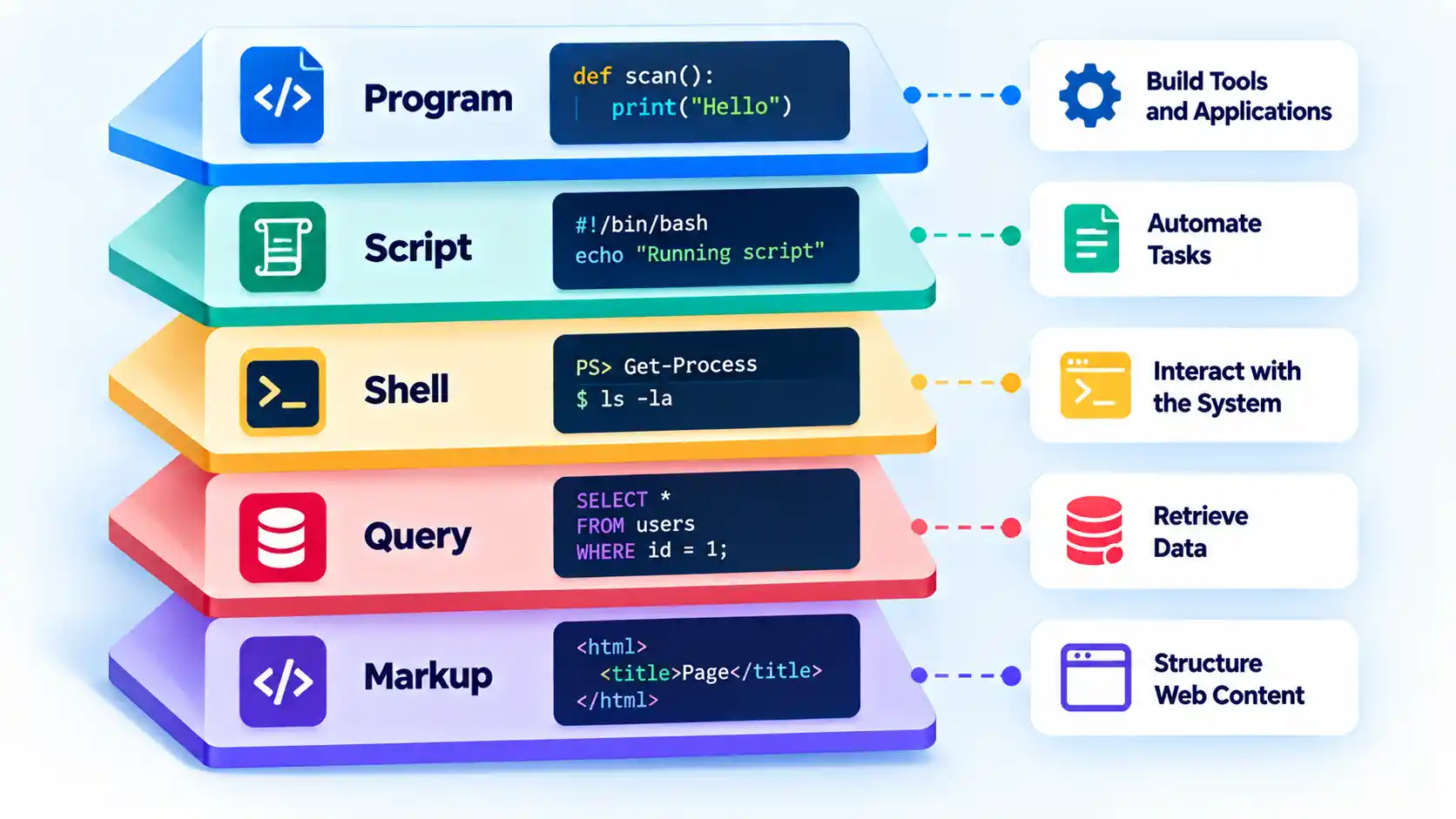
| Category | What it does | Examples |
|---|---|---|
| Programming language | Defines instructions and logic used to build software or automate computing tasks. | Python, C, C++, Java, JavaScript, Go, Ruby |
| Scripting language | Often emphasizes automation, task orchestration, and execution inside an interpreter or runtime. | Python, JavaScript, shell scripting |
| Command shell | Provides an interface for running operating-system commands and scripts. | Bash, Zsh, PowerShell |
| Query language | Requests, filters, changes, or organizes structured data. | SQL |
| Markup language | Describes the structure or presentation of content rather than general program logic. | HTML |
A single technology can cross categories. Python is a general-purpose programming language but is also widely used for scripting. PowerShell combines an interactive command-line environment with a scripting language. JavaScript is a programming language that runs in browsers and other runtimes.
This distinction matters because saying “hackers use HTML” is technically different from saying “hackers program in Python.” HTML describes webpage structure. Knowing it is still useful when examining web applications, but HTML itself is not a general-purpose programming language.
The Main Languages and Tools Used in Cybersecurity
The table below shows the practical relationship between common technologies and security work. There is no meaningful universal ranking because the appropriate language changes with the operating system, application, and analysis goal.
| Technology | Type | Common security context | Learning priority |
|---|---|---|---|
| Python | Programming and scripting language | Automation, tooling, log processing, security analysis | Strong general starting point |
| Bash | Unix shell and scripting environment | Linux administration, automation, system inspection | High for Linux-focused work |
| PowerShell | Command-line and scripting environment | Windows administration, automation, endpoint investigation | High for Windows-focused work |
| JavaScript | Programming and scripting language | Browsers, client-side applications, Node.js environments | High for web security |
| SQL | Query language | Database-backed applications and data access | High for application security |
| C/C++ | Programming languages | Native applications, memory behavior, system software | High for low-level specialties |
| Assembly | Low-level programming representation | Binary analysis and reverse engineering | Specialist skill |
Python
Python is one of the most broadly useful languages in cybersecurity because it works well for automation, data processing, quick utilities, and connecting other tools together. The official Python tutorial describes it as an interpreted language suited to scripting and rapid application development.
In practice, that makes Python useful for tasks such as parsing security logs, transforming data, checking large sets of files, communicating with documented APIs, or automating repetitive administrative checks. MITRE also records Python as a command and scripting interpreter seen in real-world adversary activity, showing why defenders may need to recognize Python execution as well as use the language themselves.
Python is not automatically the best choice for every security problem. If you need to understand native memory management or processor-level instructions, lower-level languages become more useful.
Bash and Unix Shells
Bash is one of several Unix shells used to interact with Linux and Unix-like operating systems. Shell knowledge is valuable because many security tasks involve understanding processes, files, permissions, services, networking tools, and system configuration rather than building a large standalone application.
MITRE notes that Unix shells support both interactive commands and scripts containing normal programming structures such as loops and conditionals. Bash, Zsh, and related shells therefore function as both operational interfaces and automation tools.
For a learner working mostly with Linux systems, shell fluency can be as practically important as learning a conventional programming language.
PowerShell
PowerShell fills a similar but more Windows-centered role. MITRE describes PowerShell as an interactive command-line interface and scripting environment included with Windows.
System administrators use it for legitimate automation, configuration, inventory, and remote administration. Security teams also analyze PowerShell activity because the same administrative capabilities can be misused after a system is compromised.
This dual use is important. Seeing PowerShell, Python, or Bash on a system does not by itself indicate malicious activity. Context, user identity, parent processes, commands, network activity, and other telemetry are what help determine whether behavior is expected.
JavaScript
JavaScript is especially important in web security because it controls much of the interactive behavior inside modern browsers. The MDN JavaScript guide explains that client-side JavaScript can interact with the Document Object Model (DOM), which is the browser’s programmable representation of a webpage.
Understanding that relationship helps practitioners trace how information moves from forms, URLs, application responses, and browser storage into page elements and scripts.
This matters when reviewing vulnerabilities such as cross-site scripting (XSS). OWASP’s XSS prevention guidance explains how unsafe handling of data can allow unintended content to execute in the browser and recommends context-appropriate output encoding and other defenses.
JavaScript also exists outside the browser. Node.js provides a server-side JavaScript runtime, so the language can be used for backend services and automation as well. The distinction between browser JavaScript and Node.js applications matters because their available APIs and operating environments are different.
Understanding the connection between the DOM, untrusted input, browser APIs, and output handling is central to JavaScript web security.
SQL
Structured Query Language (SQL) is used to work with relational databases. It is not a general-purpose programming language in the same sense as Python or C, but it is important for anyone assessing database-backed applications.
One reason is SQL injection. According to the OWASP SQL injection guidance, vulnerabilities can occur when applications build dynamic queries by combining SQL code with untrusted user input. Prepared or parameterized queries help keep the intended SQL instructions separate from supplied data.
The important lesson is that SQL itself is not an attack. The security problem comes from unsafe application design and query construction.
C and C++
C and C++ become more important when security work reaches native software, operating-system internals, memory handling, embedded systems, or compiled binaries. The current ISO C standard, ISO/IEC 9899:2024, defines the syntax, constraints, semantics, and other core requirements of the C programming language.
Knowledge of C helps a practitioner understand concepts such as pointers, memory layout, buffers, data representation, and interactions between programs and lower-level system components. Those concepts are useful when analyzing memory-safety defects or understanding why a native program behaves unexpectedly.
C++ adds features such as classes, templates, and a much larger language and library ecosystem. Neither language is necessary for every cybersecurity role, but they become increasingly valuable as the work gets closer to operating systems and compiled software.
Assembly
Assembly language represents processor instructions at a much lower level than Python or JavaScript. It becomes useful when a practitioner needs to examine what compiled software actually instructs the processor to do.
Reverse engineers and malware analysts may read Assembly when source code is unavailable. It is therefore a specialist skill rather than the ideal first language for most beginners.
Java, PHP, Ruby, Go, and Other Languages
Other languages matter when the target application or infrastructure uses them. Java is common in enterprise software and Android-related codebases. PHP still powers many server-side web applications. Ruby appears in web applications and security tooling, while Go has become common in modern infrastructure, networking, and cloud software.
The important principle is not to memorize a permanent ranking. Learn enough about the target technology to understand how data, code, permissions, and external inputs interact.
Which Language Is Used for Which Cybersecurity Task?
A practical way to choose a language is to start with the type of system you want to understand. The following matrix shows useful starting points rather than rigid requirements.
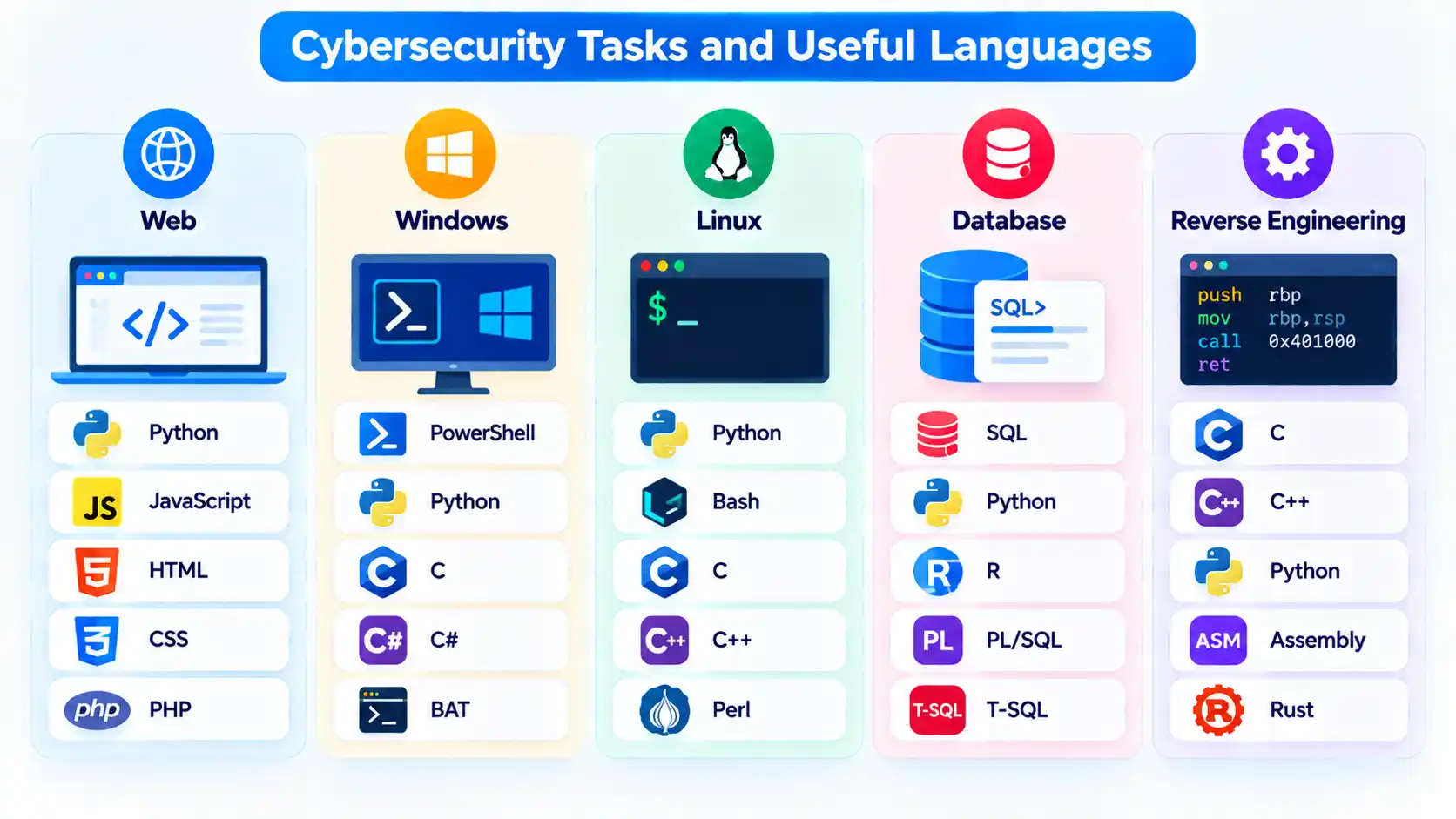
| Goal | Useful starting technologies | Why |
|---|---|---|
| General automation | Python | Readable scripting, libraries, data processing, and cross-platform use |
| Linux security | Bash, Python | Direct system interaction plus automation |
| Windows security | PowerShell, Python | Windows administration and cross-platform scripting |
| Web application security | JavaScript, HTML, SQL, relevant server-side language | Browser behavior, page structure, data flow, and database interaction |
| Database security | SQL plus the application’s programming language | Queries must be understood together with application input handling |
| Reverse engineering | C, C++, Assembly | Closer relationship to compiled native software and machine instructions |
| Cloud and infrastructure automation | Python, shell tools, PowerShell, APIs | Modern platforms expose extensive automation and administrative interfaces |
This is why a single answer such as “Python is the language hackers use” can be misleading. Python may be the most practical general starting point, while another technology becomes more important as soon as the environment changes.
Is Python the Best Language for Hackers?
Python is one of the strongest general-purpose starting languages for cybersecurity, but calling it universally “the best” goes too far.
Its advantages are clear. The syntax is relatively approachable, it is useful for scripting and automation, and it has a large standard library and broader package ecosystem. That makes it suitable for many repetitive or data-heavy tasks.
However, a Windows security specialist may get more immediate value from PowerShell. Someone concentrating on browser applications needs JavaScript. Database-focused application testing requires SQL knowledge. Reverse engineering frequently rewards C, C++, and Assembly skills.
The better question is therefore: best for what task?
Do You Need to Know Programming to Work in Cybersecurity?
You do not need expert software-development ability for every cybersecurity role, but programming and scripting knowledge can significantly expand what you are able to understand and automate.
A governance or compliance role may involve relatively little coding. A security operations analyst may benefit from scripts that process logs or automate repetitive checks. Application security engineers need to read code and understand how software handles input. Malware analysts and reverse engineers generally need much deeper low-level programming knowledge.
Even when you are using existing security tools, basic code literacy helps you understand what the tool is doing, interpret errors, review output, and decide whether the result makes sense.
A structured set of programming languages for cybersecurity beginners can therefore be organized around the security role you want to pursue rather than around a generic popularity ranking.
Which Language Should a Cybersecurity Beginner Learn First?
For most beginners who want a broad foundation, Python is a sensible first programming language. It teaches variables, conditions, loops, functions, data structures, files, and other concepts that transfer to many other languages.
After Python, choose an operating-system environment. Learn Bash if you expect to work mostly with Linux or other Unix-like systems. Learn PowerShell if Windows systems are more important to your work. Eventually, understanding both is useful.
For web security, add HTML, JavaScript, and SQL. You should understand how a page is structured, how browser-side code responds to data, and how the application communicates with its database.
If your interests move toward binary analysis, operating systems, embedded devices, or reverse engineering, C is a logical next step. Assembly becomes more useful once you need to understand compiled instructions at processor level.
- Start with Python for general programming and automation.
- Learn Bash for Linux or PowerShell for Windows administration.
- Add HTML, JavaScript, and SQL for web application security.
- Learn C and then Assembly if you move into low-level analysis.
- Study additional languages when the systems you work with require them.
The sequence is flexible. A person already working with Windows servers may reasonably start with PowerShell, while a frontend developer moving into application security may already have the JavaScript knowledge that another beginner would need to learn from scratch.
Key Takeaways
- There is no universal programming language used by all hackers or cybersecurity professionals.
- Python is a strong general-purpose starting language, particularly for scripting and automation.
- Bash and PowerShell matter because security work often involves direct interaction with operating systems.
- JavaScript, HTML, and SQL are especially relevant to web applications, but they belong to different technical categories.
- C, C++, and Assembly become more valuable for native software, binaries, memory behavior, and reverse engineering.
- The right language depends on the system and task rather than on a permanent “best hacking language” ranking.
Frequently Asked Questions
What coding language do ethical hackers use most?
There is no reliable universal ranking that applies to every ethical hacker. Python is one of the most broadly useful choices because it supports automation and general scripting, while Bash, PowerShell, JavaScript, SQL, C, and other technologies become more important in particular environments.
Can hackers use HTML even though it is not a programming language?
Yes. HTML is a markup language that defines webpage structure. Understanding it helps security professionals inspect forms, page elements, links, scripts, and the relationship between browser content and application behavior. Calling HTML a programming language, however, is technically incorrect.
Is SQL considered a hacking language?
SQL is a database query language, not a special language created for hacking. Cybersecurity professionals study it because many applications depend on relational databases and because unsafe query construction can create SQL injection vulnerabilities.
Is C or Python better for cybersecurity?
Python is usually easier to apply to general automation and security scripting. C is more valuable when you need to understand native applications, memory management, operating-system internals, or compiled binaries. Many practitioners eventually benefit from knowing both.
Why do cybersecurity professionals learn PowerShell?
PowerShell provides extensive access to Windows administration and automation. Security teams may use it to inspect configuration, collect information, automate legitimate tasks, and investigate PowerShell activity that appears suspicious in endpoint telemetry.
Is Assembly still useful for cybersecurity in 2026?
Yes, particularly in specialist fields such as reverse engineering, malware analysis, vulnerability research, and binary analysis. It is less important for many general security roles, so most beginners do not need to make it their first language.

💬 Comments