Augmented reality changes social media by adding interactive digital content to what you already see around you, while virtual reality can place people inside shared digital spaces. Both make online interaction more immersive, but they work in different ways and have different limits.
A face effect on a phone camera is a common example of augmented reality. Meeting other people as avatars inside a virtual environment is closer to social virtual reality. Understanding that difference makes it easier to see where each technology fits into modern social platforms.
Quick Take
AR keeps the physical world visible and adds digital content to it, while VR puts the user inside a mostly computer-generated environment. Social platforms use AR heavily for camera effects, product visualization, games and creative tools, while social VR focuses more on shared spaces, avatars, voice communication and a sense of being present with other people.
AR and VR Are Different Experiences
Augmented reality (AR) adds computer-generated elements to a view of the physical world. Virtual reality (VR), by contrast, places most or all of what the user sees inside a computer-generated environment. A 2026 meta-analysis comparing AR and VR also treats them as distinct technologies with different ways of affecting user experience and behavior.
The easiest way to see the difference is to think about what happens to the world around you. With AR, the real room, street, face or object normally remains visible while digital elements appear within that view. With VR, the virtual environment becomes the main place where the experience happens.
| Feature | Augmented Reality | Virtual Reality |
|---|---|---|
| Environment | The physical world stays visible while digital elements are added. | The user mainly sees and interacts with a computer-generated environment. |
| Typical device | A smartphone camera, tablet or AR glasses. | A VR or mixed-reality headset. |
| Common social role | Camera effects, games, virtual try-on, interactive objects and creative content. | Avatar-based meetings, shared worlds, multiplayer experiences and spatial social interaction. |
| Connection to the real world | Digital content can react to a face, hand, surface, object or device movement. | The user’s physical surroundings are usually secondary to the virtual environment, although mixed-reality headsets can also show the real world. |
| Main access barrier | Usually lower because many experiences run on phones people already own. | Usually higher because immersive VR generally requires additional hardware. |
The two technologies therefore do not solve exactly the same social problem. AR can make an ordinary photo, video or shopping interaction more interactive. VR can change the social setting itself by letting people occupy the same digital space.
How AR Works on Social Platforms
Imagine pointing your phone at your face and seeing a mask follow your head as you move, or pointing the camera at the floor and placing a digital object there. The software has to understand something about the scene for the effect to stay aligned as the camera moves.
Social AR normally starts with information from a camera and, depending on the effect, other device sensors. Software then tracks something useful in the scene, such as a face, hand, surface, object or the position of the phone. A digital element is rendered in relation to that tracked information so it appears to move or stay positioned in a believable way.
For example, TikTok Effect House can track a device’s position, orientation and horizontal surfaces. Its AR Camera can then place 3D objects so they appear to occupy a real-world scene.
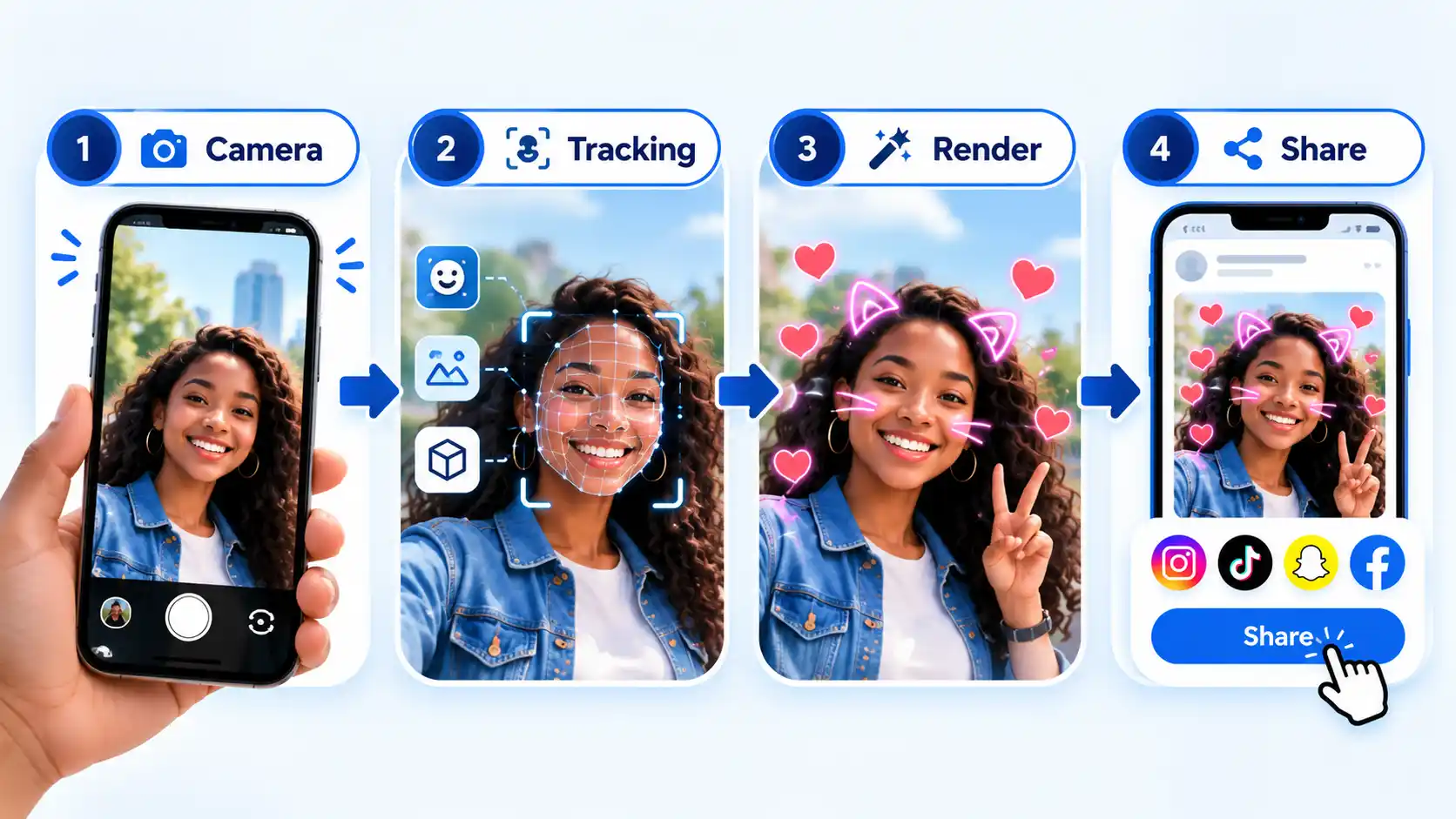
The result is an effect that responds to what the camera sees instead of behaving like a fixed graphic. Face tracking can keep digital glasses aligned with a person’s eyes. Hand tracking can make virtual jewelry follow a moving hand. Surface tracking can keep a digital object positioned on a floor or table as the camera changes position.
This is why augmented reality filters behave differently from ordinary image overlays . The effect can react to the user or environment instead of simply covering a fixed part of the screen.
After the digital content is rendered, a platform can let the user record it, take a photo, play with it live or share the result. The camera becomes part of the interaction instead of serving only as a recording tool.
Where VR Fits Into Social Media
Virtual reality takes a larger step away from the traditional feed. Instead of adding an effect to a photo or camera view, social VR can place several people inside the same digital environment and represent them with avatars.
In that setting, the experience can feel more like occupying a place together than posting to the same page. People may talk, move through a virtual space, join an activity or interact with digital objects while remaining physically far apart.
Meta Horizon supports this type of interaction with friends, followers, parties, voice chat, blocking and user reporting. Those functions give immersive apps some of the relationship, communication and safety controls that conventional social networks also need.
That makes social VR different from a traditional social feed . A feed mainly organizes posts and reactions on a screen. Social VR can make location, movement, avatars and spatial interaction part of the communication itself.
VR does not have to replace feeds, messaging or video. A person might meet friends in a virtual world and later share a recording or screenshot from that experience through an ordinary social app. The technologies can overlap without serving the same purpose.
How AR and VR Change Social Interaction and Marketing
The biggest change is that social content can become something people manipulate or enter instead of only something they watch. That creates new possibilities for personal expression, games, product visualization and shared experiences.
AR is especially suited to situations where the real person or environment still matters. Someone can change the appearance of their face, place a virtual object in a room or see how a digital representation of a product looks against their own body.
Virtual try-on is one practical example. A Snapchat Lens built for Cartier lets users place a virtual Trinity ring on their hand using hand tracking. The ring follows the hand as it moves. That example shows how a social camera can become part of product exploration, although it does not prove that AR always increases sales.
AR also changes self-expression. A creator can make digital elements respond to facial movement, gestures or surroundings. Interactive games can turn the user into part of the content rather than keeping them outside it as a viewer.
VR changes interaction in another direction. Its strength is not placing a product over the real world but giving people a shared digital place in which to meet, communicate or participate in an activity. An avatar can become part of a person’s social identity within that environment.
More immersion does not automatically produce a better result. A 2026 meta-analysis covering 206 papers and 235 independent studies examined both positive and negative responses to AR and VR and found that outcomes vary with contextual factors.
For marketers and creators, the useful question is therefore not simply whether an experience is immersive. It is whether the interaction helps the user do something meaningful, such as understand a product, express an idea, participate in a game or communicate with other people.
What Social Platforms Support Today
Support for social AR and VR differs considerably by platform. Some companies still provide large creator ecosystems, while others have closed earlier creation tools or moved immersive experiences into different products.
| Platform or ecosystem | Main immersive format | Typical device | Current creator or platform status | Social role |
|---|---|---|---|---|
| Snapchat and Snap | AR Lenses and related camera or wearable experiences | Smartphones and SPECS AR glasses | Snap continues to support Lens-based AR and launched SPECS in September 2026. | Creative effects, games, communication, product visualization and shared AR. |
| TikTok | AR effects built with Effect House | Smartphones | Effect House remains active and continues receiving software updates. | Face effects, interactive games, virtual objects and environment-based effects. |
| Instagram and Facebook | First-party AR effects | Smartphones | Meta ended Meta Spark for third-party AR effects in January 2025; Meta’s own effects remained available. | Platform-controlled camera effects rather than the former third-party Spark ecosystem. |
| Meta Horizon | Social VR and mixed-reality experiences | VR and mixed-reality headsets | Meta continues to provide social platform features for immersive apps. | Avatars, parties, voice chat and shared virtual activities. |
Snapchat
AR remains central to Snapchat. Snap currently reports that more than 350 million Snapchatters engage with augmented reality each day on average. Because this is a company-reported metric, it should be read as Snap’s measurement rather than an independent audience estimate.
Snap’s AR work has also moved beyond the phone. The company launched SPECS in September 2026 after first introducing the glasses earlier in the year. The see-through device is designed to place digital experiences into the user’s surroundings, and developers had already published hundreds of Lenses for SPECS before launch.
TikTok
TikTok continues to support creator-built effects through Effect House. The platform can be used to make face effects, virtual characters, games and other interactive AR experiences, and Effect House remains available as a desktop creation tool. Release notes also show continuing updates through September 2026.
Creating AR effects for TikTok or Snapchat requires platform-specific authoring and publishing tools because the two ecosystems use different creation systems.
Instagram and Facebook
Meta shut down Meta Spark, the platform that third-party creators used to build custom effects for Facebook and Instagram, on January 14, 2025. Third-party effects created with Meta Spark were removed, while Meta said its own first-party AR effects would remain available on products including Facebook, Instagram and Messenger.
It would therefore be inaccurate to say that Instagram and Facebook stopped supporting AR altogether. The major change was the end of the third-party Meta Spark creation ecosystem.
Meta Horizon
Meta Horizon represents the VR side of the picture more clearly. Its platform supports social features such as group presence, friend connections, parties, voice communication and shared immersive experiences. Rather than adding an object to a phone camera, these tools help make the virtual environment itself a place for social interaction.
Limits and Risks of Social AR and VR
Immersive social technology introduces opportunities, but it also creates practical limits that ordinary photos, videos and text posts do not face.
Platform dependence is one of the clearest risks. An effect can depend on software controlled by a single company. Meta Spark’s shutdown demonstrates how a creator ecosystem can disappear after a platform changes direction. Creators and brands that build around one proprietary tool therefore face platform risk.
VR has a higher hardware barrier. Many social AR experiences work through a smartphone that the user already owns. Full VR usually requires a headset, which adds cost, setup and another device the user has to be willing to wear. That makes VR less frictionless than opening an ordinary social app on a phone.
Immersion does not guarantee a positive response. Research comparing AR and VR shows that outcomes can vary with the technology, user, product and context. The 2026 meta-analysis of AR and VR research examined both positive and negative customer responses rather than treating immersion as automatically beneficial.
Immersive features can also depend on richer sensor input. A phone-based AR effect may use camera information, device movement or surface tracking, while immersive headsets can use inputs such as hand tracking, gaze, voice and passthrough cameras. The exact information collected, stored or shared depends on the product and its privacy settings, so users should evaluate the specific platform rather than assume all AR or VR systems handle data in the same way.
Moderation becomes more complex in shared spaces. A normal social post may consist of text, an image or a video. Real-time immersive spaces can also involve voice, avatar movement and direct interaction between users. Meta Horizon, for example, includes blocking and user-reporting features alongside its other social tools.
These limitations help explain why AR and VR are better understood as additions to social media rather than automatic replacements for feeds, messaging and video.
What Comes Next for AR, VR and Social Media
The clearest direction is not that every social network will turn into a virtual world. Instead, different levels of immersion are appearing across phones, glasses and headsets.
Phone-based AR remains an accessible route to immersive social features because it can work on devices people already use for social media. Wearable AR is developing alongside it. Snap’s SPECS, launched in September 2026, use see-through displays to place digital information and experiences into the user’s surroundings while keeping the physical world visible.
VR has a clearer practical fit where shared presence is central to the experience, such as multiplayer games, virtual events, collaborative spaces and social worlds. Conventional feeds and messaging remain better suited to quick interactions that do not require immersive hardware.
The boundary between AR, VR and mixed reality can also become less obvious as devices combine features. Meta Horizon OS, for example, supports passthrough, hand tracking, gaze input and social presence, allowing software to mix views of the physical environment with digital interaction.
AR and VR are therefore changing social media in different but related ways. AR makes the real world and the social camera more interactive. VR can turn a digital environment into the place where social interaction happens. Their long-term importance will depend less on whether they look futuristic and more on whether they make communication, creativity, shopping or shared activity genuinely easier or more valuable.

💬 Comments