Web 2.0 and Web 3.0 get introduced as generations, which implies the newer label wins. A more useful frame treats them as two answers to one operational question. Who controls the data, the assets, the identity, and the right to change the rules? In a Web 2.0 system, the platform operator answers all four. In a Web 3.0 system, control moves toward whoever holds the keys, plus the code the network executes.
That reframing makes the choice tractable. A payments product handling high volumes of small transactions, with chargebacks, refunds, and support agents who can restore access, will usually run better on Web 2.0 patterns. A marketplace where buyers must still prove ownership after the operator disappears has a real Web 3.0 case.
Quick Take
- Web 2.0 patterns fit when speed, mainstream onboarding, moderation, account recovery, and clear operational control carry the product.
- Web 3.0 components earn their cost when verifiable asset ownership, portable identity, open settlement, or resistance to deplatforming is the product itself.
- Decentralization is a spectrum. Ethereum’s own documentation notes that no network is entirely centralized or entirely decentralized, and that not every service needs to become a dapp.
- Hybrid is the normal outcome, and it is a legitimate architecture rather than a compromise.
Definitions: two trust models and one contested label
Web 2.0 describes the platform web most people use daily: read-write, social, ad-funded, and run by central operators who hold the infrastructure and decide the rules. Users create content, but the platform holds the traffic, the data, and most of the monetization. That is Ethereum’s own description of the model it is arguing against.
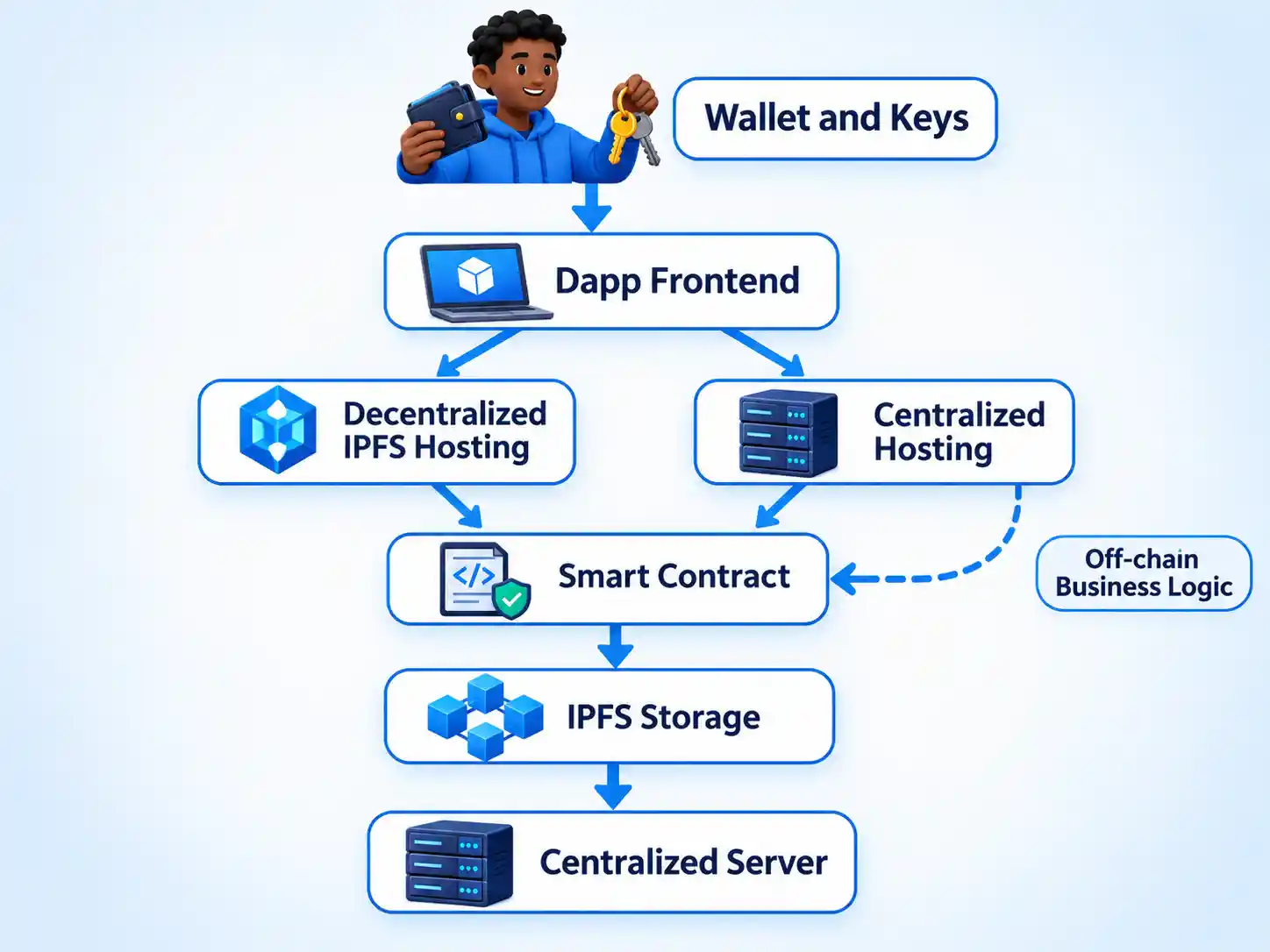
Web 3.0 is shorthand for a different arrangement: applications whose backend logic runs on a peer-to-peer network, wallets that act as a portable login, tokens that can carry payment natively, and governance experiments such as DAOs where token holders vote on how shared resources get spent. Ethereum calls Web3 a catch-all term for that vision, which is a fair warning that the label names a direction rather than a settled specification. Wider write-ups often describe Web3 as decentralized infrastructure stitched together from blockchains, IPFS storage, smart contracts, and wallets.
Info
The Web 3.0 label also covers semantic web ideas: machine understanding and AI-assisted interpretation. Those ideas come from a different lineage than the wallet-and-blockchain usage. When a vendor says “Web3,” ask which half of the umbrella they mean.
Head-to-head: Web 2.0 vs. Web 3.0 on the same criteria
| Criterion | Web 2.0 | Web 3.0 |
|---|---|---|
| Architecture and control | Central servers, proprietary databases, cloud accounts. The operator sets access policy and ships changes at will. | Backend logic in smart contracts on a public network, state stored across many nodes, frontends can also be hosted on decentralized storage. |
| Data and asset ownership | Records live inside the platform. An in-game item or a follower count is tied to an account the platform can close. | Assets and records tie to an address the user controls, transferable outside the original app’s interface. |
| Identity | Per-site accounts, OAuth sign-ins, email and password resets handled by the operator. | A wallet address serves as a single login across compatible apps, with no personally identifying information required. |
| Monetization | Advertising against behavioural data, subscriptions, transaction fees, data-driven models. | Native tokens, protocol fees, staking, governance-linked incentives, and direct asset sales. |
| Governance | Management and shareholders decide rules, upgrades, and moderation policy. | Token-holder voting and DAOs where implemented, with widely varying degrees of real decentralization. |
| Trust and verification | You trust the company, its bank partner, and its payment processor to hold records correctly. | You can verify state and outcomes against public code and network consensus, provided you understand what you are reading. |
| Performance | Higher throughput, straightforward scaling, fast state changes and easy rollback. | Lower throughput and coordination overhead; congestion on one popular app can slow the whole network. |
| UX and accessibility | Familiar flows, browser-native, operator-assisted account recovery, and standard browser integration. | Extra steps, wallet software, seed-phrase education, and weaker integration with standard browsers. |
| Cost profile | Conventional hosting and infrastructure spend under the operator’s control. | Per-transaction cost for state changes, which pushes most logic off-chain to stay affordable. |
| Key risks | Vendor lock-in, data concentration, unilateral policy shifts, single points of failure. | Smart-contract bugs, key-management and custody risk, centralization creeping back in through friendly services, and regulatory ambiguity. |
Ownership, identity, and control: what actually changes
Ownership is the strongest argument for Web 3.0 and the most overused word in the conversation. Ethereum’s own illustration is clean: buy an in-game item in a Web 2.0 game and it is bound to your account, so losing the account loses the item. Hold it as a token in a wallet and the studio cannot delete it, and you can sell it on an open market when you stop playing. The same logic applies to reputation: a creator who leaves a platform in a Web 2.0 world leaves the following behind, while a wallet-linked identity can, in principle, be plugged into another interface.
Identity follows the keys. A single Ethereum address can act as a login across many applications, which removes the per-site password problem and reduces the amount of personal data a service needs to collect. DAOs extend the same idea to governance: tokens act like shares, and holders vote on how pooled resources are spent.
Warning
Wallet-based control shifts responsibility to the user. Key custody and recovery become explicit product design decisions, and a service built on top of a blockchain can store your keys server-side, host the frontend centrally, or run important business logic off-chain before writing to the network. Any of those choices can reintroduce the centralization the design was meant to remove. “You own your data” is a claim to inspect, not a default.
The tradeoffs that decide the architecture
Web 2.0 optimises for speed, convenience, and operational control. That control is a feature: a bug can be patched quickly, a fraudulent transaction reversed, a hostile account suspended, a confused customer walked through a password reset. It is also the source of the lock-in and data concentration that make Web 3.0 arguments persuasive in the first place.
Web 3.0 optimises for verifiability, user sovereignty, and programmable ownership. It pays for that in several currencies:
- Throughput. Ethereum’s documentation puts the network at roughly 10–15 transactions per second, with the pool of unconfirmed transactions ballooning once demand outruns that ceiling. Distributed validation costs time, and every network that spreads state across many nodes inherits some version of that limit.
- Cost per action. Most successful dapps keep only a small fraction of their code on-chain because on-chain state is expensive. Anything moved on-chain carries a recurring cost rather than a one-off hosting bill.
- User experience. Interacting with a dapp can require extra steps, extra software, and extra education, and the lack of integration in mainstream browsers narrows who can practically use it. Accessibility follows the same pattern: people who depend on screen readers, keyboard navigation, or other assistive setups meet extra friction before they reach the service, which is why web accessibility has to be designed into wallet and signing flows from the start.
- Maintenance. Smart contracts are immutable once deployed. That gives you tamper-resistance and takes away the ability to hotfix. Bugs and security risks identified after launch are painful to address, so audits and upgrade paths become budget lines, not afterthoughts.
- Centralization creep and regulation. The moment a team adds a custodial wallet, a managed frontend, or an off-chain approval step for convenience, parts of the trust model move back to a company. Regulatory ambiguity remains a listed Web3 risk, which means architecture and compliance have to be designed together rather than in sequence.
Switching costs and hybrid architecture
Switching models takes more than an interface refresh. Six layers change at once, and each carries its own constraint. Teams that budget for the frontend and leave custody, settlement, and audit unplanned tend to discover the gap during launch.
| Layer | What changes | Typical constraint | Question to settle first |
|---|---|---|---|
| Custody | Operator-held accounts become user-held keys, or a custodial service holds them on the user’s behalf. | Recovery becomes a product design problem with no default answer. | Who can restore access when a user loses a device? |
| Onboarding | Email and OAuth sign-in become a wallet connection. | Extra software and education before the first useful action. | Can a first-time user reach value without buying anything? |
| Settlement | Internal ledgers and bank rails become on-chain transactions. | Fees, confirmation delay, and network throughput limits. | Does the flow tolerate delay and per-transaction cost? |
| Business logic | Server code becomes smart contracts. | Immutable once deployed; upgrades need deliberate design. | Is there budget for an audit and a documented upgrade path? |
| Governance | Management decisions become token votes and proposals. | Slow coordination and the risk of a contentious split. | Who can change the rules, and how quickly? |
| Audit and records | Private logs become public chain data plus off-chain systems. | Indexing, privacy, and retention obligations stay with you. | Can finance and compliance reconcile on-chain events with internal records? |
Selective decentralization is the practical answer most teams reach: keep the parts that need speed and human judgement on conventional infrastructure, and move only the parts that need independent proof onto a network. The ratio should follow the value argument rather than an identity statement.
Decision cards: which model fits your situation
Everyday users
Default to Web 2.0 services for daily life. Their recovery flows, accessibility, and support exist because someone is accountable for them.
Choose Web 3.0 when you actually need to hold and move an asset across services. Reconsider if you are not prepared to manage keys and take on custody and recovery responsibilities.
Creators and independent publishers
Web 3.0 addresses the real problem of losing an audience and a reputation when a platform changes its rules or closes your account.
Choose it when portable identity or direct sales are central to your income. Reconsider when your audience lives on a mainstream platform and the on-chain version splits your reach.
Developers and technical founders
Web 3.0 components justify themselves when composability, verifiable execution, or user-held assets are the product’s reason to exist.
Choose it for settlement and ownership layers, with audits and an explicit upgrade strategy. Reconsider if the only argument is market positioning: immutable code you cannot patch becomes a liability when the value proposition does not require it.
Businesses and product teams
Run the product front, analytics, support, and moderation on Web 2.0 patterns. Add Web 3.0 where proof of ownership or open settlement creates measurable advantage.
Choose hybrid as the default starting point for this kind of product team, with each decentralized component tied to a named benefit. Reconsider when nobody on the roadmap can articulate what the token or chain layer actually unlocks.
Regulated and compliance-heavy teams
Treat architecture and compliance as one design problem. Custody, identity verification, audit trails, and record retention all shape what can live on-chain.
Choose a hybrid with off-chain orchestration and on-chain proof where it earns its place, and get qualified legal input before committing. Reconsider any design where the compliance answer depends on assumptions about rules that are still in motion.
If the wider build roadmap is still open, it is worth checking where the market around your stack is heading; this overview of trends in web development covers adjacent tooling and delivery patterns that affect either architecture choice.
How to decide, layer by layer
The useful question is which layer of the product needs independent verification and which layer needs someone accountable at 2 a.m. Work through the sequence below in order; each answer narrows the next one.
- Start with the ownership need. Is there an asset, a reputation, or a balance that has to survive without your company? If nothing of value has to outlive the interface, a decentralized ownership layer has nothing to secure and adds cost without a matching benefit.
- Settle custody and recovery. Name who holds the keys and what happens the day a user loses a device. Recovery is a design problem with no default answer, and it constrains every layer chosen after it.
- Test the core flow against settlement limits. Does the main transaction tolerate confirmation delay, per-transaction cost, and lower throughput than an internal ledger would give it?
- Check first-run onboarding. Can a new user reach real value without buying a token, installing extra software, or opening a support ticket?
- Design compliance and record-keeping alongside the stack. Custody rules, identity checks, audit trails, and retention obligations decide what can live on-chain, and they are harder to retrofit than to plan.
- Budget for audit and maintenance. Immutable code removes the hotfix, so audits, documented upgrade paths, and monitoring belong in the plan from the beginning.
- Check the motive. If decentralization is core to the product’s promise, the cost buys something real; if it is a landing-page feature, the same cost is dead weight.
Work through that sequence and the split tends to become visible: central control where convenience, moderation, and recovery matter; verifiable ownership where the asset has to outlive the interface. Anything else is a slogan with a roadmap attached.

💬 Comments