Avoiding plagiarism means keeping track of where information comes from, writing borrowed ideas genuinely in your own words, quoting exact language when necessary, and giving credit to the original source. A plagiarism or similarity checker can help with the final review, but it cannot replace careful source use and citation.
Quick Take: How to Avoid Plagiarism
Plagiarism is not limited to copying an entire article or submitting somebody else’s paper. It can also happen when you borrow an idea without credit, paraphrase too closely, lose track of a source while taking notes, or reuse exact wording without quotation marks. The Purdue OWL plagiarism overview describes both intentional and unintentional forms of plagiarism.
A reliable prevention process is straightforward:
Quick Take
- Record your sources while researching.
- Understand a source before writing from it.
- Paraphrase ideas rather than simply replacing words.
- Use quotation marks when exact wording matters.
- Cite borrowed ideas, facts, quotations, and other source-dependent material.
- Add your own analysis instead of assembling an article entirely from rewritten sources.
- Review similarity matches individually before submitting or publishing.
The important principle is attribution. A sentence can be completely rewritten and still require a citation because the underlying information or idea came from somebody else.
What Counts as Plagiarism?
Plagiarism happens when material from another source is presented in a way that makes it appear to be your own work without appropriate acknowledgement. That material can include exact wording, ideas, arguments, research findings, data, methods, images, or other creative work.
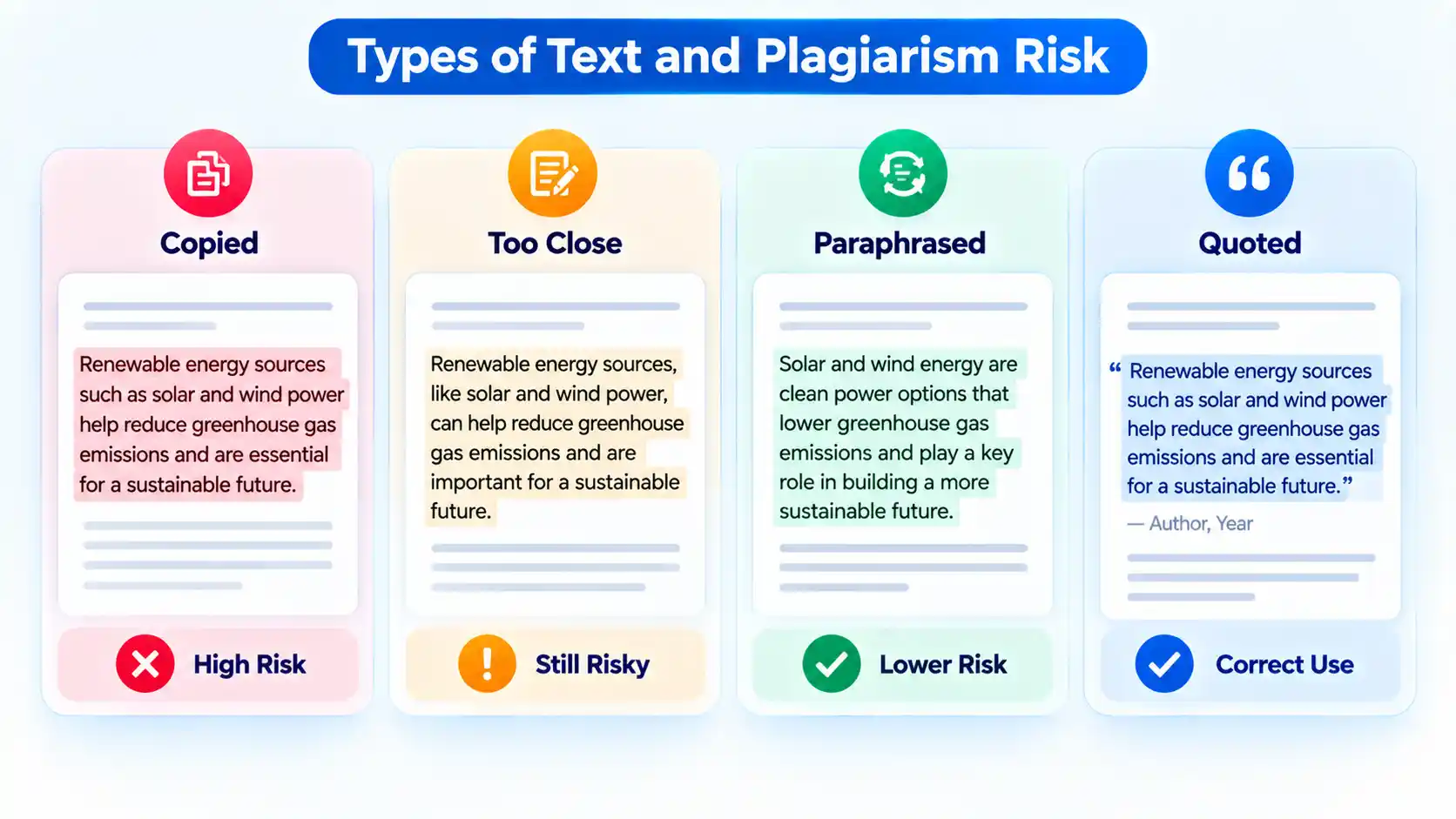
The clearest example is copying a sentence from an article and publishing it without quotation marks or attribution. However, changing several words while keeping the source’s sentence structure can also be too close to the original. This is sometimes called patchwriting.
A proper paraphrase is different. You first understand what the source means, then express that idea using your own sentence structure, emphasis, and explanation. You still credit the source because the idea did not originate with you. The UW–Madison paraphrasing guidance recommends understanding a passage as a whole and, where practical, looking away from the original before rewriting it.
Not every statement requires a citation. Widely accepted common knowledge may not need one, although what qualifies as common knowledge can depend on the audience and field. When you are unsure whether a distinctive idea, finding, statistic, or explanation is common knowledge, identifying the source is usually the safer approach.
Self-plagiarism is another special case. Reusing substantial portions of your own previously submitted or published work can violate the expectations of a school, journal, client, or publisher even though the original author is still you. The applicable policy matters, so check it before recycling earlier work.
7 Steps to Avoid Plagiarism
The easiest way to prevent plagiarism is to build source control into the entire writing process. Trying to repair attribution only after an article or assignment is finished makes mistakes much harder to identify.
-
Record Every Source While You Research
Keep enough information to identify every source as soon as you decide it may be useful. For an academic paper, that could include the author, title, publication, date, page number, DOI, or URL. For web research, save the page title, publisher, URL, and any relevant publication or update date.
Most importantly, distinguish exact quotations from your own notes. If you copy wording into your research notes, place it in quotation marks immediately or label it clearly as copied text. Otherwise, a sentence copied during research can later look like your own writing.
For example, a useful note might contain three fields: “source statement,” “my summary,” and “how I will use this.” That makes the boundary between evidence and your interpretation much clearer.
This becomes especially important when you research using dozens of browser tabs. Once quotations and notes are separated from their URLs, reconstructing their origins can become surprisingly difficult.
-
Draft From Your Understanding, Not From the Source Sentence
Read the relevant material until you understand the point. Then explain that point without using the original sentence as a template.
Suppose a source says that a particular software update reduced the time needed to complete a task. Replacing “reduced” with “decreased” and rearranging two phrases is not meaningful paraphrasing. Instead, identify the actual fact you need, explain it in the context of your own argument, and cite the source.
If you cannot explain an idea without repeatedly looking at the source sentence, you may not understand it well enough yet. Read the surrounding material and clarify the concept before drafting.
-
Paraphrase the Idea, Not Just the Vocabulary
A genuine paraphrase changes more than individual words. It reconstructs the explanation around your purpose while preserving the meaning of the source.
Changing synonyms, moving clauses, or running a passage through automated rewriting software does not by itself make borrowed material original. Even a well-written paraphrase normally needs attribution when the underlying idea or information comes from another source.
A more detailed paraphrase without plagiarizing workflow can help when a source is technically dense or difficult to rewrite without following its original structure too closely.
Software can help you experiment with alternative wording, and a rewording tool may be useful during revision. However, rewritten wording still needs a citation when the underlying idea came from another source.
If you use a paraphrasing tool to test another formulation, compare the result against the source, correct any change in meaning, and preserve the required attribution rather than treating rewritten text as automatically original.
-
Quote When the Exact Words Matter
Paraphrasing is not always the best option. Sometimes the exact language is important because you are analyzing a statement, presenting a precise definition, documenting what somebody said, or discussing wording that would lose its meaning if rewritten.
In those cases, reproduce only the necessary passage, clearly mark it as a quotation, and provide the appropriate attribution. Citation systems differ in how they format short quotations, block quotations, page numbers, footnotes, and reference entries, so follow the style required by your school, journal, client, or publisher.
Quoting does not mean that the surrounding explanation can be omitted. Tell the reader why the quotation matters and how it supports, contradicts, or qualifies your point.
-
Cite Borrowed Ideas and Information
Citations are not reserved for direct quotations. You normally also need to acknowledge paraphrases, summaries, distinctive arguments, research findings, and information obtained from another source when it is not common knowledge.
The UW–Madison citation handbook covers multiple documentation systems, including APA, MLA, Chicago, and others. The exact format varies, but the purpose is consistent: a reader should be able to understand which material came from another source and identify that source.
Academic writing often uses formal in-text citations, footnotes, endnotes, and reference lists. Web articles may instead cite sources through contextual hyperlinks and explicit attribution. The format can change, but simply rewriting somebody else’s information without acknowledging where it came from does not solve the attribution problem.
-
Add Your Own Analysis and Contribution
Original writing is not just writing that avoids identical sentences. A useful article should also contribute organization, analysis, comparison, explanation, examples, or conclusions that help the reader understand the subject.
This distinction is particularly important for web publishers. An article can paraphrase several sources correctly and still provide little reason for somebody to read it if it merely repeats what those sources already say.
Google’s Search Essentials guidance recommends creating helpful, reliable, people-first content. Its spam policies also address scaled content created primarily for ranking manipulation when that content provides little or no value, including pages assembled or automatically transformed from other sources.
For a product comparison, for example, do not simply rewrite each manufacturer’s description. Define useful comparison criteria, verify specifications, identify meaningful differences, explain limitations, and help the reader understand what those differences mean in practice.
-
Review Similarity Matches Before You Submit or Publish
A similarity checker can be a useful final control, but the percentage it produces should not become the goal of the writing process.
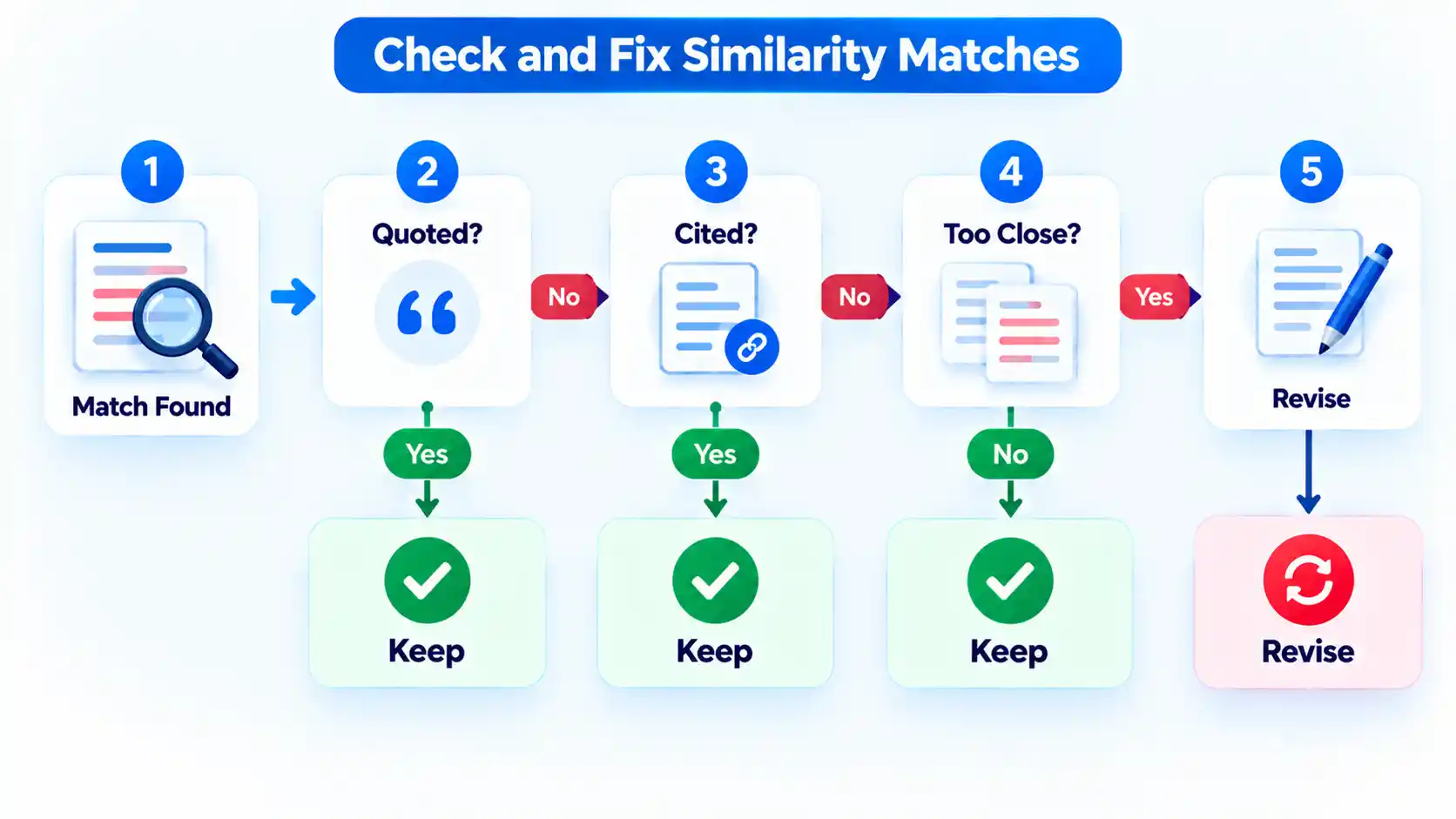
Turnitin, for example, says its Similarity Report identifies text that matches material in its databases. Its Turnitin similarity guidance explicitly explains that similarity and plagiarism are not the same thing and that a score alone cannot determine whether plagiarism occurred.
Properly quoted and referenced text can create a match. Common terminology can create matches. Previous versions of a paper may also affect results in some systems. Conversely, a low similarity percentage does not prove that every borrowed idea was properly attributed.
When reviewing a report, inspect each meaningful match and ask:
- Is this wording copied directly from the source?
- If so, is it clearly presented as a quotation?
- Does the source receive the required attribution?
- If it is supposed to be a paraphrase, does it follow the original too closely?
- Does the match involve unavoidable technical or common terminology?
- Does the passage accurately represent what the source actually says?
Common Plagiarism Mistakes and How to Fix Them
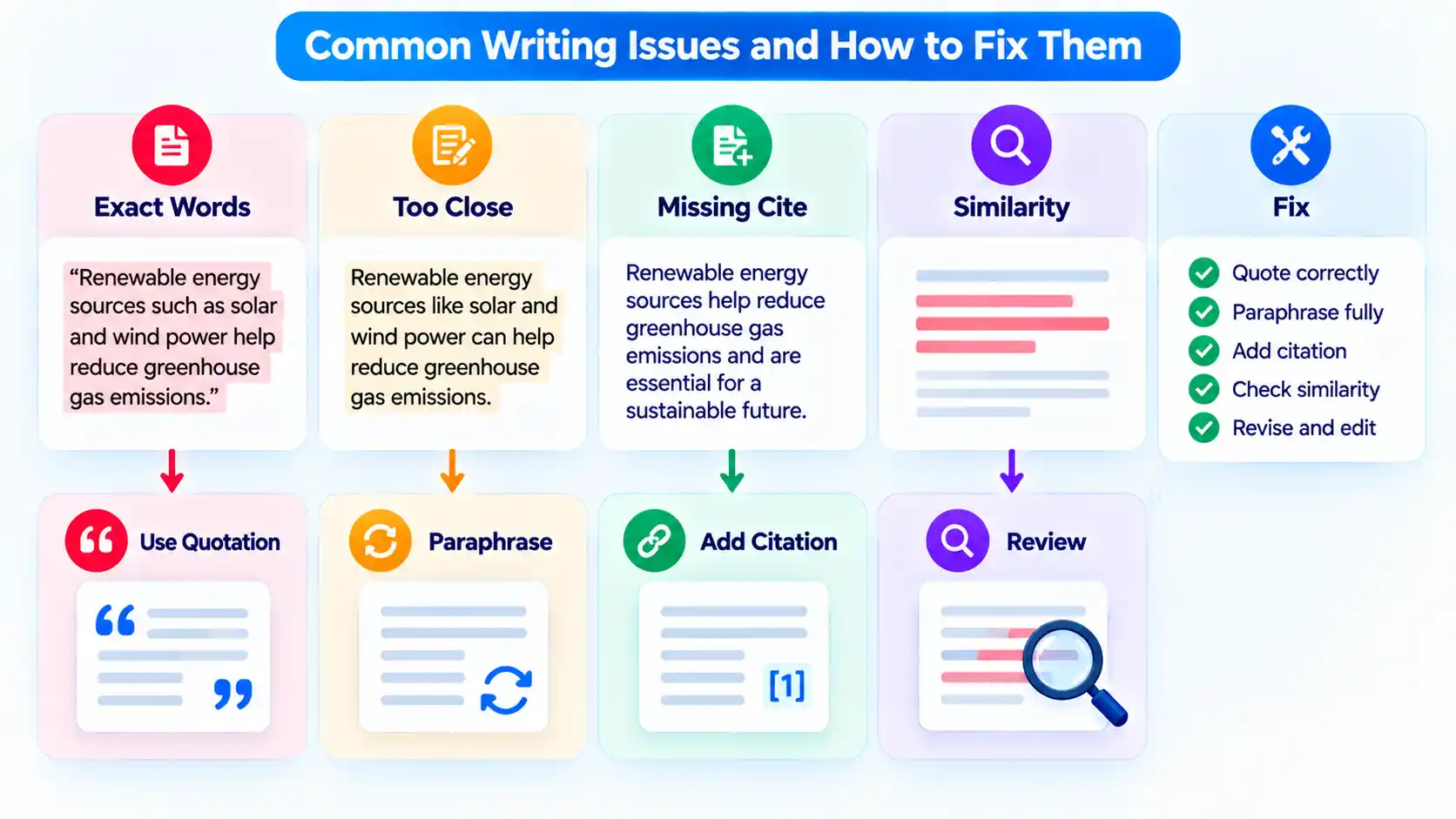
Most plagiarism problems fall into a small number of patterns. The right correction depends on whether the problem is exact wording, overly close paraphrasing, missing attribution, or incorrect interpretation of a similarity report.
| Problem | Why it is risky | What to do |
|---|---|---|
| Copying exact wording without quotation marks | The source’s language appears to be your own. | Quote and cite the wording, or rewrite it genuinely and cite the source. |
| Changing only a few words | The sentence structure and expression may remain too close to the source. | Return to the underlying idea and reconstruct the explanation independently. |
| Paraphrasing without attribution | The wording may be new, but the borrowed idea still appears to be yours. | Add the appropriate source attribution. |
| Dropping quotations into a paragraph without explanation | The source is identified, but the writer’s contribution and purpose remain unclear. | Introduce the quotation and explain its relevance. |
| Treating every similarity match as plagiarism | Correct quotations, references, technical phrases, or common wording can also match. | Review each match in context before deciding whether revision is necessary. |
| Assuming a low similarity score proves originality | A checker may not identify every attribution or authorship problem. | Audit source use and citation independently of the score. |
| Reusing earlier work without checking the rules | A school, publisher, journal, or client may restrict undisclosed reuse. | Check the applicable policy and disclose or cite earlier work when required. |
Plagiarism and Duplicate Content Are Not the Same SEO Issue
For website publishers, plagiarism should not be confused with Google’s handling of duplicate URLs or repeated website content.
Google’s duplicate-content guidance says duplicate content is generally not a violation of its spam policies. Search engines may encounter legitimate duplication because of alternate URLs, regional versions, mobile pages, ecommerce filters, syndicated material, and other technical situations.
That does not give publishers permission to copy other people’s work. Ethical attribution, copyright, contractual rights, and Google’s search policies are separate issues. From an SEO perspective, the more useful question is whether a page contributes useful, original value rather than whether every phrase on the internet is unique.
Plagiarism vs. Copyright Infringement
Plagiarism and copyright infringement can overlap, but they describe different problems.
Plagiarism concerns attribution and whether somebody else’s material is being presented improperly as original work. Copyright infringement is a legal question involving rights granted to copyright owners and whether protected material has been used in a way that violates those rights.
Under U.S. law, Section 501 defines infringement in relation to violations of a copyright owner’s exclusive rights. The U.S. Copyright Office publishes the statutory text and related copyright materials.
This distinction means proper attribution does not automatically make every use of copyrighted material legally permissible, while plagiarism can also occur in situations that do not produce a copyright claim. Copyright rules vary by jurisdiction and circumstances, so specific disputes may require qualified legal advice.
Key Takeaways
- Record sources while researching rather than reconstructing them after writing.
- Paraphrase from your understanding of an idea, not by swapping words in the original sentence.
- Cite borrowed ideas even when you express them completely in your own words.
- Use quotation marks and attribution when exact wording is necessary.
- Add analysis, examples, comparisons, or other useful contribution instead of merely rewriting sources.
- Treat similarity software as a review tool, not as an automatic plagiarism detector.
- Check the specific academic, publishing, or workplace rules that apply to your project.
Frequently Asked Questions
Can you plagiarize even if you change all the words?
Yes. Changing the wording does not make a borrowed idea yours. If the information, argument, finding, method, or distinctive idea came from another source and requires attribution in your context, you should still identify that source. A paraphrase solves the wording problem; citation solves the attribution problem.
Do you need to cite a source after paraphrasing it?
Usually, yes, when the paraphrase contains an idea or information taken from that source rather than common knowledge. The wording is yours, but the source of the information still needs to be clear. Follow the citation system required for your assignment or publication.
Does a 0% similarity score mean there is no plagiarism?
No. A very low or 0% score only describes what a particular system matched against the material in its available databases and according to its settings. It does not independently prove authorship, correct attribution, or compliance with an institution’s academic-integrity rules.
Can AI-generated or AI-paraphrased text still create plagiarism problems?
Yes. Using AI does not remove your responsibility to verify sources, check whether borrowed material is attributed correctly, and follow applicable school, employer, publisher, or client rules. AI can also produce inaccurate citations or wording that closely resembles source material, so generated text should be reviewed rather than assumed to be original or properly sourced.
Is duplicate content on a website the same as plagiarism?
No. Duplicate content is an SEO and indexing concept describing substantially identical material available at more than one URL, and legitimate duplicate pages can occur for technical reasons. Plagiarism concerns improper presentation of somebody else’s work or ideas as your own. A page can therefore involve duplicate content without plagiarism, while plagiarized material can appear on a page that has no technical duplicate-content problem.

💬 Comments