Modern technology improves water restoration in Brisbane mainly by finding moisture more accurately, controlling structural drying, documenting progress, and providing better flood-risk information. These tools improve decisions, but they do not replace physical inspection, contamination controls, electrical safety checks, or professional judgment.
One source of confusion is that several very different technologies are grouped under the label “water restoration.” A moisture meter used inside a wet building does a different job from a river-height gauge or Brisbane City Council flood map. Understanding those boundaries makes it easier to see which innovations actually help during recovery and what their limitations are.
Water Restoration Technology Covers Two Different Problems
At the property level, water-damage restoration involves locating affected materials, removing unwanted water, controlling drying conditions, monitoring moisture, and deciding what can safely remain. In April 2025, Standards Australia adopted the AS-IICRC S500 Standard for Professional Water Damage Restoration. Its scope includes inspection and evaluation, psychrometry and drying technology, equipment, instruments, safety, documentation, and other parts of professional restoration practice.
A second technology layer operates at the city, catchment, and property-risk level. Brisbane City Council provides flood information based on modelling and planning data, while the Bureau of Meteorology operates rainfall, river-height, forecasting, and warning systems. These tools can help people understand flood exposure and developing conditions, but they do not measure whether plasterboard, flooring, insulation, or another material inside a particular building is still wet.
For example, a FloodWise Property Report can provide modelled and historic flood information for an address. After actual water entry, however, determining the extent of wet building materials requires a site-level assessment.
Detecting Moisture That Is Not Obvious
Visible water is only part of the inspection problem. Moisture can extend into wall linings, flooring systems, cabinetry, insulation, and other areas where the surface gives an incomplete picture. That is why finding hidden water damage usually involves measurements rather than relying on sight or touch alone.
Moisture meters
Moisture meters provide information about moisture in building materials. Different designs work differently. Pin meters place electrodes into or against a material, while non-invasive instruments can scan without puncturing the visible surface.
Manufacturer documentation for the Protimeter Digital Mini, for example, describes a pin-type instrument intended to assess building moisture, identify the extent of moisture penetration, and monitor changes. Those are manufacturer-described capabilities rather than independent performance findings.
The most useful measurement is not always a single “wet” or “dry” number. A technician may compare a suspect area with an appropriate unaffected reference area, map how far moisture extends, and then repeat readings during drying. Material type, instrument mode, and the manufacturer’s measurement scale all matter when interpreting those results.
Thermal imaging
A thermal camera serves a different purpose. It detects surface-temperature patterns, not water itself. Evaporation and heat-transfer differences can sometimes make a moisture-affected area appear thermally different from the surrounding surface.
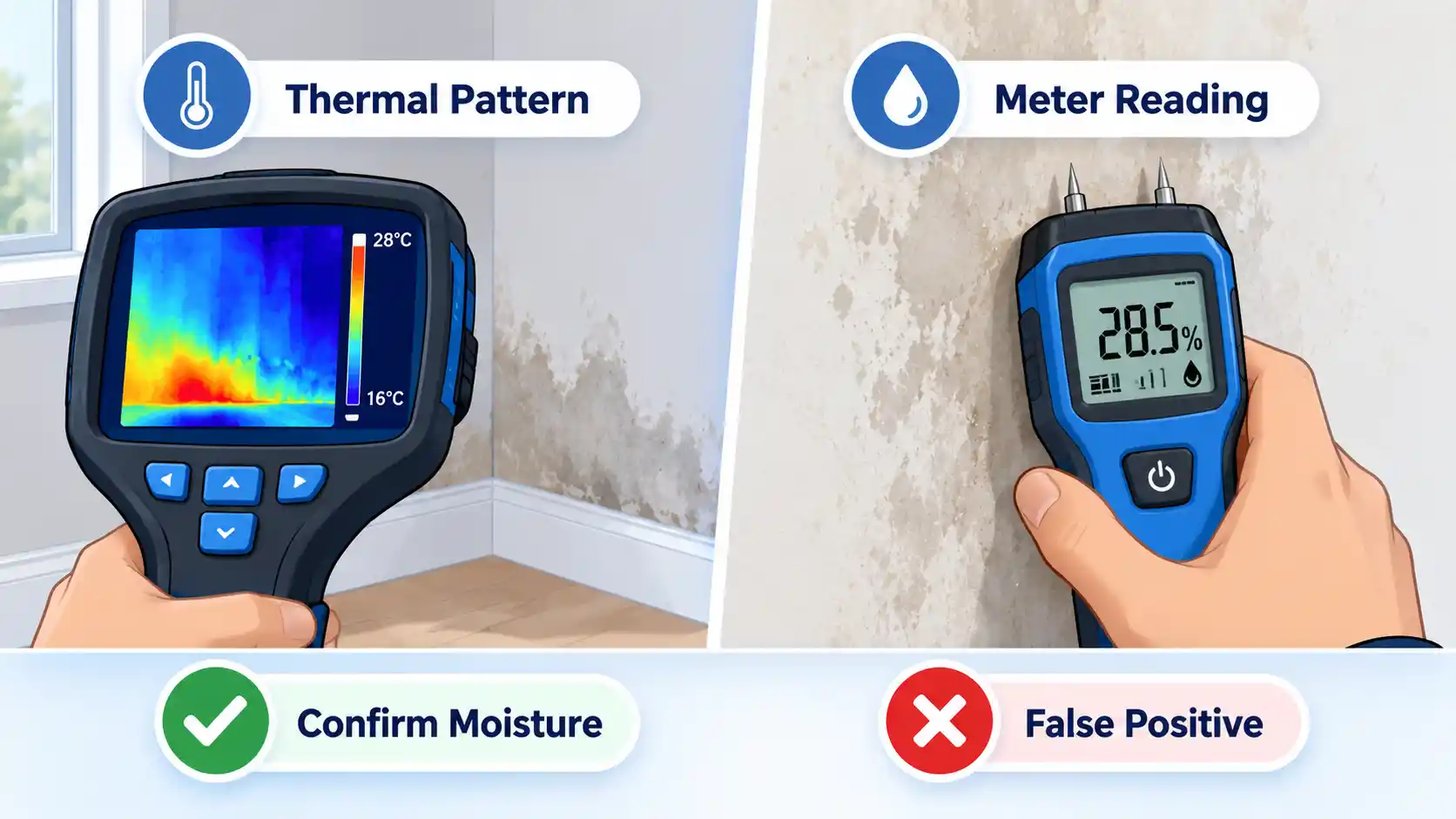
This distinction is important because temperature differences can also result from insulation, airflow, sunlight, heating and cooling systems, construction details, or other conditions. FLIR’s guidance on using thermal imaging to investigate water leaks states that a pattern resembling moisture does not guarantee that water is present and recommends confirmation with a moisture meter.
The distinction between a thermal camera and a moisture meter therefore matters because the instruments answer different questions. Thermography can help prioritise where to investigate, while appropriate moisture measurements provide additional evidence about the material itself.
Extraction and Controlled Structural Drying
Finding wet materials is only the diagnostic part of restoration. The next task is to remove unwanted water and create conditions in which affected materials can dry.
Bulk water extraction deals with standing or readily removable liquid. After that, moisture may still remain within porous materials and assemblies. Air movement can support evaporation from wet surfaces, while dehumidification removes water vapour from the air. Temperature, relative humidity, airflow, material properties, and the amount of retained moisture all affect the process.
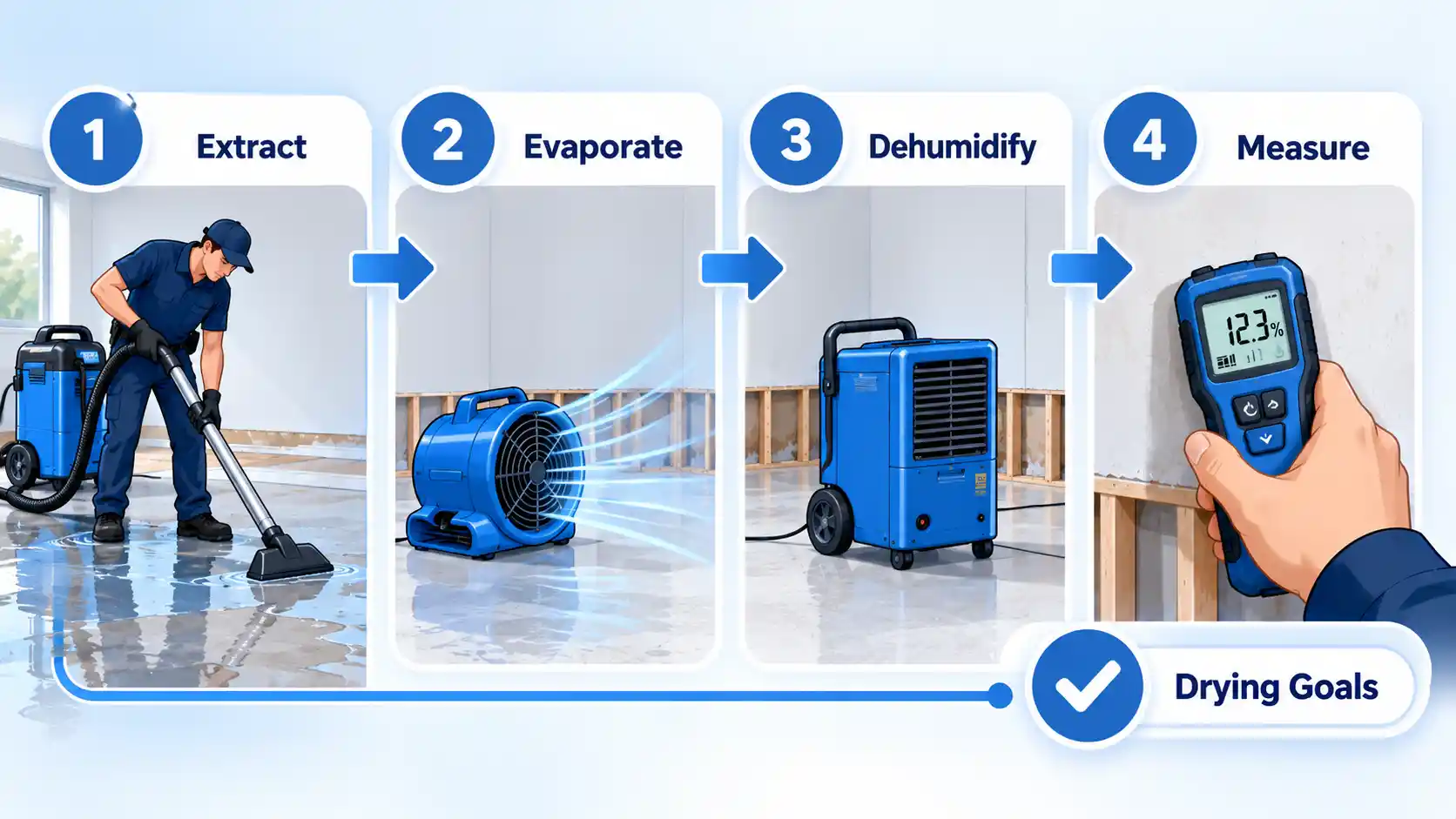
Psychrometry is the measurement and interpretation of air conditions relevant to moisture and drying, including temperature and humidity. In restoration, those measurements help practitioners understand the environment in which evaporation and dehumidification are occurring. The AS-IICRC S500 standard includes psychrometry and drying technology within the professional restoration process rather than treating drying as a matter of simply leaving equipment running for a predetermined number of days.
This is why professional structural drying is better understood as a measured process. A floor or wall surface can appear dry before all affected material has reached an appropriate endpoint, while another material may require a different drying approach altogether.
There is no defensible universal drying time for every Brisbane water-loss event. Material construction, water quantity, environmental conditions, access, and contamination can all change what is appropriate.
Disclosure: This article contains sponsored links. Commercial destinations are not used as evidence for technical claims.
Commercial restoration companies may combine extraction, drying, and monitoring within one service. The sponsored Water Damage specialist destination is one Brisbane service-provider example; the technical explanations in this article are independently sourced.
Monitoring Turns Drying Into a Measurable Process
One useful development in modern restoration is the ability to build a record of conditions rather than judging progress only by appearance. Material-moisture readings can be combined with measurements such as relative humidity and temperature and then repeated as work progresses.
Some current instruments can also store readings electronically. Protimeter states that its current Digital Mini moisture meter can save readings with date and time stamps through a connected app, while its HygroMaster L measures ambient relative humidity, temperature, dew point, and specific humidity. These are manufacturer specifications, but they illustrate how digital measurement and logging can support restoration records.
A sequence of properly collected readings can show whether conditions are changing as intended. That is more informative than assuming that equipment has worked simply because it has operated for a certain period.
Data collection still has limits. Incorrect sensor placement, inappropriate comparison values, unsuitable measurement methods, or readings taken without understanding the material can produce misleading conclusions. Connected instruments make record-keeping easier; they do not make interpretation automatic.
Brisbane’s Flood Technology Helps Before and Around Restoration
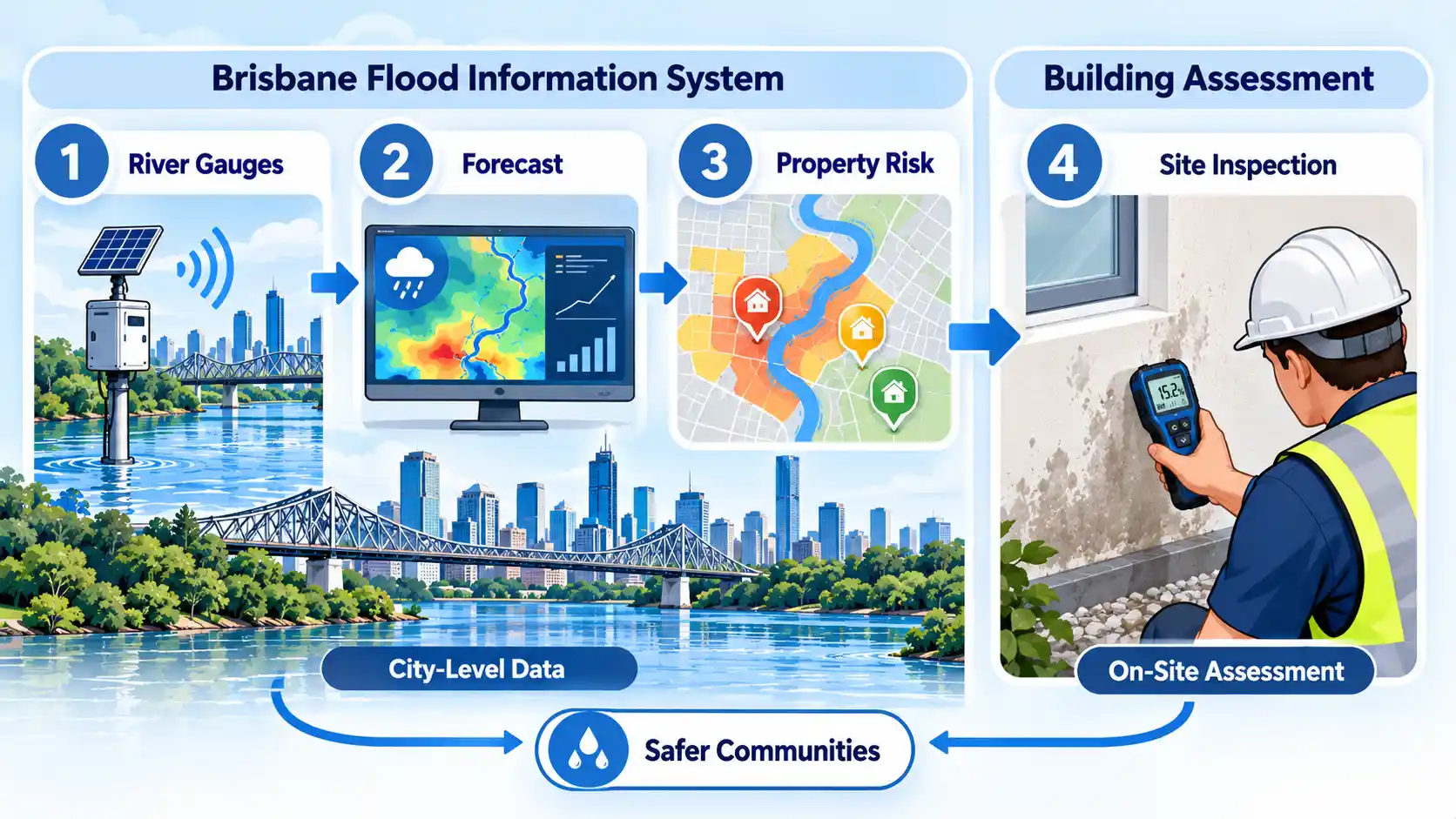
Brisbane also has a separate technology layer devoted to understanding flood risk and monitoring developing conditions. These systems can improve preparation and situational awareness, but they should not be confused with equipment used to diagnose moisture inside a building.
Flood Awareness Map and FloodWise reports
Brisbane City Council’s Flood Awareness Map provides general information about possible flooding and incorporates information from Council-endorsed flood studies and models. Council states that the Flood Awareness Map does not show flooding in real time.
For more property-specific planning information, Council’s FloodWise Property Report can include estimated flood levels, historic flood information, aerial maps, and technical data used for building and development purposes. Council identifies surveyors, builders, certifiers, architects, and engineers among the professionals who use the report.
These are useful tools for understanding flood exposure and development considerations. They are not post-loss moisture reports and do not establish whether building materials are dry after an incident.
Rainfall gauges, river-height monitoring, and warnings
The Bureau of Meteorology maintains Brisbane River rainfall and river-condition information and uses rainfall and river-height observations in flood-warning and forecasting operations.
The Bureau’s Queensland flood-warning network documentation describes both manual and automatic rainfall and river-height stations used for flood warning and forecasting. For the upper Brisbane River above Wivenhoe Dam, the network also includes automated telemetry equipment that supplies data used in warning operations.
What these systems cannot tell you
Suppose heavy rainfall produces a flood warning and water subsequently enters a house. River gauges can help describe what is happening across the catchment, while Council flood information can provide property-risk context. Neither source establishes whether water remains behind a particular wall, under a floor covering, or inside a cabinet assembly.
That final question requires building-level inspection and suitable measurements. The city-scale and building-scale technologies complement each other, but they should not be treated as interchangeable evidence.
Where Drones and Aerial Imagery Actually Fit
Drones are often described broadly as a restoration technology, but the available Queensland evidence supports a clearer role in wider disaster observation and imagery rather than internal building-moisture diagnosis.
Queensland Government’s natural-disaster imagery service includes publicly available imagery captured using satellites, crewed aircraft, and remotely piloted drone platforms. The service covers disaster events including floods and supports imagery at resolutions that vary by project.
That imagery cannot, by itself, establish whether hidden plasterboard, insulation, flooring, or framing inside a building is dry. Image resolution, capture timing, viewing angle, obstructions, and the absence of direct material-moisture measurements all limit what aerial imagery can prove at property-restoration level.
Drones can therefore contribute to the wider assessment picture without replacing instruments and inspections inside an affected structure.
Technology Does Not Remove Flood-Cleanup Safety Risks
Accurate moisture detection is valuable, but a low moisture reading does not answer every safety question. Floodwater can introduce biological or chemical contamination, and damaged properties may also contain electrical, structural, or other hazards.
Queensland Government’s flood health and safety guidance warns that floodwater is often contaminated by sewage, agricultural or industrial wastes, and chemicals. It also advises people not to return to affected sites until hazards have been cleared and the site is safe.
Mould prevention is another reason to control moisture promptly. WorkSafe Queensland recommends fixing the source of moisture and drying wet areas as soon as possible, and lists wet vacuums, dehumidification units, fans, heaters, and air conditioners on dry mode among tools that can assist drying. Its mould-management guidance also distinguishes cleanable materials from porous materials that may need to be discarded.
Queensland Health similarly advises that carpets or rugs waterlogged for more than two days may need to be removed. Its post-disaster mould guidance also warns against mixing cleaning agents such as bleach and ammonia because toxic fumes can result.
Service approaches vary with the material and circumstances. A sponsored commercial page on wet and flooded carpet restoration describes one provider’s Sydney service, while Queensland Health guidance remains the evidence basis here for determining when prolonged waterlogging may make carpet removal appropriate.
Routine building maintenance, including identifying and repairing leaks and maintaining building systems, can also reduce the chance that a corrected moisture problem simply returns.
How to Judge Whether a Restoration Technology Is Actually Useful
The word “technology” can make almost any new instrument sound inherently better. A more useful test is to ask what decision it improves.
- Ask what the tool measures. A thermal camera measures temperature patterns. A material-moisture meter provides a moisture-related reading. A humidity instrument measures conditions in the air. A river gauge measures water level at its monitoring point.
- Ask what decision changes because of that measurement. A thermal pattern may identify where to investigate next. Repeated moisture readings may help establish whether an affected area is changing during drying.
- Ask how the result is verified. Where the technology is indirect, confirmation may require another instrument, repeat readings, physical inspection, or comparison with an appropriate reference area.
- Ask what the tool cannot determine. A technically correct reading can still answer only the question the instrument was designed to address. It may say nothing about contamination, structural safety, electrical hazards, or hidden conditions outside the measurement area.
This approach is more useful than judging equipment by novelty alone. Technologies that generate repeatable, interpretable measurements can improve assessment and documentation, but only when those measurements are connected to the right restoration decision.
The Practical Outlook for Brisbane Water Restoration
The evidence does not support treating artificial intelligence, robots, or drones as replacements for the core restoration process. A better-supported trend is toward more instrumented and documented assessment.
Moisture meters help quantify material conditions. Thermal cameras help identify areas that merit further investigation. Humidity and temperature instruments add information about the drying environment. Digital records can make repeated measurements easier to compare. Outside the building, Brisbane’s flood maps, property reports, gauges, forecasts, and warnings provide a separate layer of information for understanding risk and developing conditions.
The important question is therefore not whether a technology sounds advanced. It is whether the tool measures something useful, changes a real decision, can be checked appropriately, and is used within its limitations. In Brisbane water restoration, better information is valuable when it leads to better assessment rather than greater confidence in an unsupported assumption.

💬 Comments