Your paid retargeting budget is buying back customers you already own. That is the margin leak worth measuring before you build anything else. Run one audit (CRM export against paid audience lists) and you will know whether an owned SMS and behavior-triggered engine is worth standing up for your brand.
Skip the audit and you cannot tell whether the engine worked. Skip consent and the platform shuts your channel down.
Quick Take
The reacquisition leak is measurable in your own ad account. Export your CRM, segment it into active, lapsing, and dormant buckets, then overlap it against your paid audiences to size the problem. Build consent-first SMS capture in stages, wire three behavior triggers, and gate expansion behind a clean 30-day read. If unsubscribe churn spikes, pause and fix frequency before scaling.
The Leak, Not the Ad Bill
Paid ads are not expensive in the abstract. They are expensive because a slice of that spend targets people who already bought from you, drifted away, and are now being reacquired at full market cost. The customer’s lifetime value does not change. Your acquisition cost doubles.
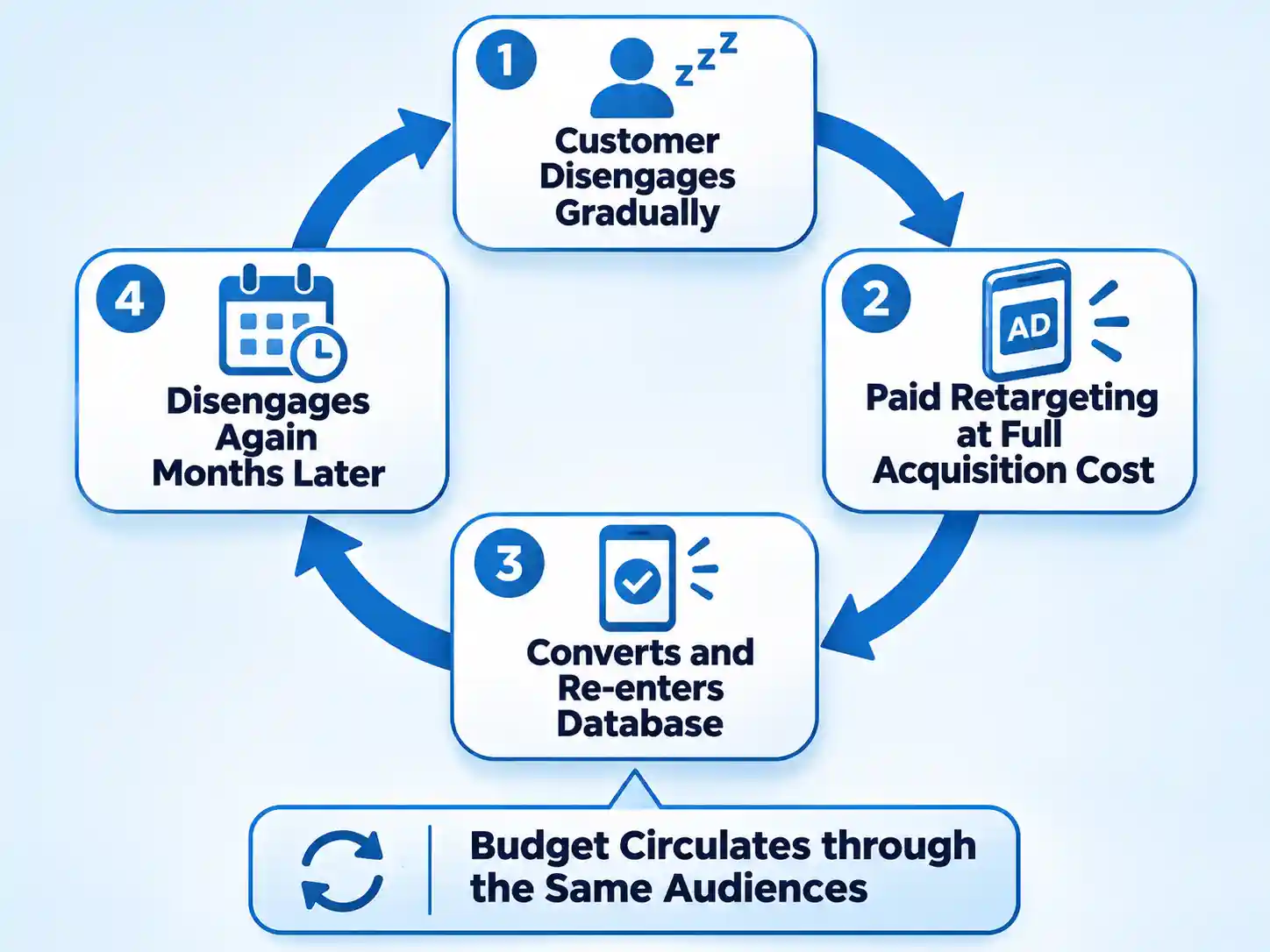
This is a self-reinforcing loop. A customer disengages gradually: purchase frequency drops, email opens fall off, touchpoints thin out. By the time the decline is obvious, owned channels can no longer reach them easily. Paid retargeting becomes the only reliable reconnect. They convert, re-enter the database, and the cycle starts again months later. The budget circulates through the same audiences instead of expanding the customer base.
Owned channels (email, SMS, push, WhatsApp, in-app, on-site) reach known customers directly. There is no ad auction between you and the person who already gave you their number. That is the economic argument for building the engine, and it is why how mobile devices reshaped digital marketing matters here: the phone is where the disengagement happens first, and where the re-engagement has to land.
Vendor-published figures on owned-channel performance exist, and they are worth reading with attribution. Omnisend’s own 2025 report, which analyzed 230 million SMS messages and 413 million push notifications, claims SMS volume growth and higher click rates for automations than campaigns. Those are vendor-reported numbers from a company selling the software. Treat them as directional, not as a benchmark you can bank on.
What You Need Before You Start
Prerequisites
- A CRM export with purchase dates, last-engagement dates, and contact details for every customer.
- Paid audience lists from your ad platform, exportable as a file you can match against the CRM.
- Spend broken down by ad set or campaign, so you can attribute cost to the audiences you are matching.
- A consent capture point on your storefront or mobile web: a form, popup, or preference center you control.
- An SMS-capable platform that handles opt-in records, opt-out keywords, and frequency caps out of the box.
The Five-Step Diagnostic That Sizes the Leak
Run these steps in order. Each one produces a number you will use in the next. Do not skip to the build until you have the overlap percentage from step four.
- Export and segment your CRM.Pull every customer record with purchase date and last-engagement date. Split the list into three buckets: active (purchased or engaged recently), lapsing (no activity for a while), and dormant (no activity for an extended period).
This segmentation is the baseline for everything that follows. A customer who crossed from active to lapsing is in the intervention window: the point where an owned-channel message can still reach them before they become an expensive reacquisition.
Your export should show three clean counts. If the buckets overlap or the dates are missing, fix the export before continuing.
- Export your paid audience lists.Download the audience files from your ad platform: retargeting pools, lookalike seeds, and prospecting lists. Keep them separate so you can match each one against the CRM individually.
Most ad platforms classify retargeting and prospecting separately, but the audiences often contain a mix of new and previously known customers. That overlap is the leak.
You should now have a folder of audience files, each labeled by campaign or ad set.
- Match the audiences against the CRM.Join each paid audience file to your CRM on a stable identifier: email hash or phone number. Count how many records in each audience already exist in your customer database.
This is a data join, not a judgment call. Use a spreadsheet or your CDP. The output is a percentage per audience: what share of the people you are paying to reach already bought from you.
The matched records should reconcile against your CRM total. If the match rate looks implausibly high or low, check for formatting mismatches in the identifier column.
- Calculate the reacquisition premium.Multiply the overlap percentage by the spend on each audience. That product is the reacquisition premium: the money you are spending to reach customers you already own.
Netcore’s diagnostic method describes many brands directing a meaningful share of paid budget toward prior purchasers each quarter, and presents the audit as a self-measurement exercise. Your number will be your own. The method generalizes; the percentage does not.
You should now have a single currency figure: the quarterly reacquisition premium. That is the budget you can redirect toward the owned engine.
- Set the intervention window.Use the cohort analysis from step one to find the point where engagement starts to decline: typically somewhere in the lapsing bucket. That is your intervention window: the moment to send an owned-channel message before the customer becomes a paid reacquisition.
Write the window down as a rule. For example: “Send a replenishment reminder at day 75 of inactivity.” The rule becomes a trigger in section five.
Your CRM should now show a defined lapsing cohort with a clear day count. That count is the input to your first behavior trigger.
| Bucket | Definition | What it tells you | Action |
|---|---|---|---|
| Active | Purchased or engaged within 90 days | Owned channels can reach them cheaply | Nurture with preference-based content |
| Lapsing | No activity for a while | Intervention window: still reachable | Trigger a replenishment or win-back message |
| Dormant | No activity for an extended period | Owned reach is weak; paid becomes the default | Attempt one owned-channel re-engagement, then suppress from paid overlap |
Consent and the SMS Channel
SMS is a mostly paid text messaging service that runs over cellular networks and carries up to 160 characters per message. Go over that limit and the message splits into two, and you pay for both. It is used for mobile marketing, two-factor authentication, banking alerts, and commercial notifications.
That 160-character constraint is not a suggestion. It forces you to write like an operator: one offer, one link, one action. If your message needs a second paragraph, it belongs in email.
Consent is the load-bearing wall of the channel. Every SMS platform requires an opt-in record and a working opt-out (usually a “STOP” keyword) and the sender’s applicable local rules impose their own requirements on top. Check your jurisdiction and your carrier’s rules before you send the first message. An SMS list built from purchased or scraped numbers is not a shortcut; it is a channel-ending mistake that gets your sender ID shut down.
Never import a purchased or scraped phone list into your SMS platform. Consent must be captured directly from the person, recorded with a timestamp, and revocable through a working opt-out. Platforms enforce this, and a violation can end your ability to send on that channel.
Frequency control is a retention lever, not a compliance checkbox. Over-messaging is the fastest route to unsubscribe churn, and unsubscribe churn is the metric that kills the channel. Set a cap before you send anything (weekly for most retail brands, monthly for lower-frequency categories) and hold it.
Questions to Ask an SMS and Journey Platform
You do not need a dedicated platform at small scale. A built-in storefront app can carry you to a few thousand subscribers. At medium scale, the evaluation criteria matter more than the vendor name. Ask these questions before you sign.
| Criterion | Question to ask | Why it matters |
|---|---|---|
| Native SMS routing | Does the platform route SMS directly, or through a third-party gateway? | Direct routing reduces delivery delays and gives you clearer sender reputation data. |
| Journey builder | Can I build a trigger with a condition, a message, and an exit rule without code? | You need to wire behavior triggers yourself, not file a ticket for each one. |
| CRM sync | Does it sync two-way with my CRM, or only import? | Two-way sync keeps segment membership current as customers move between buckets. |
| Consent records | Does it store opt-in timestamps and opt-out events per contact? | You need an audit trail if a subscriber disputes consent. |
| Frequency caps | Can I set a global cap across all journeys? | A per-journey cap lets two journeys double-message the same person. |
Dedicated mobile marketing software platforms bundle these capabilities, and it is worth comparing two or three against the questions above before committing. The criteria decide the vendor, not the other way around.
Staged Zero-Party Capture
Zero-party data is information the customer declares about themselves (preferences, goals, intentions) with consent. It is more accurate than behavioral inference because the customer told you directly. The mistake most brands make is asking for all of it at once.
Progressive profiling spreads the asks across multiple interactions. Each touchpoint requests only the highest-value field you do not yet have. Over three or four interactions, a profile that would have needed an intimidating form assembles itself a couple of questions at a time.
The Four-Stage Capture Ladder
Attach each stage to a natural moment in the customer relationship. The sensitive ask comes last, after trust exists.
- Stage one: the minimum ask.On first visit, request one field: email, or a two-tap mobile signup. Nothing else. The goal is a low-friction conversion that opens the relationship.
Every field you add to a form costs you completions. Ask for twelve things at once and most people bail; ask for one and far more finish. The remaining fields wait for later touchpoints.
Your capture point should show a single field and a clear close button. If a visitor cannot dismiss it with one tap, you have built a bounce trigger.
- Stage two: preference capture.On the second interaction (a return visit, a category browse, a first purchase) ask one preference question. Which category they shop, what they are shopping for, which content topics they want.
Answers given in context are sharper. Asking about a preference right after the customer browsed that category yields a more accurate answer than asking it inside a giant intake form weeks later.
Your subscriber record should now show one preference field populated. If it is blank, the prompt did not fire or the field mapping is broken.
- Stage three: SMS opt-in.Ask for SMS consent only after the customer has shown buying intent: a cart view, a back-in-stock request, a second purchase. Present the opt-in with explicit consent language and a clear statement of what they will receive.
This is the stage where most brands rush. An SMS opt-in asked on the first visit converts poorly and produces a list that unsubscribes fast. Asked after intent, it converts better and holds longer.
Your platform should now show a consent record with a timestamp for that contact. If the record is missing, the opt-in did not register.
- Stage four: behavior-based enrichment.Use behavior to decide the next question. A customer who browsed running shoes gets a question about training frequency. A customer who bought coffee gets a question about brew method. The question arrives when it is most relevant.
This stage never re-asks a known field. A “smart” system that asks for a name it already has erodes trust faster than any other failure mode. Skipping known fields is the whole point of progressive profiling.
Your profile should now show a mix of declared fields and behavior-derived fields, with no duplicates. If a known field is being re-asked, audit the field-mapping logic before you expand.
Safeguards to verify before you expand
- Every capture point has a clear close button that dismisses with one tap.
- Frequency caps are set globally, not per campaign, so no contact receives two prompts in the same session.
- Consent language is explicit and stored with a timestamp for every SMS opt-in.
- No capture point asks for a field the system already knows.
- Every question you ask changes a decision downstream; if it does not, remove it.
Behavior-Triggered Journeys
Generic promotional blasts can train customers to ignore you. Behavior triggers send the right message at the moment the customer’s action makes it relevant. Mobile campaigns tend to work best when they focus on behavior and timing, and a well-timed notification can often do more than a highly creative campaign delivered at the wrong moment.
Wire three triggers first. Add more only after the first three run clean for a full data window.
Wire Three Triggers With Exit Rules
Each trigger needs a condition, a message, and an exit rule. The exit rule is what stops the journey when the customer acts, opts out, or hits the frequency cap.
- Cart and browse recovery.Condition: a customer adds an item to cart or views a product page and leaves without purchasing. Message: a short SMS or push reminder with a direct link back to the cart.
Timing matters more than copy. A cart-recovery message sent while purchase intent is still high converts better than one sent a day later. Set the delay to the shortest window your platform supports.
Exit rule: the customer purchases, opts out, or hits the frequency cap. The journey should stop on any of the three. Verify by checking that a test purchase removes the contact from the journey.
- Back-in-stock alerts.Condition: a customer requests notification for an out-of-stock item. Message: a single SMS when the item returns, with a direct link to the product page.
This trigger is a promise. Send it once, promptly, and only when the item is actually back. A late or duplicate back-in-stock message reads as a broken system and drives unsubscribes.
Exit rule: the customer purchases, opts out, or the item goes out of stock again before the message sends. Verify by restocking a test item and confirming exactly one message fires.
- Post-signup enrichment and post-delivery follow-up.Condition: a new subscriber completes stage one of the capture ladder, or a customer’s order is marked delivered. Message: a preference question for the new subscriber, or a replenishment reminder timed to the product’s typical use cycle for the delivered order.
These are trigger patterns you configure in your journey builder. Price-drop alerts and post-delivery follow-ups follow the same structure: a condition, a message, and an exit rule. Build them once the first three run clean.
Exit rule: the customer answers the question, purchases, opts out, or hits the frequency cap. Verify by running a test contact through each journey and confirming the exit fires.
Location-Aware Offers
Location-based marketing delivers offers based on a customer’s current location, and it is a legitimate campaign type for retail and regional businesses with physical presence. Geo-targeting is used to drive foot traffic to stores or events.
Geofence configuration (radius, dwell time, trigger mechanics) is platform-specific. It varies by vendor and by operating system, and the setup steps are documented in your chosen platform’s own documentation. Verify the mechanics there before you promise a location campaign to your team. Do not assume a geofence behaves the same way across two platforms.
If you are building the trigger layer now, staying ahead of competitors on mobile comes down to which triggers you wire first and how cleanly they exit. Location offers are a later addition, not the foundation.
Verification: What to Check After Launch
Signup rate is the wrong metric to judge a progressive capture system. It measures the first step and tells you nothing about whether the profile is usable or the channel is healthy. Track the metrics below instead.
| Metric | What it reveals | Where to observe it |
|---|---|---|
| Step completion | Whether each stage of the capture ladder converts | Your capture platform’s funnel report |
| Segment coverage | What share of subscribers have each profile field populated | CRM field-completion report |
| Revenue per subscriber | Whether the channel is producing revenue, not just messages | Attribution report joined to subscriber count |
| Unsubscribe churn | Whether frequency and relevance are sustainable | SMS platform opt-out report |
| Cohort retention | Whether subscribers stay engaged past the window you defined | CRM cohort review over time |
Judge the engine by complete results, not one number. A high signup rate with rising unsubscribe churn is a failing channel. A modest signup rate with stable churn and growing revenue per subscriber is a working one.
Verify the result
- Every stage of the capture ladder shows a completion rate you can read, not a blank report.
- Segment coverage shows the fields you intended to collect are actually populated.
- Revenue per subscriber is tracked against a baseline, not reported as a single campaign total.
- Unsubscribe churn is stable or falling across the first data window.
- Each trigger fires once per contact and exits on purchase, opt-out, or frequency cap.
Recovery and the Expansion Gate
Failure modes in an owned engine are predictable. The recovery path depends on which one you hit.
Unsubscribe churn spikes after a send
Frequency is the usual cause. Pause the journey that fired, lower the global cap, and re-check relevance before resuming. If churn stays elevated after the cap change, the message is reaching the wrong segment: audit the trigger condition. Do not resume sending until churn returns to its pre-spike level.
Consent records are missing or unclear for part of the list
Suppress the affected contacts from all SMS journeys immediately. Re-capture consent through the stage-three opt-in before re-adding them. A contact without a stored opt-in timestamp is a liability, and the platform can shut down your sender ID over it. Check your jurisdiction’s rules and your carrier’s requirements before you resume.
The platform changes its routing, pricing, or API
Freeze new journey builds until you have re-read the platform’s current documentation. Test one journey end-to-end on the new configuration before resuming the rest. If the change affects consent handling or opt-out keywords, re-verify those first: they are the load-bearing wall.
A trigger fires twice or fires late
Check the exit rule first. A missing or misconfigured exit lets the journey re-enter the same contact. If the exit is correct, check the trigger’s delay window and the platform’s send queue. Late sends usually indicate a routing delay, not a logic error.
A shared device is receiving messages meant for one person
This is a device-hygiene issue, not a marketing one. On shared or public computers, messaging sessions should be unpaired when the user is done. Google Messages, for example, auto-unpairs after weeks of inactivity and advises manual unpairing on shared machines. Apply the same discipline to any web-based messaging session your team uses.
Info
Expansion gate: do not scale the engine until you have a clean data window (at minimum 30 days) showing stable unsubscribe churn, populated segment coverage, and a revenue-per-subscriber trend you can read. If any of the three is unclear, extend the window before adding volume.
The Decision Rule
Build the engine if the audit shows a material reacquisition premium: a slice of paid spend large enough that redirecting it toward owned channels changes your margin. If the overlap is small, the engine is not worth the operational cost yet, and you should revisit the audit next quarter.

💬 Comments