Acquisition spend does not buy shelf space, distributor trust, or a working credit cycle. A D2C brand can spend its way to a million app installs and still lose the counter to a ₹5 pack that has sat in the same kirana for years.
The five lessons below come from legacy Indian enterprises that solved these problems decades before “D2C” existed. Each one ends with a decision rule you can apply this quarter.
Quick Take
Indian general trade runs on five mechanics that digital-first brands tend to ignore: price-point engineering, controlled cold chain, distributor credit discipline, portfolio focus, and realistic channel costs. Legacy firms like Parle, Amul, and Royal Enfield built durable businesses by mastering them. The practical order for a D2C founder is to fix the price pack, then the credit cycle, then prune the portfolio, and only then scale distribution spend.
Why the digital playbook breaks at the shelf
Online, you control the shelf. You decide what the customer sees, in what order, and at what price. In general trade, a kirana owner with roughly two metres of counter space decides that for you, and their priority is inventory turnover, not novelty.
The scale of that channel is hard to overstate. India’s general trade ecosystem comprises over 1.4 crore kirana stores and accounts for nearly 75–80 per cent of FMCG sales, according to DPIIT and ONDC’s DigiDukaan roundtable briefing. Much of it still runs on fragmented ordering, limited inventory visibility, and manual sales processes. That is the market you are entering.
Meanwhile, the digital channel has its own cost structure. Quick-commerce firms have been reported burning roughly ₹1,500 crore a month across the sector, per Economic Times reporting. That figure is a sector-level estimate, not a per-brand benchmark, but it tells you something useful: the platforms selling your product are themselves subsidised. Building a margin model on top of a subsidised channel is a bet on someone else’s balance sheet.
The shelf, by contrast, has been priced by decades of competition. Retailers earn margins of only 7–8 per cent on low-priced FMCG packs while bearing rent, electricity, and staffing costs, according to trade estimates cited by Outlook Business. Every rupee you ask for has to come out of a number that is already thin.
Lesson 1: Engineer the price point before you engineer the ad
Parle G is the clearest case study in Indian price-pack engineering. Its small pack weighed 100 g in 1994 and had shrunk to 55 g by 2022 (a 45 per cent grammage cut) while the price stayed at ₹4 until 2021, when it moved to ₹5. The brand held a familiar price point for nearly three decades by shrinking the product instead of the number on the wrapper.
| Year | Pack weight | Price point |
|---|---|---|
| 1994 | 100 g | ₹4 |
| 2022 | 55 g | ₹5 (raised from ₹4 in 2021) |
The mechanism is straightforward once you see it. A ₹5 note is a physical object in a customer’s hand. Moving that pack to ₹6 or ₹7 breaks the transaction: the buyer now needs change, or a second coin, and the purchase stops being thoughtless. As one trade expert put it in the same report, a product priced at ₹5 cannot easily move to ₹6 or ₹7; brands instead migrate consumers to the next established price point.
That lever has limits, and they are arriving now. Packaging accounts for a larger share of the selling price on smaller packs, and the margin on ₹5–₹10 packs is described as remaining challenging even by consultants advising the sector. Analysts quoted in the report expect the ladder to shift upward over time: ₹10 becoming the new ₹5, and so on. Shrinkflation is approaching its ceiling.
There is also a distribution cost that small packs carry disproportionately. Retailers must stock many low-value packets to generate meaningful sales, and display space is finite. Transporting lightweight, air-filled snack packets is expensive relative to their value; a truckload of chips from Delhi to Mumbai can cost around ₹1 lakh against goods worth ₹3–5 lakh. That economics favours brands manufacturing within roughly 100–500 km of their market.
What to do: Before you spend on acquisition, model your entry pack at the exact price point your category already trades at, and calculate the gross margin after trade margin and freight. If it does not clear your floor, either move your manufacturing closer to your first market or launch at the next price point up. Do not plan to shrink grammage indefinitely: build a migration path to a higher price point from day one. If you are benchmarking against established biscuit players, a look at commercial biscuit brand rosters shows how crowded the low price-point tiers already are.
Lesson 2: Control the temperature-sensitive link, not the whole chain
Amul’s advantage in dairy was never a single clever product. A peer-reviewed comparative study of Amul and Danone in the Asian Journal of Dairy and Food Research describes Amul’s structured traditional supply chain as the backbone of its position, and notes that Amul lagged Danone in adopting emerging technologies across that chain. Read that carefully: Amul’s edge came from coordination and physical control of a perishable chain, not from being the most technologically advanced operator.
That distinction matters for a D2C founder. Cold chain is capital-heavy and coordination-heavy. You cannot copy Amul’s scale, and you should not try. What you can borrow is the principle: own or tightly control the link where temperature failure destroys the product, and build the producer relationship at the origin.
For a D2C food or beverage brand, that usually means one of two structures. Either you contract a cold-chain logistics partner and hold them to documented temperature windows with audit rights, or you run your own refrigerated leg for the highest-risk segment of the journey: typically the last mile into retail. The first is cheaper to start; the second gives you control where spoilage losses concentrate.
What to do: Map your product’s journey and mark every point where a temperature excursion would make the unit unsellable. If more than one of those points sits outside your control, you are running a cold chain you cannot see. Fix the highest-risk link first. If you are weighing which cold-chain categories have room, regional ice cream brand rankings show how fragmented that shelf still is.
Lesson 3: Distributor credit is where D2C margins quietly die
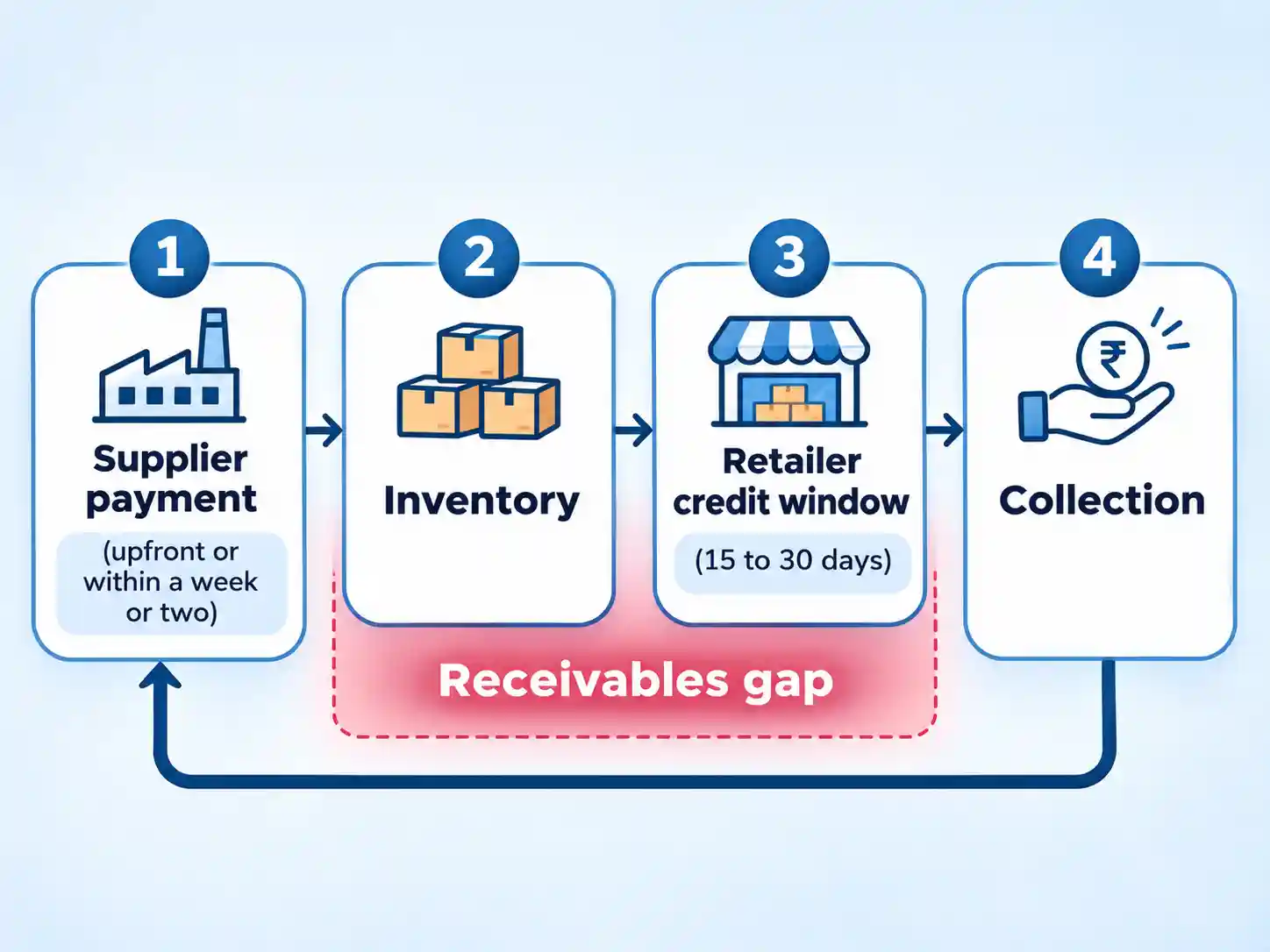
This is the lesson most digital-first founders learn last and pay for most. The FMCG distribution model runs on a structural cash mismatch: payments to suppliers fall due upfront or within a week or two, while credit extended to retailers stretches 15 to 30 days. Money leaves faster than it returns, permanently.
The arithmetic is unforgiving. A distributor with ₹20 lakh monthly turnover and a 21-day average collection period has roughly ₹14 lakh locked in receivables at any given moment: that is ₹20 lakh × 21/30, per the worked example in IIFL’s distributor finance guide. That capital is not lost, but it is unavailable for stock, and stock is what generates the next sale.
Kirana owners are not being difficult when they ask for credit. They are managing their own thin margins on low-priced packs. The trust that gets you paid on time is built through consistent fill rates, reliable scheme settlement, and a salesperson who shows up: the same things DPIIT’s DigiDukaan initiative is trying to digitise through order and collection tracking, with early traction of more than 10,000 retailers and over 35 brands onboarded in Hyderabad.
What to do: Before you sign your first distributor, calculate your receivables lock-up at realistic collection periods and confirm you can fund it without starving stock. Then set a hard credit ceiling per distributor and review receivables days monthly. If your collection period is drifting past your terms, that is a margin problem wearing a logistics costume.
Lesson 4: Prune to the profitable core before you scale distribution
Royal Enfield’s turnaround is usually told as a brand story. The operational version is more useful. As Business Today’s case study lays it out: despite the bikes’ fan following, the motorcycle division was bleeding. The way out was appealing to a wider base and making the products more reliable. The challenge was modernising without stripping the identity that made the brand worth saving.
Notice what is absent from that account: a sprawling new product line. The turnaround came from making the core offering better and more broadly sellable, while retaining what made it distinctive. Siddhartha Lal is credited with driving that turnaround at Eicher Motors.
For a D2C founder, the parallel is capital allocation. Every SKU you carry consumes working capital in stock, shelf space at the retailer, and distributor attention. A long tail of low-velocity variants makes your fill rate worse on the products that actually sell. Distributors and retailers both prioritise turnover, and a brand with twelve SKUs where three move is a brand that gets deprioritised.
What to do: Rank your SKUs by contribution margin per unit of shelf space and per rupee of working capital tied up. Cut the bottom third before you expand into a new region. A tighter range with reliable availability beats a broad range with patchy fill.
Lesson 5: Compare channel costs honestly, not aspirationally
Quick commerce is a real channel with real customers. It is also, at sector level, a heavily subsidised one. The reported ₹1,500 crore monthly burn across quick-commerce firms is the clearest available signal that the economics of fast delivery are still being worked out by companies with far deeper pockets than yours.
Physical distribution has its own costs, and they are not small: trade margin, freight, distributor margin, sales force, and the working capital locked in receivables. But those costs are visible, negotiable, and stable. You can model them. You can renegotiate freight. You can shorten a credit cycle. A platform subsidy, by contrast, can be withdrawn on someone else’s timetable.
The honest comparison is not “digital is expensive, physical is cheap.” It is that physical distribution costs are legible and within your influence, while platform economics are set by parties whose interests are not aligned with your margin.
What to do: Build a channel P&L that puts quick commerce, marketplaces, your own site, and general trade side by side, using fully loaded costs including working capital. Then decide where each channel earns its place. Treat platform volume as a distribution opportunity, not as proof of durable margin.
The numbers to watch
Five metrics tell you whether your distribution is holding or quietly leaking. All of them are observable from your own books and your distributors’ reports; none require platform telemetry you cannot access.
| Metric | What it signals | Where you observe it |
|---|---|---|
| Receivables days | How much working capital is trapped between your payment to suppliers and collection from retailers | Your own ledger and distributor statements |
| Fill rate | Whether retailers can actually get the SKUs they order; low fill rate erodes trust fast | Distributor order versus dispatch records |
| Shelf turnover per SKU | Which products earn their shelf space and which are dead weight | Retailer reorder frequency |
| Secondary sales visibility | Whether stock is moving off retail shelves or piling up in the distributor’s godown | Retailer-level sales data, or digitised order and collection records |
| Contribution margin per pack | Whether your price point survives trade margin and freight | Your own cost sheet |
Secondary sales visibility is the one most D2C founders lack, and it is the one that matters most. Primary sales (what your distributor buys from you) can look healthy while stock sits unsold. Digitised order and collection systems are closing that gap across general trade, and the same discipline applies at your scale. A structured approach to tracking retailer relationships, as covered in this guide to CRM strategy for modern business, is the practical starting point.
The order to do this in
These five lessons are not equally urgent. Here is the sequence that keeps a cash-constrained D2C brand from scaling a broken model.
- Fix the entry price pack. Confirm the gross margin after trade margin and freight clears your floor before you approach a single distributor.
- Model your receivables lock-up. Calculate how much capital sits in the credit gap at realistic collection periods, and confirm you can fund it.
- Prune the portfolio. Cut low-velocity SKUs so your fill rate on the core range is reliable.
- Secure the temperature-sensitive link if your category needs it. Control the highest-risk point in the chain before you widen distribution.
- Then scale channel spend, with a channel P&L that treats platform volume as an opportunity rather than a margin guarantee.
The bottom line
The practical test is simple: can each pack leave enough margin, can stock keep moving, and can cash return in time to fund the next replenishment cycle? If the answer is no, wider distribution will magnify the weakness rather than fix it.

💬 Comments