There is no cheaper fulfillment method in the abstract. There is a cheaper method per SKU, and the difference shows up first in your cash position, not your fee invoice. Fulfillment by Amazon converts working capital into prepaid per-unit fees and inventory locked inside Amazon’s network. Fulfillment by Merchant converts it into warehouse space, labor, and carrier relationships you own. Pick the structure that matches your product’s size, weight, and velocity, and you stop guessing.
Quick Take
FBA prepays fees and parks your stock in Amazon’s warehouses, so cash leaves early and storage costs compound on slow movers. FBM carries fixed overhead and keeps inventory under your roof, so cash leaves per order and you absorb the labor. Small, light, fast-turning SKUs usually favor FBA; bulky, heavy, fragile, slow, or restricted SKUs usually favor FBM. Most established catalogs run both, assigned SKU by SKU.
The Same Product, Two Very Different Cash Profiles
Amazon gives sellers both methods and lets you combine them per product, so the choice is never all-or-nothing at the account level. The official framing is straightforward: FBA runs on a pay-as-you-go model where costs track product size, weight, dimensions, storage duration, and returns, while FBM costs come from your own in-house processes and carrier arrangements (Amazon Seller Central).
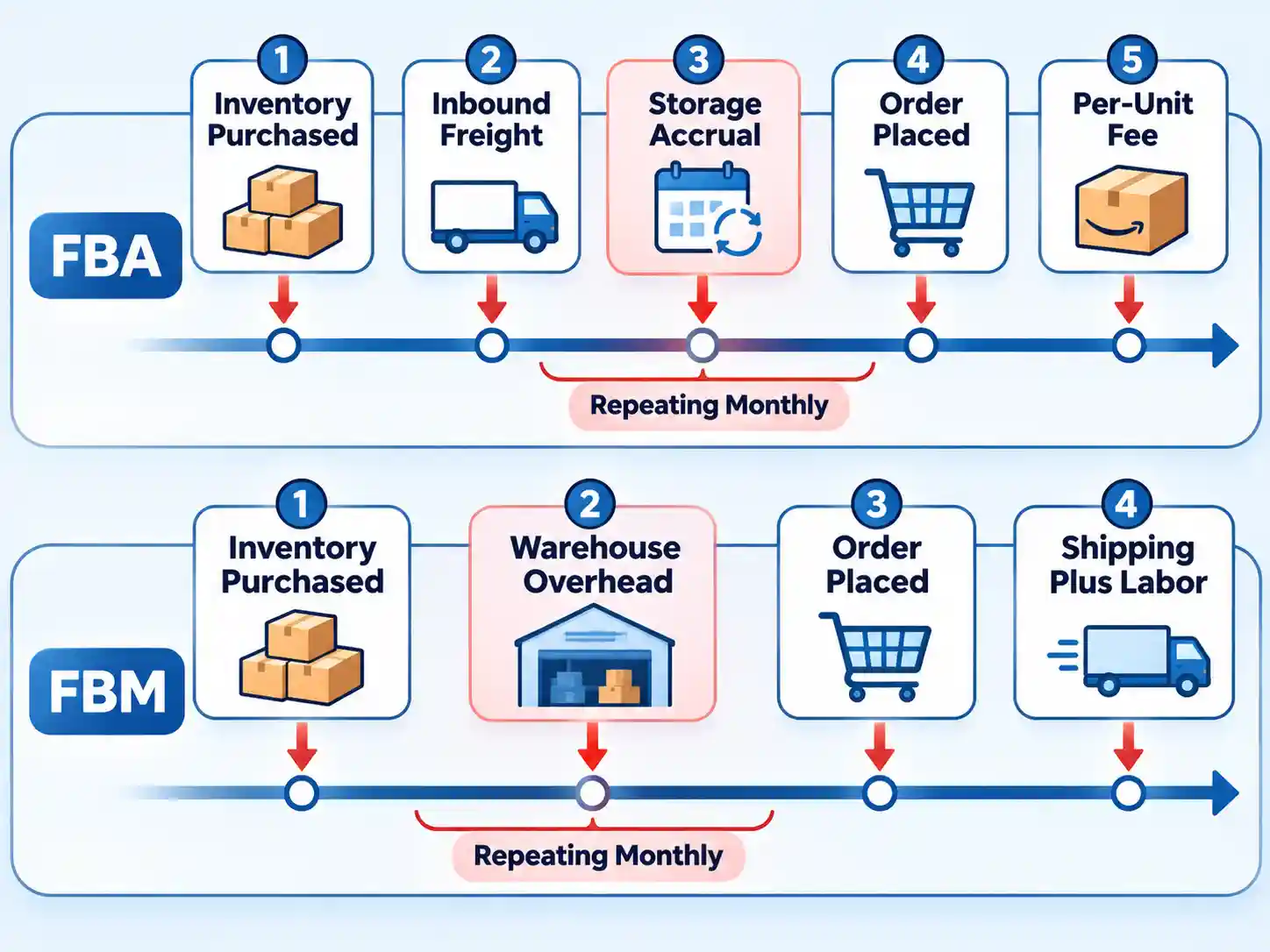
That difference in where costs land is the whole decision. Under FBA you pay before you sell: inbound freight, prep, and then a per-unit fulfillment fee plus storage accrual for every month the stock sits. Under FBM you pay as you ship: postage, box, tape, and the hourly cost of the person packing it. Same product, same referral fee, two entirely different cash curves.
| Capital line | FBA | FBM |
|---|---|---|
| Inventory purchase | Committed at supplier order, then shipped into Amazon | Committed at supplier order, held in your facility |
| Inbound freight | Paid upfront to move stock to fulfillment centers | Paid upfront only if you replenish a warehouse; otherwise per-order carrier cost |
| Storage | Accrues monthly on cubic volume inside Amazon | Fixed rent, utilities, and shelving in your own space |
| Per-unit fulfillment | Charged at the moment of sale | Postage and packing materials charged per order |
| Labor | Absorbed by Amazon inside the fee | Your payroll or your own hours |
| Returns | Amazon processes; returns fees apply in covered categories | You inspect, restock, and refund |
Where Your Cash Actually Sits
The clearest way to see the difference is to follow one SKU through a quarter. Under FBA, cash leaves the business in three waves: when you pay the supplier, when you pay to move the pallet into Amazon, and then continuously as storage accrues on whatever hasn’t sold. By the time the first order lands, you have already spent money on inventory that may sit for months. That is the real capital cost of FBA, and it is why slow-moving stock inside Amazon’s network can quietly bleed a margin that looked healthy on the calculator.
Under FBM, the same inventory sits in your building. You still paid the supplier, but you are not paying Amazon to hold it, and you are not paying inbound placement to distribute it across fulfillment centers. What you carry instead is fixed overhead: rent, shelving, a packing bench, and the people or hours to run them. That overhead only pays for itself at volume, or when you already have the space and staff in place for other reasons.
This is the trade in one line: FBA turns variable operational work into predictable per-unit fees and pulls your cash forward. FBM keeps your cash closer and your inventory visible, at the price of running fulfillment as a real operation. Neither is free. FBA’s cost is committed inventory plus a fee stack that grows with size, weight, and dwell time. FBM’s cost is overhead that sits there whether you ship ten orders or a thousand.
The Fee Stack and Storage Overhead
FBA is not a single charge. It is a stack, and each layer responds to a different property of your product. Amazon’s own program pages list the categories: fulfillment fees, monthly storage, returns processing, removal, disposal, and liquidation, and inbound placement service (Amazon FBA program page). Secondary guides add aged-inventory surcharges on top.
- Fulfillment fee — charged per unit, scaled by size tier and weight. This is the layer that punishes bulky goods fastest.
- Monthly storage — charged on the cubic volume your stock occupies, and typically higher during peak season.
- Aged-inventory surcharge — an escalating charge on units that sit past a long-tenure threshold. Slow movers pay this every month until they sell or get removed.
- Inbound placement — a charge tied to distributing your inbound shipment across multiple fulfillment centers.
- Returns processing — applied in categories where Amazon provides free customer returns.
- Removal, disposal, and liquidation — per-item charges when you pull stock out of the network.
Treat every rate as a moving target. Amazon sets these schedules and revises them periodically, sometimes more than once a year, and the direction is not uniform. Recent cycles have included both fee reductions in some regions and new surcharges in others. Any figure you read online, including in this article’s worked example, is illustrative and region-specific. Confirm current rates in Seller Central or through Amazon’s Revenue Calculator before you commit a purchase order.
Warning
Storage and aged-inventory charges compound monthly. A SKU that looks profitable at a two-month sell-through can turn into a loss by month eight. Model your worst-case dwell time, not your average.
The Prime and Featured Offer Trade vs. the Fee and Storage Trade
FBA’s headline benefit is real: Prime eligibility and a better shot at the featured offer. Amazon’s UK fulfilment page states plainly that FBA products display the Prime badge and improve your chance of winning the featured offer spot (Amazon UK fulfilment). That badge matters because Prime shoppers filter for it, and a listing without it can be invisible to a large share of buyers.
What FBA does not do is guarantee the Buy Box. Price, seller metrics, inventory depth, and fulfillment speed all feed the algorithm. FBA improves your odds; it does not hand you the sale. Sellers who plan their whole margin around an assumed Buy Box win are building on sand.
FBM’s counter-trade is control and margin retention. You keep the difference between your real shipping cost and what FBA would have charged, you avoid aged-inventory and inbound placement fees entirely, and you can put your own packaging and inserts in the box. Amazon’s UK page frames FBM as the fit for tighter margins and for products that are eligible to sell but ineligible for FBA. The cost is that you own the delivery promise. Late shipments and invalid tracking hit your seller metrics directly.
Seller Fulfilled Prime is the bridge. It lets you ship from your own warehouse and still show the Prime badge, but only if you clear Amazon’s bar. Expect a trial period, weekly-reviewed performance thresholds on late shipment, valid tracking, and cancellation rates, and delivery-speed expectations that vary by size tier. SFP is an operational commitment, not a checkbox.
Inbound Freight and Pallet Movement
Getting stock from a port or regional warehouse to a fulfillment center is a real capital line, and it is easy to underestimate. Amazon may split a shipment across multiple centers, which means multiple freight legs instead of one. For sellers moving palletized stock, comparing carrier quotes before booking is the difference between a manageable inbound cost and a painful one.
Transport marketplaces are one route to those quotes. Shiply, for example, is a UK-based marketplace where transport providers bid in a reverse-auction format: you post the job, providers bid, and you choose. Posting is free, but fees are charged once you accept a bid, and the platform operates across multiple countries including the US and Canada. If you are moving palletized inventory and want competing quotes from independent haulers, a freight shipping courier marketplace can be a practical starting point.
Verify carrier credentials before you book. Reporting has raised concerns that some carriers bidding on loads lack active operating authority, and that the platform does not disclose motor carrier registration details during bidding. Ask for the paperwork directly and confirm insurance before your pallet leaves the dock.
Packaging, Labeling, and Prep
Every unit you send to FBA has to arrive prepped to Amazon’s requirements: poly-bagged or boxed, FNSKU-labeled, and packed to spec. You can do that work in-house or pay Amazon to do it for you. The comparison is simple arithmetic once you know your own labor rate.
- In-house prep — you buy the labels, bags, and tape, and you pay someone (or yourself) to apply them. Cheaper per unit at volume, but it consumes hours you could spend on sourcing or advertising.
- Amazon prep — a per-unit fee that removes the labor from your plate. Convenient for small runs and for sellers without staff, expensive at scale.
- FBM prep — no FNSKU requirement, but you still pay for boxes, void fill, and the time to pack each order. The materials cost is similar; the labor is per-order instead of per-inbound-shipment.
The judgment call: if your prep labor costs more per unit than Amazon’s prep fee, pay Amazon. If you already run a packing line for other channels, do it yourself and keep the margin.
Advertising as a Capital Line Item
Sponsored Products is a cost-per-click model. There is no monthly or upfront fee, you set your own bids and daily budget, and you pay only when a shopper clicks. Ads require your product to be eligible for the featured offer, and they can appear in search results, on product pages, and on Amazon-owned and third-party destinations.
That structure matters for fulfillment math because ad spend is a per-order cost that stacks on top of whichever fulfillment method you chose. Your break-even is not the fulfillment fee plus referral fee. It is fulfillment plus referral plus ad cost per acquired order plus returns. If your FBA fee is high and your ad cost per order is high, the two compound. If you move that SKU to FBM and cut the fulfillment fee, the same ad spend now clears a wider margin.
Structure your campaigns around your actual unit economics. If you want a deeper playbook on campaign structure, bidding, and budget pacing, these Sponsored Product ad strategies are worth reading alongside Amazon’s own documentation. Treat any third-party strategy guide as a starting point and validate results against your own campaign reports.
Net Margin Reality Check
Here is a worked comparison using clearly illustrative inputs. Replace every number with your own from the Revenue Calculator and your carrier quotes. The point is the framework, not the figures.
| Line item | FBA (illustrative) | FBM (illustrative) |
|---|---|---|
| Sale price | 40.00 | 40.00 |
| Referral fee | -6.00 | -6.00 |
| Fulfillment fee | -5.50 | 0.00 |
| Shipping and materials | 0.00 | -6.50 |
| Storage accrual (per unit, amortized) | -0.80 | 0.00 |
| Warehouse overhead (per unit, amortized) | 0.00 | -1.20 |
| Labor (per unit) | 0.00 | -1.80 |
| Ad cost per order | -6.00 | -6.00 |
| Returns allowance | -1.50 | -1.50 |
| Product cost | -12.00 | -12.00 |
| Contribution per unit | 8.20 | 5.00 |
In this constructed example, FBA wins because the fulfillment fee is low and storage barely registers. Flip the inputs to a heavy, slow-moving product and the picture reverses: the fulfillment fee climbs, storage accrues for months, and the FBM overhead gets spread across fewer orders but avoids the compounding storage charge. The figures are purely hypothetical, so substitute your own inputs. Run both columns for every SKU that matters. The method that leaves the most contribution per unit is the one to use.
Decision Rules by Product and Seller Type
Small, light, fast-turning SKUs
Bulky, heavy, or oversized products
Slow-moving or seasonal stock
Fragile, high-value, or custom items
Sellers with existing warehouse or 3PL capacity
New sellers testing a product
Switching Costs and Constraints
Moving a SKU between methods is not a toggle. It is a per-SKU conversion with real friction, and the friction runs in both directions.
FBA to FBM means pulling your inventory out. That triggers removal or disposal fees, and it takes time for the stock to arrive at your facility. During the gap, the listing can go out of stock, which damages ranking and featured-offer eligibility. Plan the switch around a replenishment cycle, not in the middle of one.
FBM to FBA means prepping and shipping stock into the network, waiting for it to check in, and accepting that Amazon may split the shipment across centers. If you are chasing Prime eligibility through SFP instead, you face the trial and the ongoing performance bar. Miss the thresholds and you lose the badge.
The most useful switching tactic is to run both methods on the same listing. Keep FBM as a backup channel so that when your FBA stock sells out or gets stuck in receiving, you can still fulfill from your own warehouse and avoid going out of stock. That backup protects ranking and featured-offer position during the gaps.
Info
Amazon’s Revenue Calculator lets you model both fulfillment methods side by side for a specific product using current rates. Run every SKU through it before you assign a method, and re-run it whenever Amazon revises its fee schedule.
The Per-SKU Test You Can Repeat
Fulfillment is a capital-structure decision, and it deserves a repeatable test rather than a one-time gut call. Run this on every SKU that carries meaningful revenue.
- Pull the SKU’s dimensions, weight, and current sell-through rate. These three inputs drive most of the cost difference.
- Model the FBA contribution per unit in the Revenue Calculator, including storage accrual at your realistic dwell time and a returns allowance.
- Model the FBM contribution per unit using your actual carrier quotes, packing materials, and labor rate, with overhead amortized across your real order volume.
- Assign the method that leaves the higher contribution, and keep the other method as a backup channel on the same listing.
Most established catalogs end up hybrid: FBA for the fast-moving core, FBM for the oversized, fragile, seasonal, and long-tail items, and FBM as a safety net on FBA listings. That split is not a compromise. It is the structure that keeps the most cash working and the fewest units stranded.
Re-run the test whenever Amazon changes its fee schedule. A method that made sense last quarter may not survive the next surcharge.

💬 Comments