The Canon EOS R7 carries more megapixels; the Canon EOS R6 Mark II carries a bigger sensor. That single tension explains almost every buying decision between these two bodies. The R7 puts 32.5 megapixels on an APS-C chip and fires up to 30 fps with the electronic shutter, which is why it suits distant wildlife and fast sport. The R6 Mark II pairs a full-frame sensor with a far higher ISO ceiling, which is why it handles dim rooms, wide angles, and clean high-ISO files with less strain. Pick the body that matches the photos you actually take.
Quick Take
Reach and speed point to the R7. Light-gathering and wide framing point to the R6 Mark II. Neither body wins outright, and the megapixel number on the box tells you less than the sensor behind it.
Why Megapixels Alone Don’t Decide Photo Quality
A bigger number feels like a better camera, and camera marketing leans into that instinct. It’s a trap. Megapixels describe how many pixels the sensor records, not how good each one is, and sensor image quality is measured across several separate dimensions at once.
DxOMark’s camera sensor testing protocol is a useful window into how that works. It measures RAW sensor performance before demosaicing or any JPG processing, and it scores sensors on color sensitivity, noise (standard deviation, signal-to-noise ratio, dynamic range, and tonal range), and ISO sensitivity. Those metrics feed three use-case scores (Portrait for color depth, Landscape for maximum dynamic range, and Sports & action for low-light ISO) plus an overall score.
Info
DxOMark normalizes its Sensor Overall Score to a defined printing scenario: an 8 MP print at 8×12 in (20×30 cm) at 300 dpi. That normalization is why a higher-megapixel sensor doesn’t automatically score higher, since the comparison is leveled to a common output size.
The protocol also sets interpretation thresholds worth keeping in mind. DxOMark describes 22-bit color sensitivity and 12 EV dynamic range as excellent, and treats a 25% difference in low-light ISO as roughly 1/3 EV, which is only slightly noticeable. Small gaps between two sensors often evaporate in real photographs. The R6 Mark II and R7 differ in ways that matter, but the differences are specific, not a blanket “one is better.”
Side-by-Side Specification Table
Both sets of figures below come from Canon’s official specification pages for each body. Read them as manufacturer-stated specifications, which is exactly what they are.
| Specification | Canon EOS R6 Mark II | Canon EOS R7 |
|---|---|---|
| Sensor type and size | 35.9 × 23.9 mm CMOS (full-frame) | Approx. 22.3 × 14.8 mm CMOS (APS-C) |
| Effective megapixels | Approx. 24.2 MP | 32.5 MP |
| Total megapixels | Approx. 25.6 MP | 34.4 MP |
| Lens mount | RF (EF and EF-S via mount adapter) | RF (natively supports RF and RF-S; EF/EF-S via adapter) |
| Focal-length equivalence | 1.0x with RF/EF lenses; 1.6x with RF-S/EF-S | 1.6x with RF/RF-S and EF/EF-S lenses |
| Autofocus system | Dual Pixel CMOS AF II | Dual Pixel CMOS AF II |
| AF working range | EV -6.5 to 21 (at 23°C, ISO 100) | EV -5 to 20 (at 23°C, ISO 100) |
| ISO sensitivity | 100–102400, expandable to L:50 / H:204800 | Standard maximum ISO 32,000 |
| Sensor-shift stabilization | Up to 8 stops depending on lens | Up to 8 stops depending on lens (7 stops with RF-S 18-150mm F3.5-6.3 IS STM) |
| Shutter speed range | Mechanical 30–1/8000 s; electronic 30–1/16000 s | Up to 15 fps continuous; 30 fps bursts with electronic shutter |
| Anti-flicker | 100/120 Hz | 100/120 Hz |
What Each Difference Means
Sensor size: the biggest structural difference
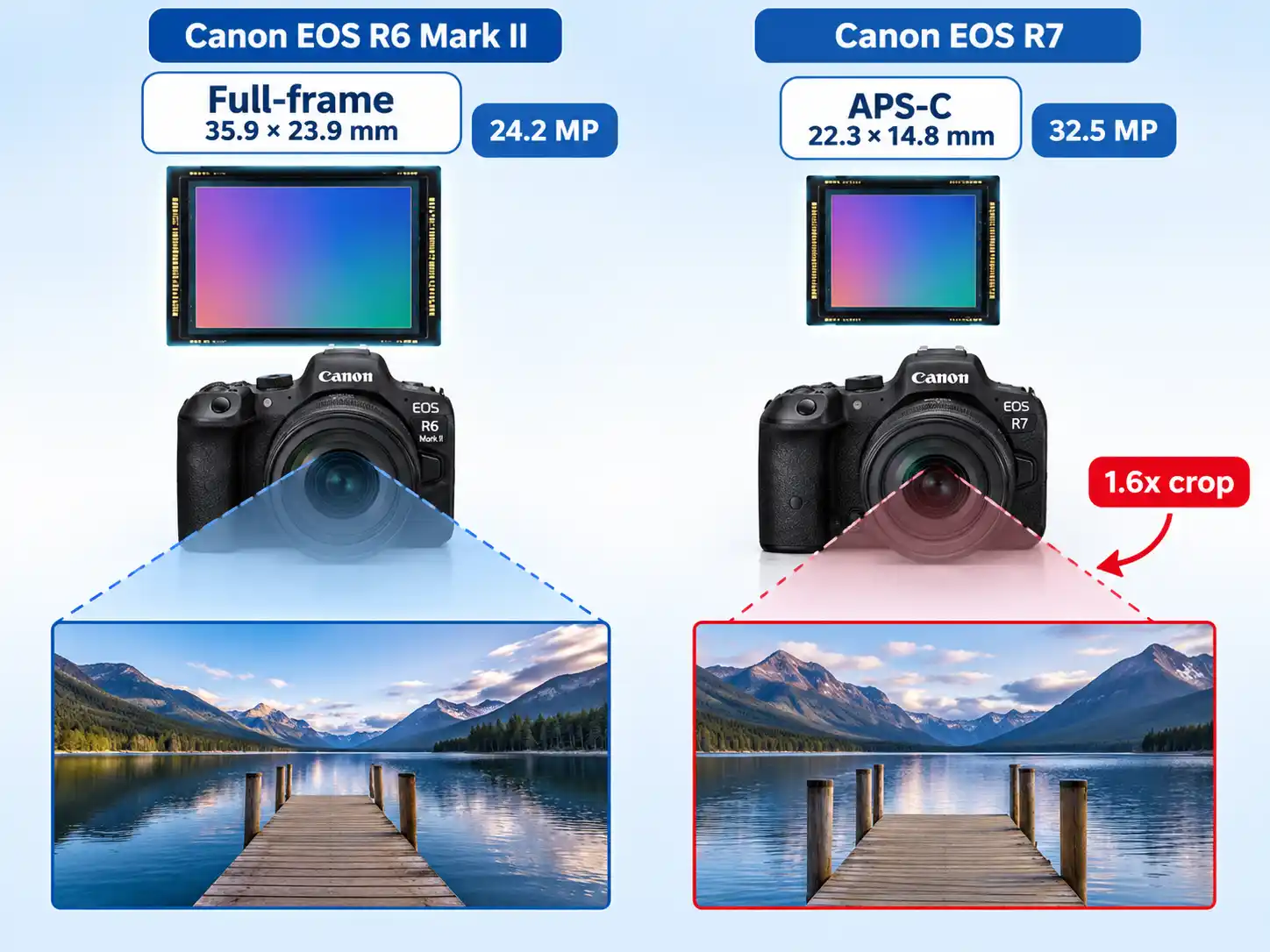
Canon lists the R6 Mark II sensor as 35.9 × 23.9 mm CMOS, which is full-frame. The R7 is an APS-C body at approximately 22.3 × 14.8 mm. That’s a substantial physical gap, and it drives most of the downstream differences between the two cameras.
The practical consequence shows up in the crop factor. Canon states 1.0x focal-length equivalence with RF and EF lenses on the R6 Mark II, and 1.6x with RF-S and EF-S lenses. On the R7, the 1.6x equivalence applies to RF, RF-S, EF, and EF-S lenses alike. A 100mm lens frames like a 160mm lens on the R7. That’s a real advantage for anyone chasing distant subjects, since you get more reach from the same glass. The trade-off is that wide-angle framing becomes harder, because every lens is effectively pushed toward the telephoto end.
Megapixels: more pixels, smaller photosites
Canon specifies the R6 Mark II at approximately 24.2 effective megapixels (25.6 total) and the R7 at 32.5 effective megapixels (34.4 total). The R7’s higher count gives you more room to crop and still produce a usable file, and it puts more pixels on a distant subject when you’re reach-limited.
But the R7 packs those extra pixels into a smaller sensor, which means smaller individual photosites. That’s the structural reason the R6 Mark II’s larger sensor tends to hold up better in low light, though how much better in any given shot depends on processing, lens, and exposure. Treat the megapixel gap as a cropping and detail advantage for the R7, not a blanket image-quality win.
ISO ceiling: the low-light dividing line
Canon lists ISO 100–102400 on the R6 Mark II, expandable to L:50 and H:204800. The R7’s standard maximum is ISO 32,000. That’s a meaningful ceiling difference for anyone shooting indoor events, concerts, or night scenes where you can’t add light. The R6 Mark II gives you more headroom before you’re forced to lean on noise reduction. Canon notes that expanded ISO settings may reduce image quality, so the expanded range is a fallback, not a free lunch.
Burst rate: the R7’s action advantage
Canon lists up to 15 fps continuous shooting on the R7, plus 30 fps bursts with the electronic shutter. The R6 Mark II’s shutter range runs mechanical 30–1/8000 s and electronic 30–1/16000 s. For fast-moving subjects such as birds in flight, sport, and wildlife, the R7’s burst ceiling is the more directly useful number. Electronic-shutter caveats apply to both bodies, so check for rolling-shutter behavior on fast lateral motion.
Stabilization: closer than the marketing suggests
Both bodies claim up to 8 stops of sensor-shift stabilization depending on the lens used. Canon lists 7 stops for the R7 when paired with the RF-S 18-150mm F3.5-6.3 IS STM. These are manufacturer claims and they’re lens-dependent, so treat them as a ceiling rather than a guarantee. In practice, the stabilization story is close to a wash between the two bodies.
Autofocus: same system, slightly different low-light floor
Both cameras use Dual Pixel CMOS AF II. The R6 Mark II’s AF working range is EV -6.5 to 21; the R7’s is EV -5 to 20. The R6 Mark II focuses in slightly darker conditions, which pairs naturally with its higher ISO ceiling for low-light work.
Which Camera Fits Which Photographer
Stop comparing spec sheets and start with your last fifty photos. The body that matches your shooting pattern will feel obvious once you name it.
- Wildlife and distant subjects: The R7’s 1.6x focal-length equivalence and higher burst ceiling make it the more natural fit. You get more reach from the same lens and more frames per second when the subject moves.
- Sport and action: The R7’s up-to-15 fps continuous and 30 fps electronic bursts give you more chances to catch the decisive moment.
- Low-light events and interiors: The R6 Mark II’s larger full-frame sensor, higher ISO ceiling, and slightly darker AF working range make it the more comfortable body when light is scarce.
- Wide-angle and landscape: The R6 Mark II’s 1.0x equivalence with RF and EF lenses preserves wide framing that the R7’s 1.6x crop would tighten.
- Cropping flexibility: The R7’s 32.5 effective megapixels give you more room to crop and still produce a usable file.
- Mixed or general-purpose shooting: Either body will serve, but the R6 Mark II’s full-frame sensor is the more forgiving starting point if you don’t yet know your niche.
Decision Rules
If you want a single rule, use these conditional tests in order. The first one that matches your situation is your answer.
- If most of your subjects are far away or moving fast (wildlife, birds, sport, distant action), choose the R7. The 1.6x crop and higher burst rate do more for those photos than a larger sensor would.
- If most of your shooting happens in dim light (indoor events, concerts, night scenes), choose the R6 Mark II. The full-frame sensor and higher ISO ceiling give you more headroom.
- If you shoot wide and want the full field of view from your RF and EF lenses, choose the R6 Mark II. The R7’s 1.6x crop tightens every frame.
- If you need maximum cropping flexibility from a single frame, choose the R7. Its higher effective megapixel count leaves more room to crop.
- If you’re torn between the two, choose the R6 Mark II. The full-frame sensor is the more versatile default, and the R7’s reach advantage is easier to replicate with a longer lens than the R6 Mark II’s low-light advantage is to replicate with anything.
Switching Costs and Practical Realities
Both bodies use the RF mount, so lenses are largely portable between them, but not identically. The R6 Mark II accepts RF and EF lenses at 1.0x equivalence, and RF-S and EF-S lenses at 1.6x. The R7 natively supports RF and RF-S, with EF and EF-S via adapter, all at 1.6x. If you already own a stable of full-frame RF glass, the R6 Mark II preserves your wide-angle framing; the R7 will crop it. If you’re building a kit around APS-C RF-S lenses, the R7 is the more natural home for them.
Stabilization claims are lens-dependent on both bodies, so budget for a lens with IS if handheld low-light work matters to you. And if you’re shopping accessories alongside the camera, a Gopro discount code can help stretch the budget on action-cam gear for the trips where you’d rather not risk the mirrorless body.
Conclusion
There’s no universal winner here, and anyone who tells you otherwise is selling something. The Canon EOS R7 is the reach-and-speed body: 32.5 effective megapixels on an APS-C sensor with a 1.6x focal-length equivalence and up to 30 fps electronic bursts. The Canon EOS R6 Mark II is the low-light and wide-angle body: a 35.9 × 23.9 mm full-frame sensor, approximately 24.2 effective megapixels, and an ISO range that reaches 102400 standard. Choose by the photos you actually take, not by the number on the box.

💬 Comments