Most spec-sheet arguments are really arguments about labels. Two people quote a megapixel figure, one of them is reading the total count and the other the effective count, and neither notices. Read a spec sheet in the right order and that kind of confusion stops happening: hardware facts first, pixel counts with their labels attached, format fields next, and every sharpness number treated as a claim about a test rather than a property of the camera.
Quick Take
Before you compare two cameras on paper, find out what each number is counting. A pixel figure without a total-or-effective label, or a sharpness score without a stated method, tells you almost nothing on its own. Get those two habits in place and the rest of the sheet reads cleanly.
Info
What “fooled” means here. This guide is about misreading and omission, not manufacturer intent. Spec sheets are terse by design, and terse documents invite over-reading. It covers sensor, pixel, format, and measurement-methodology fields only. Autofocus accuracy, stabilization, weather sealing, battery life, lens optical quality, and price need different evidence than a spec table can supply.
What the Numbers Actually Mean
Start with the fields that describe hardware, because those are the ones you can trust at face value once you know what they’re counting. A sensor’s physical size is a distinct variable from its pixel count. A larger sensor and a denser sensor are different design choices, and neither one alone tells you how an image will look. On a real spec sheet, the Sony ILCE-7M4 support page lists a 35 mm full-frame sensor measuring 35.9 × 23.9 mm, an Exmor R CMOS type, and a 3:2 aspect ratio.
Mechanically, the sensor is an array of photosites that convert light into electrical charge proportional to intensity, with a red-green-blue filter mosaic layered on top so the camera can record color as well as brightness. That signal then passes through amplification, analog-to-digital conversion, and the image processor before it becomes a file, as Canon’s image-sensor explainer describes. That chain matters for reading specs: everything after the photosite is processing, and processing is where numbers start to get slippery.
| Spec field | What it describes | ILCE-7M4 example | How to read it |
|---|---|---|---|
| Sensor type and size | Physical dimensions and technology of the imaging chip | 35 mm full frame (35.9 × 23.9 mm), Exmor R CMOS | Hardware fact; compare like with like across bodies |
| Aspect ratio | Shape of the recorded frame | 3:2 | Hardware fact; affects crop and composition, not quality |
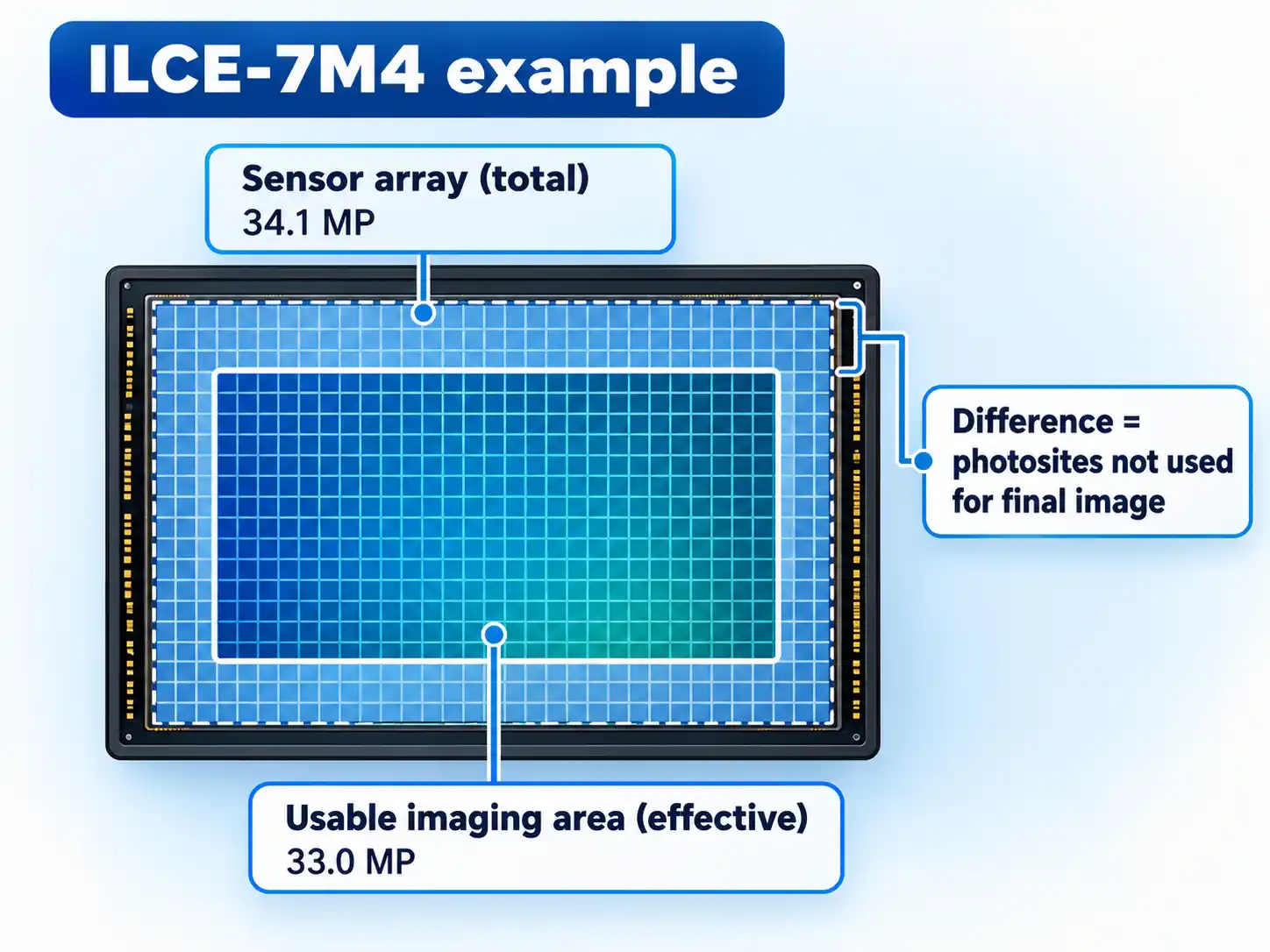
| Pixels (total) | Every photosite on the array | Approx. 34.1 megapixels | Not the number your images are built from |
| Pixels (effective) | Photosites used for the final image | Approx. 33.0 megapixels | The number that matters for output size |
| Bit depth (RAW) | Precision per channel in raw capture | 14-bit RAW | Format capability; check it applies to the mode you’ll shoot |
| Color spaces | Color gamuts the camera can tag or output | sRGB, Adobe RGB, BT.2020 | Workflow fact; matters for print and video pipelines |
| Recording formats | File containers and codecs | JPEG, HEIF, RAW (ARW 4.0); XAVC S / XAVC HS for movies | Compatibility fact; check your editor supports them |
Notice the gap in that table: the total count runs higher than the effective count. That difference is photosites on the array that don’t contribute to the final image. It’s small on this body, but the distinction is the single most useful thing to internalize, because marketing summaries routinely quote whichever number is larger.
Where Spec Sheets Get Slippery
Three categories of spec-sheet content deserve suspicion, and none of them require assuming bad faith.
Pixel counts. Total versus effective is the classic ambiguity. A sheet that says “34.1 megapixels” and a sheet that says “33.0 megapixels” may describe the same sensor. Always find the label.
Resolution and sharpness figures. These are method-dependent by nature. There is a formal standard for measuring resolution and SFR of electronic still-picture cameras: ISO 12233. The 2017 edition is listed as withdrawn, with a withdrawal date of 2023-02-17. The honest lesson is not “this standard is current” but “a standard exists, editions change, and you should check which edition a lab cites.” Beyond the standard, the measurement technique itself changes the answer. Imatest’s technical documentation covers slanted-edge MTF, how to interpret MTF50, standardized sharpening for camera comparison, and the difference between image-centric and object-centric comparison, all of which affect the number you see. Signal processing affects results, so a sharpness figure is a claim about a test, not a property of the camera alone.
Aggregate scores. Third-party scores are proprietary benchmarks. DXOMARK describes itself as an image-quality evaluation lab publishing benchmark scores since 2003. That establishes what the scores are, namely its own benchmarks, and nothing about whether one camera beats another for your purposes.
Warning
Two traps to avoid. First, a cited standard may be a withdrawn edition, so check the edition, not just the number. Second, an aggregate score from a commercial lab is a proprietary benchmark, not a neutral measurement, and it cannot rank cameras for your needs.
The 6-Step Spec-Sheet Read
Run this sequence on any camera spec sheet before you compare two bodies. Each step ends with a check you can perform on the page in front of you.
- Confirm you’re on the official spec page. Find the manufacturer’s own support or specifications page for the exact model, not a retailer summary or a marketing landing page. Check: the URL sits on the manufacturer’s domain and names the model.
- Record the hardware facts first. Note sensor type, physical dimensions, and aspect ratio. Check: you can state the sensor size in millimeters, not just “full frame.”
- Find both pixel counts. Locate the total and effective figures and write them side by side. Check: you know which number the marketing copy is quoting.
- Map the format and color fields. Note bit depth for RAW, the color spaces listed, and the still and movie recording formats. Check: each format is one your editing software opens.
- Flag every resolution or sharpness claim. For any sharpness figure, find the measurement method and the standard edition cited. Check: if the method isn’t stated, treat the number as non-comparable.
- Verify the consequential numbers at the source. Re-open the manufacturer’s support page and confirm the figures you plan to rely on. Check: every number in your shortlist matches the official page exactly.
Verify the result
- You can state the sensor size in millimeters and the aspect ratio from the official page.
- You have both total and effective pixel counts written down, with the larger one identified.
- Every sharpness figure you’re considering carries a stated measurement method or is marked non-comparable.
- Your shortlisted numbers match the manufacturer’s support page exactly.
Verify at the Source
When a number will influence a purchase, confirm it on the manufacturer’s own support page rather than a summary. The procedure is short.
- Search the manufacturer’s support site for the exact model number, then open the specifications page.
- Locate the field you care about and read its exact label, whether total or effective.
- Compare it against the number you saw elsewhere; if they differ, trust the official page and note the discrepancy.
The spec sheet lists one megapixel figure with no label
Assume nothing. Check the manufacturer’s support page for both total and effective counts. If only one appears, treat the figure as unverified for comparison purposes until you find the labeled version.
A sharpness score has no stated method
Treat it as non-comparable. Without a stated measurement method and standard edition, the number cannot be meaningfully set against another source’s figure.
A review cites a standard edition you can’t confirm is current
Look up the standard record directly. The ISO 12233:2017 record, for example, shows a withdrawn status, so a lab citing that edition is citing a superseded document, which is worth knowing before you weigh its numbers.
What This Guide Does Not Adjudicate
A spec sheet is not a review, and this guide stays inside the fields a spec sheet can actually settle. It does not tell you anything reliable about:
- Autofocus accuracy or tracking performance
- In-body or lens stabilization effectiveness
- Weather sealing and durability
- Battery life in real use
- Lens optical quality
- Price or value for money
Those require hands-on testing, independent measurement, or current pricing, which is different evidence than a spec table supplies. Don’t let a clean spec read stand in for them.
Bottom Line
Read the hardware facts first, then the pixel counts with their labels, then the format fields, and treat every sharpness figure as a claim about a method. Verify anything consequential on the manufacturer’s own support page. That sequence won’t tell you which camera is better. It will tell you which numbers you can trust and which you can’t compare.
- If two cameras quote different megapixel figures, check total versus effective before assuming a difference in resolution.
- If a sharpness score lacks a stated method, don’t compare it to anything.
- If a number will affect your purchase, confirm it on the official support page.
- If the field is autofocus, stabilization, sealing, battery, lens quality, or price, look beyond the spec sheet entirely.

💬 Comments