For U.S. consumers, a credit card is generally safer than a debit card for online shopping when the main concern is unauthorized transactions, covered merchant disputes, or keeping checking-account funds available while a problem is investigated. Debit cards still have important protections, but their direct connection to a deposit account and their timing-sensitive federal liability rules can make fraud more disruptive.
That does not make a credit card the best financial choice in every situation. If using credit leads you to carry an unaffordable balance and pay interest, avoiding debt may be the more important risk. The useful comparison is what happens when an online transaction goes wrong.
Why Credit Cards Usually Come Out Ahead for Online Shopping
The first difference is where the purchase is funded. A debit card normally uses money already held in the linked checking account. A credit card uses credit provided by the card issuer. The Federal Trade Commission’s comparison of payment cards explains both this funding difference and the different legal protections that apply.
Suppose an unauthorized $800 online purchase appears on each type of card. With a debit card, that transaction can reduce the money available in the linked account while the matter is investigated. With a credit card, the disputed transaction normally affects the credit account rather than directly removing $800 from checking.
That difference matters even when the consumer ultimately has no financial loss. A temporarily reduced checking balance can interfere with rent, utilities, scheduled transfers, or other payments. Final fraud liability and short-term access to cash are separate risks.
Credit cards also have a relatively simple federal limit for qualifying unauthorized use. Under Regulation Z’s credit-card provisions, a cardholder’s liability generally cannot exceed the lesser of $50 or the amount obtained through unauthorized use before the issuer is notified, provided the regulation’s conditions for imposing liability are met.
Credit Card vs Debit Card: Safety Comparison at a Glance
The most useful comparison is not whether both cards advertise fraud protection. It is how federal liability, access to checking-account funds, merchant-dispute rights, network policies, and debt risk differ.
Credit Card vs Debit Card for Online Purchases
| Feature | Debit Card | Credit Card |
|---|---|---|
| Purchase funding | Usually draws from money in a linked checking account. | Uses a credit line rather than directly withdrawing checking-account funds. |
| Federal unauthorized-use liability | Can vary based on the circumstances and how quickly the consumer reports the problem. | For qualifying unauthorized use, liability generally cannot exceed $50 and may be lower. |
| Stolen account number | Regulation E protections apply to unauthorized electronic fund transfers, with reporting rules affecting potential liability. | If the physical card was not lost but the account number was stolen and used, CFPB guidance says the consumer generally has no liability. |
| Effect on checking-account cash | An unauthorized transfer can reduce available account funds before the matter is resolved. | A disputed purchase normally does not directly remove funds from the checking account. |
| Federal merchant-dispute framework | Regulation E provides error-resolution rights for electronic fund transfer errors, but it does not mirror Regulation Z’s billing-error category for goods or services not delivered as agreed. | Regulation Z covers several billing errors, including certain transactions involving goods or services not accepted or not delivered as agreed. |
| Additional network protection | Some networks and issuers provide protections beyond federal minimums. | Networks and issuers may also provide protections beyond federal minimums. |
| Debt and interest risk | Usually uses money already held in the account and does not create ordinary revolving credit-card debt. | Can create interest charges and revolving debt when balances are carried, depending on the account terms. |
For online-payment protection, credit generally has the advantage. That does not mean it wins every financial criterion. A shopper who is likely to carry expensive credit-card debt may reasonably give greater weight to borrowing risk.
What Happens If Someone Uses Your Card Without Permission?
Credit-card unauthorized use
Federal credit-card rules provide a relatively straightforward liability ceiling. Regulation Z states that qualifying liability for unauthorized credit-card use cannot exceed the lesser of $50 or the value obtained before the issuer is notified.
The protection can be stronger when the physical card remains in your possession. According to the Consumer Financial Protection Bureau’s guidance on unauthorized credit-card charges, if someone steals and uses only the account number and you have not lost the card itself, you generally have no liability for that unauthorized use.
“Unauthorized use” has a specific legal meaning. Regulation Z defines it as use by someone other than the cardholder who lacks actual, implied, or apparent authority and from which the cardholder receives no benefit. A disagreement involving a family member, employee, or another person who was previously allowed to use the card can therefore be more complicated than a straightforward stolen-number case.
Debit-card unauthorized transfers
Debit cards also have federal protections, but reporting timing can materially affect potential liability. Under Regulation E’s unauthorized-transfer rules, a consumer who notifies the financial institution within two business days after learning that an access device was lost or stolen generally faces liability of no more than the lesser of $50 or the unauthorized transfers that occurred before notice.
If the consumer waits longer than two business days, potential liability can rise. Regulation E describes circumstances in which the applicable ceiling can reach $500, although the actual amount depends on when the transfers occurred and whether the institution establishes that later transfers could have been prevented by timely notice.
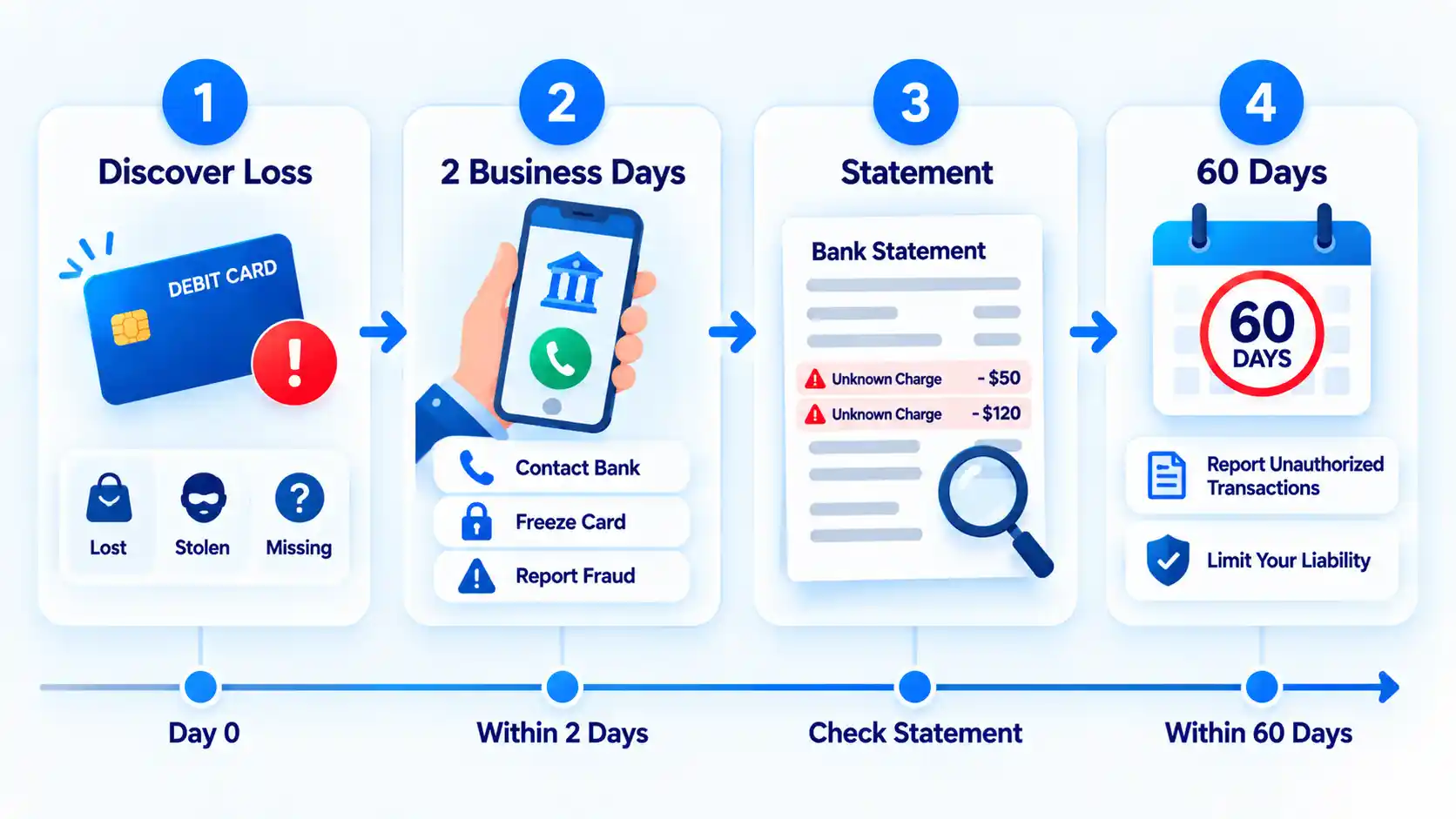
The often-repeated “60-day rule” also needs precision. If an unauthorized electronic fund transfer appears on a periodic statement, the consumer generally must report it within 60 days after the institution transmits that statement to avoid potential liability for later unauthorized transfers that timely notice could have prevented. It is misleading to say that every unauthorized dollar automatically becomes the consumer’s responsibility on day 61.
Because reporting time can affect the outcome, responding to an unauthorized online card purchase should include prompt notice to the issuer or financial institution and preservation of the relevant transaction records.
Fraud Liability Is Not the Same as Immediate Access to Your Money
A consumer can ultimately have little or no liability and still experience temporary disruption. That distinction is particularly important with debit cards because the disputed transfer can affect money already sitting in the linked account.
Under Regulation E’s error-resolution procedures, a financial institution generally must investigate promptly and determine whether an error occurred within 10 business days after receiving a qualifying notice of error.
If the institution cannot complete the investigation within that period, it can generally take up to 45 days if it provisionally credits the consumer’s account within the required period and satisfies the other conditions in the rule. Regulation E provides longer investigation periods for specified categories, including certain point-of-sale debit-card transactions, transfers initiated outside a state, and qualifying new-account cases.
Provisional credit is a temporary credit placed in the account while the investigation continues. It is not necessarily a final determination that the consumer’s claim is valid.
Consider the $800 fraud example again. If an unauthorized debit transaction reduces the checking balance shortly before rent is due, the consumer may face a cash-flow problem before the investigation or provisional-credit process restores access to those funds. An unauthorized credit-card transaction ordinarily does not remove that $800 from checking in the first place.
Credit Cards Have Federal Billing-Error Rights for Some Merchant Problems
Online-shopping problems are not limited to card theft. A merchant might bill twice, charge the wrong amount, fail to deliver an order, send the wrong quantity, or deliver an order somewhere other than the location agreed upon.
Regulation Z’s billing-error rules cover several categories of problems with open-end credit accounts. One category includes charges for property or services that the consumer did not accept or that were not delivered as agreed. The CFPB’s official interpretation gives examples including different property than agreed, the wrong quantity, late delivery, and delivery to the wrong location.
For the formal billing-error process, the consumer’s written notice generally must reach the creditor no later than 60 days after the creditor transmitted the first periodic statement reflecting the alleged error. The notice must also contain enough information for the creditor to identify the account and understand the alleged problem.
Once a qualifying notice is received, the creditor generally must acknowledge it in writing within 30 days unless the matter has already been resolved, and complete the applicable resolution procedures within two complete billing cycles, but no later than 90 days.
There is an important limit. Regulation Z expressly says this billing-error category does not cover a dispute merely about the quality of property or services that the consumer accepted. Whether the consumer legally accepted the goods can depend on state or other applicable law.
For example, a laptop that never arrives can fit the non-delivery framework more readily than a laptop that arrives as ordered but feels less premium than the buyer expected.
Credit cards also have a separate federal claims-and-defenses provision. Under Regulation Z’s claims-and-defenses rules, a cardholder can in qualifying circumstances assert certain merchant-related claims or defenses against the card issuer after the merchant fails to resolve the dispute satisfactorily.
That right has conditions and should not be presented as a universal guarantee. The regulation generally requires a good-faith effort to resolve the dispute with the merchant and includes transaction-value and geographic requirements. Its official interpretation also notes that internet orders can qualify as credit-card purchases, while the location of an internet or telephone transaction for the geographic condition can depend on state or other applicable law.
For that reason, “you can always charge it back” is too broad. The applicable right depends on the type of dispute, the facts, the account, and the governing rules.
What About Debit Cards With Zero-Liability Policies?
Network and issuer policies can improve the protection available to debit-card users beyond the federal statutory minimum. They do not make Regulation E and Regulation Z identical.
For example, Visa’s current Zero Liability Policy says qualifying Visa credit and debit cardholders are not held responsible for unauthorized charges made with the account or account information. Visa states that the policy covers most credit and debit cards but excludes certain commercial-card and anonymous prepaid-card transactions and transactions not processed by Visa.
Visa also instructs cardholders to notify their issuing financial institution immediately and tells consumers to check with the issuer about coverage for a specific card.
This creates two distinct layers. Federal law sets statutory rights and liability rules. A network or issuer can then provide contractual protections that are more favorable to the cardholder. A network policy should therefore be described as an additional protection, not as evidence that every debit card has identical rights or that statutory debit and credit protections are the same.
When Using a Debit Card Online Can Still Make Sense
A debit card can still be a reasonable choice when avoiding revolving debt is the higher financial priority. Debit purchases normally use money already held in the linked account rather than creating an ordinary credit-card balance.
The FTC notes that credit cards can charge interest when balances are carried from month to month. It also explains that on most cards, paying the whole bill by the due date can avoid purchase interest, although the exact account terms control.
Debit may therefore make sense for someone who does not have a credit card, prefers not to borrow, or knows that available credit tends to lead to balances that are difficult to repay. In that situation, it is particularly important to understand the bank’s reporting procedures, review account activity regularly, use available transaction alerts, and report suspicious transfers promptly.
If you want to avoid conventional credit, consider other ways to pay online without a credit card and compare their fees, privacy implications and consumer protections.
How to Shop More Safely With Either Card
Choosing credit instead of debit does not make an untrustworthy merchant safe. Payment protections matter after something goes wrong, while merchant checks can reduce the chance of entering the transaction in the first place.
- Check an unfamiliar seller before paying. Look for independent information about the business and search its name with terms such as “complaint” or “scam.”
- Do not treat HTTPS as proof that a seller is legitimate. The FTC explains that HTTPS means the connection is encrypted, but fraudulent sites can use encryption too.
- Keep transaction records. Save the order confirmation, price, promised delivery information, return or refund terms, and important communications with the seller.
- Review account activity regularly. Detecting an unauthorized transaction sooner can make it easier to report within applicable deadlines.
- Use transaction alerts when your issuer offers them. They can make unexpected activity easier to notice.
- Report suspicious activity promptly. Follow the card issuer’s or financial institution’s stated reporting process rather than waiting to see whether another transaction appears.
The FTC’s online-shopping guidance specifically recommends paying by credit card when possible because of the protections available when a scam or covered purchase problem occurs. The FTC also recommends keeping purchase records and warns that an encrypted website is not necessarily legitimate.
How the card credentials themselves are exposed is a separate security question. Virtual card vs physical card for online shopping can be evaluated separately from the legal differences between debit and credit accounts.
Which option should you choose?
Credit Card
Avoid this if: using available credit is likely to leave you carrying debt that you cannot comfortably repay.
Main trade-off: stronger payment protections come with the possibility of interest and revolving debt if the balance is carried.
Debit Card
Avoid this if: temporary loss of checking-account funds could interfere with essential bills or you are unlikely to notice and report unauthorized activity promptly.
Main trade-off: you avoid ordinary revolving credit-card debt, but unauthorized transactions can directly affect available account funds while a dispute is being investigated.
For most U.S. shoppers who can use a credit card without carrying unaffordable debt, credit is the safer default for online purchases. Its advantage comes from federal unauthorized-use limits, specific billing-error protections for several merchant problems, and the practical separation between a disputed purchase and money held in checking.
Debit is not inherently unsafe. It simply makes rapid detection and reporting more consequential and exposes the linked account more directly when fraud occurs. Whichever card you use, verify unfamiliar sellers, keep transaction records, review account activity, and report suspicious transactions promptly.

💬 Comments