You can sometimes consolidate debt even when your credit is poor, but approval alone does not make a consolidation loan a good deal. The useful test is whether the new loan makes repayment more manageable or less expensive after you account for its rate, fees, repayment term, and other risks.
Quick Take
Bad credit can make favorable loan terms harder to obtain. Compare a proposed consolidation loan with your current debts using APR, fees, monthly payment, repayment length, total repayment, and any collateral requirement before deciding whether it improves your position.
A debt-consolidation loan can simplify several debts into one payment, but it does not erase the underlying debt. The Consumer Financial Protection Bureau’s debt-consolidation guidance warns that a lower monthly payment can result from stretching repayment over a longer period, which can increase the amount you pay overall.
What Debt Consolidation Actually Changes
Suppose you are juggling three credit-card balances and a personal loan. A debt-consolidation loan lets you borrow a new lump sum, use it to repay some or all of those existing debts, and then make payments on the new loan instead.
The main change is structural: several balances and due dates may become one loan and one payment. According to the CFPB, a consolidation loan may offer a lower interest rate, but that outcome is not guaranteed.
Consolidation also does not automatically reduce the principal you owe. If you borrow enough to repay $15,000 of existing debt, you generally replace those obligations with a new loan large enough to cover the balances, subject to the lender’s fees and disbursement structure. The financial benefit therefore depends on the terms of the replacement debt.
Other products can also combine balances. A balance-transfer credit card can move card debt onto one account, while a home-equity loan can be used to repay unsecured debt. Those options introduce different risks. The CFPB notes that using home equity for consolidation puts your home at risk if you cannot repay the home-equity loan.
Can You Consolidate Debt With Bad Credit?
Possibly. The more important question is whether the terms available to you are better than the debts you already have.
There is no single credit score that universally separates an acceptable consolidation applicant from a rejected one. Credit-scoring models differ, and lenders use their own underwriting processes. The CFPB explains that consumers can have multiple credit scores and that scores are used, along with other information, in decisions about credit availability and pricing.
Your credit history can affect the terms you receive. The CFPB describes risk-based pricing as a lender offering less favorable terms, such as a higher interest rate, based on information in a credit report or application. It also notes that individual lenders use their own processes and may consider credit score, employment, income, outstanding debts, and other factors.
That means someone can technically qualify for a new loan without receiving an offer that produces meaningful savings. If the rate is high, the fees are substantial, or the repayment period is much longer, consolidation may merely reorganize the debt rather than improve its cost.
When a Consolidation Loan Helps, and When It Does Not
A useful consolidation loan should solve a specific problem. It might reduce borrowing costs, make the required monthly payment sustainable, simplify several due dates, or achieve more than one of those goals.
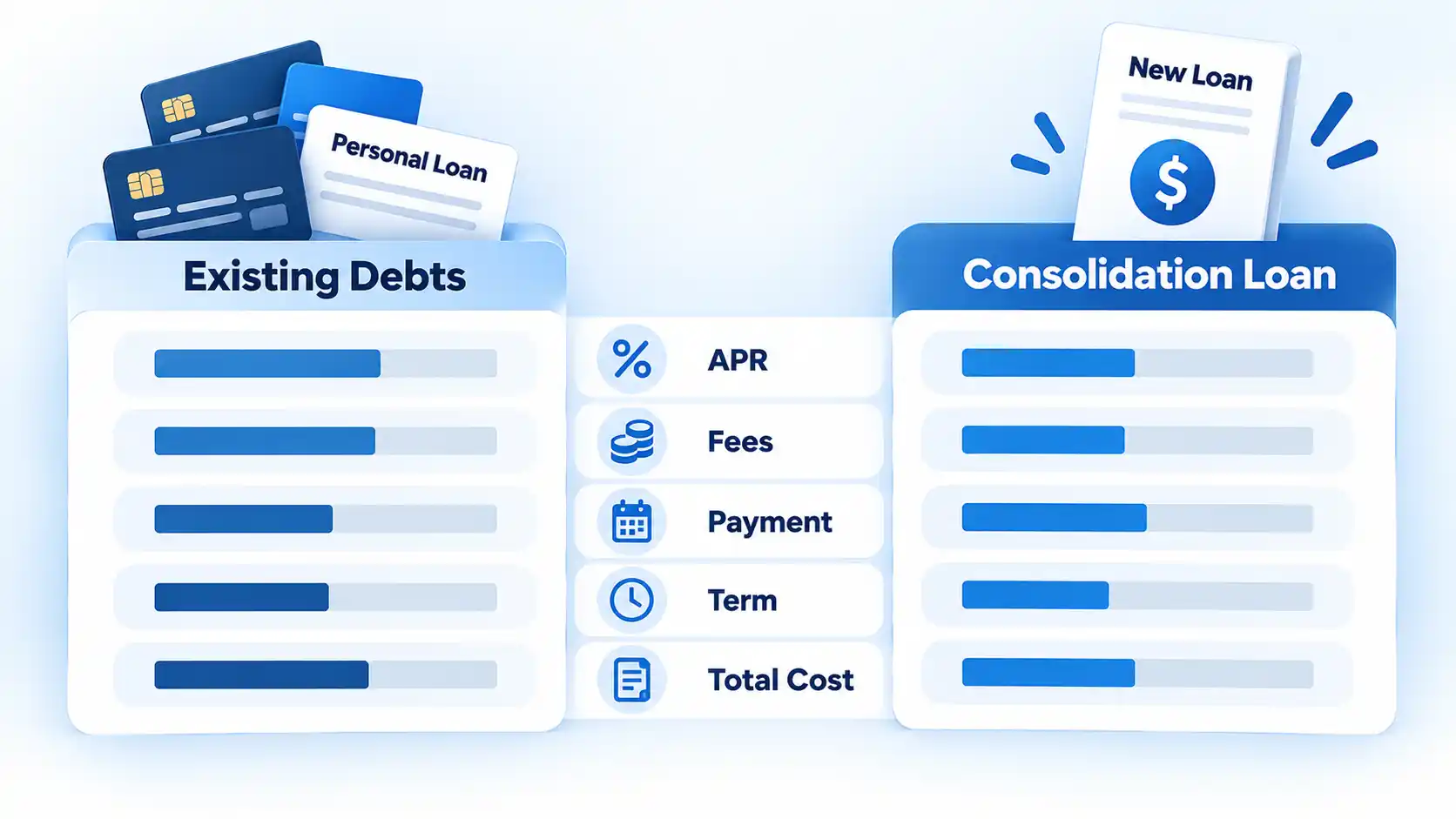
Start with the annual percentage rate, or APR. APR combines the interest rate with certain loan fees to provide a broader measure of borrowing cost. The CFPB distinguishes APR from the stated interest rate and recommends using APR when comparing loan pricing. Then examine the repayment length, required monthly payment, and total amount you would repay.
Warning
A lower monthly payment is not the same thing as a cheaper loan. Extending repayment can make the payment easier to handle while increasing the total amount paid over time.
A lower payment can still have legitimate value when cash flow is the immediate problem. For example, if current minimum payments are consistently unaffordable, a longer term may make the monthly obligation more manageable. The trade-off should be explicit: you may be buying payment relief rather than reducing total borrowing cost.
The loan becomes harder to justify when its APR is not meaningfully better, fees erase the interest savings, or the term is extended so far that total repayment rises substantially. A consolidation strategy can also fail if you use the loan to pay off credit cards and then quickly rebuild those balances. The CFPB recommends examining why the debt accumulated and making a budget rather than treating new borrowing as a complete solution.
Secured borrowing requires another layer of caution. If a consolidation product requires property as collateral, default may put that property at risk. That is materially different from replacing unsecured card balances with an unsecured personal loan.
What to Check Before You Apply
Before sending formal applications, make sure the information behind your decision is accurate. A few basic checks can prevent you from comparing loan offers against the wrong balances, an inaccurate credit report, or a monthly payment your budget cannot support.
- Review your credit reports. The CFPB says requesting your own credit report is a soft inquiry and does not affect your credit scores. Nationwide credit reporting companies currently provide weekly report access. You can request the reports through AnnualCreditReport.com, the federally authorized central source.
- Correct material errors. If you find inaccurate information, the CFPB’s credit-report dispute guidance says to dispute it with the credit reporting company and the company that supplied the information, including supporting documents where appropriate.
- Inventory the debts you want to consolidate. Record each balance, interest rate, required payment, due date, and whether the debt is secured by property.
- Set a sustainable payment ceiling. Work from actual income and essential expenses rather than the largest payment a lender is willing to approve.
Verify the result
- You have reviewed current credit reports and identified any material errors that still need correction.
- You have recorded the balances, rates, and required payments for every debt you intend to consolidate.
- You know the maximum monthly payment your regular budget can support without relying on unusually high income or unusually low expenses.
If the debt accumulated because routine spending consistently exceeds income, consolidation alone does not correct that imbalance. The CFPB advises consumers considering consolidation to identify why the debt developed and determine whether their budget can support repayment.
Comparing APR, fees, and total repayment is more useful than comparing monthly payments alone because it exposes the effect of both loan pricing and repayment length.
How to Compare Debt-Consolidation Offers
Compare every proposed loan against the debts it would replace. The goal is to determine what changes in cost, cash flow, repayment time, and risk rather than simply choosing the smallest advertised payment.
- Record the APR. Write down the annual percentage rate for each offer and compare it with the rates on the debts you plan to repay. Check whether the offered rate is fixed for the loan term or can change.
- Identify every loan fee. Look for origination charges and other disclosed costs. Determine whether a fee is deducted from the loan proceeds, paid separately, or added to the financed balance.
- Compare repayment terms. Note how many months or years each offer requires. A longer term can reduce the required monthly payment while keeping you in debt for longer.
- Check the monthly payment against your budget. Decide whether the required payment remains affordable after housing, food, utilities, insurance, transportation, taxes, and other essential obligations.
- Compare total repayment. Use the lender’s disclosures to determine how much you would pay over the scheduled life of the loan, then compare that amount with the expected cost of continuing to repay your current debts.
- Check for collateral or another person’s obligation. Determine whether the offer is unsecured or puts property at risk, and whether another person would become legally responsible for repayment.
- Identify what the offer actually improves. If it lowers total cost, document the savings. If it mainly lowers the monthly payment by extending the term, treat that as a cash-flow trade-off rather than an interest-saving win.
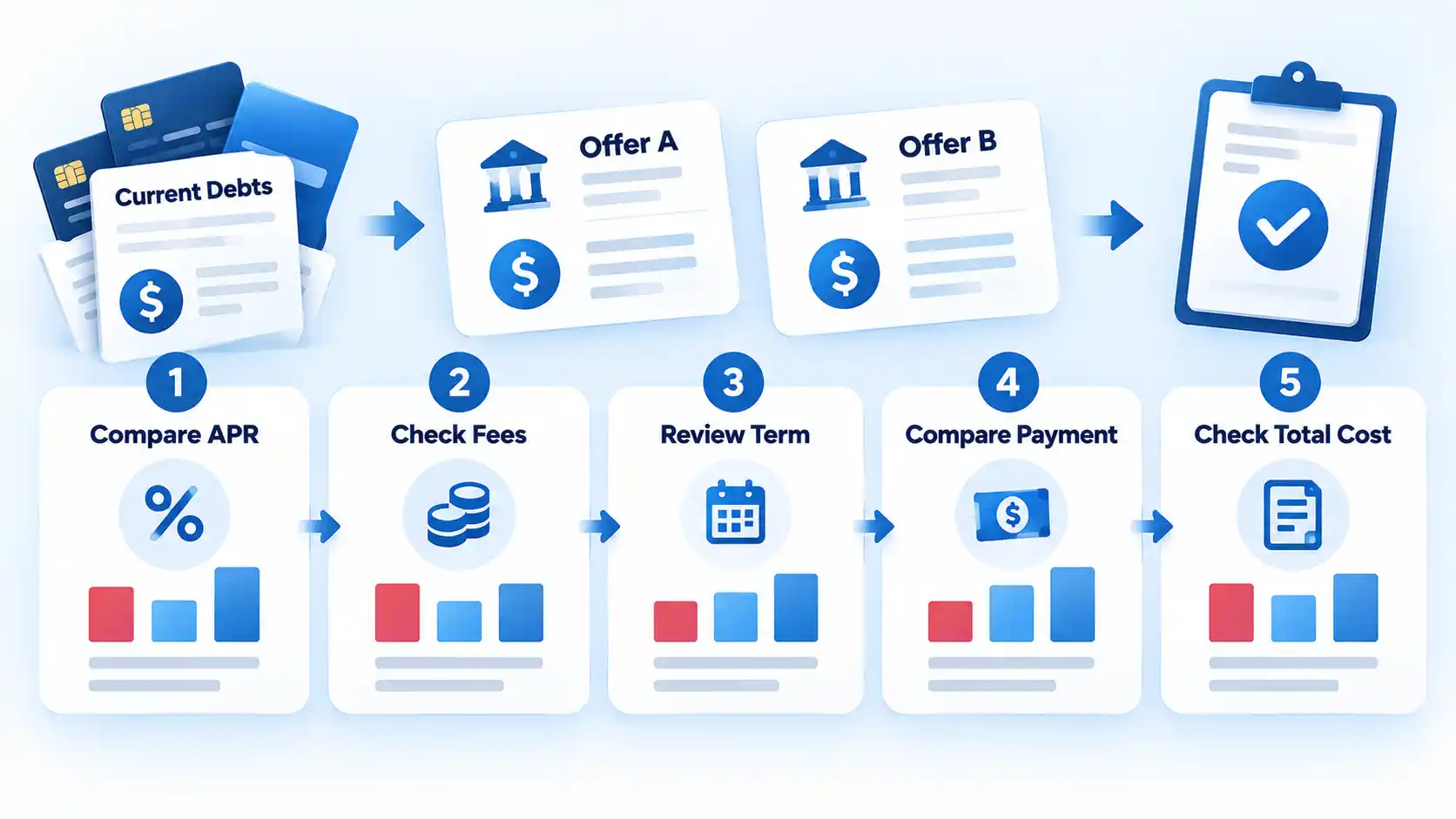
The following worksheet keeps each comparison focused on the same decision fields:
| Option | APR and fees | Monthly payment | Term and total repayment | Security or other risk |
|---|---|---|---|---|
| Current debts combined | Record current rates and relevant account costs | Add current required payments | Record the expected repayment path where practical | Note secured balances or other material risks |
| Consolidation Offer A | Record APR and all disclosed fees | Record required payment | Record term and disclosed total repayment | Note collateral or other material conditions |
| Consolidation Offer B | Record APR and all disclosed fees | Record required payment | Record term and disclosed total repayment | Note collateral or other material conditions |
No single column decides the answer. Someone under severe monthly-payment pressure may reasonably place more weight on cash flow, while someone who can already make the existing payments may place more weight on reducing total cost.
How Applying Can Affect Your Credit
Checking your own credit report is different from applying for a loan. According to the CFPB’s guidance on credit inquiries, requesting your own report is a soft inquiry and does not affect your credit scores. A lender’s inquiry after you apply for new credit is generally a hard inquiry, which can affect a score.
That does not mean a consolidation application produces the same score change for everyone. Credit scores are calculated using different models, and the CFPB identifies payment history, unpaid debt, available-credit use, account history, new credit applications, and other information as factors that scoring models commonly consider.
For that reason, avoid treating claims such as “debt consolidation will raise your score” as guarantees. A more accurate expectation is that an application may add a hard inquiry, while the longer-term result depends on your broader credit file and what happens to the old and new accounts afterward.
Alternatives if a Consolidation Loan Is Too Expensive or Unavailable
If the numbers do not improve, you do not have to force a consolidation loan into the plan. Different alternatives solve different problems, so the useful question is what is making repayment difficult.
Ask Existing Creditors About Hardship Options
Contacting existing creditors can be a useful first step when the immediate problem is an unaffordable payment or inconvenient due date. The CFPB notes that some creditors may agree to lower minimum payments, waive certain fees, reduce an interest rate, or change a payment due date.
The available terms depend on the creditor and account. Before agreeing to a change, ask what it does to interest, fees, account status, monthly payment, and the time required to finish repayment.
Nonprofit Credit Counseling and a Debt Management Plan
Credit counseling is not the same thing as taking another loan. A counselor can review your budget and debts and may help organize a debt management plan, or DMP.
Under a typical DMP, you make one payment to the counseling organization, which then distributes money to participating creditors. The CFPB describes credit counseling organizations as usually nonprofit and says they can help with budgeting, money-management education, and debt management plans. Fees may still apply to some counseling services.
A debt consolidation loan and a debt management plan can both reduce the number of payments you personally manage, but they work differently: one replaces debts with new borrowing, while the other coordinates repayment of participating existing debts.
Debt Settlement
Debt settlement is different from consolidation. Instead of borrowing enough money to repay creditors according to the original balances, a settlement provider seeks agreements under which participating creditors accept changed repayment terms, often including less than the full amount claimed.
The trade-offs can be substantial. The CFPB warns that debt settlement companies commonly encourage consumers to stop paying creditors while money is accumulated for settlements. Interest or fees may continue, credit can be damaged further, collection activity can continue, and lawsuits remain possible.
Federal fee restrictions also require precise wording. For debt-relief services covered by the Federal Trade Commission’s Telemarketing Sales Rule, the FTC says a provider cannot collect its debt-relief fee until required conditions are satisfied. These include obtaining a qualifying result on at least one debt, the consumer agreeing to that result, and the consumer making at least one payment under the resulting agreement.
Debt that is forgiven can also have tax consequences. The IRS says canceled debt is generally taxable unless an exception or exclusion applies. Bankruptcy and insolvency are among the listed exclusions, but the correct tax treatment depends on the facts.
Commercial services are another avenue some consumers investigate. One example is debt relief options through CuraDebt; CuraDebt’s current website says it reviews consumer situations and, where appropriate and permitted by law, connects consumers with independent providers rather than directly performing every debt-relief service itself.
Bankruptcy
When debts cannot realistically be repaid, bankruptcy may be a legal option rather than another repayment product. Its eligibility rules and consequences are fact-specific, so general information cannot determine whether filing is appropriate for a particular person.
The U.S. Courts describes Chapter 7 as liquidation, in which a trustee may sell nonexempt property and distribute proceeds to creditors. Exemptions and the facts of the case affect what property is actually at risk.
Chapter 13 generally allows an eligible individual with regular income to propose a repayment plan lasting three to five years. U.S. Courts also cautions that its Bankruptcy Basics material is general information rather than legal or financial advice.
The distinction between personal and business circumstances also matters when considering bankruptcy because the available chapters, treatment of property, and legal consequences depend on who owes the debt and the structure of the case.
Red Flags Around “Bad Credit” Debt Relief
Financial pressure can make guaranteed-sounding offers especially attractive. Before treating an advertisement as a solution, identify what product or service is actually being offered and what obligations it creates.
- A promise of guaranteed approval or unusually favorable terms. Actual loan pricing depends on underwriting. Judge an offer by its written terms rather than the headline claim.
- A “consolidation” promotion that is actually selling debt settlement. Ask whether you are receiving a new loan, entering a repayment plan, or hiring a settlement provider. Those approaches work differently and carry different risks.
- A covered debt-relief provider demanding a fee before the applicable federal conditions are met. The FTC Telemarketing Sales Rule restricts advance fees for debt-relief services within its scope.
- Instructions to stop paying creditors without explaining the consequences. Nonpayment can lead to additional interest or fees, negative credit reporting, collection activity, and possible litigation.
- Guaranteed savings or guaranteed credit-score improvement. Neither result should be assumed. Loan savings depend on the actual terms, while credit-score effects depend on the broader credit file and subsequent account management.
- Fees or repayment terms that are difficult to identify. If you cannot determine APR, fees, payment, term, and total repayment from the disclosures, do not judge the offer by its advertised monthly payment alone.
Verify the result
- You can identify whether the offer is a loan, debt management plan, debt settlement service, or another product.
- You can identify the relevant fees, payment requirements, repayment term, and material consequences before enrolling or signing.
- Any claim about guaranteed approval, guaranteed savings, or guaranteed credit improvement has been treated as a marketing claim rather than an established outcome.
Bottom Line
Debt consolidation with bad credit can be useful, but the right question is not simply whether someone will approve you. Compare what you have now with what the new loan actually changes.
A consolidation offer deserves consideration when it creates a sustainable payment or meaningful cost improvement without introducing disproportionate fees, collateral risk, or an unnecessarily long repayment period. If the numbers do not improve, alternatives such as creditor hardship arrangements, nonprofit credit counseling, a debt management plan, debt settlement, or bankruptcy may address the underlying problem differently.
The decision should come from written terms and your budget: know the debts being replaced, understand the new obligation, and make the trade-offs visible before signing.

💬 Comments