Go usually finishes CPU-heavy tasks faster than Python, often by a wide margin, because Go compiles straight to machine code while Python runs through an interpreter. Python usually wins on ease of learning and how fast you can turn an idea into working code.
Quick Take
If your top priority is raw speed and handling thousands of things at once, Go is the stronger pick. If your top priority is writing code quickly, using ready-made libraries, or working in data science and AI, Python still wins for most beginners. Many teams use both: Python for building and testing ideas, Go for the parts of a system that need to run fast under heavy load.
What Go and Python Actually Are
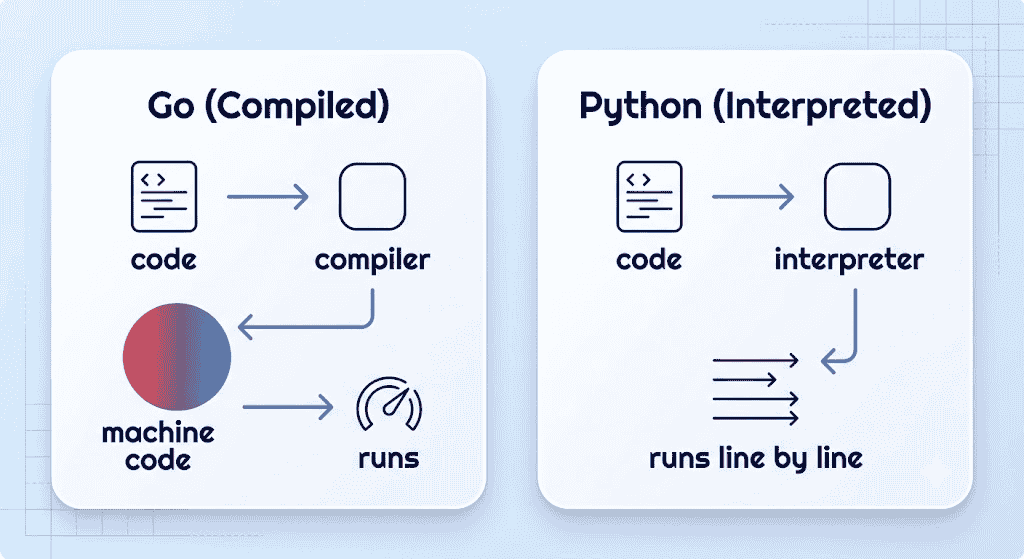
Go is a programming language made by Google. It first came out in 2009. Go turns your code into a machine-ready program before you run it. This step is called compiling. Once compiled, the program runs directly on your computer’s hardware, with no extra translation step in between.
Python is a programming language made in the early 1990s. Python reads your code line by line while the program runs. This is called interpreting. It does not need a separate compiling step, which makes Python faster to test and change. It also makes Python slower to run than a compiled language like Go.
Both languages are free and open source. Both run on Windows, macOS, and Linux.
Performance Compared
Raw Speed
Go’s official documentation confirms that Go programs compile ahead of time to native machine code, with no virtual machine sitting in between. This is a big reason Go tends to run fast.
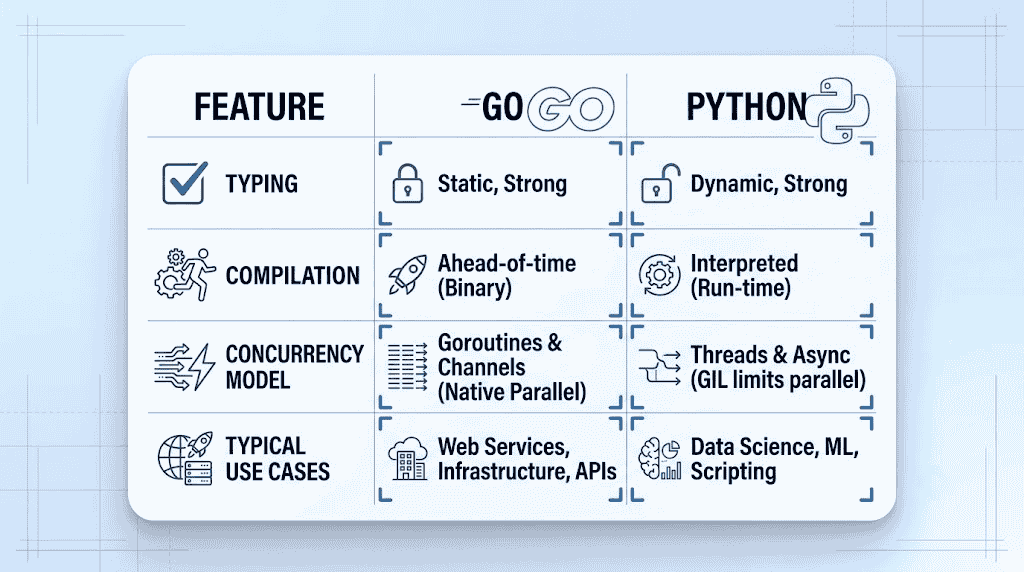
Python works differently. The standard version of Python, called CPython, uses something called the Global Interpreter Lock, or GIL. The official Python documentation explains that the GIL allows only one thread to run Python code at a time, even on a computer with many processor cores. The GIL does get released during input/output tasks, like reading a file or waiting on a network request. But for heavy number-crunching, it becomes a bottleneck.
To see what this looks like in practice, one technical benchmark comparing the two languages found that a Go program scraping 20 web pages used about 404 milliseconds of CPU time, while an equivalent Python program used about 1,090 milliseconds for the same task. On a tight text-processing loop in the same test, Go finished in about 27 nanoseconds per operation versus roughly 10 milliseconds for Python. That gap is workload-specific and won’t repeat exactly in every project. Treat it as one real example of the pattern, not a fixed rule you can apply to your own code without testing it yourself.
Memory Use
In that same scraping test, Go used about 132 mebibytes of peak memory, compared to about 170 mebibytes for Python. Go’s memory advantage tends to show up most clearly when a program creates many small, short-lived objects or many concurrent tasks, since Python’s object model carries more overhead per item.
Concurrency: Doing Many Things at Once
Concurrency means a program can handle more than one task at the same time, instead of finishing one task fully before starting the next. This matters for things like web servers handling thousands of requests.
Go was built around a concurrency tool called a goroutine. A goroutine is a lightweight task that the Go runtime manages for you. A new goroutine starts with only a few kilobytes of memory, and it’s practical to run hundreds of thousands of them in a single program. Go’s design follows a rule summed up as “share memory by communicating,” meaning goroutines pass data to each other through channels instead of fighting over the same shared variables.
Python can also run tasks concurrently, using threads or a separate approach called async. But because of the GIL described above, Python threads don’t get true parallel execution on multiple CPU cores for standard, GIL-bound code. Python developers usually work around this by using separate processes instead of threads for CPU-heavy parallel work, which adds complexity.
One change worth watching: Python’s official PEP 703 proposal, accepted in October 2023, added an optional build of Python (starting with version 3.13) that can run without the GIL. This free-threaded mode is still experimental and not turned on by default. If you’re evaluating it for a real project, check the current Python documentation first, since support and stability are still changing.
Feature Differences
Typing: How Each Language Checks Your Code
Go uses static typing. This means you must state the type of data a variable holds — like a number or a piece of text — and Go checks this before your program ever runs. If you make a typing mistake, Go stops you at compile time, before the bug reaches a user.
Python uses dynamic typing by default. You don’t have to state a variable’s type up front, and Python checks types while the program is running. This makes Python faster to write and more flexible for beginners, but a type-related bug can slip through until that exact line of code actually runs.
This trade-off is well known enough that many Python programmers have asked for optional static typing to catch more bugs earlier, and Python has added optional type hints over the past several years to meet that demand halfway.
Syntax and Learning Curve
Python’s syntax reads close to plain English. A short program to add two numbers and print the result takes only a few lines, with no required punctuation to mark the end of a line. This is a major reason Python is often recommended as a first programming language for beginners.
Go’s syntax is stricter and more explicit. You must declare types, handle errors as a normal part of your code instead of relying only on exceptions, and follow a fixed code formatting style enforced by the language’s own tools. This makes Go code more predictable to read across a team, but it usually takes a beginner longer to write their first working program.
Tooling and Package Management
According to a comparison from TechTarget, Go ships with a single built-in command-line tool that handles starting a new project, managing dependencies, and running tests, all without installing anything extra. Python instead relies on separate third-party tools, like pip for installing packages and virtual environments for keeping project dependencies separate. These tools work well, but a beginner has to learn them as a separate step, and mixing tool versions across projects is a common source of setup headaches.
Real-World Use Cases
Go shows up most often in infrastructure and backend systems that need to handle heavy traffic reliably. Container tools like Docker, and orchestration systems like Kubernetes, are both written in Go. These are the kinds of tools that run behind the scenes to keep large web services online.
Python’s biggest strength today is data-heavy work: data analysis, automation scripts, and especially data science and machine learning, where Python’s libraries are the default choice for most teams. If you’re building or training a machine learning model, you’ll almost always start in Python rather than Go, since that’s where the mature libraries live.
Microservices — small, independent pieces of a larger application — get built in both languages. Teams often choose Go for the specific services that need to handle the most traffic per server, and Python for services where development speed matters more than raw throughput.
Common Misconceptions
“Go is always faster than Python” is an oversimplification. Go tends to win on CPU-bound tasks — heavy math, tight loops, high-volume request handling. But for a short script that mostly waits on a network call or a database query, the difference often barely matters, since both languages spend most of their time waiting, not computing.
“Python can’t do concurrency” is also wrong. Python handles concurrent I/O well through its async tools. What Python struggles with is true parallel execution of CPU-heavy code on multiple cores, due to the GIL — a narrower and more specific limitation than “Python can’t do concurrency” suggests.
“You have to pick one language for your whole company” isn’t how most real teams operate. It’s common to use more than one language across different services, matching each language to the part of the system where its strengths matter most.
Where Each Language Falls Short
Go’s error handling can feel repetitive to a beginner, since you check for errors explicitly after almost every operation that could fail, rather than relying on a single catch-all block. Go’s standard library also has fewer ready-made options for data science and machine learning work compared to Python’s ecosystem.
Python’s biggest weakness is raw computational speed for CPU-heavy work, plus the packaging and environment problems that come from relying on third-party dependency tools instead of one built-in system. Large Python codebases can also be harder to maintain safely without adding type hints, since dynamic typing means more bugs are only caught by running the code.
Which Should You Choose
Pick Python if you’re new to programming, want to work in data science or machine learning, or need to build and test an idea quickly. Its gentle learning curve and huge library ecosystem make it the more forgiving starting point for most beginners.
Pick Go if you’re building a backend service that needs to handle heavy, concurrent traffic, or a command-line tool that needs to start instantly and use little memory. Go rewards the extra setup time with predictable performance under load.
If you’re not sure yet, learning Python first is still the more common path for total beginners, since its syntax teaches core programming concepts without Go’s stricter rules getting in the way early on. You can add Go later once you understand the fundamentals and hit a real performance wall in a Python project.
Key Takeaways
Go compiles to native machine code and avoids Python’s Global Interpreter Lock, which is why it tends to win on CPU-heavy, highly concurrent workloads. Python trades some raw speed for a shorter learning curve, faster iteration, and the deepest library ecosystem for data science and AI work. Neither language is strictly “better” — the right choice depends on whether your bottleneck is developer time or computing time. Many production systems use both languages side by side, choosing per service rather than company-wide.
FAQ
Which language do more developers actually use today?
Python is far more widely used. The 2025 Stack Overflow Developer Survey found that 57.9% of developers did extensive work in Python, compared to 16.4% for Go. Go still scores well on satisfaction among the people who use it (55.8% admired it, close to Python’s 56.4%), but far fewer developers said they wanted to learn it next (19.4% for Go versus 39.3% for Python).
Is it hard to switch from Python to Go later, if I already know Python?
The core programming logic transfers over fine. What takes adjustment is Go’s explicit style: you’ll need to declare variable types instead of letting Python infer them, and you’ll handle errors as a normal, visible part of your code instead of relying mainly on exceptions. How long that adjustment takes varies by person, but the concepts are learnable once you already understand programming basics from Python.
Do I need to learn Go to get a job in backend development?
No, but it helps for certain roles. Plenty of backend jobs are built entirely in Python, especially at companies focused on data or rapid product changes. Go becomes more valuable specifically when a job posting mentions high-traffic infrastructure, microservices, or systems like Kubernetes, since those tools and the teams around them are usually built in Go.



💬 Comments