Search engine optimization (SEO) helps a business website become easier for search engines to understand and easier for people to discover when they search for relevant products, services, or information. Its real value is not simply reaching a high ranking; it is attracting useful search visibility that can contribute to enquiries, sales, bookings, sign-ups, or other business goals.
SEO does not guarantee first place on Google, automatic traffic, or revenue. A stronger business case comes from understanding what SEO actually changes, which businesses benefit most, what it cannot control, and how to measure whether it is producing useful results.
What SEO Does for a Business Website
A website can be online without being easy to find through search. SEO is the work of making pages clearer to search systems while also making them useful and relevant to the people those pages are intended to serve. SEO helps search engines understand your content and helps people decide whether to visit your site from search results, but it does not automatically rank a site first.
For Google Search, discovery happens through several stages. Google first finds pages through crawling, then analyzes suitable pages for its index, and later decides what information to show when someone searches. Crawling, indexing, and serving results are separate stages, so publishing a page does not guarantee that it will appear for every relevant search.
That distinction matters to a business owner. Writing a useful page is not enough if search engines cannot access or understand it. At the same time, making a page technically accessible is not enough if it does not satisfy what potential customers are searching for. Understanding how SEO works at the crawling, indexing, and ranking level helps explain why SEO combines technical work, content, site structure, and relevance rather than relying on one tactic.
The same fundamentals remain relevant as Google adds AI-based search experiences. Normal SEO best practices still apply to AI Overviews and AI Mode, and websites do not need special AI text files, markup, or schema to become eligible for those features.
Why SEO Matters to Business Results
The strongest reason to invest in SEO is not simply to move a page higher on a results page. The goal is to make the business visible for searches that matter and then turn some of that visibility into useful visits.
Consider a company that repairs air conditioners. Appearing for a broad query that has little connection to its service area may produce impressions without useful enquiries. Appearing when someone nearby searches for a service the company actually provides is more valuable because the search and the business offering are closely connected.
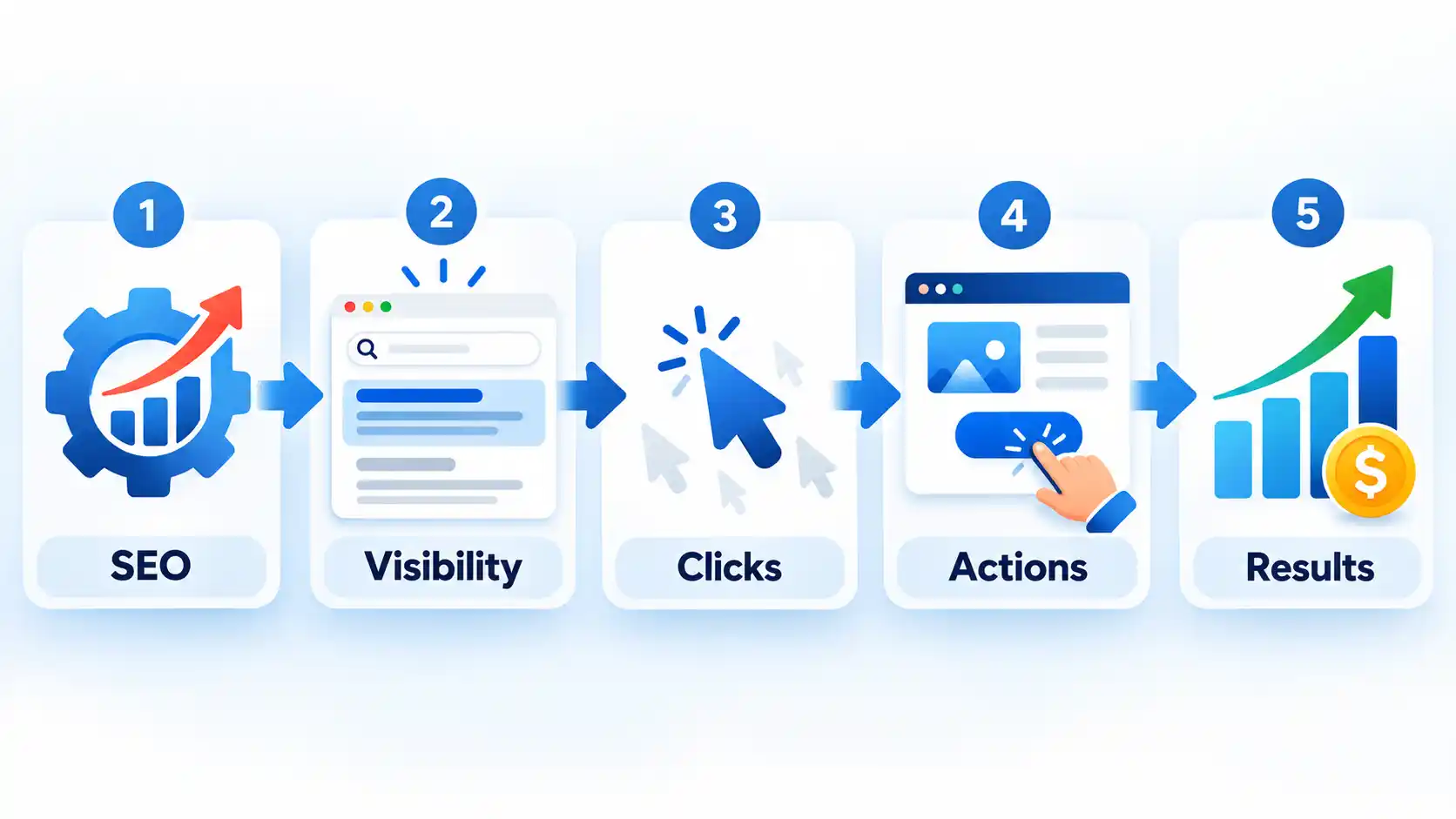
The practical chain looks like this: SEO improvements can increase relevant search visibility; visibility creates an opportunity for a click; the visit gives the website an opportunity to satisfy the searcher’s need; and only then can a business outcome occur. A page can succeed at one stage and fail at the next.
For example, more impressions with very few clicks may mean the page is appearing for the wrong searches or that its search result does not look relevant enough. More clicks without enquiries or purchases may point to a weak offer, an unsuitable landing page, poor traffic quality, or a measurement problem rather than a lack of search visibility.
This is also why organic traffic should not be described as completely free. A business may not pay a fee for every organic click, but good SEO still requires time, content, technical maintenance, analysis, and sometimes specialist help. A useful page may continue attracting search visits after the work that created it, although its visibility can change as competitors, demand, content, and search systems change.
Where SEO Matters Most by Business Type
SEO does not create the same kind of value for every business. The useful search opportunity depends on what people search for, where they are, what they need, and what the website offers them when they arrive.
Local service businesses
A plumber, clinic, restaurant, repair company, or other location-dependent business may benefit when nearby customers search for the service it provides. Local visibility is not determined by ordinary website SEO alone. Google’s local results are mainly influenced by relevance, distance, and prominence, while complete and accurate Business Profile information can help Google understand the business.
This means a company may perform well in one area and less strongly in another even when its website has not changed. Local SEO is therefore important when location affects the buying decision, but it is not a requirement for every type of website.
Ecommerce businesses
An ecommerce store can use search visibility to help people discover products, categories, buying information, comparisons, and answers to questions that arise before a purchase. The value is strongest when a page matches the reason behind the search rather than merely repeating a product keyword.
For example, someone searching for a specific replacement part is much closer to a purchase than someone asking a broad question about how the equipment works. Both searches may be useful, but the pages should serve different needs.
B2B and information-led businesses
Business-to-business companies often sell products or services that require research before a customer contacts anyone. Search can introduce the business earlier in that process through useful explanations, comparisons, case-specific pages, or service information.
The same principle applies to publishers and information-heavy websites. Their immediate goal may be readership, subscriptions, advertising exposure, downloads, or another action rather than a direct sale. SEO value should therefore be judged against the website’s actual purpose instead of a universal definition of conversion.
What SEO Cannot Guarantee
SEO improves the conditions under which a website competes for search visibility. It does not give the website owner control over Google’s results.
Following SEO best practices does not guarantee that a page will be indexed or reach a particular position. Google’s systems use multiple ranking systems and signals, so one factor such as links, keywords, or site speed should not be treated as a shortcut to a specific ranking.
Page experience illustrates the difference. Core Web Vitals measure loading performance, responsiveness, and visual stability, and good results are recommended for both Search and user experience. However, they are one part of a broader page experience, not a guarantee that a page will outrank a more relevant competitor.
SEO also cannot guarantee how many people will search for a product, whether competitors will improve their sites, or whether a visitor will eventually become a customer. Search demand can change with seasonality, trends, prices, new products, and changes in customer behaviour.
Results also take time to evaluate. Some website changes may be reflected in Google Search within hours, while others can take months, and not every change produces a noticeable improvement. A business should therefore be cautious of promises of instant organic rankings, permanent positions, or guaranteed revenue.
When SEO Is Worth the Investment
SEO tends to make the strongest business case when potential customers genuinely use search to find the information, products, or services the company provides. If almost nobody searches for the offering or the audience is reached mainly through another channel, SEO may deserve a smaller share of the marketing budget.
The website also needs something worth discovering. A technically optimized page will not solve a weak offer, thin product information, unclear service details, or content that does not answer the searcher’s need. Search-focused work is most useful when it supports helpful, reliable, people-first content rather than content produced mainly to attract search visits.
Businesses should also consider their ability to maintain the work. SEO is rarely a one-time edit because products change, pages become outdated, competitors improve, technical problems appear, and search behaviour shifts. Once SEO fits the business model, improving your website’s search presence works better as a cycle of identifying a real problem, making a targeted improvement, checking the live result, and measuring what changed.
Capacity matters as well. A small business may handle basic content and website improvements internally, while more complicated technical work, larger sites, or limited staff can make outside help reasonable. Businesses with limited internal capacity may use a digital marketing agency for some combination of SEO, content, technical implementation, and measurement.
Hiring help does not change what SEO can and cannot promise. Before outsourcing, understand what professional SEO services are expected to do, how their work will be measured, and which results remain outside the provider’s control.
How to Measure Whether SEO Is Working
SEO measurement becomes clearer when you stop treating one ranking position as the final score. A business should follow the path from search visibility to the outcome that actually matters to the organization.
Google Search Console can show search-performance trends for queries and pages, including impressions and clicks. Absolute average position should not be the main success metric: Google’s Search traffic guidance states that impressions and clicks are ultimately more useful measures of success than focusing too heavily on a single position number.
The table below separates the main measurement layers. A strong result at an earlier layer is encouraging, but it does not prove that the next layer is working.
| Measurement layer | Example metric | What it tells the business |
|---|---|---|
| Search visibility | Relevant impressions | Whether pages are appearing for searches that matter to the business. |
| Search engagement | Clicks and click-through rate | Whether searchers are choosing the result after seeing it. |
| On-site quality | Relevant page actions or engagement | Whether the visitors arriving from search are finding the page useful enough to continue. |
| Business result | Leads, sales, bookings, sign-ups, or another defined goal | Whether organic search is contributing to an outcome the organization actually values. |
A useful review therefore asks more than “Did the ranking increase?” If impressions rise but clicks remain flat, investigate the queries and how the page appears in Search. If clicks improve but business actions do not, inspect the landing page, offer, tracking, and relevance of the traffic. When search performance changes, compare periods and examine queries, pages, devices, countries, and search appearances instead of relying on a single number.
Do not use a universal conversion-rate or return-on-investment benchmark to judge SEO. A local service company, ecommerce store, publisher, and B2B software company may assign very different values to the same amount of organic traffic. The meaningful benchmark is the business’s own baseline and whether relevant search traffic contributes to its defined goals over time.
The Bottom Line
SEO is important when people search for topics, products, or services that a business can genuinely satisfy. It can improve discoverability and create more opportunities for relevant visitors to reach the website, but rankings are only one stage between optimization and a business result.
A sensible SEO investment focuses on relevant visibility, useful pages, realistic expectations, and measurement tied to actual business goals. When those pieces are missing, more rankings or more traffic alone may not create meaningful value.
