SEO marketing services help a business improve how its website is discovered, understood, and presented in organic search. A good service combines technical work, content and search-intent research, site optimization, off-page promotion, and measurement, but it cannot guarantee rankings, traffic, leads, or revenue.
The practical value of professional SEO is not simply getting a page “higher on Google.” It is identifying the search problems that matter to the business, prioritizing changes that can improve visibility for relevant searches, implementing those changes correctly, and measuring whether they lead to useful outcomes.
What Are SEO Marketing Services?
Search engine optimization, or SEO, is the work involved in helping search engines understand a website and helping people find useful pages through unpaid search results. Google describes SEO in similar terms: it involves improving a site’s presence in Search while making its content easier for search engines to crawl, index, and understand. Google also makes clear that no technique automatically guarantees a first-place ranking. You can see that distinction in its SEO Starter Guide.
SEO marketing services apply that work on behalf of a business. Depending on the provider and the site, the service may include reviewing site structure, diagnosing technical problems, researching search demand, improving existing pages, planning new content, strengthening internal links, supporting site migrations, analyzing search performance, and advising the people who implement the changes.
The exact scope matters because an SEO provider may operate in several different ways. One consultant might audit the site and provide recommendations for an internal development team. Another agency might handle research, content, technical implementation, and reporting. A business should therefore evaluate the work being delivered rather than assume that every package called “SEO services” includes the same things.
It also helps to understand three basic terms. Crawling is the process search engines use to discover pages. Indexing is the process of processing eligible pages so they can potentially appear in search results. Search intent is the underlying task or need behind a query, such as learning about a subject, comparing options, or finding a service.
Why Businesses Use SEO Services
Businesses usually invest in SEO because search visibility depends on several systems working together. A useful page can still perform poorly if search engines cannot crawl it efficiently, if the content does not match what people are looking for, or if the site makes important pages difficult to discover.
Improve Discoverability for Relevant Searches
SEO can reduce the gap between what potential customers search for and what a website communicates. For example, a commercial cleaning company may already offer office cleaning but describe the service so vaguely that neither users nor search engines can easily distinguish it from residential cleaning.
Research can identify the language people use, the questions they ask, and the types of pages appearing for those searches. The business can then improve the page around the actual service and intent rather than simply repeating a keyword.
That does not mean every relevant phrase deserves its own page. Google notes that its language systems can understand many query variations without a page containing every exact wording. The objective is to satisfy the underlying need clearly, not produce near-duplicate pages for every keyword variation.
Fix Problems That Prevent Useful Content From Performing
SEO is also technical. A page cannot earn useful organic visibility if important barriers prevent search engines from accessing or interpreting it properly.
Common work may include checking crawl access, redirects, canonical URLs, duplicate pages, internal links, JavaScript rendering, site architecture, sitemaps, and other indexing signals. A canonical URL identifies the preferred version when several URLs contain duplicate or very similar content. Rendering refers to how page content, including content generated by JavaScript, becomes available for browsers and crawlers to process.
A practitioner should prioritize those problems by likely impact rather than by the number of warnings an audit tool produces. Ten serious indexing or architecture problems can matter more than hundreds of minor recommendations that have little practical consequence.
Turn Search Demand Into a Content Roadmap
Keyword research is useful when it reveals what audiences need at different stages of a decision. A software company, for example, may find separate demand for basic definitions, troubleshooting questions, comparisons, integrations, pricing, and alternatives. Those searches represent different tasks, so forcing all of them onto one generic sales page would rarely serve readers well.
Research should combine several forms of evidence. Search Console can show queries already generating impressions and clicks, customer conversations can reveal real terminology, manual search-result analysis can show what kinds of pages currently satisfy a query, and third-party tools can provide additional estimates.
Those third-party estimates should not be treated as Google’s internal data. Google states in its guidance on third-party SEO tools that these services do not have access to its internal ranking data and cannot guarantee search performance.
Add Specialist Capacity
SEO often crosses several functions. A single project may involve developers, content writers, analytics specialists, designers, product teams, and marketing staff.
A site migration is a useful example. The SEO work can include mapping old URLs to new destinations, preserving valuable content, checking redirects, reviewing internal links, monitoring crawl and indexing behavior, validating analytics, and looking for post-launch losses. A business without that expertise or capacity may benefit from outside help.
Professional services are not automatically necessary, however. Google notes in its guidance for businesses considering an SEO that many small local businesses can handle much of the work themselves. The value of outsourcing depends on complexity, opportunity, available skills, and the cost of implementation.
What a Good SEO Service Usually Includes
A useful SEO engagement connects diagnosis, implementation, and measurement. The individual workstreams differ, but they should support the same objective rather than operate as unrelated monthly tasks.
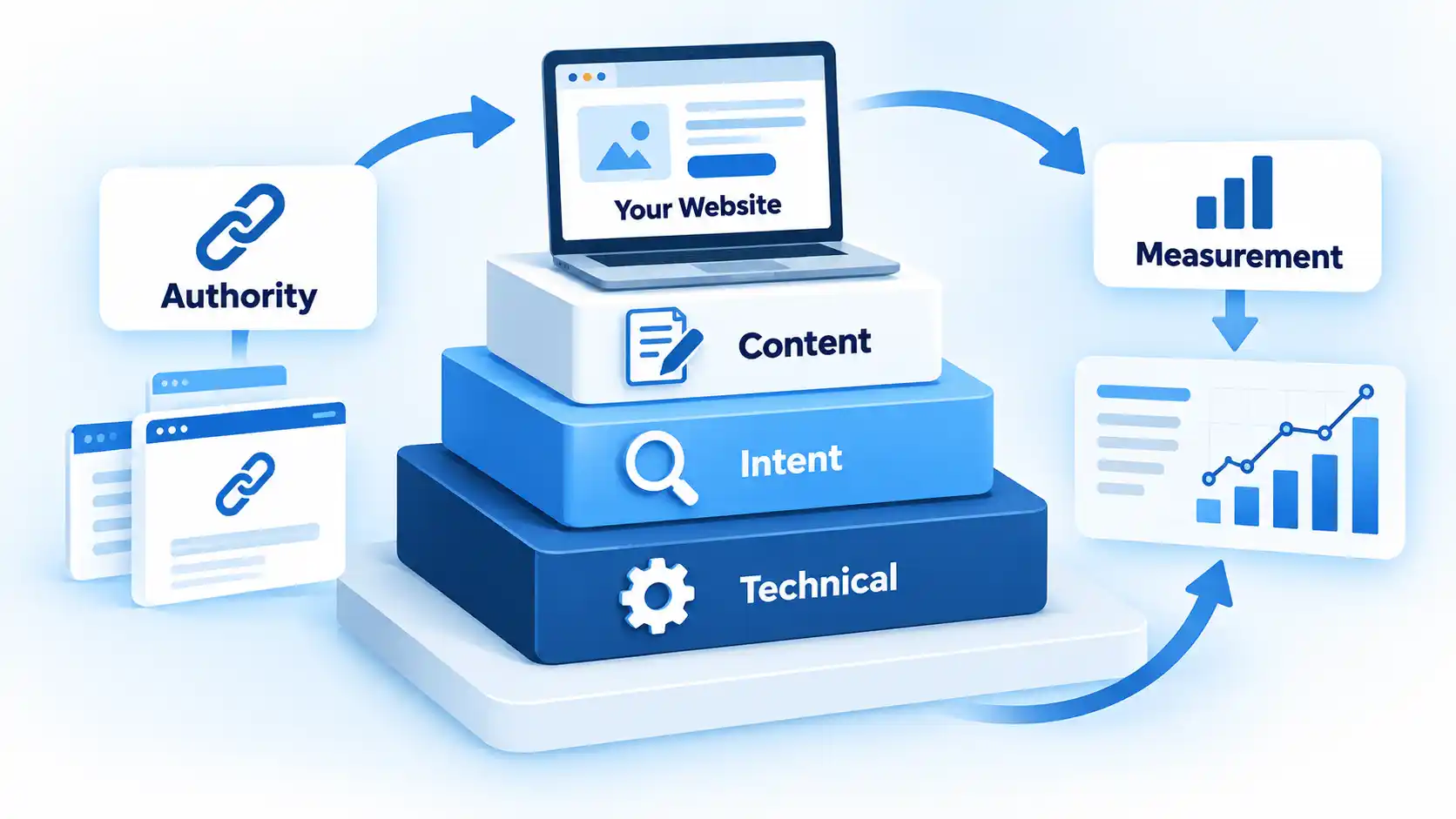
SEO Audit and Prioritization
An SEO audit examines how a website currently performs from a search perspective and identifies constraints worth addressing. Depending on the site, that can include crawlability, indexing, site architecture, internal linking, duplication, page templates, content quality, search visibility, and measurement.
The most useful output is not necessarily the longest list of issues. A good audit distinguishes between problems that can materially affect important pages and items that are technically imperfect but unlikely to change business results.
For example, finding a few product categories accidentally excluded from indexing is more urgent than changing minor metadata across hundreds of pages that already perform adequately. Prioritization should consider expected impact, implementation effort, dependencies, and risk.
Search Intent and Keyword Research
Keyword research identifies the language people use and the needs behind those searches. Strong research goes beyond collecting high-volume phrases. It groups related queries by intent and determines whether the appropriate response is a product page, service page, comparison, guide, category, support document, or another format.
Research may combine your own Search Console query data, manual search-result analysis, customer language, and free keyword research tools to identify topics worth investigating; third-party estimates should be treated as inputs rather than Google’s internal search data.
The result should be a prioritized content or optimization plan, not a spreadsheet containing thousands of phrases with no explanation of what the business should do with them.
Technical SEO
Technical SEO focuses on whether search engines can efficiently discover, process, and understand the site’s important pages. Work may involve crawl directives, redirects, canonicalization, JavaScript rendering, URL structure, sitemaps, internal linking, duplicate URLs, structured data where appropriate, and coordination around site performance. Structured data is machine-readable information added to a page to describe entities or content in a standardized format.
The objective is not technical perfection for its own sake. A practitioner should ask whether a problem prevents discovery, wastes crawl attention on unimportant URLs, creates competing versions of the same page, breaks a migration path, or makes important content harder to interpret.
This matters especially on ecommerce sites, publishers, marketplaces, large software-as-a-service websites, and other properties where templates or parameters can generate many URLs.
On-Page and Content Optimization
On-page SEO improves individual pages so their purpose is clearer to readers and search engines. That can include refining titles, headings, page structure, internal links, images, descriptions, and the content itself.
Useful content should answer the reader’s actual question rather than exist primarily to contain keywords. Google says its ranking systems aim to prioritize helpful, reliable information created for people, and its people-first content guidance recommends original, substantial content rather than material that merely rewrites what other pages already say.
For an existing page, optimization might mean adding a missing decision criterion, removing outdated material, improving a confusing explanation, consolidating duplicate sections, or restructuring information so the important answer appears earlier. It does not always mean making the page longer.
Internal links are part of this work because they help readers move between related topics and help search engines discover and contextualize pages. A structured SEO audit should therefore consider whether important pages receive useful contextual links, not simply count the total number of links on the site.
Authority and Off-Page Work
Off-page SEO concerns signals and exposure beyond the site itself. Legitimate work can include digital public relations, useful research or resources that attract references, industry outreach, partnerships, and promotion that brings relevant audiences to worthwhile content.
The distinction between promotion and manipulation matters. Google’s web search spam policies cover practices intended to manipulate search systems, and policy violations can result in lower visibility or removal from search results.
A provider should therefore be able to explain why a proposed link or promotional tactic has value beyond increasing a backlink count. Promises built mainly around purchasing large volumes of links deserve particular scrutiny.
Local SEO When Location Matters
Businesses that serve particular locations may also need local SEO. The work can include ensuring business details are accurate, aligning location and service pages with genuine customer needs, managing relevant local information, and maintaining Google Business Profile data where appropriate.
Local SEO is not a universal requirement. An online software company serving customers globally has different search needs from a dentist, plumber, restaurant, or multi-location retailer.
Measurement, Reporting, and Iteration
SEO should be measured as an ongoing system rather than a monthly list of completed tasks. Reporting can connect impressions and clicks from search with landing-page behavior and, where tracking is configured correctly, leads, sales, sign-ups, or other meaningful actions.
The report should also document what changed. Without an implementation record, it becomes difficult to connect an improvement or decline with specific work.
Useful reporting separates activity metrics from outcome metrics. “Twenty pages optimized” describes work completed. It does not show whether relevant visibility, qualified traffic, or business results improved.
What SEO Services Cannot Guarantee
SEO can improve the conditions under which a site competes in search, but it cannot control Google’s ranking systems, competitor activity, user demand, or whether a visitor eventually becomes a customer.
Warning
No SEO provider can guarantee a number-one Google ranking. Google specifically advises businesses to avoid providers that guarantee first place in search results.
Changes also do not have a fixed timetable. Google’s SEO guidance on implementation timing says some changes may be reflected within hours while others can take several months, and not every change produces a noticeable effect.
Rankings themselves are also only one stage in the chain. A page can gain visibility for the wrong searches and generate little business value. Another page may receive fewer visits but attract people who are much more likely to request a quote, start a trial, or buy.
A practical measurement chain is:
Search visibility → relevant clicks → useful on-site behavior → business outcome.
Each stage can fail independently. If impressions increase but clicks do not, the issue may involve query relevance or search presentation. If clicks rise without conversions, the problem may be the landing page, offer, tracking, or traffic quality rather than SEO visibility itself.
Paid search should also remain conceptually separate. Google states in its SEO hiring guidance that advertising with Google does not improve a site’s organic ranking.
How to Evaluate SEO Services Before Hiring
A useful evaluation starts with the business problem, then moves through diagnosis, scope, methods, and measurement. That order helps prevent a generic SEO package from becoming the solution before the actual problem is understood.
- Define the business outcome. Decide what SEO needs to improve. That might be qualified organic leads, ecommerce discovery, visibility for a new service, recovery after a migration, or reducing dependence on paid acquisition. A vague goal such as “rank better” gives the provider little basis for prioritization.
- Ask for a diagnosis before accepting a solution. A provider should explain what appears to be limiting performance and what evidence supports that assessment. A local service site with weak location relevance needs different work from an ecommerce site with indexing and duplicate-URL problems.
- Review the proposed scope and implementation responsibilities. Clarify which work the provider will perform directly, which recommendations your team must implement, what dependencies exist, and how priorities will be set. An audit has limited value when nobody owns implementation.
- Check the methods, not just the promised outcome. Ask how the provider approaches content, technical changes, links, automation, and AI-assisted workflows. Compare important recommendations with official search-engine guidance, especially when a proposed tactic could violate spam policies.
- Agree on measurement, reporting, and access. Define which metrics will indicate progress, how often they will be reviewed, and who owns relevant analytics and Search Console access. During an initial audit, Google’s SEO hiring guidance recommends read access to Search Console rather than write access.
- Reject guarantees and unexplained shortcuts. Ask the provider to explain why each important recommendation should help and what risks it carries. Be cautious when the sales pitch depends on guaranteed positions, secret ranking methods, Google “approval,” or third-party tools presented as if they reveal Google’s internal ranking data.
The most suitable provider is not necessarily the one promising the most activity. The more useful question is whether its diagnosis, priorities, methods, implementation plan, and reporting fit the problem your business actually has.
How to Measure Whether SEO Is Working
SEO measurement should move from search visibility toward business impact. No single number can explain the whole system, so reporting should answer several different questions.
| Measurement layer | Example metric | What it helps answer | Common mistake |
|---|---|---|---|
| Search visibility | Impressions and relevant query visibility | Is the site appearing more often for searches that matter? | Treating every additional impression as valuable regardless of intent |
| Search engagement | Organic clicks and click-through rate | Are searchers choosing the site’s results? | Assuming a ranking change automatically produces more useful visits |
| Business outcome | Qualified leads, purchases, sign-ups, or other tracked conversions | Is organic search contributing to an outcome the business values? | Claiming revenue impact when conversion tracking is incomplete |
| Execution and diagnosis | Implemented recommendations, affected page groups, indexing checks, and change logs | What changed, where, and when? | Reporting task completion as if it were proof of business performance |
Google Search Console’s Search results Performance report provides metrics including clicks, impressions, click-through rate, and average position, with dimensions such as queries, pages, countries, devices, search appearance, and dates. Those dimensions make it possible to investigate which parts of a site changed rather than looking only at one site-wide total.
Position should be interpreted carefully. Search results can vary by time, place, device, and user context, while Search Console reports aggregated data. For many business decisions, trends across relevant pages and queries are more informative than watching the position of one phrase.
Verify the result
- Search Console shows whether impressions and clicks are changing for the relevant pages or query groups, not just for the site as a whole.
- Reports distinguish branded searches from non-brand discovery when that distinction is important to the business goal.
- Tracked organic visits can be connected to meaningful business actions where analytics and conversion tracking are reliable enough to support that conclusion.
- Completed SEO changes are documented with affected pages and dates so later performance changes can be investigated rather than guessed at.
If impressions or clicks stop growing, diagnosing stalled organic traffic requires separating indexing problems, shifts in search demand, relevance issues, competitive changes, and measurement errors. A traffic decline alone does not identify its cause.
Does SEO Still Matter With AI Search?
Yes. Google states that its existing SEO best practices remain relevant to generative Search features such as AI Overviews and AI Mode because those experiences use its core Search ranking and quality systems and retrieve information from the Search index.
Google’s current guidance for generative AI features in Search also addresses Answer Engine Optimization (AEO) and Generative Engine Optimization (GEO). From Google’s perspective, optimizing for its generative Search experiences remains SEO rather than a separate ranking system.
Google also says sites do not need special AI text files, special markup, or AI-specific schema to appear in its generative Search features. Existing technical SEO, crawlability, useful content, and other foundational practices continue to apply.
That does not mean search behavior will remain static. AI-generated result formats can change how people investigate a topic and which queries they use. SEO services may therefore need to monitor different search journeys, improve the distinctiveness and usefulness of content, and make sure important information remains crawlable and understandable.
A provider selling a separate “AI SEO” package should still be able to explain the underlying work. If the recommendation improves technical accessibility, useful content, business information, product data, or another documented search input, its value can be evaluated. A claim that depends on a secret AI ranking shortcut deserves the same scrutiny as any other unsupported ranking promise.
When Professional SEO Services Make Sense
Professional SEO tends to make more sense when the opportunity or complexity exceeds what the existing team can reasonably handle.
- A large or technically complex website: Ecommerce stores, marketplaces, publishers, software-as-a-service platforms, and sites with many templates or dynamic URLs can create crawling, indexing, architecture, and duplication problems that require specialist analysis.
- A redesign or migration: Search considerations are easier to incorporate before URLs, templates, navigation, and redirects are changed than after traffic has already been lost. Google identifies redesigns and new-site launches as useful times to involve an SEO.
- A recurring search opportunity: If potential customers consistently research the problem, product, or service through search, systematic SEO work may justify ongoing investment.
- Cross-functional work: Businesses that need developers, writers, analytics specialists, and marketing teams coordinated around search may benefit from an experienced owner for the process.
- A decline that needs diagnosis: When organic performance changes materially, specialist analysis can help distinguish technical problems, content issues, search-demand changes, competitive shifts, and measurement problems.
There are also cases where an ongoing agency relationship may not be the best use of budget. A small site with limited search demand may be able to handle essential optimization internally. A company with no capacity to implement recommendations may continue paying for audits without changing the site. A weak product, poor pricing, or an uncompetitive offer also cannot automatically be fixed by increasing organic traffic.
Organic search and paid advertising can also serve different purposes. A useful SEO vs PPC comparison should consider time horizon, control, marginal cost, and how each channel captures existing demand rather than assuming one should replace the other.
Conclusion
SEO marketing services are most useful when they connect a real search or business problem to prioritized work, responsible implementation, and measurable outcomes. That can involve technical fixes, content, search-intent research, internal architecture, promotion, local visibility, or performance analysis depending on the site.
The important distinction is between improving the conditions for organic visibility and promising control over the result. A capable provider should be able to explain what it found, what it plans to change, why that work matters, how success will be measured, and what remains uncertain.

💬 Comments