No universal, fault-tolerant quantum computer exists today. Every credible roadmap, vendor guide, and government explainer starts from that fact, and it should reset how you read the next quantum pitch that lands in your inbox.
The useful work sits in a narrower band. Current machines hold hundreds of qubits, and noise still decides how long a useful circuit can run. The working pattern is a hybrid loop, where a classical optimizer steers a noisy quantum circuit and improves it iteration by iteration.
Quick Take
- Real now. Local simulators, cloud access to quantum processors, and three finalized NIST post-quantum cryptography standards you can start evaluating.
- Plausible near term. Hybrid experiments on transition-metal catalysts, greenhouse-gas capture materials, and specific optimization problems that already have a measured classical baseline.
- Not established. General speedups, portfolio-risk advantage, or any claim that quantum machines replace classical computing.
- Your next step. Run the simulator workflow, then write a benchmark plan before you request budget.
What a quantum computer actually does
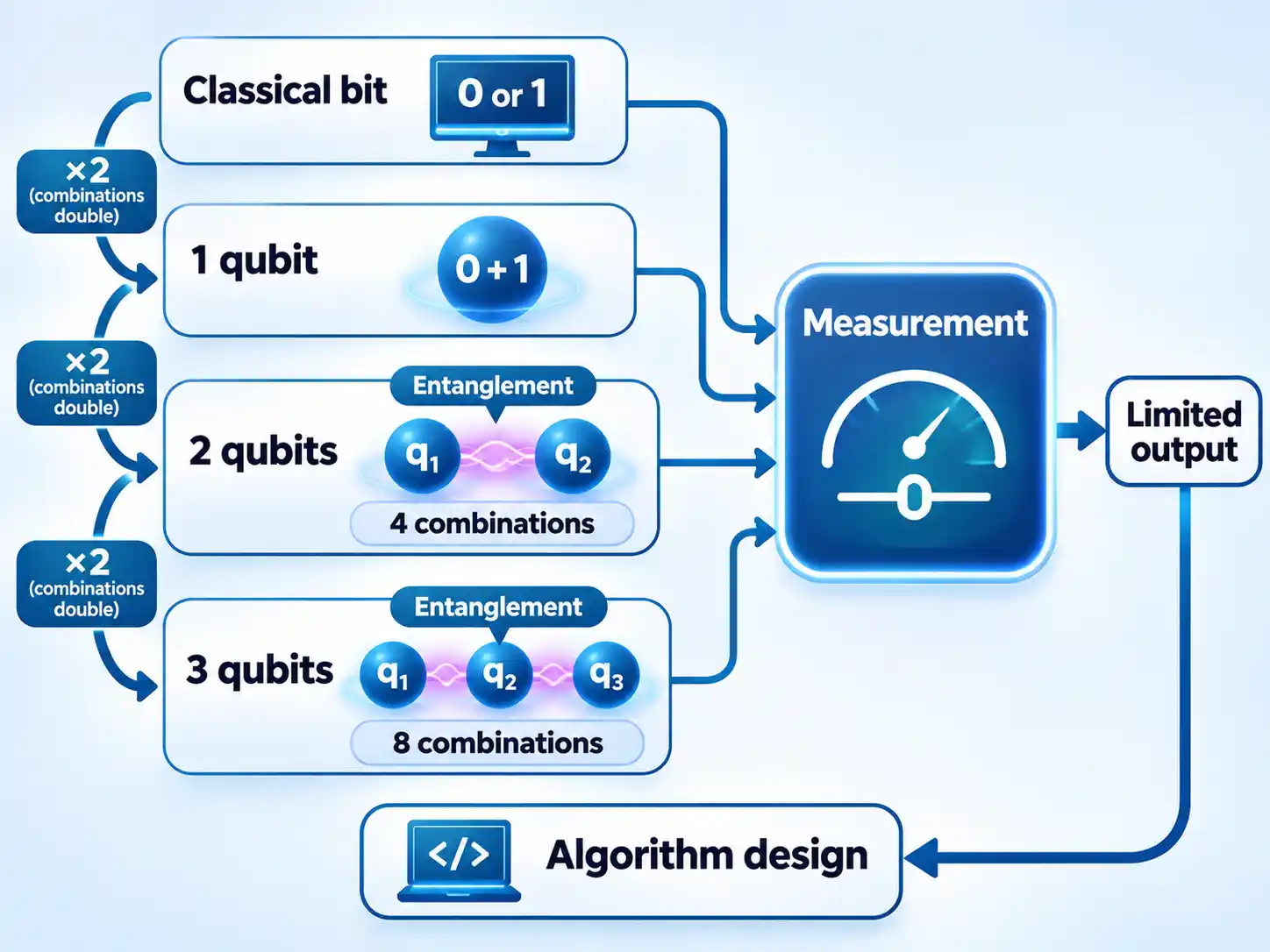
A quantum computer processes information using qubits instead of ordinary bits. A classical bit holds a 0 or a 1. A qubit can sit in a superposition of both states at once, and separate qubits can be entangled so they share a single quantum state.
The scale point is easier to grasp with a count. Two qubits can represent a superposition of four combinations of zeros and ones. Three qubits can represent eight. Each added qubit doubles the number of combinations. That exponential growth is where the computing power comes from, and it is also where most popular explanations go wrong.
Richard Feynman made the case in 1982 that simulating physics is a natural job for a computer built from quantum parts. Four decades later the argument still holds, but only for problems where the state space itself is the difficulty.
Measurement is the constraint that breaks the fantasy. Reading a qubit collapses it and returns only a small amount of information about the state. A quantum computer therefore cannot simply try every answer to a problem and hand you the winner. Quantum computers do not efficiently brute-force all solutions. Algorithm design exists to amplify the right answer before you measure, and much of the field’s difficulty lives in that step.
The hardware snapshot matters more than the qubit count on a press release. NIST describes the best current machines as holding hundreds of qubits and making roughly one error per thousand operations. Early demonstrations are not truly useful yet, and classical machines sometimes equal or exceed them.
Chemistry and materials are the strongest fit
Molecules are quantum systems. Simulating one on a classical machine means approximating a space of electronic configurations that grows quickly with the size of the molecule, and the approximation is where the method breaks down. A quantum processor is built from the same physics it is being asked to model, which is why chemistry keeps appearing at the top of application lists.
A peer-reviewed review of quantum computational chemistry describes the field as one of the most promising suggested applications of quantum computing for classically intractable chemistry problems. It names high-temperature superconductivity, solid-state physics, transition-metal catalysis, and biochemical reactions as questions that better simulation might help answer. The same review is blunt about the obstacle: building a sufficiently large quantum computer remains a difficult scientific challenge.
Concrete examples are worth naming. NIST’s rundown of potential applications includes designing new drugs by simulating individual molecules, modeling fertilizer-production catalysts, and developing materials for greenhouse-gas capture. Those are research targets rather than products, and none comes with a delivery date.
| Target | Where it appears | What it supports in practice |
|---|---|---|
| Transition-metal catalysis | Peer-reviewed review of quantum computational chemistry | A research target worth a benchmarked study |
| Fertilizer-production catalysts | NIST quantum computing explainer | A potential application named without any delivery date |
| Greenhouse-gas capture materials | NIST quantum computing explainer | A potential application that must pair with laboratory work |
| Drug design and biochemical reactions | NIST explainer and the chemistry review | Long-horizon potential that does not justify a hardware purchase |
| Proven advantage over classical chemistry methods | Not established | You have to build your own benchmark before you believe it |
Treat catalysis and energy-relevant materials as the entry point for a technical pilot. Treat any claim of a finished commercial chemistry product with suspicion, because the same research that names the possibility also names the difficulty.
Optimization and finance need a measured bottleneck
Optimization appears on every serious quantum application list, with supply-chain scheduling and complex process work such as airplane assembly as the standard examples. The appeal is straightforward. When you are scheduling thousands of interdependent parts, the number of possible arrangements explodes, and finding a good one gets expensive.
That does not mean quantum hardware wins the job. Optimization is highly problem-specific, and classical solvers have decades of tuning behind them. Quantum cloud services list optimization among their supported computation categories and name financial services, biotechnology, manufacturing, and pharmaceuticals among the application sectors. Those are category labels. They say nothing about measured results.
Warning
A quantum optimization pilot without a recorded classical baseline gives you no honest way to call it a success or a failure, because there is nothing to compare against. Write down your current solver, its runtime, and the quality of the answers it returns before you write the quantum test, and state in advance the threshold that would count as an improvement.
The decision rule is simple and unforgiving. If an existing classical solver already meets the business requirement inside your time window, a quantum experiment has no gap to close. Build the pilot only around a documented case where the classical approach misses a target you care about.
Finance deserves a separate sentence because it attracts the loosest claims. Financial services appears in vendor documentation as a supported application area. No published benchmark establishes an advantage for portfolio risk analysis, so treat any pitch that promises one as an open question that needs evidence from your own data.
Build quantum literacy with a simulator first
You do not need hardware to start. Qiskit installs locally with pip, and the built-in simulators run after a local installation completes. That gives a team a safe place to learn circuit construction, measurement, and result interpretation before anyone spends money on cloud processor time.
If you want the concepts before the code, BlueQubit’s educational guide to quantum basics covers foundational quantum principles, gates, and circuits at a level that suits a developer meeting the subject for the first time.
Install Qiskit and run your first circuit
You need Python 3 and a terminal. An IBM Cloud account is optional and only becomes necessary when you want to run jobs on IBM quantum processors rather than a local simulator.
- Create an isolated Python environment.Navigate to your project folder and run
python3 -m venv .venvon macOS or Linux, orpython -m venv .venvon Windows. Then activate it, for example withsource .venv/bin/activatein a shell.The isolation matters. A virtual environment keeps Qiskit and its dependencies away from the base Python installation, so a corrupted setup can be deleted and rebuilt without breaking anything else on the machine.
Your terminal prompt should now show the environment name at the start of the line.
- Install Qiskit and Jupyter.With the environment active, run
pip install qiskitto install the SDK, thenpip install jupyterif you want notebooks.Keep the environment active for every install. Packages installed after deactivation land in the base interpreter and stay invisible to the project.
Run
pip listand confirm that Qiskit appears in the output. - Run a circuit on the local simulator.Launch Jupyter from the same shell with
jupyter notebook, open a new notebook, and import Qiskit. Build a short circuit with a couple of gates, then execute it on the simulator bundled with the SDK.A common failure mode here is environment confusion. If Jupyter starts from the base environment instead of your virtual environment, the import raises a “No module named ‘qiskit'” error even though the install succeeded. Relaunch the notebook from the activated environment and the import resolves.
A successful run returns a result object with measurement counts for the circuit you built.
- Send the same circuit to real hardware when you are ready.IBM requires an IBM Cloud account before a job can run on its quantum processors. Amazon Braket offers a managed alternative with notebooks, high-performance simulators, and on-demand access to gate-based hardware from several providers, plus an analog simulator.
Log the backend name, the shot count, and the timestamp beside every result. A simulator result checks that your code is correct. It says nothing about hardware performance.
Compare the hardware result with the simulator result on the same circuit. A large gap tells you that noise, not your algorithm, is shaping the output.
Verify the result
- The shell prompt shows the virtual environment name before any command runs.
pip listlists Qiskit inside that environment.- A notebook launched from the same shell imports Qiskit without an error.
- The local simulator returns measurement counts for your circuit.
Post-quantum cryptography is the migration you can start now
In August 2024, NIST released its first three finalized post-quantum cryptography standards. They are ready for immediate use, and NIST encourages system administrators to begin the transition as soon as possible because full integration takes time. Some experts predict a device capable of breaking current encryption within a decade. The prediction explains the urgency without setting a deadline.
These algorithms rest on math problems intended to stump both conventional and quantum computers. That distinction matters for planning: post-quantum cryptography is defensive security work on ordinary hardware, separate from any workload you would send to a quantum processor.
| Standard | Algorithm | Purpose | What the standard specifies |
|---|---|---|---|
| FIPS 203 | ML-KEM | Key encapsulation | A mechanism for two parties to establish a shared secret key over a public channel; parameter sets ML-KEM-512, ML-KEM-768, and ML-KEM-1024 |
| FIPS 204 | ML-DSA | Digital signatures | A set of algorithms to generate and verify digital signatures, believed secure against a large-scale quantum computer |
| FIPS 205 | SLH-DSA | Digital signatures | A stateless hash-based signature algorithm based on SPHINCS+, selected through the NIST standardization process |
The timeline inside NIST’s standards program is the part to put in front of a budget owner. Under its transition plan, NIST will deprecate and ultimately remove quantum-vulnerable algorithms from its standards by 2035, with high-risk systems moving much earlier. Organizations are expected to identify where vulnerable algorithms are used and plan a replacement or update.
Four actions cover most of the first year of work.
- Inventory every place public-key cryptography appears, including transport security, code signing, and firmware update paths.
- List vendor dependencies and ask each supplier for a post-quantum roadmap with dates.
- Prioritize systems that protect data with a long confidentiality life, such as medical records and long-lived contracts.
- Assign one owner and one deadline for the first replacement before you publish a policy.
Jurisdiction deserves care here. NIST sits inside the U.S. Department of Commerce, and its post-quantum standards are U.S. federal standards and guidance. They do not, by themselves, create a legal obligation in every country. Check your own regulator, your sector rules, and your customer contracts before a migration date enters a compliance document.
NISQ work today, fault tolerance later
The industry is in the noisy intermediate-scale quantum era. Existing hardware is limited by noise, and today’s devices are too noisy to sustain pure quantum algorithms such as Shor’s or Grover’s at useful scale, which is why practical work combines classical computing resources with quantum processors.
In a hybrid algorithm, the quantum processing unit acts as a co-processor for a classical CPU. Computation moves back and forth. Variational algorithms are the common form: a classical optimization routine adjusts the parameters of a quantum circuit iteratively, similar to the way a neural network’s weights are adjusted during training. Chemistry, optimization, and machine learning experiments all use this structure today.
| Dimension | NISQ hybrid work today | Fault-tolerant future |
|---|---|---|
| Hardware status | Exists today as noisy devices, where error rates limit what can run | Not available today; error correction remains a research goal |
| Algorithm style | Hybrid variational loops where a classical optimizer tunes a parameterized circuit | Pure quantum algorithms such as Shor’s and Grover’s, which current noise prevents at useful scale |
| Error handling | Errors are a primary limit on what circuits can run and how reliable the output is | Error correction is the enabling requirement, and it remains a research goal |
| Evidence of value | Early demonstrations are not yet proven useful, and classical machines sometimes match or beat them | No delivery date is established |
The realistic read holds the line. Most applications of quantum computing remain years or decades away. Plan for a decade of experimentation, not a two-year deployment.
Decide whether to pilot, wait, or start with security
Five filters decide most quantum proposals. The first four test the pilot itself; the fifth decides whether security work should come first.
- Is the problem quantum-native? Electronic structure, molecular simulation, and materials modeling pass. General business analytics and routine data processing do not.
- Do you have a measured classical baseline? Record the current solver, its runtime on your real inputs, and the quality of the answers it returns.
- Can you define success before you start? Write a benchmark plan with a threshold that would change your decision, and name the metric in advance.
- Do you have the data and the people? Prioritize engineers who can write Python, run a simulator, and interpret results honestly, and establish a clear baseline before expanding the team.
- Is a security clock already running? If you hold sensitive data with a long confidentiality life, the cryptography inventory matters more this quarter than any quantum pilot.
This path suits research, chemistry, materials, and optimization teams with a specific hard problem, a documented classical shortfall, and the patience to measure. It does not suit anyone shopping for turnkey acceleration, a replacement for ordinary servers, or a headline for an annual report.
Above all, treat quantum capability like an experimental instrument: if your classical solver already meets the requirement, the honest answer is to wait. And keep post-quantum cryptography on an entirely separate track with a dedicated security owner. NIST’s finalized post-quantum standards are ready now, deprecation timelines are set, and protecting long-lived sensitive data is work you cannot afford to delay while waiting on hardware.

💬 Comments