Online casino technology is easy to demo and hard to verify. A studio tour, a testing seal, and a wallet logo all look like proof, but only some of them give you something you can check before you deposit. Judge a platform on what you can measure or read in its own published terms: how the lobby performs on your phone, whether live video holds up on your connection, which lab and scope sit behind a seal, what a hash actually verifies, and what the banking page says about withdrawals. The technology behind the spin is real; the marketing around it often blends separate layers into one trust signal. Pulling them apart is how you make a better pre-deposit decision.
Browser performance you can test yourself. Live video follows published web standards. Lab certification has a named scope you can look up. Payment logos tell you which checkout method exists, not how fast a withdrawal lands. The gap between “this technology exists” and “this casino uses it well” is where most pre-deposit mistakes happen.
Quick Take
- Start with your phone and live stream. Open three games on your phone, and test any live table at your normal play time to see how the connection holds.
- Read the testing seal for a lab name, product, scope, and date. An unlabelled badge is decoration.
- Treat a hash page as change detection. Ask for the full protocol before you accept it as evidence of fair odds.
- Read the withdrawal section line by line. Method, review period, identity checks, and any stated queue.
- Ask what the protection policy actually does. An algorithm is not a limit; the operator has to confirm the trigger.
- Warning: no technology claim on any casino page guarantees wins, payout speed, or your legal eligibility where you live.
Seven layers, one comparison
Each layer behind a modern casino answers a different question. Mixing them up is how a wallet logo ends up reading like a payout rating, and how a hash string ends up reading like an audit.
The table below separates them. Read down the middle columns when you want the honest version of a marketing claim.
| Layer | What you can see | What it can establish | Main trade-off | Reader fit |
|---|---|---|---|---|
| Browser rendering and mobile speed | The lobby opens in a phone browser and games start without a download | That the page runs on standard web graphics, and how quickly it responds on your device | Reach depends on the phone’s graphics chip, browser, and network; a speed score describes the page, not the odds | Mobile slots and casual players |
| Real-time video transport | A live dealer stream that plays inside the browser tab | That browser-based real-time video can use standards-based media delivery with documented connection handling | Quality depends on network conditions and relay servers; no latency guarantee exists | Live-table players |
| Table-data capture (OCR and RFID) | Almost nothing visible to a player | That text recognition and radio-frequency identifier reading are established, documented technologies | General capability only; no public evidence ties them to a named studio’s tables | Tech-curious live-table readers |
| RNG lab testing | A lab name and a certification mark in the footer or help pages | That a testing firm says it evaluated a specific product against a stated scope | Labs describe their own commercial services; statistical testing has an acknowledged ceiling | Fairness-focused readers |
| Hash integrity checks | A seed, a hash value, and sometimes a verification tool | That disclosed data has not changed since the digest was generated | Detects tampering with published data; says nothing about odds, RNG quality, or payouts | Crypto-curious and fairness-focused readers |
| Recommendation systems | A lobby that reorders games around what you played last | That machine-learning models such as matrix factorization and neural networks are used in recommendation systems | General model knowledge only; no casino-specific data or protection behaviour is established | Tech-curious readers |
| Payment-app availability | An Apple Pay or Google Pay button at the cashier | That the platform accepts that checkout method, and what the wallet itself states about security | Acceptance and tokenisation say nothing about withdrawal speed, queues, or identity review | Payment and privacy-focused readers |
Browser play: what makes a lobby open without a download
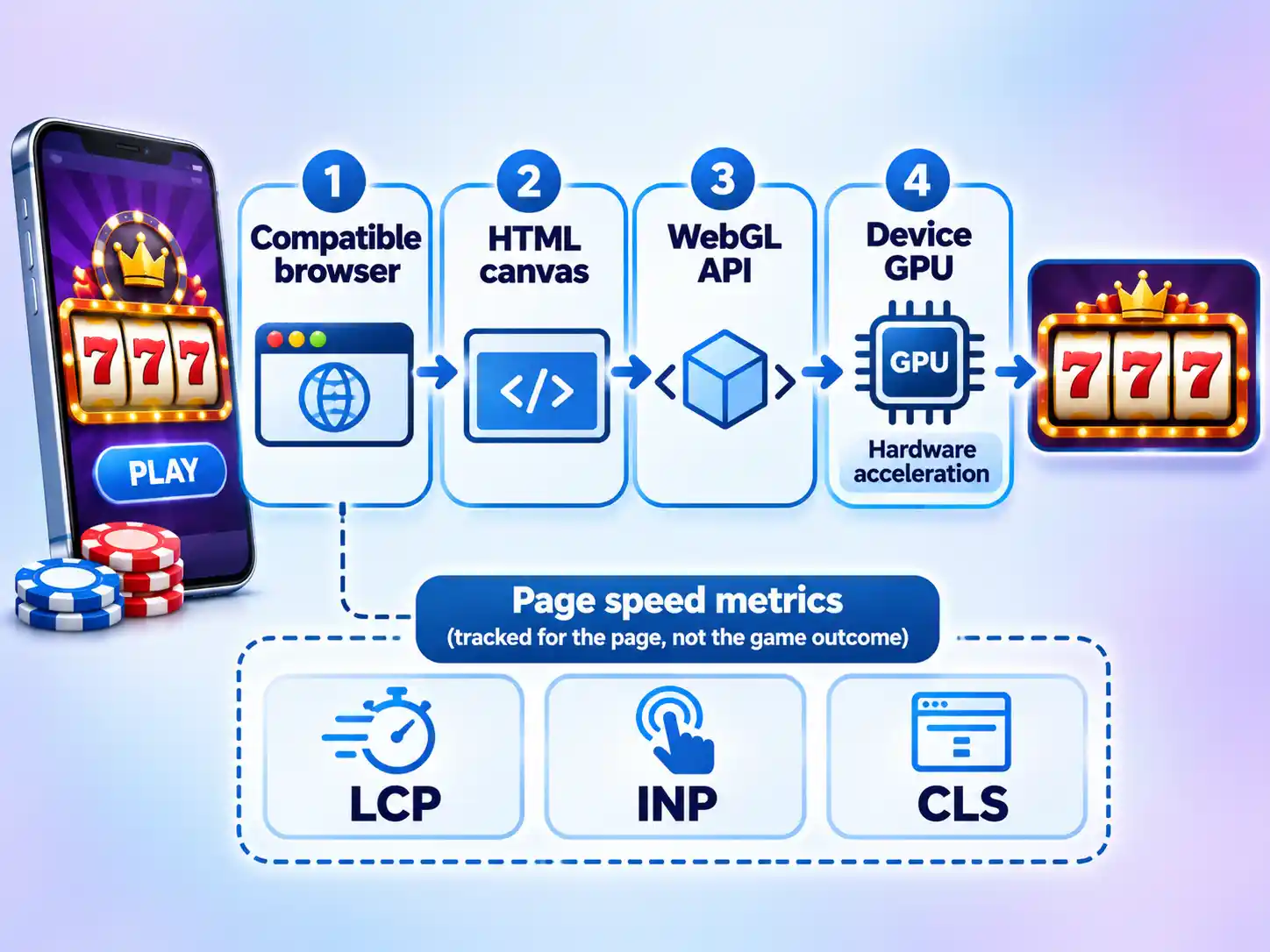
Open a modern slot on a mid-range phone and you are watching a browser do something that once needed a plug-in. The rendering layer is often WebGL, a JavaScript API for rendering high-performance interactive 2D and 3D graphics inside any compatible browser without plug-ins. It draws into an HTML canvas element, closely follows OpenGL ES 2.0, and can tap the hardware graphics acceleration on your device.
That last part is the catch you should care about before depositing. Support exists in all modern browsers, but the device must also have hardware that supports the feature. WebGL gives a casino reach across phones; it does not give every phone the same frame rate.
Judging mobile speed before you deposit
Page speed is measurable, which makes it one of the most honest pre-deposit checks available to you. Google’s current Core Web Vitals guidance sets three thresholds for a good experience: Largest Contentful Paint should occur within 2.5 seconds of the page starting to load, Interaction to Next Paint should land at 200 milliseconds or less, and Cumulative Layout Shift should stay at 0.1 or less. Assess those at the 75th percentile of page loads, segmented across mobile and desktop. Google also notes the metrics evolve, so treat the numbers as current guidance.
You do not need developer tools installed. Lighthouse is an open-source automated audit that runs in Chrome DevTools, from a command line, or as a Node module, and it scores performance, accessibility, SEO, and more for any page you point it at. Failed audits are indicators, not verdicts, and the report describes an automated run rather than your actual network.
Run it on the lobby, then do the part no tool can do: open three games on your own connection and watch for stutter, layout jumps, and buttons that lag behind your thumb. A page can score well and still feel wrong on a weak phone.
If you want an optional directory to browse mobile-facing sites, Dobramine’s mobile casino reviews can help you shortlist interfaces. Use it to build a candidate list, then run your own audit on each one. A review page tells you what someone else saw; the audit tells you what your phone does.
Info
A fast lobby measures the page. It does not measure the random number generator, the payout queue, or the terms attached to a bonus. Keep those checks separate.
Live tables: separating the video from the card data
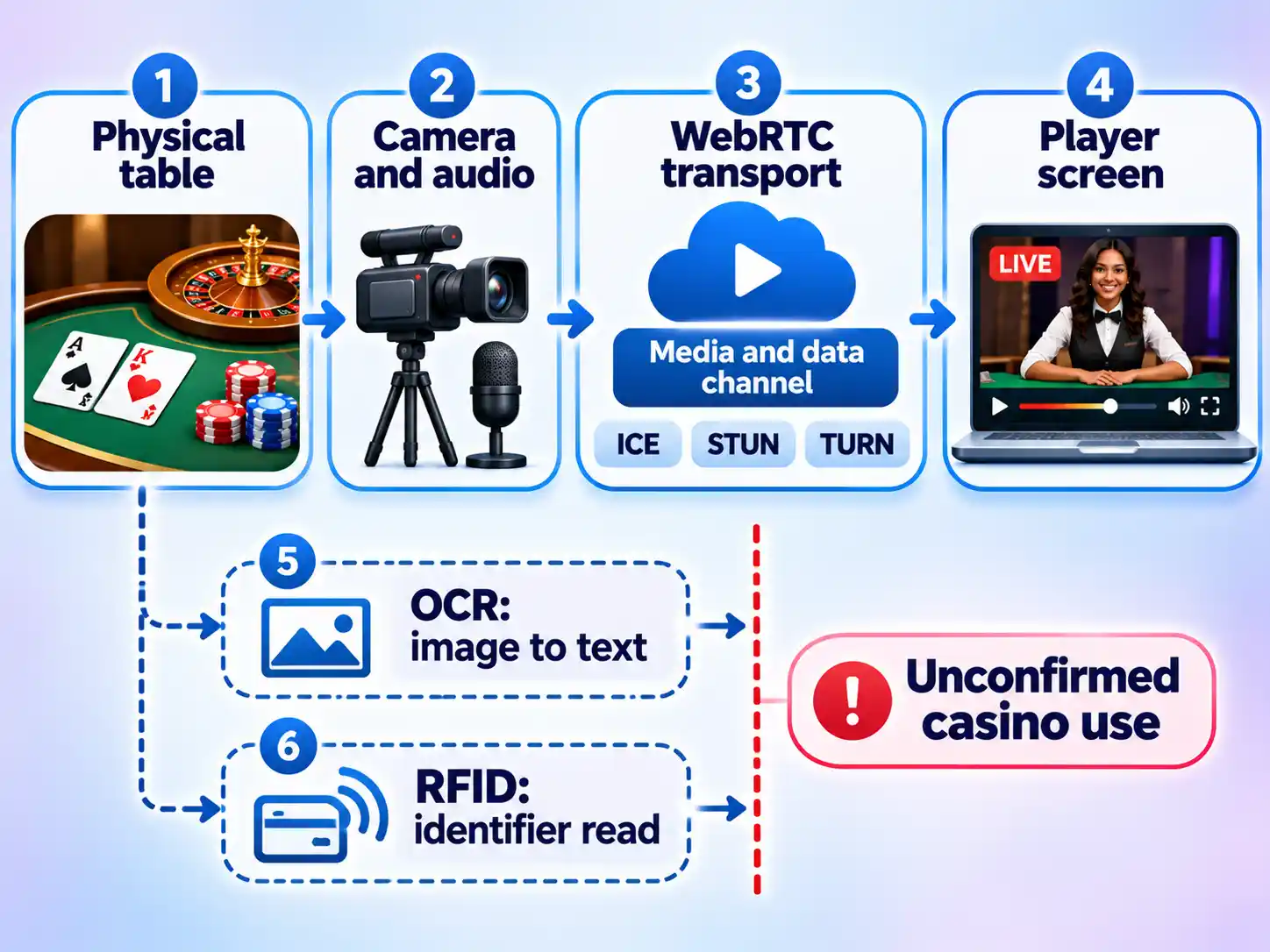
A low-latency live-dealer stream can use WebRTC, the browser standard for real-time communication. The W3C WebRTC Recommendation published in March 2025 defines a set of ECMAScript APIs that let media and generic application data travel to and from another browser or device, and it covers NAT traversal through ICE, STUN, and TURN. MDN’s WebRTC documentation adds the practical detail: audio and video capture and streaming plus arbitrary data exchange, with no plug-ins or third-party software required.
What that buys you is browser-native video without an install. What it does not buy you is a latency guarantee. The connection still depends on your network, the relay servers in the path, and the device decoding the stream. A studio can be well built and still stutter on hotel Wi-Fi.
The scanning layer underneath the video
Live-table data can also be captured from the physical table itself. Optical character recognition takes an image and returns text. The Tesseract OCR engine recognises text in images across more than 100 languages and several image formats, and its project notes that image quality affects the result. Radio-frequency identification works differently: GS1’s EPC/RFID standard documents the Electronic Product Code as a syntax for unique identifiers assigned to physical objects, with binary forms suitable for RFID tags, and notes that RAIN RFID can capture those identifiers at very high rates and at distances beyond 10 metres without line of sight.
Both technologies are real and documented. Neither of those facts tells you what a specific live-dealer studio does at its tables.
Warning
Documented component capability is not confirmed casino deployment. Ask the operator directly whether a named studio uses OCR or RFID for card and wheel data, and what accuracy or latency it publishes. If the answer is vague, treat the claim as unverified.
If live blackjack is your game, the table rules and the disclosure on the help page will tell you more about your session than stream quality will. Our guide to live dealer blackjack covers what to compare at the table itself.
What a testing seal proves, and what a hash proves
Testing laboratories describe their own work, and that description is the useful part. eCOGRA describes itself as an independent game testing laboratory founded in 2003 in the United Kingdom, specialising in the evaluation, inspection, and certification of online gambling software and systems. iTech Labs describes itself as an independent iGaming test lab that tests and certifies RNGs, games, and platforms, including source-code evaluation and testing of raw and scaled output from both pseudo-random and hardware generators.
Both are commercial self-descriptions. That does not make them worthless; it tells you what a seal is. A seal is a claim that a firm with a stated scope examined a product. It is not a statement that this operator’s current build is fair, and it says nothing about withdrawal speed.
The statistical ceiling matters too. NIST SP 800-22 provides statistical tests for random and pseudorandom generators and describes them as potentially useful as a first step, while stating plainly that no set of statistical tests can absolutely certify a generator as appropriate for a particular application. Statistical testing cannot substitute for cryptanalysis.
Hash checks sit in a different category entirely. FIPS 180-4 specifies hash algorithms that generate digests of messages, and the digests are used to detect whether messages have been changed since they were generated. That is integrity, and integrity is worth having. A “provably fair” page that publishes a hash lets you confirm that the disclosed data was not swapped afterwards. It does not prove fair odds, RNG quality, or that a payout will arrive quickly.
| Question | RNG lab certification | Hash-based verification page |
|---|---|---|
| Who issues it | A commercial testing laboratory with a stated accreditation scope | The operator, sometimes with a public verification tool |
| What it examines | Source code, raw generator output, and scaled or shuffled output against a defined standard | Whether published data matches a published digest |
| What it can establish | That a named product was tested within a described scope at a point in time | That the disclosed data has not changed since the digest was generated |
| What it cannot establish | Absolute proof of fairness across every future round; current certification status without a check | Fair odds, RNG quality, or payout speed |
| What to ask for | The lab name, the certificate reference, the scope, and the most recent date | The full protocol: what is hashed, when the seed is revealed, and who independently checked it |
If you want the deeper version of how randomness and payout percentages interact inside a slot, read our explainer on RNG, fairness, and slot technology.
Where personalisation stops
A lobby that reshuffles around your last session is running a recommendation system. Those systems commonly use model families such as matrix factorization and deep neural networks. That is real, mainstream engineering, and it explains why a casino homepage can feel oddly well ordered after a short session.
Personalisation and player protection are separate systems, and the second one is a policy question. Whether a platform triggers a deposit-limit reminder, a cool-off prompt, or an account review is a decision its operators make, written into rules. No public model documentation tells you when that happens.
Ask support two specific questions before you deposit: can I set my own deposit and session limits, and what happens when I ask for a cool-off. The answers will be concrete or evasive, and evasiveness is the signal.
What a payment logo tells you about withdrawals
Apple states that Apple Pay works on websites and in apps, that setup requires verification with your bank or card issuer, that card numbers are not stored on Apple’s servers or shared with merchants, and that Apple does not charge users a fee, though an issuer may. Google states that Google Pay saves payment details for checkout on Android and Chrome, offers fraud alerts and encryption, does not sell personal information or transaction history, and processes U.S. domestic payments through Google Payment Corp., a licensed money transmitter. That last detail is U.S.-specific.
All of that describes the wallet. None of it describes the casino’s cashier. A supported Apple Pay or Google Pay button establishes that a checkout method exists. It does not establish that the platform accepts your country, that your withdrawal will be paid to the same method, or that the money will leave in minutes.
Withdrawal timing normally depends on the platform’s stated review period, identity and anti-money-laundering checks, your bank or card issuer, and the method you withdrew to. Those are written in the banking section, not on the wallet’s logo. If a site advertises a payment brand but its banking page has no stated review period, treat the absence as the finding.
For a broader list of operators, BonusInsider’s casino directory is an optional place to build a comparison list. Read each platform’s own banking page before you accept any timeline you find in a directory.
Which checks fit which player
You do not need all seven layers at once. Match the checks to what you actually play.
| Reader type | Check first | Spend less time on | Why |
|---|---|---|---|
| Mobile slots player | Lobby load, game launch, layout stability across three games | Studio branding and lobby animations | Your session quality is decided by page performance on your own phone |
| Live-table player | Stream stability at peak hours, table rules, published limits | Claims about table-data capture | Video transport and table rules affect your session; internal studio hardware does not |
| Fairness-focused reader | Named lab, certificate scope, date, and the full hash protocol if offered | Unlabelled trust badges | Scope and date are checkable; a badge without a lab name is not |
| Payment and privacy-focused reader | Withdrawal methods, stated review periods, identity requirements | Wallet security marketing | Settlement terms live in the platform’s banking page |
| Tech-curious reader | Which layer proves what, and who can actually observe it | Feature lists that blend layers together | The observability boundary is the fastest way to spot an inflated claim |
Run a pre-deposit check before you fund an account
Work through these in order. Each step produces something you can look at or quote back to support later, which is what makes the routine worth repeating on every new platform.
- Audit the lobby, then test it on your phone.From desktop Chrome DevTools or the Lighthouse CLI (using mobile emulation or remote debugging where needed), run a Lighthouse audit against the lobby URL. Then switch to your phone, open three games on your own connection, and watch for stutter, layout jumps, and lag between your tap and the response.The Lighthouse audit is an automated snapshot, so your live phone session is the real test. Compare both against the Web Vitals targets rather than against a competitor’s marketing page.A shortlist candidate should load its lobby and open a game without a visible freeze. If the audit fails performance checks and the live session stutters, drop it.
- Open a live table before you commit.Load a live blackjack or roulette table during the hours you would normally play. Watch whether the video holds when you switch from Wi-Fi to mobile data, and whether the audio stays in sync with the dealer.Browser-based real-time video handles the connection in the browser, so a persistent failure here usually reflects the site’s delivery setup or your network path rather than your device.The stream should recover on its own after a brief dip. Repeated freezes on a stable connection are your answer.
- Find the testing lab name and its scope.Scan the footer, the help centre, and the responsible-gaming page for a laboratory name and a certificate reference. Write both down.A lab seal is a commercial self-description with a defined scope, so the name and reference are what let you ask a precise question later.You should be able to state which lab certified which product and when. An unnamed badge means you have nothing to check.
- Read the withdrawal section end to end.Locate the banking page and note the stated review period, the identity documents required, any method-specific rules, and whether withdrawals must return to the deposit method.Payment-app availability does not set settlement speed. Those terms live here, in the operator’s own published wording.A complete banking page names methods, timelines, and identity requirements. A page with logos and no timings is incomplete.
- Ask support one precise question.Send a single question about the withdrawal queue or the account’s limit controls, and note how specific the reply is.Recommendation systems drive what you see in the lobby; protection controls are policy decisions set by the operator.A useful answer names a process and a timeframe. A reply that restates the marketing copy tells you how the rest of the relationship will go.
- Set your limits before the first deposit.Find the deposit limit, session reminder, cool-off, and self-exclusion controls in the account settings, and set them while the balance is still zero.Limits set in advance are easier to keep than limits negotiated mid-session.The controls should confirm the new limit in writing, and a cool-off request should take effect without a support negotiation.
Verify the result
- The lobby and three games open without a visible freeze on your own connection.
- You can name the testing laboratory, the certified product, and the reference on file.
- The banking page states a review period, required documents, and method-specific rules.
- Your deposit limit and cool-off controls are set and confirmed before any money moves.
When the page and the pitch do not match
Most mismatches follow a small number of patterns. Here is how to read each one.
The lobby stutters on a fast connection
Run a Lighthouse audit and compare the result with your live session. If the audit passes but gameplay still stutters, the problem is likely in the game build or your device’s graphics support rather than the page itself. Try a second game from a different provider before writing off the platform.
The live stream runs several seconds behind the table
Some delay is inherent to browser-based real-time video, which depends on your network and the relay servers in the path. Persistent multi-second lag on a stable connection points to the operator’s delivery setup. Test at a quieter hour to separate load problems from routing problems.
There is a “provably fair” page with no protocol
A hash confirms that disclosed data has not changed since the digest was created. Without a documented protocol showing what is hashed, when the seed is revealed, and who verified it, you cannot check anything. Ask for the protocol, and if it does not arrive, treat the badge as decoration.
The withdrawal page lists methods but no timelines
Method logos establish acceptance. Settlement depends on the review period, identity checks, and your bank. Ask support in writing how long a first withdrawal typically takes after verification clears, and keep the reply.
A page claims automated protection without describing it
Recommendation models are documented in public machine-learning material. Automated protection triggers are operator policy. Ask for the specific trigger and the action it produces, and compare that with the limit controls you can set yourself.
Before you open an account
No technology claim—whether a fast lobby, a live stream, a testing seal, or a wallet logo—guarantees wins, payout speed, or fairness on its own. When a platform leaves its testing scope or withdrawal terms vague, that gap is your answer before any money moves.
Check that the operator is permitted to serve your country, that you meet the age and eligibility rules that apply where you live, and how to use deposit limits, cool-off, and self-exclusion before you need them. If play stops feeling like a choice, stop and use the platform’s controls or a local support service.

💬 Comments