The easiest way to advertise a product is to identify a specific buyer, explain one clear benefit, choose a channel where that buyer already spends time or searches, run a small measurable test, and improve the campaign using real conversion data. You do not need to advertise everywhere at once.
Advertising is one part of marketing. Advertising usually refers to paid or deliberately placed promotional messages, while marketing also includes product positioning, pricing, email, search engine optimization, content, referrals, partnerships, and customer retention.
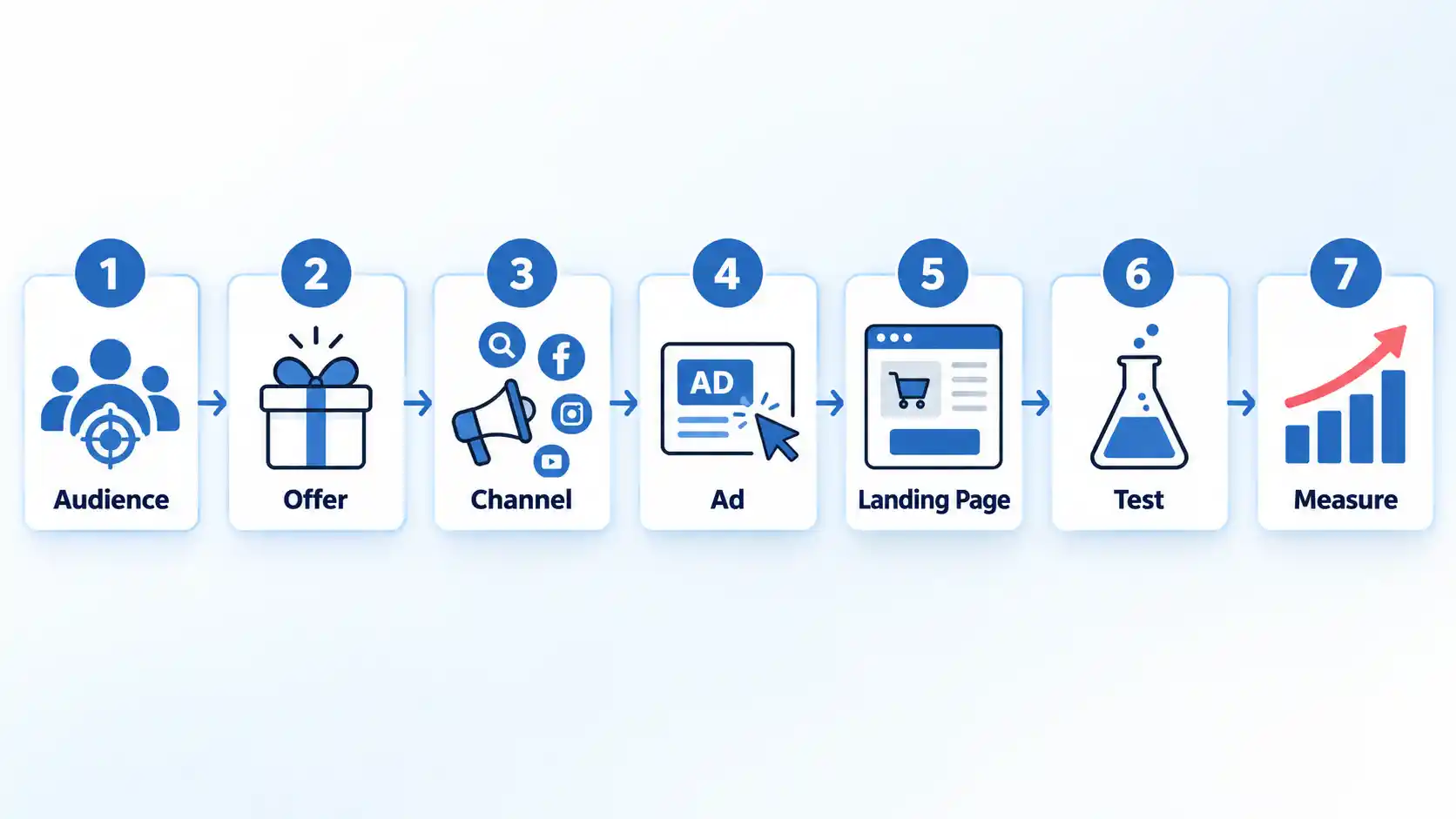
Quick Take: A Simple Product Advertising Process
- Identify the specific customer most likely to buy the product.
- Choose one benefit or problem to emphasize.
- Make sure the product or landing page is ready to convert visitors.
- Select one primary advertising or promotional channel.
- Set a budget or test period you can afford.
- Track a meaningful action such as a purchase, booking, lead, or signup.
- Keep, change, or stop the campaign based on what the results show.
This approach reduces complexity. Instead of opening several advertising accounts, producing dozens of ads, and dividing a small budget across multiple platforms, you start with one reasonable hypothesis and test it.
What You Need Before Advertising a Product
A campaign can bring people to a product, but advertising cannot fix every weakness in the offer. Before spending money or promoting the product heavily, make sure three basic pieces are in place.
1. A specific target customer
A target customer is the type of person most likely to need, want, or benefit from the product. The definition should be specific enough to influence your message and channel selection.
For example, “people interested in fitness” is broad. “Beginners building a home gym who need compact equipment for a small apartment” gives you a clearer audience, use case, message, and set of possible advertising channels.
Do not narrow an audience using sensitive personal characteristics merely because an advertising platform makes detailed targeting possible. Platform rules and applicable privacy or anti-discrimination requirements can restrict how certain characteristics are used.
2. A clear product benefit
A feature describes what a product has. A benefit explains why that feature matters to the customer.
A laptop with a 12-hour battery has a feature. Being able to work through most of a day without searching for a power outlet is the benefit. Strong advertising usually connects the feature to an observable customer outcome instead of presenting specifications without context.
3. A purchase-ready destination
The page people reach after clicking an ad should confirm the promise made in the advertisement. At minimum, check the product name, price, important specifications, availability, images, shipping information when applicable, and the main purchase or contact action.
A fast campaign can expose a weak product page very quickly. If visitors repeatedly click but leave without buying, the problem may be the offer, page, price, checkout, trust signals, or audience rather than the ad itself.
How to Advertise Your Product Easily in 7 Steps
The following process works as a practical starting framework for physical products, digital products, and many services sold like products. The exact platform and economics will differ, but the decision sequence remains useful.
Choose one advertising objective
Decide what successful advertising should cause people to do. A conversion is a valuable action you want someone to complete after interacting with your promotion.
Common objectives include a purchase, qualified lead, consultation request, booking, app installation, or email signup. Awareness and product-page visits can also be objectives, but they should not be confused with sales.
If the real business goal is purchases, a campaign that generates thousands of cheap clicks but no sales has not automatically succeeded. Define the desired result before selecting metrics.
Set an affordable test budget or test period
There is no universal amount that every business should spend on product advertising. Costs vary by product category, country, competition, audience, platform, margin, and campaign type.
For paid campaigns, choose an amount you can afford to test without putting inventory, payroll, or essential operating expenses at risk. For organic promotion, define a test period and workload instead, such as publishing a specific set of product demonstrations over several weeks.
The first campaign does not need to prove that the product can scale indefinitely. Its job is to give you useful information without creating unnecessary financial exposure.
Choose one primary advertising channel
Start where customer behavior and the product fit each other. Different channels solve different discovery problems.
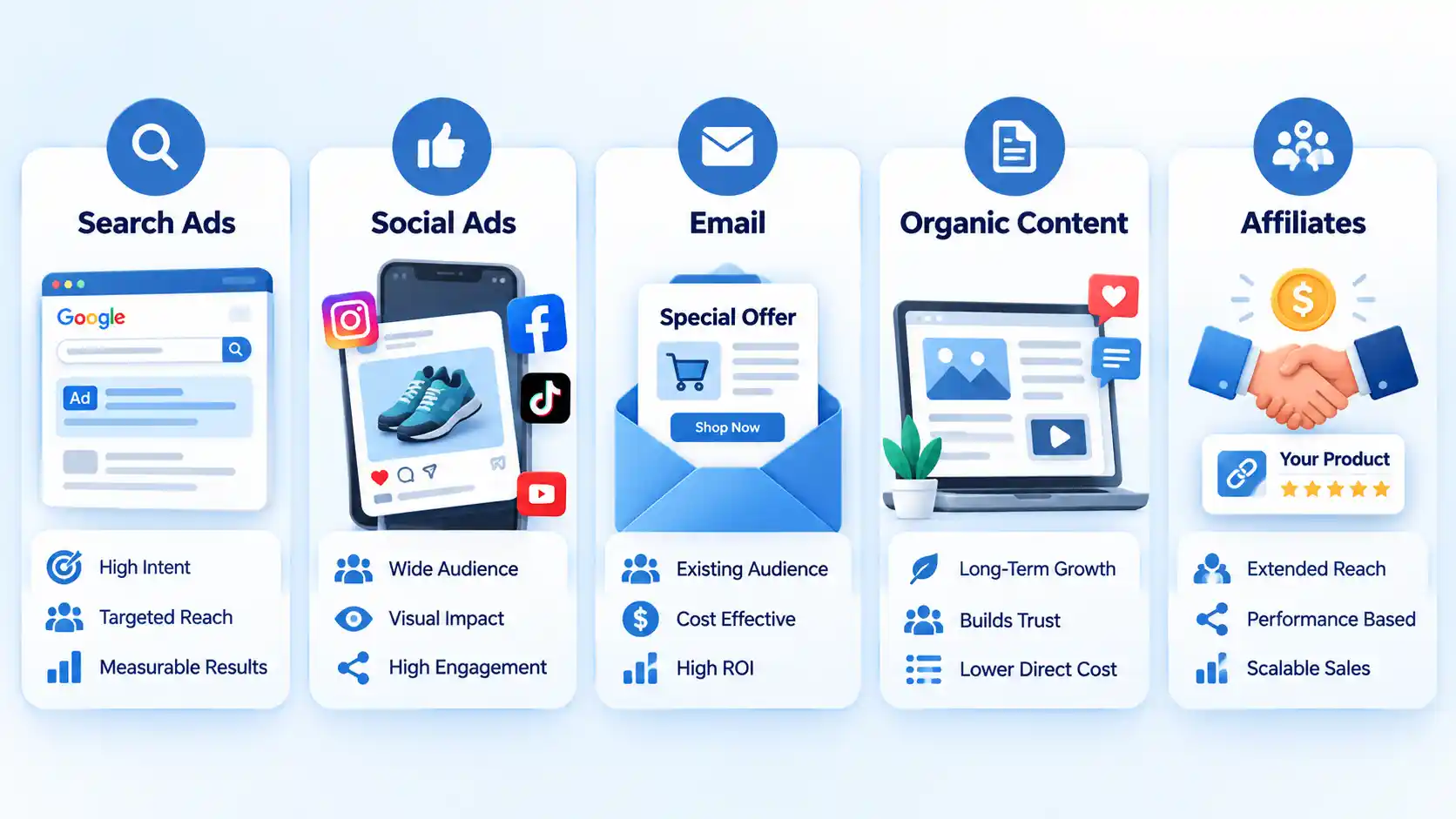
Starting channels for different product advertising situations Situation Reasonable starting channel Why it may fit People actively search for the product or problem Search advertising Reaches people while they are expressing relevant intent. The product is visual or discovery-led Social media or video Demonstrations, comparisons, and visual results can create interest before someone searches. You already have subscribers or customers Email Uses an audience that has already chosen to hear from the business. There is little paid-ad budget Organic content and referrals Trades more time and consistency for lower direct media spending. Buyers rely heavily on trusted niche creators Influencer or affiliate partnerships Places the product inside an existing creator-audience relationship. The product depends on nearby customers Local search and community promotion Keeps promotion focused on the geographic market that can realistically buy. There is no universally best channel. A visually striking consumer product and an industrial replacement component may require completely different discovery paths.
Broader direct-to-consumer marketing strategies can combine channels such as email, content, influencers, and search, but a small advertiser does not need to activate all of them simultaneously.
Create one clear advertising message
A simple message can usually answer four questions: What situation or problem does the customer recognize? What does the product help them do? Why should they believe the claim? What should they do next?
For example, an advertisement for a compact desk lamp might focus on a small-workspace problem, explain that the lamp folds into a limited desk area, show its actual dimensions, and invite the viewer to see available models.
Avoid unsupported guarantees and exaggerated performance claims. In the United States, the Federal Trade Commission’s advertising guidance states that advertising claims must be truthful, not deceptive or unfair, and supported by evidence. Advertising platforms can impose additional rules. Google Ads, for example, prohibits misleading representations and material omissions about businesses and offers.
Make the destination match the advertisement
The ad and destination should tell a consistent story. If an advertisement promotes a particular price, model, feature, availability condition, or offer, visitors should be able to verify that information after clicking.
Before launch, test the page on a phone as well as a desktop browser. Confirm that the main button works, the price is visible, required options can be selected, forms submit correctly, and the advertised item is actually available.
This is also where a product landing page checklist becomes useful: the page should remove avoidable friction before paid traffic is sent to it.
Launch a small controlled test
Begin with a limited audience, a manageable number of advertisements, and one main objective. Too many simultaneous changes make results harder to interpret.
Suppose you test five audiences, eight ads, three landing pages, two offers, and several platforms at once on a small budget. Even if a few sales occur, you may not have enough observations to understand what caused them.
A simpler test might compare two versions of one message aimed at the same customer group. Once the campaign produces enough useful evidence, make one meaningful change at a time where practical.
Measure what happened and improve the campaign
Measurement connects advertising activity to business results. Google Ads describes conversions as valuable actions chosen by the advertiser, such as purchases, signups, and phone calls, and its conversion measurement guidance recommends using that data to identify the ads, keywords, and campaigns producing valuable activity.
Do not rely on a single metric. Impressions tell you that an advertisement was displayed. Clicks show that people interacted with it. Neither proves that the campaign generated profitable customers.
A simple advertising conversion tracking setup helps connect clicks with purchases, leads, calls, or other outcomes before you decide whether to increase spending.
Which Product Advertising Method Is Easiest for Your Situation?
Ease depends on what you already have. Email can be simple for a business with a useful subscriber list but ineffective for a new company with no audience. Search advertising can reach people with strong purchase intent, but competitive keywords may be expensive.
| Method | Best starting use | Direct media cost | Setup complexity | Main limitation |
|---|---|---|---|---|
| Search ads | Existing search demand | Usually paid | Moderate | Competitive demand can increase acquisition costs. |
| Social ads | Visual discovery and audience targeting | Usually paid | Moderate | Requires ongoing creative testing. |
| Organic content | Education, demonstrations, and long-term discovery | Low direct media cost | Moderate | Reach can take time to build. |
| Existing subscribers and customers | Usually low relative media cost | Low to moderate | Requires a legitimate audience that has agreed to receive appropriate communications. | |
| Influencer partnerships | Products influenced by creator trust or demonstrations | Varies | Moderate | Audience fit and disclosure practices require attention. |
| Affiliate marketing | Performance-linked publisher or creator promotion | Commonly commission-based | Moderate | Requires tracking, partner management, and suitable economics. |
| Referral marketing | Products with satisfied existing customers | Varies | Low to moderate | Depends on customers being willing to recommend the product. |
If you are unsure where to begin, choose the channel that most closely matches how customers currently discover or evaluate products like yours. Expand only after the first channel gives you enough evidence to justify another.
How Affiliate Marketing Fits Into Product Advertising
Affiliate marketing is one way to distribute product promotion. It is not a substitute for the entire advertising or marketing process.
In a typical arrangement, a merchant makes a product available, an affiliate publishes content or promotions containing a trackable link or other attribution method, and the affiliate can receive compensation when an agreed qualifying action occurs.
The exact arrangement varies by program. Amazon’s Associates Program, for example, uses specially formatted links and can pay commission income on qualifying purchases. Its Associates Program agreement also requires associates to identify their participation clearly and prominently.
U.S. advertisers and affiliates should also consider endorsement disclosure rules. The FTC says an affiliate who earns commissions through retailer links should disclose that relationship clearly and conspicuously, with the disclosure placed close enough to the recommendation or link for readers to understand the connection. See the FTC’s affiliate disclosure guidance.
For publishers that rely on search traffic, affiliate pages also need independent value. Google’s Search spam policies describe “thin affiliation” as affiliate content that largely reproduces merchant material without adding meaningful original information or features.
A deeper affiliate marketing vs. paid advertising comparison is useful when deciding whether to pay directly for media or compensate partners for attributed results.
How to Know Whether Your Advertising Is Working
The simplest way to think about advertising performance is as a sequence:
Impression → Click → Product page → Conversion → Revenue
Each stage answers a different question.
- Impressions show how often the advertisement was displayed.
- Clicks show how often people interacted with it.
- Conversion rate shows what proportion of relevant visitors or interactions resulted in the action you are measuring.
- Cost per acquisition (CPA) is the advertising cost associated with acquiring a measured customer or conversion, according to the calculation being used.
- Return on ad spend (ROAS) compares attributed revenue with advertising spend.
Imagine Campaign A receives 500 clicks and produces 40 purchases, while Campaign B receives 1,000 clicks but produces 10 purchases at a similar cost. Judging only by traffic would make Campaign B look stronger even though Campaign A produces substantially more purchases.
Tracking quality matters as well. A duplicate purchase event can make a campaign look better than it really is, while a broken tag can make real sales disappear from advertising reports. Google recommends checking implementation and conversion status when recorded conversion numbers appear incorrect.
Common Product Advertising Mistakes and How to Fix Them
Many disappointing campaigns fail for predictable reasons. The table below separates problems with the advertisement from problems with the underlying marketing system.
| Problem | Why it causes trouble | Practical fix |
|---|---|---|
| Advertising to everyone | The message becomes too broad to match a specific need. | Define the most relevant customer and use case first. |
| Listing features without benefits | Customers may not understand why a specification matters. | Connect important features to practical outcomes. |
| Sending traffic to a weak product page | Interested visitors encounter friction after clicking. | Fix pricing, information, availability, usability, and the main action before scaling. |
| Testing too many channels at once | A small budget becomes fragmented and harder to analyze. | Start with the channel that best matches customer behavior. |
| Judging performance by clicks alone | Traffic does not necessarily create revenue or qualified leads. | Track the business conversion connected to the campaign goal. |
| Changing campaigns constantly | You may never collect enough comparable evidence. | Define a test plan and avoid unnecessary changes during it. |
| Making unsupported product claims | The advertising may mislead customers or violate laws or platform policies. | Use claims that can be supported and qualify limitations where necessary. |
| Hiding affiliate or sponsorship relationships | Customers may not understand the financial relationship behind a recommendation. | Use clear disclosures appropriate to the arrangement and jurisdiction. |
Advertising Limits and Edge Cases
A simple advertising workflow does not mean every product can be promoted under the same rules.
Products involving health, finance, alcohol, gambling, housing, employment, politics, children, or other regulated or sensitive areas can face additional laws, platform policies, age restrictions, certification requirements, or targeting limits. Check the rules that apply to the product, country, audience, and advertising platform before launch.
Privacy requirements also affect measurement. Advertising systems may use cookies, tags, customer information, or other identifiers, and consent may be required depending on the technology and jurisdiction. Google notes in its conversion-tracking documentation that advertisers should provide appropriate information about collected data and obtain consent where required by law or applicable Google policies.
Inventory creates another practical limit. A successful campaign can become a problem if the company cannot fulfill the resulting orders. Confirm inventory, shipping capacity, customer support, and margins before rapidly increasing spending.
Finally, revenue alone does not prove that advertising is profitable. A $50 sale cannot support a $40 acquisition cost if product costs, shipping, transaction fees, returns, support, taxes, and overhead consume most of the remaining amount.
Key Takeaways
- Start with one clearly defined customer rather than trying to reach everyone.
- Advertise the product benefit that matters to that customer.
- Make the product page ready before paying to send traffic to it.
- Select a channel based on how customers discover and evaluate the product.
- Begin with a controlled test instead of spreading a small budget across many platforms.
- Measure purchases, leads, or another meaningful conversion rather than relying only on impressions and clicks.
- Treat affiliate marketing as one possible distribution channel, not as the entire advertising strategy.
- Scale campaigns only when the economics and operational capacity support doing so.
Frequently Asked Questions
How can I advertise a product without paying for ads?
You can use educational content, search-optimized product pages, organic social media, product demonstrations, email to an existing permission-based audience, customer referrals, community participation, public relations, and suitable partnerships. These approaches can reduce direct media spending, but they still require time, content, relationships, tools, or other resources.
Should I advertise a new product before it is available?
You can promote a product before launch when the timing and availability are explained accurately. A prelaunch campaign might collect email signups, reservations, or legitimate preorders. Do not create the impression that a product is immediately available when customers cannot actually obtain it under the terms shown.
Is affiliate marketing cheaper than paid advertising?
Not automatically. Affiliate programs can shift some costs toward performance-based commissions, but they can also require tracking software, partner recruitment, program management, creative material, commission payments, compliance monitoring, and sufficient product margins. Compare total acquisition economics rather than only the upfront media cost.
How long should I test an advertisement before changing it?
There is no universal number of days. A campaign with substantial traffic may accumulate useful evidence quickly, while a low-volume product may take much longer. Base decisions on whether the test has produced enough relevant observations and conversions to support the conclusion, not simply on how many calendar days have passed.
Can I use the same product advertisement on every platform?
You can reuse the central product promise, but the format and presentation usually need adjustment. A search ad responds to explicit intent, while a short social video may need to demonstrate the product before the viewer has decided to look for it. Keep the underlying claim consistent while adapting the creative to the context.

💬 Comments