South Korea combines a tightly controlled gambling system with one of the world’s largest video-game markets. Unauthorized online casinos and betting operations are generally prohibited, but specifically authorized gambling sectors coexist with mainstream mobile gaming, PC bangs, esports, and regulated probability-based game items.
The key is not to treat “gaming” and “gambling” as interchangeable terms. Playing League of Legends in a PC bang, buying a randomized item in a mobile game, purchasing an authorized lottery ticket, and wagering on an unlicensed live-casino website can involve very different legal frameworks.
Quick Take: Gambling and Gaming Are Not the Same Thing
- South Korea’s Criminal Act generally penalizes gambling, subject to a limited exception for gambling that amounts merely to a pastime.
- Specific gambling industries are authorized by separate laws, including casinos, horse racing, bicycle racing, motorboat racing, lotteries, Sports Toto, and bullfighting.
- Some regulated gambling sectors have authorized online channels. That does not make privately operated or offshore gambling websites legal.
- Unauthorized live casinos, illegal Sports Toto services, online reel games, and similar operations are specifically identified by the National Gambling Control Commission as illegal gambling.
- Mainstream video games fall under a different regulatory framework and form a large entertainment industry in South Korea.
- Probability-based game items are subject to disclosure rules, but they should not automatically be described as ordinary casino gambling.
A useful example is the difference between playing a competitive video game in a PC bang and staking money on an unauthorized baccarat stream. Both may happen through a screen, but the legal activity taking place is fundamentally different.
Is Online Gambling Legal in South Korea?
The Criminal Act sets the starting point
South Korea does not begin with a general right to operate or participate in gambling and then regulate exceptions. The baseline is restrictive. Under Articles 246 and 247 of the Korean Criminal Act, a person who gambles can face a fine of up to KRW 10 million, while habitual gambling can carry imprisonment of up to three years or a fine of up to KRW 20 million. Setting up a gambling place or space for profit can carry up to five years’ imprisonment or a fine of up to KRW 30 million.
The statute also contains an exception for gambling that amounts merely to a pastime. That phrase should not be converted into an invented universal cash threshold. Whether conduct fits the exception depends on the circumstances rather than a simple rule such as “anything below X won is legal.”
An overseas website does not automatically fall outside Korean law
The same Criminal Act states that it applies to Korean nationals who commit crimes outside the territory of the Republic of Korea. That makes it unsafe to assume that an activity becomes lawful for a Korean citizen merely because the server, casino, sportsbook, or physical gambling venue is located abroad.
This does not mean that every instance of overseas gambling automatically produces a prosecution. It means that location alone is not a reliable legal exemption. The underlying activity, statutory exceptions, evidence, frequency, and enforcement circumstances can all matter.
Some gambling is specifically authorized
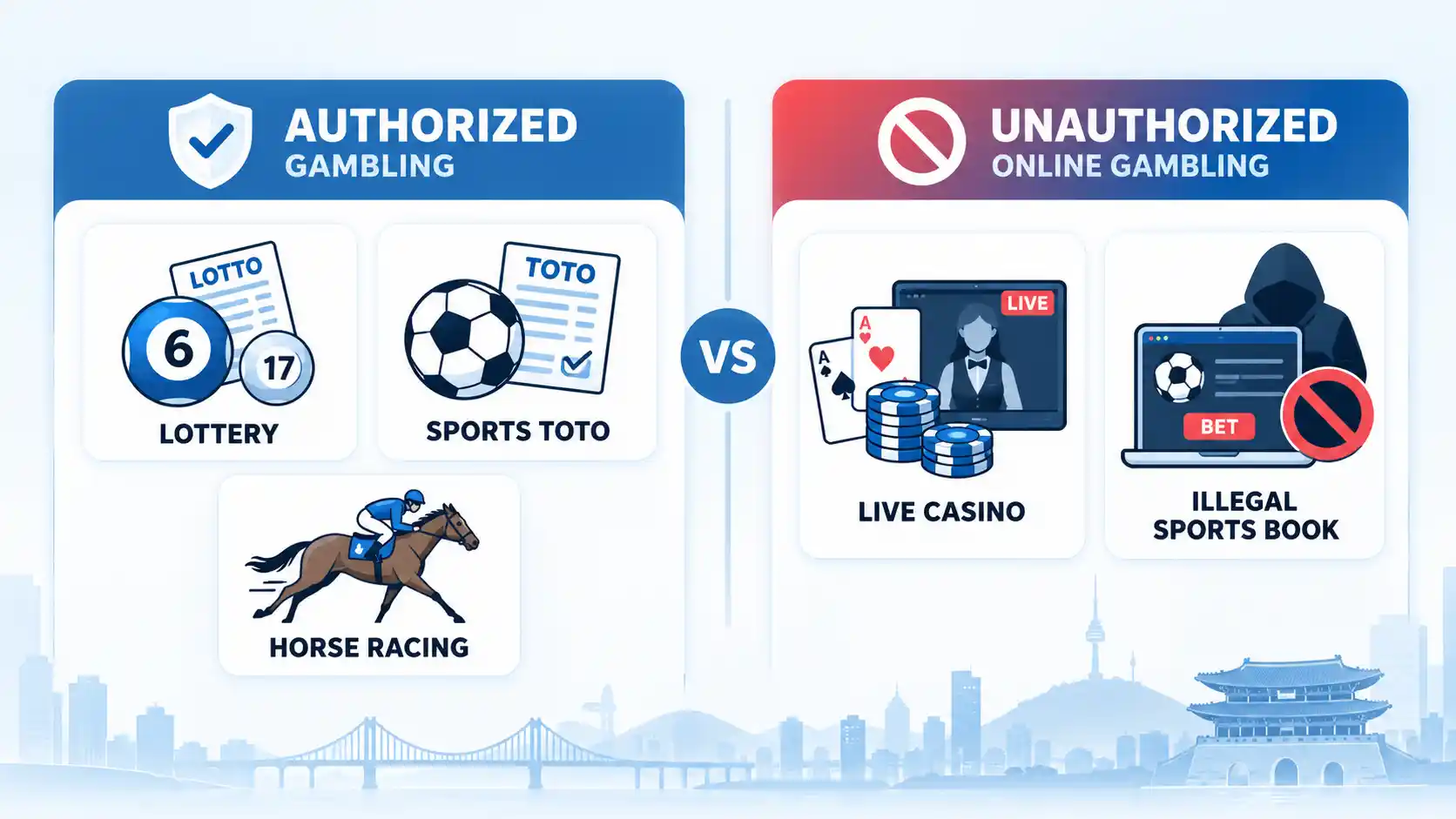
South Korea also maintains a regulated gambling industry. The National Gambling Control Commission identifies casinos, horse racing, bicycle racing, motorboat racing, lotteries, Sports Toto, and bullfighting as gambling-industry categories recognized under Korean law.
This is why saying simply that “gambling is illegal in South Korea” is incomplete. A better summary is that gambling is generally restricted unless the activity falls within a specific authorized framework.
South Korea’s Regulated Gambling Landscape
The most useful way to understand the system is to compare the activity with the legal channel through which it is offered. A category can be lawful in an authorized system while an imitation or independently operated version of the same activity remains illegal.
| Activity | Regulatory position | Online relevance |
|---|---|---|
| Lottery | Statutorily authorized through regulated channels | Authorized internet sales exist, but unauthorized lottery operations do not inherit that status |
| Sports Toto | Authorized sports wagering product under the regulated gambling system | An official online channel exists; imitation or unauthorized sports-betting services remain illegal |
| Horse racing | Authorized under a dedicated statutory framework | Regulated online turnover is recorded separately from on-course and off-course activity |
| Bicycle and motorboat racing | Authorized regulated wagering activities | Official online channels operate alongside physical channels |
| Casinos | Licensed and subject to access and location restrictions | A physical casino licence does not create general permission for internet casino gambling |
| Bullfighting | Narrow regulated gambling category | Unauthorized wagering outside the legal system remains prohibited |
The Commission’s latest published 2025 gambling statistics make the online distinction particularly clear. They record online turnover separately for horse racing, bicycle racing, motorboat racing, lotteries, and Sports Toto. Therefore, “online” is not itself the deciding legal characteristic. Authorization is.
For example, an official Sports Toto online transaction and a wager placed through a private offshore sportsbook may display similar sporting events on screen. The legal status of the two transactions is not necessarily the same.
The Casino Exception and Why It Is Often Misunderstood
Casino rules create another common source of confusion. Current National Gambling Control Commission statistics distinguish Kangwon Land from casinos categorized as being for foreigners only. This reflects South Korea’s unusually restrictive treatment of domestic casino access.
That physical-casino framework should not be extended to online casinos by analogy. Permission for a licensed casino at a particular location does not amount to nationwide permission for websites offering roulette, baccarat, blackjack, or slots over the internet.
Readers comparing commercial resources such as Korean casino information should therefore distinguish a site’s listings or availability claims from the legal status of gambling under South Korean law. A site’s accessibility, language, payment support, foreign licence, or willingness to accept a registration does not by itself establish Korean authorization.
Gaming Culture Is a Different Story
South Korea’s mainstream video-game sector operates on a very different scale and policy basis from its gambling market. According to the 2025 Korea Game Industry White Paper from the Korea Creative Content Agency, the domestic game market generated KRW 23.8515 trillion in 2024, an increase of 3.9% from the previous year.
Mobile games accounted for KRW 14.071 trillion, or 59.0% of the domestic market. KOCCA also recorded 1,398 game production and distribution companies, 7,243 PC cafés, 515 arcade centers, and 87,576 industry employees.
Mobile gaming drives the largest share of revenue
Mobile gaming’s 59.0% market share shows how strongly smartphones shape South Korea’s commercial game industry. That figure describes market revenue, not the percentage of citizens who play mobile games, so it should not be used interchangeably with a player-participation statistic.
Mobile games also span many business models. Some are sold outright, some are free to download with optional purchases, and others monetize through subscriptions, advertising, cosmetic goods, battle passes, or probability-based items. The presence of spending inside a game does not by itself turn the game into a gambling product.
PC gaming remains culturally important
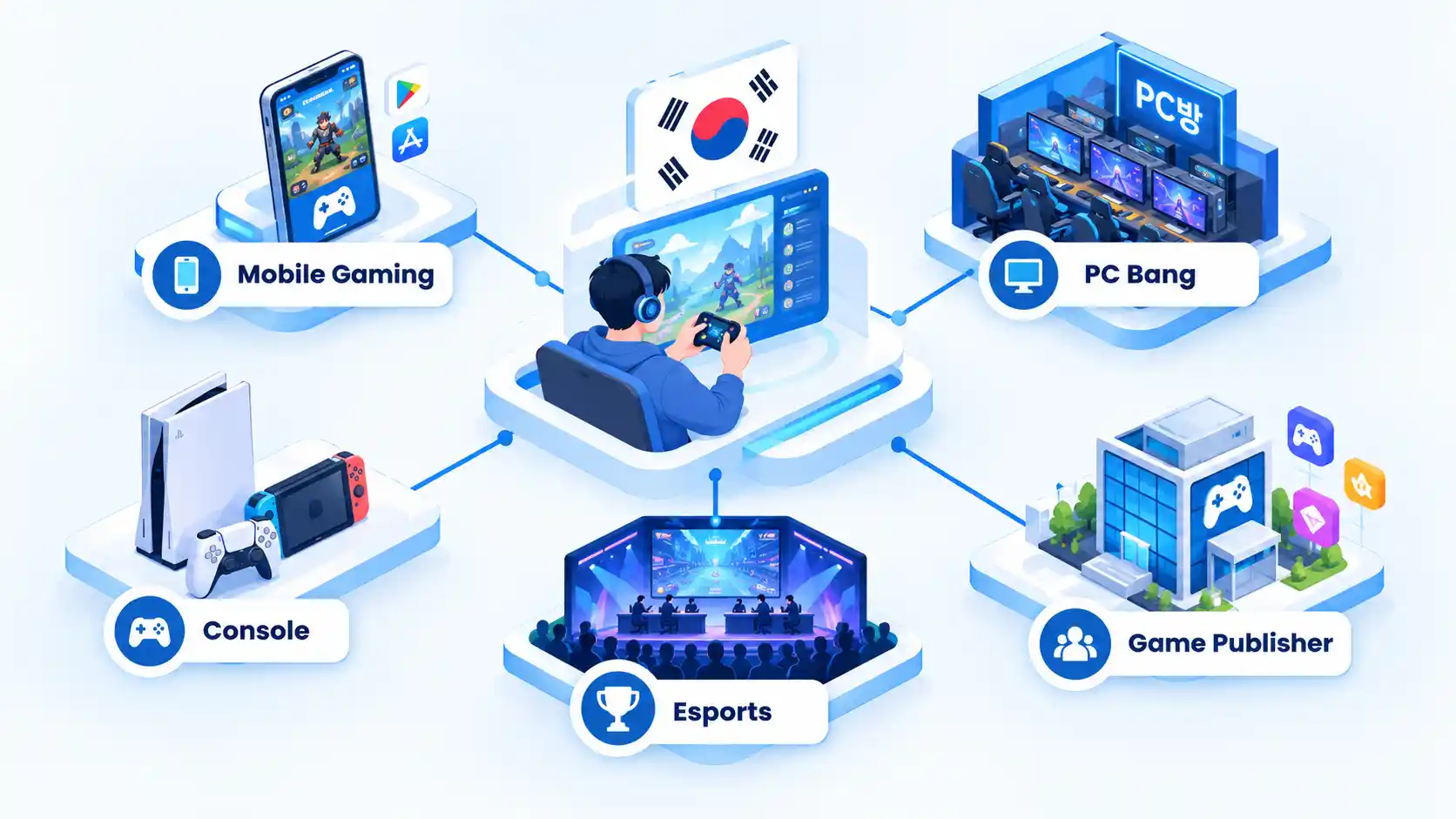
PC gaming remains unusually visible because South Korea still has thousands of PC bangs. A PC bang is a commercial gaming café where customers pay for access to gaming computers and network connectivity. These businesses are used by ordinary players as well as highly competitive gamers.
The format supports activities that are harder to reproduce consistently at home: groups can sit together, machines are configured for popular titles, high-performance equipment is available without individual ownership, and publishers may offer in-game benefits tied to PC-bang access.
Console gaming adds another layer
Console gaming is smaller than mobile gaming in commercial scale, but it forms part of a broader platform mix. This matters because Korean gaming culture should not be reduced to a single stereotype about esports or internet cafés. Modern players move among phones, PCs, consoles, cloud services, and streaming platforms depending on the title and context.
Why PC Bangs Still Matter
PC bangs were central to South Korea’s early networked gaming boom, but treating them only as a historical phenomenon would also be inaccurate. KOCCA still counted 7,243 PC cafés in the 2024 industry data.
Their relevance is partly social. Multiplayer gaming from home can connect people remotely, but a PC bang lets friends play in the same physical space while remaining inside an online game. It therefore functions as both a technology service and a social venue.
PC bangs also influence which games remain visible. Competitive multiplayer titles benefit from environments where machines, peripherals, broadband access, and nearby teammates are readily available. This does not mean every PC-bang customer is an aspiring professional player. Many use them simply because they are convenient, affordable for short sessions, or better equipped than a personal computer.
For publishers, the PC-bang environment can also be commercially significant. Time spent in cafés, rankings of popular titles, publisher promotions, and game-specific benefits can reinforce the visibility of particular competitive games.
Esports and Spectator Culture
Esports is another area where the words gaming and gambling can become blurred. Esports itself means organized competitive video gaming. A professional tournament, a team league, a paid spectator event, or a prize competition does not automatically become gambling simply because money is involved somewhere in the ecosystem.
The distinction becomes important when a separate wager is placed on the outcome. Watching two professional teams compete in a League of Legends match is esports entertainment. Paying an entry fee to compete under legitimate tournament rules is a competition question. Staking money with a betting operator on which team will win is a gambling question.
South Korea’s long-established competitive gaming infrastructure makes esports culturally important, but that cultural prominence should not be used to imply that esports betting has the same legal status as esports itself.
Loot Boxes and Probability-Based Items
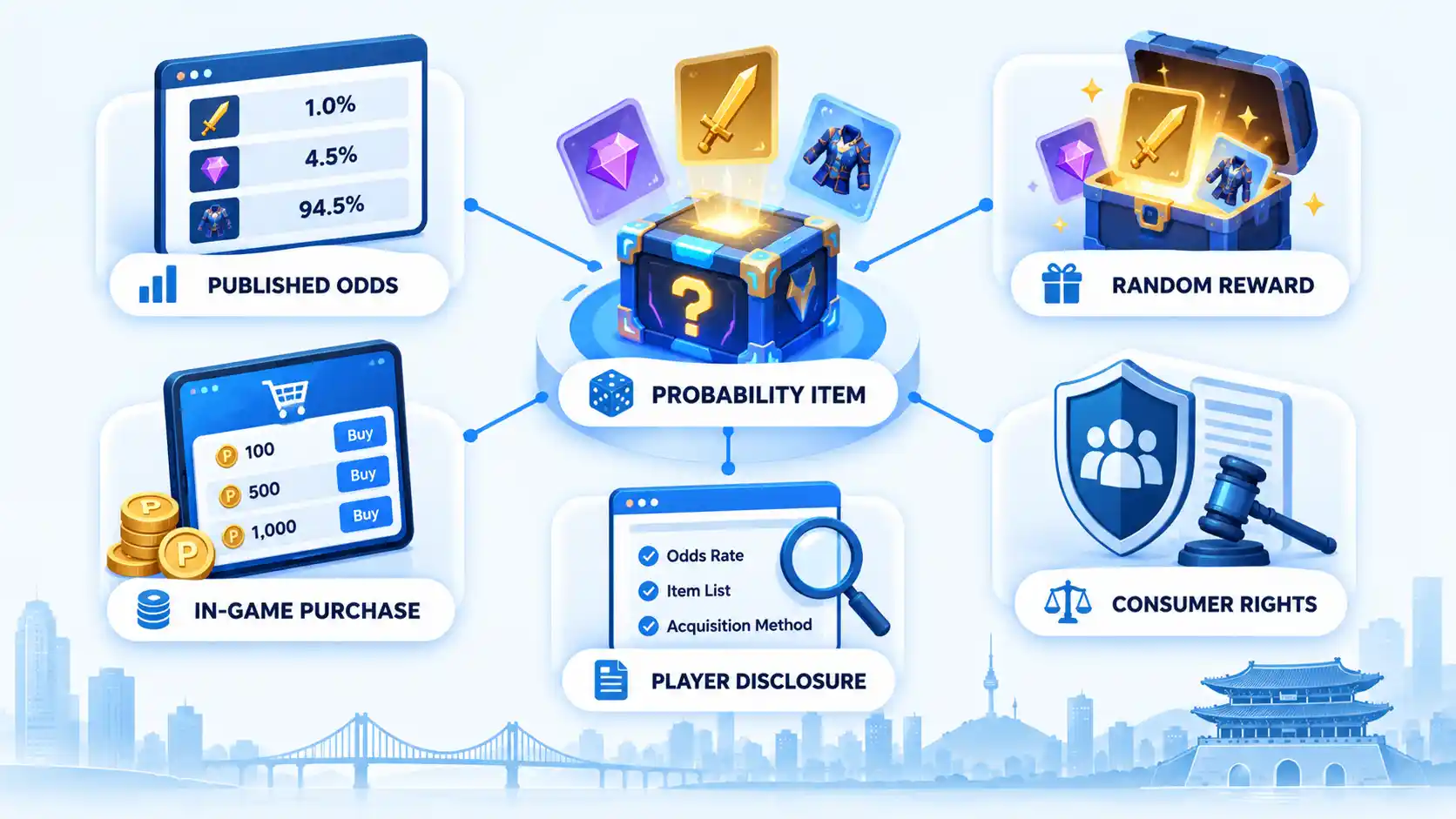
Probability-based game items are one of the clearest examples of why gaming and gambling need careful terminology. A probability-based item gives a player a randomized outcome according to defined probabilities. The player may know the pool of possible rewards without knowing which particular result will be received.
South Korea regulates these mechanics through its game-industry framework. Article 33 of the Game Industry Promotion Act requires covered game providers to display the types and supply probabilities of probability-based items in the game, on the game’s website, and in advertising or promotional materials.
The implementing rules add more detail about which games are covered and what information must be displayed. The policy objective is therefore not simply “ban random rewards.” It is to make specified probability information visible to users and impose obligations on covered providers.
It would still be inaccurate to conclude that every loot box or randomized game item is legally identical to a casino wager. The mechanics of the product, whether value can be cashed out or transferred, the applicable game regulations, and other legal characteristics can matter.
For practitioners, the important distinction is that probability disclosure compliance and gambling classification are separate questions. A game company can have disclosure obligations even when the product is not being treated as a conventional casino service.
Illegal Online Gambling and Enforcement
The existence of official online gambling channels does not create an open internet market. The National Gambling Control Commission’s illegal-gambling guidance specifically identifies online live casinos, unauthorized web-board gambling, online reel games, illegal Sports Toto, illegal lotteries, and illegal wagering on horse, bicycle, and motorboat racing.
Its examples of online live-casino gambling include baccarat, blackjack, and roulette offered through real-time video. The Commission also operates surveillance and reporting functions connected with illegal gambling.
This distinction has practical consequences. A website can look professional, provide Korean-language support, use familiar sporting events, accept local users, and process digital payments while still lacking Korean authorization. Interface quality is not evidence of legality.
The same applies to a foreign licence. A regulatory approval in another jurisdiction may tell you something about the operator’s status in that jurisdiction, but it does not automatically override South Korean criminal or gambling law.
Technology can also make enforcement more complicated. Operators can use overseas hosting, rapidly changing domains, messaging apps, digital payment intermediaries, and layered account structures. These technical features affect investigation and access, but they do not by themselves determine whether the underlying gambling activity is permitted.
For additional technical context on how regulated casino platforms combine identity, payments, security, and infrastructure, see this explanation of online casino technology trends. Those platform capabilities should still be evaluated separately from jurisdiction-specific legality.
Youth Gambling Has Become a Policy Priority
Youth cyber-gambling has become a visible enforcement and prevention issue. In 2026, the Korean National Police Agency operated a national voluntary-reporting period for youth cyber-gambling from May 18 through August 31 and published the program’s results on September 7.
The significance is not that ordinary gaming should be treated as a cause of gambling. That causal claim would require different evidence. The more defensible point is that smartphones, online communities, messaging systems, digital payments, competitive sports, and game-like interfaces can place gambling offers within the same broader digital environment used by younger people.
That overlap makes clear labeling and education important. A minor may understand the mechanics of skins, virtual currencies, ranking systems, randomized rewards, streaming, and esports long before understanding how an unauthorized betting service differs legally or financially from a normal game.
For parents, schools, platforms, and regulators, the operational challenge is therefore to distinguish entertainment mechanics from wagering while identifying services that deliberately make gambling resemble familiar digital-game experiences.
Gaming vs Gambling in South Korea: Practical Comparison
The table below summarizes the distinctions that matter most. It is deliberately simplified, because a particular product can require a more detailed legal assessment.
| Dimension | Ordinary video gaming | Authorized gambling | Unauthorized online gambling |
|---|---|---|---|
| Primary activity | Entertainment or competition | Wagering within a statutory framework | Wagering outside an authorized framework |
| Main regulatory basis | Game-industry legislation and related consumer rules | Sector-specific gambling statutes and controls | Criminal prohibitions and illegal-gambling enforcement |
| Cash stake | Usually not required as a wager on an uncertain monetary outcome | Common and specifically structured by the authorized product | Common |
| Random outcomes | Can exist in gameplay or probability-based items | Chance or uncertain event outcomes are central to many products | Frequently central |
| Online access | Normal distribution method | Permitted for some officially authorized products | Website availability does not establish legality |
| Consumer information | Can include ratings, probability disclosures, and game-specific rules | Depends on the regulated gambling sector | Claims may be difficult to verify against Korean authorization |
The most important conclusion from the comparison is that the screen or device does not determine the legal category. A smartphone can run an ordinary game, an authorized lottery product, or an unauthorized casino service. The underlying transaction and legal authorization matter more than the hardware.
Key Takeaways
- South Korea has a restrictive gambling baseline, but several gambling sectors are specifically authorized.
- Some legal gambling products have official online channels, so “all online gambling is illegal” is too broad.
- Unauthorized live casinos, sports-betting sites, reel games, and similar services remain a significant enforcement concern.
- South Korea’s video-game industry is separate and much broader, generating KRW 23.8515 trillion in 2024.
- Mobile gaming dominates game-industry revenue, while thousands of PC bangs continue to support PC gaming and competitive culture.
- Probability-based game items are subject to disclosure requirements and should not automatically be described as conventional gambling.
- Accessibility, a foreign licence, or a polished Korean-language website does not establish that an online gambling service is authorized in South Korea.
Frequently Asked Questions
Can Korean citizens gamble on overseas websites?
An overseas location does not automatically place a Korean citizen outside Korean criminal law. Article 3 of the Criminal Act states that the Act applies to Korean nationals committing crimes outside South Korea. The legality of a particular activity therefore cannot be determined solely from the location of the website or operator.
Is esports betting legal in South Korea?
Esports competition and esports betting are separate activities. The fact that an esports event is lawful does not automatically authorize a private betting market on its result. Any wagering service must be assessed according to the applicable Korean gambling framework and its authorization.
Are loot boxes considered gambling in South Korea?
They should not be universally described that way. South Korea has specific game-industry rules requiring probability disclosures for covered probability-based items. Whether a particular mechanic also raises gambling-law issues depends on how the product works and the applicable law.
Can foreign tourists enter casinos in South Korea?
South Korea has casinos designated for foreign customers, while current regulatory statistics separately identify Kangwon Land from casinos classified as foreigner-only. Entry rules should be checked with the licensed venue, particularly for nationality and identification requirements.
Are PC bangs only for professional gamers?
No. PC bangs are commercial gaming cafés used by ordinary players, groups of friends, competitive players, and others who want access to configured gaming PCs without owning equivalent equipment. Their continued presence is reflected in KOCCA’s count of 7,243 PC cafés for 2024.
Does a foreign gambling licence make a site legal in South Korea?
Not automatically. A foreign licence establishes regulatory status in the jurisdiction that issued it. South Korean legality depends on South Korean law and whether the particular gambling activity or channel is authorized there.

💬 Comments