Two quotes land for the same job. One contractor describes themselves as a Level 2 electrician. The other describes themselves as a licensed electrician. Both phrases sound reassuring, and neither one, on its own, tells you whether the person quoting can legally touch the equipment in your home.
Each description reflects a real way the phrase gets used. None of them establishes a portable credential. “Level 2” may describe how much supervision someone needs, or the kind of infrastructure work a business is set up to quote. What it will not tell you, unaided, is whether that person is authorized for your specific job in your specific area.
Warning
A “Level 2” title alone does not prove local authorization. Treat it as a prompt to ask which licence, registration, and network approval apply to the work on your quote.
Quick Take
- The label is context-dependent: it can mean an informal experience tier or a description of service-boundary work, and the two are not the same thing.
- Skill tiers are not licences. Licensing, registration, and contractor authority come from your local regulator and are verified separately.
- Work on service lines, meters, main switchboards, or overhead and underground supply may need network or utility approval on top of a licence.
- Ask for the written scope first, then match it against the licence number, insurance, and any approval reference.
The Label Problem: What “Level 2” Can Mean
In career and employer usage, “electrician levels” describes progression inside a company or a training programme. A Level 2 electrician, in that usage, is someone with moderate experience who can handle a broader range of installations and troubleshooting with limited supervision, while a Level 1 electrician still works closely under someone else’s eye. It is an internal description of experience and trust. It carries no legal weight.
In service-work usage, the same label appears around the boundary between a property and the distribution network. That boundary covers the equipment that connects a building to the grid: service lines, metering, main switchboards, and overhead or underground supply, along with the meter boxes and supply cables that sit at that connection point. Contractors who quote this work often market themselves with a level-based title, and the work can involve an electricity network or utility in some capacity.
Both usages are legitimate within their own context. The confusion starts when a homeowner reads one and assumes the other. A “Level 2” on a quote may mean the contractor works at the network boundary, or it may mean an employer’s internal pay band. Without asking, you cannot tell which.
Taxonomy: Informal Levels vs Formal Roles
The cleanest way to read the term is to separate two systems that run in parallel across the electrical trade. Informal levels describe skill and experience. Formal roles describe authority, credentials, and legal responsibility. They often overlap in the same person, but they answer different questions.
| Category | What it describes | Legal status | How to use it |
|---|---|---|---|
| Informal levels (Entry, Level 1, Level 2, Level 3) | Skill and experience tiers used by employers, training programmes, and job listings | Not a licence; defined by the company or programme, not by legislation | Read it as a rough signal of experience and how much supervision the person needs |
| Apprentice | A structured training role performed under supervision | Tied to a recognized training arrangement and, in many places, licensing rules | Ask who will supervise the apprentice on your job |
| Journeyman or qualified tradesperson | Independent installation, maintenance, and repair work | Tied to licensing or registration requirements in many jurisdictions | Verify the licence or registration number with your local regulator |
| Master electrician | Oversight, planning, and compliance responsibility for the work | Highest authority role in the trade; often holds final responsibility for planning and compliance | Confirm the business holds the contractor-level authority your local rules require |
The practical takeaway is short. If a quote or job listing says “Level 2”, you have learned something about experience or market positioning. You have not learned anything about licensing, and you should not infer it. Naming conventions also shift between jurisdictions, so treat the table as a way to organise the question, not a translation chart.
Where Boundary Work Fits: Service Lines, Metering, and Switchboards
Work labelled Level 2 in service-work contexts tends to cluster around the network boundary. The jobs commonly associated with that boundary include:
- Service lines and metering. Service lines run between the connection point and the distribution system, and the work can include energizing and installing metering services.
- System upgrades and cable work. Single-phase to three-phase upgrades, meter box installation, and overhead or underground cable work all sit in this category.
- Main switchboard connection and disconnection. Work can include maintenance and repair of overhead or underground power lines and connection or disconnection at a building’s main switchboard. Where a network operator or local electricity provider owns the connection, approval may be required before the work can proceed.
Use the boundary description as a signal about the kind of work involved. Local rules still decide which licence, accreditation, or approval applies. When a contractor advertises boundary-level work, the job likely involves equipment between your property and the grid, and it may need a third party to sign something off.
Whether a given task requires a particular class of licence, a specific network accreditation, or simply a licensed electrician with the right insurance is a local question. Ask it locally, and ask for the answer in writing.
Why the Distinction Matters
Those figures are U.S.-specific and describe electrical safety generally, not Level 2 licensing. Their relevance here is narrower: the equipment that Level 2 marketing tends to describe is exactly the equipment that carries the most energy into a property. Getting the authorization question wrong on a switchboard or service line is a different order of mistake from getting it wrong on a light fitting.
Approval is the second risk. Where equipment connects to the distribution network, verify that the utility or network operator has authorized the connection before work starts, and obtain the reference number in writing. Network or utility approval belongs to the job, so ask who applies for it, who pays for it, and what proof you will receive.
Insurance is the third. Ask for a certificate of currency before the first day on site, and check that it covers the type of work being quoted. Sorting out a coverage question after water has come through a ceiling is a far worse conversation than asking for a PDF up front.
If the power is already off, the priority order changes: you need someone licensed and equipped to handle emergencies, and you can run the paperwork checks while they are on the way.
Common Misconceptions and Limits
| Misconception | What is actually true |
|---|---|
| “Level 2 is a licence.” | In career and employer usage it is an informal skill tier. Licensing is a separate status granted by a local authority, and it must be checked separately. |
| “Level 2 means better than a regular electrician for every job.” | Some commercial guides frame it as more advanced training. For basic wiring, switches, and circuits, a licensed electrician with the right insurance may be entirely appropriate. Match the scope to the credential. |
| “The title means the same thing everywhere.” | Definitions vary by employer, training programme, and market. Check the local rules rather than relying on the title. |
| “A Level 2 contractor is pre-approved by the network.” | Do not treat a general claim of approval as job-specific proof. Ask for the approval or authorization reference for your job. |
| “Insurance makes the licence question irrelevant.” | They answer different questions. Insurance covers loss; licensing covers authority to perform the work. You need both answers. |
Listings and guides use the term inconsistently. A title on a quote cannot establish which local licence, registration, or approval applies. Ask better questions at the quoting stage, and keep the answers with the quote.
Before You Hire: Verify the Credential and the Scope
Run these checks in order. Each one narrows the next, and the order matters: a perfect licence number is meaningless if the scope is wrong.
- Get the task named in writing. Ask the contractor to list the specific equipment involved: service line, meter box, main switchboard, overhead or underground supply cable, or interior circuits and fittings. The written scope should be specific enough that two contractors would quote the same physical job.
- Look up the licence or registration number yourself. Ask for the individual’s licence number and the contracting business’s number, then search your local electrical licensing authority’s public register. Confirm the name, the number, and the expiry date match the quote.
- Check the licence class against the scope. Read what the licence class actually permits, and compare it with step one. If the scope includes boundary equipment and the licence class does not clearly cover it, stop and ask what authorization is being relied on.
- Establish who owns the network approval. Ask directly whether the job needs approval, inspection, or sign-off from the electricity network or utility, who applies for it, and who pays. Request the approval or authorization reference in writing before work begins.
- Confirm insurance in writing. Request a certificate of currency for public liability, and for contract works or professional cover where the job size warrants it. Check the policy is current and the entity named matches the quoting business.
- Pin down what happens at completion. Ask which certificates, notifications, or compliance documents will be issued when the work is finished, who lodges them, and what you will be given as proof. A quote that leaves this blank is worth pushing back on.
Verify the result
- The written scope names the specific equipment, and the licence number on the quote matches an active record on the regulator’s public register.
- The licence class covers the listed work, or you have a written explanation of the alternative authorization being used.
- Where network approval applies, you hold a written approval or authorization reference and know who applied for it.
- A current insurance certificate names the same business that issued the quote.
- Completion documents are specified in the quote, with a named party responsible for lodging them.
If you are comparing contractors for boundary work in Sydney’s south, this listing of best level 2 electricians is a starting point for names. The checks above still decide whether any of them is right for your job.
When to Verify Scope, Not Just the Label
Info
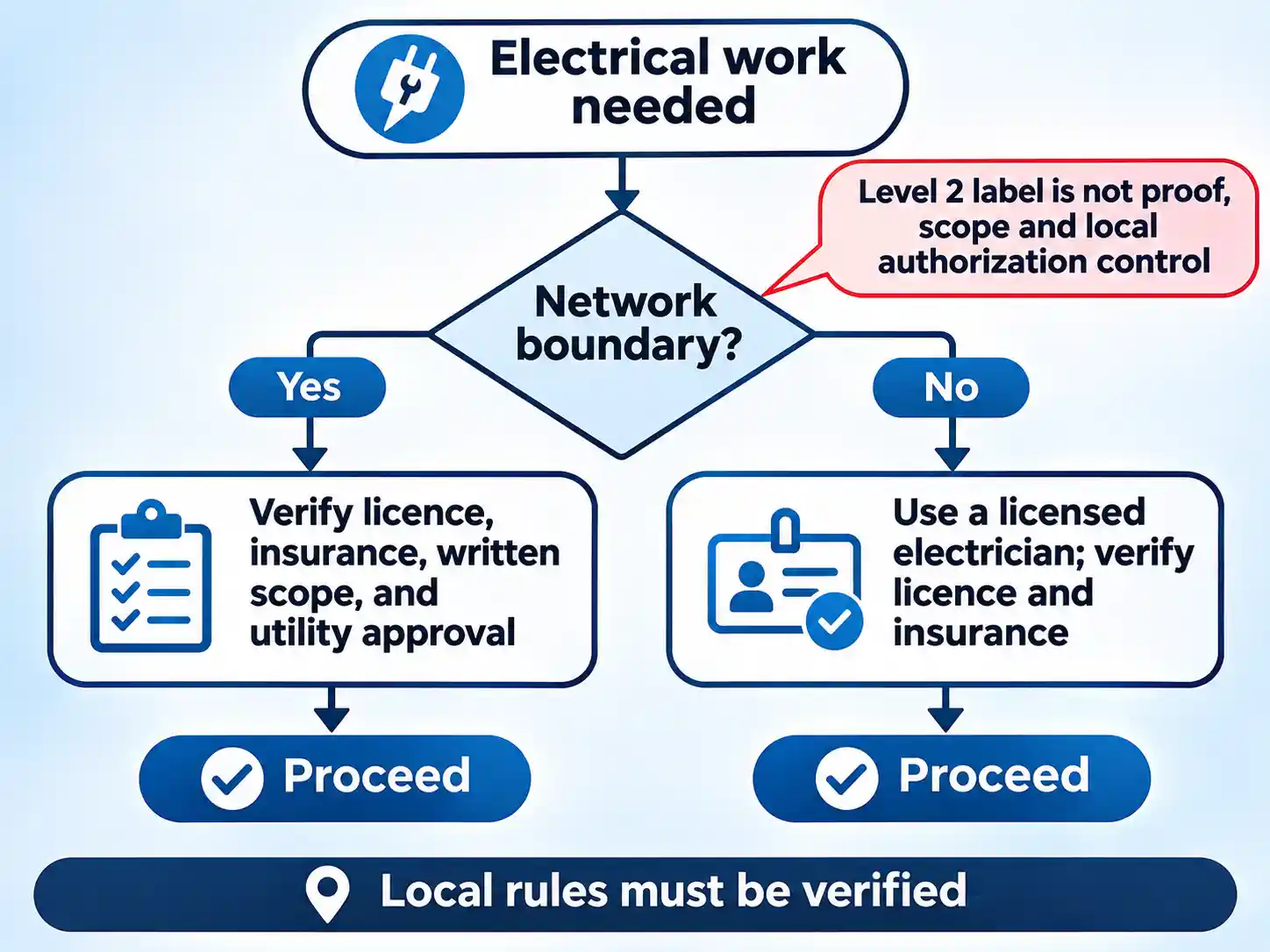
Decision rule. If the job involves service lines, metering, a main switchboard, overhead or underground supply, or any utility approval, ask specifically whether local rules require an authorized or Level 2 contractor and who signs off the connection. If the job is basic wiring, switches, lighting, or circuits, the question is simpler: licensed electrician, current insurance, written quote.
A short illustration makes the split concrete. Suppose your quote covers a switchboard upgrade plus a new meter box ahead of a three-phase conversion for a home workshop. That is boundary work: the meter and switchboard are part of the connection equipment, the network may need to disconnect and reconnect the supply, and the approval chain may involve the utility. Your verification effort should concentrate on licence class, network approval, and inspection sign-off.
Now suppose the quote is for adding four power points and replacing a bathroom light fitting. The equipment is downstream of the switchboard, the network is not involved, and the sensible checks are the licence, the insurance, and a written scope. Applying boundary-level paperwork to a light fitting is wasted effort; applying light-fitting diligence to a switchboard is a genuine risk.
Conclusion
Hiring decisions should hinge on the specific work an electrician is authorized to perform on this property and on written proof that the authorization covers the job. A clear scope, an active licence, the right licence class, the relevant network approval, and current insurance give you a decision you can defend.
Those answers tell you more than any title on a business card. Keep the paperwork for professional after service support too. Certificates and approval references are the documents you will want if anything needs revisiting later.
If the work is urgent, fix the safety problem first and run the checks in parallel. If the work is routine, the checks come first. The label can start the conversation, but the documents should carry the decision.

💬 Comments