Effective online marketing for a small business means choosing the channels that help the right customers discover you, evaluate what you offer and take a useful action. You do not need to be everywhere; you need a reliable website or destination, a focused mix of discovery and communication channels, and a way to measure whether those channels produce enquiries, bookings, purchases or other meaningful results.
The right mix depends on how customers buy from you. A local plumber, an online retailer and a business-to-business consultant may all market online, but they should not automatically use the same channels or judge success by the same metrics.
Start with the customer and the action you want
Before choosing a marketing channel, decide whom you are trying to reach and what you want that person to do next. That action might be calling your business, submitting an enquiry, booking an appointment, visiting a store or completing a purchase.
This distinction keeps marketing decisions tied to business outcomes. A local service company may care more about phone calls and map visibility than social-media followers. A consultant selling to other businesses may place more emphasis on qualified enquiries, useful search content and professional networks.
It also gives you a better basis for deciding where to spend limited time and money. Instead of creating accounts on every platform, you can build a small-business digital marketing plan around the customer journey, the channels customers actually use and the actions that matter to the business.
1. Build a website that helps visitors take the next step
A small-business website should explain what the business does, who it serves and how a visitor can take the next step. Depending on the business, that next step may be a purchase, booking, quote request, phone call or visit to a physical location.
Keep navigation predictable and make important information easy to find. Service businesses usually need clear service descriptions, contact details and operating information. Stores need understandable product information, buying terms and a working checkout. Businesses that depend on appointments should make the booking path obvious rather than forcing visitors to hunt through several pages.
The technical foundation matters too. Google recommends making sites secure, fast, accessible and usable across devices in addition to making their content understandable to search engines. Its Search guidance for web developers also emphasizes making pages accessible to Google’s crawler while prioritizing the visitor’s experience.
If you prefer to outsource the build, providers range from general website platforms to local specialists such as firms offering Sunshine Coast web design. Regardless of who builds the site, judge the result by whether customers can understand the offer, use the site comfortably and complete the intended action.
2. Set up your Google Business Profile if you serve local customers
For an eligible local business, a Google Business Profile can put essential business information directly in Google Search and Maps. Keep the profile accurate rather than treating it as a one-time setup task.
Google’s Business Profile editing guidance covers details such as address, hours, contact information, website links, photos and other available profile features. Some features differ by region or business category.
Eligibility also matters. Google’s business representation guidelines state that a business must either have a physical location customers can visit or travel to customers where they are. Online-only businesses without that kind of physical or service-area presence are not treated the same way.
A service-area business, such as a plumber that travels to customers, should represent its real operating model accurately. Local visibility involves more than creating a listing, so topics such as profile optimization, local pages and consistent business information fit better within a dedicated local SEO strategy for small businesses.
3. Use SEO to make useful pages easier to discover
Search engine optimization, or SEO, is the process of making a website easier for search engines to understand and easier for relevant searchers to discover. It is not a shortcut that guarantees a first-place ranking.
Google’s SEO Starter Guide describes SEO as helping search engines understand content while helping users find a site and decide whether to visit it. For a small business, that usually starts with pages that clearly describe actual products, services, locations and customer questions.
For example, a repair company is better served by a clear page explaining a real repair service, the problems it solves and how to request help than by repeating the same keyword unnaturally throughout a page. Search-friendly content still needs to be useful to the person reading it.
Technical basics also affect whether search engines can access and interpret the site. Check that important pages are crawlable, work on mobile devices, use sensible page titles and headings, load reliably and link logically to related pages.
Keep organic search separate from advertising. Google’s guide to how Search works states that Google does not accept payment to crawl a site more frequently or rank it higher.
4. Publish content around real customer questions
Content marketing works best when the subject is connected to a real customer need. Useful articles, guides, videos, demonstrations and reference pages can help a potential customer understand a problem, compare possible approaches or use a product more effectively.
Start with questions that repeatedly appear in sales conversations, support requests, search data or customer emails. An accountant might explain which records clients should prepare before an appointment. A furniture retailer might publish practical sizing and care information. A software company might explain a common workflow that its intended customers need to understand before choosing a product.
A publishing calendar by itself is not a strategy. Creating large numbers of generic articles simply to target keywords can consume resources without improving the customer’s experience. Each piece should have a specific purpose and add information that belongs on the site.
Content can support several channels at once. A strong reference page may attract search traffic, answer questions shared through social media, give an email subscriber useful information and provide sales staff with a resource to send to prospects.
5. Focus social media on the platforms your customers actually use
Social media can support awareness, customer communication, content distribution and lead generation, but a small business rarely needs an active presence on every network. The useful question is where the intended audience spends time and what kind of content the business can realistically maintain there.
A visually demonstrable consumer product may have different platform needs from a consultancy selling to corporate buyers. A professional network such as LinkedIn may be relevant when the people making or influencing the purchase decision use it for work-related communication and research, but that does not make it the right platform for every business.
If LinkedIn matches your audience, the practical work includes building a complete business presence, publishing useful material and engaging with relevant conversations. A more focused breakdown of how to promote your business on LinkedIn can help when that platform is part of your channel mix.
Whichever platforms you choose, avoid turning every post into an advertisement. Useful demonstrations, answers, customer education, updates and behind-the-scenes material can give people reasons to follow or engage with the account between purchase decisions.
Consistency should reflect your actual capacity. Posting less frequently with useful material and replying to genuine questions is generally more sustainable than establishing several accounts that quickly become inactive.
6. Build a permission-based email audience
Email gives a business a direct communication channel with customers and prospects, but the quality of the list matters more than collecting as many addresses as possible. Build the audience through legitimate sign-ups, customer choices and other collection methods appropriate to the laws and platform rules that apply to your business.
A useful email program also needs a reason to exist. Subscribers might receive product updates, useful industry information, appointment reminders, educational material or relevant offers. The content should match what people reasonably expected when they subscribed.
Permission standards can differ between law and email-service policy. For example, Mailchimp defines marketing permission as express, verifiable consent for its service and advises senders not to assume that an address can simply be added to a marketing list. Its permission guidance is a platform requirement, not a statement of every country’s law.
In the United States, commercial email is also subject to the CAN-SPAM Act. The Federal Trade Commission’s CAN-SPAM compliance guide covers requirements including accurate header information, non-deceptive subject lines, a valid postal address, an opt-out method and honoring opt-out requests within the required period. Businesses operating elsewhere need to check the rules that apply in their own jurisdictions.
7. Make reviews and customer proof part of your online presence
Reviews can help prospective customers evaluate a business where the relevant platform supports them. They can also reveal recurring strengths, complaints and questions that the business can use to improve its information or service.
Ask genuine customers for honest feedback rather than attempting to manufacture positive reviews. Google permits businesses to share a review link or QR code with customers, but its review guidance prohibits incentives such as discounts, free products or services offered in exchange for posting, changing or removing reviews.
Responding can also be useful when a platform allows it. Keep replies factual and professional, especially when addressing criticism. A public argument may create a worse impression than the original complaint.
Customer proof can extend beyond star ratings. With appropriate permission, case studies, portfolio examples and specific testimonials may help visitors understand the type of work a company actually performs. Avoid presenting isolated testimonials as proof that every customer will achieve the same outcome.
8. Participate in relevant online communities without spamming them
Industry forums, professional groups and specialist communities can put a business close to the questions its potential customers are asking. Their value comes from participation, not from dropping promotional links into unrelated conversations.
Start by reading the community rules and observing what members find useful. When you have relevant expertise, answer the question directly. Mention your business only when disclosure is appropriate and the community permits it.
This approach can produce benefits even when a conversation never sends traffic to your website. Repeated questions can reveal confusing terminology, emerging customer concerns or gaps in the information already available on your site.
The limitation is scale. Community participation can require significant staff time and is difficult to automate without becoming low quality. Prioritize communities where the audience and subject genuinely overlap with your work.
9. Work with complementary businesses and partners
Partnership marketing can extend your reach when another business serves a similar audience without directly competing for the same sale. The strongest collaborations usually have a practical reason beyond exchanging promotional posts.
For example, a wedding photographer and a venue might collaborate on a planning resource. A software consultant and an accountant serving the same type of small business might run an educational event. A manufacturer and a specialist installer might produce documentation that helps customers understand how the two parts fit together.
Evaluate a potential partnership by audience relevance, reputation, responsibilities and the value offered to customers. A large follower count is not especially useful when those followers have little connection to the business.
Be clear about commercial relationships and avoid presenting a paid or reciprocal arrangement as an independent recommendation. If the collaboration collects leads or shares customer information, the businesses also need to consider the privacy and consent obligations that apply to the arrangement.
10. Test paid advertising when you can measure the result
Paid advertising can put an offer in front of relevant audiences faster than waiting for organic discovery, but it makes the most sense when the business has a clear destination and knows what result it is trying to buy.
Cost-per-click, or CPC, is a pricing model in which an advertiser pays for clicks on an ad. Google Ads notes that CPC pricing is also commonly called pay-per-click, or PPC, in its cost-per-click definition. Search engine marketing, or SEM, is commonly used to describe paid search campaigns that place advertisements around search results.
A practical campaign might send a searcher to a focused service page and measure a completed enquiry. An online store might measure purchases. A business that depends on phone calls might need appropriate call tracking. Without a defined outcome, it is easy to optimize for traffic while missing whether that traffic produces business value.
Start with a controlled budget and a narrow objective rather than assuming more spending automatically produces better results. Review search terms, targeting, landing-page performance and actual conversions before increasing spend.
Businesses that do not want to manage paid search internally can use agencies providing services such as search engine marketing services in Mississippi. Outsourcing campaign management does not remove the need to define the target customer, budget and success metric beforehand.
Paid search and SEO can support the same business without being the same mechanism. When budget allocation is the main question, a dedicated SEO vs PPC comparison for small businesses can examine the differences in cost model, speed, control and long-term maintenance more closely.
11. Measure meaningful outcomes and invest more in what works
Marketing reports become useful when they connect activity to actions the business values. Page views, reach, impressions and follower counts can provide context, but they should not automatically be treated as the final measure of success.
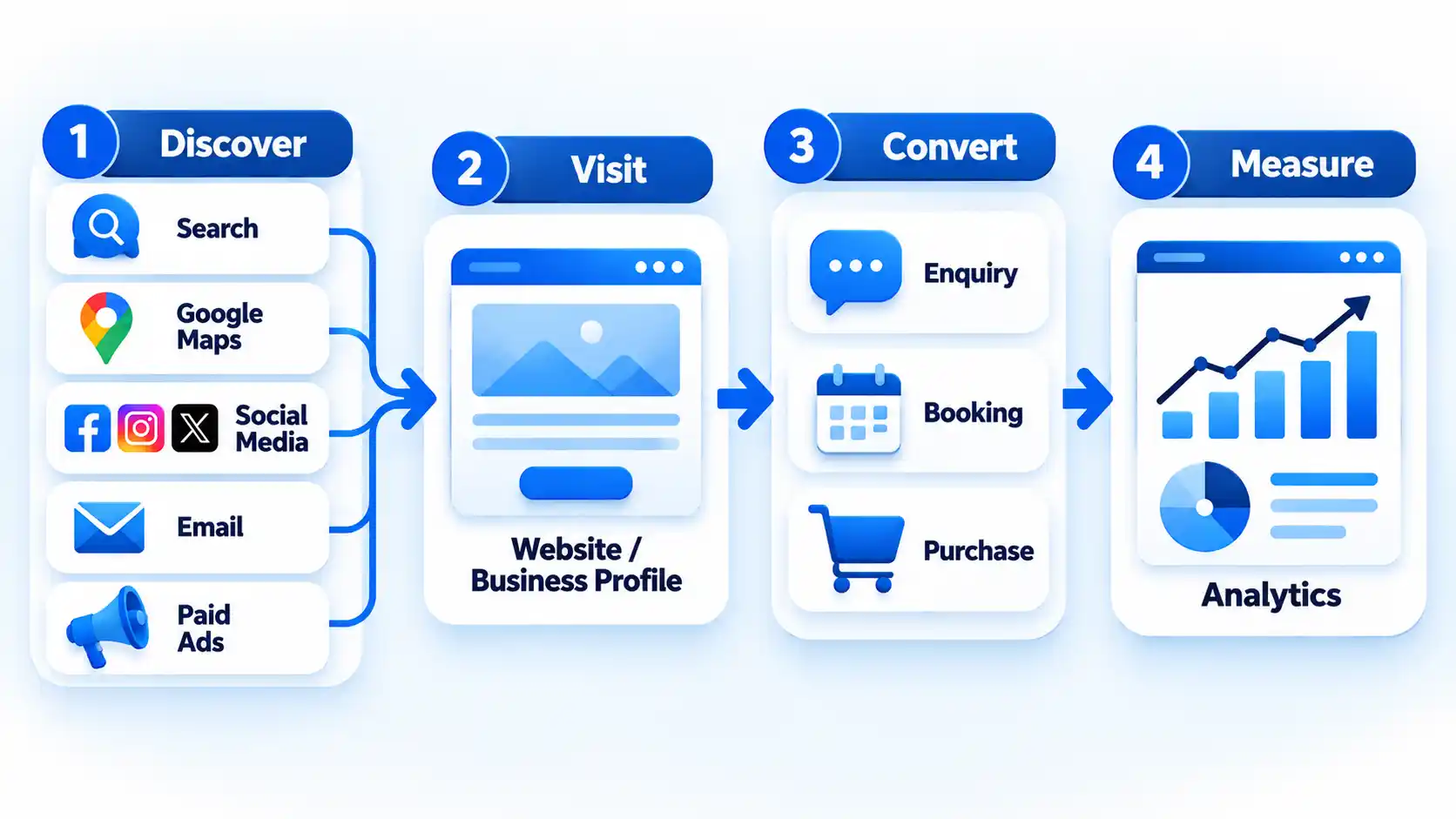
Choose measurements that fit the business. A service company might track qualified enquiry forms, booked consultations and phone calls. An ecommerce business may focus on completed purchases, revenue and repeat purchases. A subscription business might care about trials, activated accounts and retained customers.
Google Analytics 4 uses the term key event for an event that represents an action important to the business. Google’s key-event and conversion documentation explains that key events can be used to evaluate marketing performance across channels, while conversions are used when an important action is also needed for advertising measurement.
Do not assume attribution is perfect. A customer may discover a company through social media, return through search and finally purchase after receiving an email. Different reporting systems may assign credit differently. Look for consistent patterns and use the data as decision support rather than treating one attribution report as a complete account of why a customer bought.
Review performance regularly enough to act on it. Reduce work that repeatedly consumes resources without producing a useful result, improve promising channels and invest more carefully where evidence supports doing so.
How to choose where to start
You do not need to launch all 11 strategies at once. Start with the channels closest to how customers already discover and buy from the business, establish a usable website or destination, and add other channels when you can maintain and measure them properly.
| Business situation | Good starting emphasis | Why |
|---|---|---|
| Local service business | Website, Google Business Profile and local SEO | Customers often need to confirm the service, location or service area, availability and a way to make contact. |
| Business-to-business service | Website, search-focused content and a relevant professional network | Prospects may research expertise and compare providers before making an enquiry. |
| Repeat-purchase business | Website or store, email and appropriate social channels | Retention and continued communication may be as important as first-time discovery. |
| New offer with a working landing page | Organic foundation plus a controlled paid-advertising test | Paid campaigns can test demand faster when the business has a defined audience, conversion and budget. |
The table is a starting point, not a universal ranking. A business with strong referral demand may need little paid advertising, while another may depend on it. The important question is whether each channel has a clear purpose and whether the business has enough capacity to maintain it.
Conclusion
Small-business online marketing works better as a connected system than as a collection of isolated tactics. Build a dependable destination, make the business discoverable where appropriate, use a small number of communication channels well, and measure the actions that matter to the business.
Expand only when the existing channels are useful enough to justify more effort. That keeps marketing decisions tied to customers and results instead of platform trends or vanity metrics.

💬 Comments