Fleet and field teams usually need more than a desktop timer. The most useful systems combine employee time records with job or site assignment and, where the workflow requires it, GPS verification, geofencing, route or mileage context, scheduling, and payroll-ready timesheets.
Quick Take
- Choose the location model before comparing feature counts: a GPS stamp at clock-in is very different from tracking movement throughout a shift.
- Workyard and Timeero are particularly relevant when travel, jobsite time, or mileage needs to stay attached to field work records.
- Connecteam and ClockShark combine time tracking with broader scheduling and field-team coordination.
- QuickBooks Time makes the most sense to examine first when the accounting and payroll workflow already depends heavily on QuickBooks.
- Employee time tracking does not replace vehicle telematics, routing, maintenance, or proof-of-delivery software.
What fleet time tracking software should actually track
Consider a technician who visits three customer sites in one day. Payroll needs the hours worked, but an operations manager may also need to know which job received those hours, whether the technician reached the assigned site, and how travel between sites should be recorded. Those are separate requirements, and not every time-tracking app handles all of them.
A geofence is a virtual boundary around a physical location. A time clock can use that boundary to restrict or influence clocking behavior when a worker enters or leaves the area. That is different from a simple GPS stamp, which records where the device was at a specific event such as clock-in.
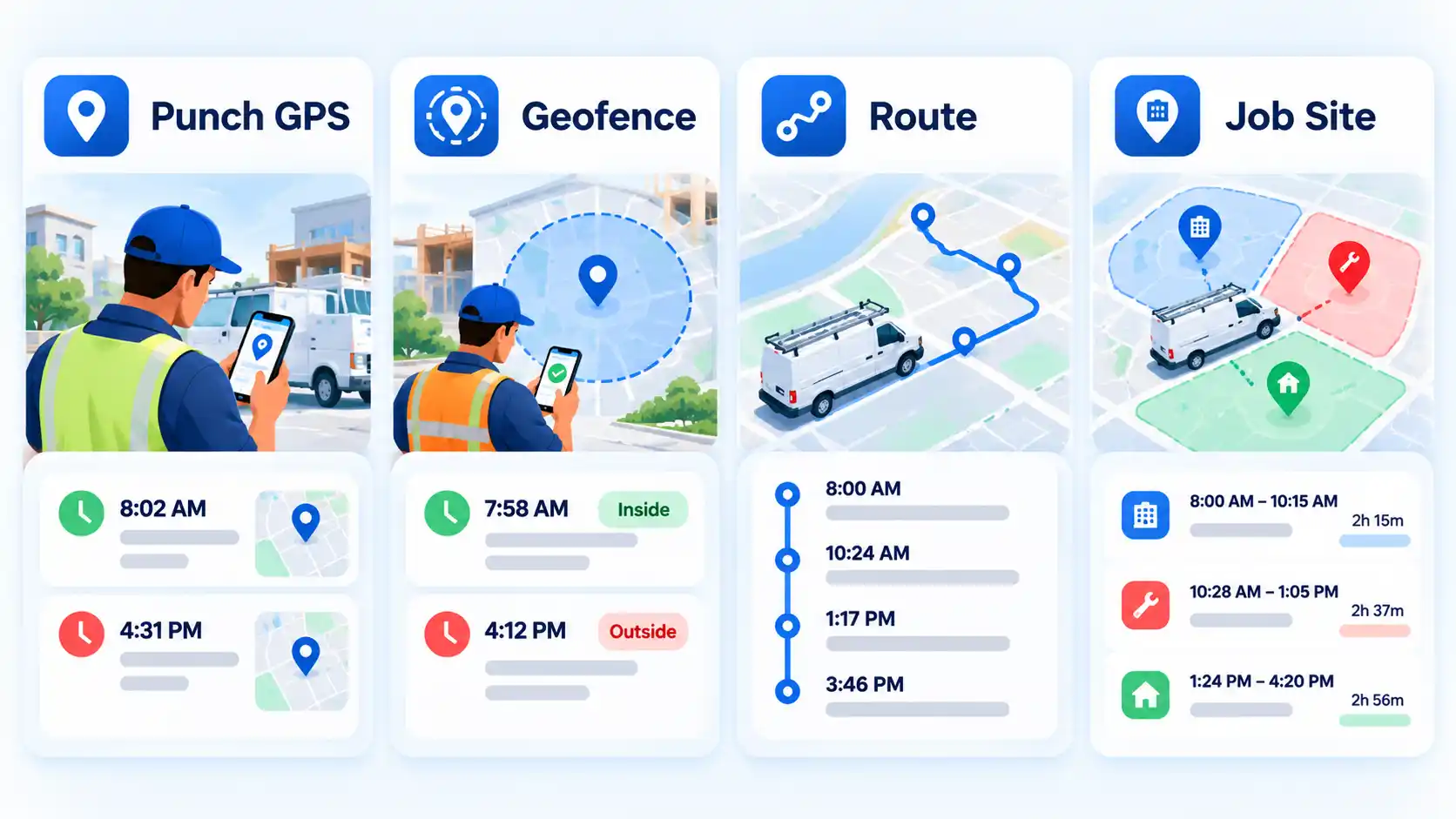
For fleet and field work, four location models are especially useful to distinguish:
- Punch-location verification: records where an employee clocks in or out.
- Geofenced timekeeping: uses a defined site boundary to control, prompt, or automate clocking behavior.
- Clocked-in route or breadcrumb tracking: records location points while an employee is working, creating a view of movement during the shift.
- Jobsite and mileage segmentation: separates time spent traveling from time spent at recognized jobs or locations when the product supports that model.
Those distinctions matter more than a generic “GPS included” label. Connecteam distinguishes geolocation, geofences, and its Breadcrumbs live-tracking mode, which records location stamps while a user is clocked in and moving. Timeero’s Segmented Tracking can show trips, mileage, and time spent at jobs or locations on a timeline. ClockShark likewise records periodic location points during a clocked-in workday.
Job allocation matters too. A job code or equivalent project assignment connects time with the customer, project, task, or site that received the labor. That makes the time record more useful for payroll review, job costing, billing, and operational analysis than a standalone start-and-stop timer.
GPS time tracking and geofencing solve related but different problems, so identify whether you need proof of a punch location, restrictions around a site, or a record of movement during paid time before you shortlist software.
Fleet time tracking systems compared
The table below is designed for first-pass filtering rather than declaring a universal winner. Compare the location model and operational fit first, then verify plan availability, mobile permissions, payroll integrations, and regional availability for the configuration you intend to deploy.
| System | Location and time model | Strongest operational fit | Field-work capability to examine | Important limitation or check |
|---|---|---|---|---|
| Workyard | Clocked-in GPS, project assignment, jobsite detection, travel, and mileage records | Multi-jobsite field crews | Project-linked time, travel, and driving records | Check which automation and geofence controls are included in the required configuration |
| Timeero | Clocked-in GPS, mileage, geofencing, and optional segmented tracking | Teams moving among multiple stops | Travel versus site-time visibility | Segmented Tracking is an add-on for qualifying paid plans |
| Connecteam | Clock events, geofences, and optional clocked-in Breadcrumbs | Deskless operations needing scheduling and time tracking together | Jobs, schedules, timesheets, and workforce coordination | Location mode and mobile permissions should match the intended privacy model |
| ClockShark | GPS punches, periodic breadcrumb tracking, and geofence reminders | Construction and field-service crews | Job and task time tied to scheduling | Compare another product if detailed mileage analysis is a primary requirement |
| QuickBooks Time | Clocked-in GPS points, geofencing on qualifying configurations, and mileage controls | Businesses centered on the QuickBooks ecosystem | Timesheets, jobs, scheduling, and accounting or payroll workflow | Geofencing and other field controls depend on the relevant product setup |
| Hubstaff | Configurable tracking-time, shift, jobsite, or Always location modes | Mixed field and project-based work | Job sites, schedules, time, budgets, and reports | Always mode can collect location outside active tracked time |
| Jibble | GPS clock events, geofencing, kiosk use, and offline clock-in or clock-out | Budget-conscious attendance and field-time tracking | Attendance verification and payroll-ready timesheets | Offline mode has feature restrictions and does not guarantee a GPS record on every device |
| ezClocker | GPS verification at clock-in and clock-out | Small teams needing straightforward punch verification | Schedules, jobs, kiosk use, and timesheet export | It is a narrower model than continuous route tracking |
The location column is deliberately more specific than “GPS: yes.” A manager who only needs to verify where a shift started has a different requirement from one who needs travel history or automatic separation of jobsite and driving time.
Workyard
When employees move among projects during the day, the useful question is not simply whether they clocked in. You may need work hours, site arrival information, and driving activity attached to the correct project so that payroll and job-cost records reflect where labor was spent.
Workyard combines mobile time tracking with clocked-in GPS and project tracking. Its current product and support material describes automatic project-time assignment, jobsite arrival and departure detection, driving routes, travel time, mileage capture, and offline storage that uploads after the device reconnects.
Workyard also documents that GPS data is collected between clock-in and clock-out, with break-time location hidden. Its geofences can support project tagging and other location-based controls, although the exact automation available depends on the account configuration.
That makes Workyard worth examining when travel between sites is part of the labor record rather than an incidental detail. A contractor whose crews start at one site, drive to another, and finish elsewhere has more to gain from this model than a company that merely wants a timestamped punch at a fixed depot.
Choose it when: project-linked site and travel records materially affect payroll or job costing. Look elsewhere first when: you mainly need a basic attendance punch with little field-location detail.
Timeero
A multi-stop workday creates a different record-keeping problem. If an employee spends part of the shift driving and part at customer locations, a single eight-hour time entry does not explain how the day was divided.
Timeero tracks time, GPS and mileage, and its segmented tracking feature can show business trips, mileage, trip duration, and time spent at different jobs or locations on a visual timeline. The company states that Segmented Tracking is an add-on for Pro, Premium, and Enterprise plan users.
Field connectivity is another relevant difference. Timeero states that its GPS, time, mileage, and segmented tracking can continue collecting data without an internet connection and sync after connectivity returns. That is useful for teams working in rural areas, basements, large facilities, or other places where mobile data cannot be assumed.
Timeero deserves particular attention when the question is not merely “Was the employee at Site A?” but “How much of the paid day was spent traveling versus at each stop?” Teams that only need basic clock-in verification may not need that additional tracking depth.
Connecteam
Some field teams need the time clock to sit inside a broader daily-operations system. The manager may be publishing schedules, assigning jobs, tracking attendance, and communicating with employees rather than treating timesheets as a separate application.
Connecteam combines employee time tracking with jobs, scheduling, timesheets, and location controls. Its current configuration supports geofences linked to jobs and work locations. Its Breadcrumbs mode uses GPS to record movement while the employee is clocked in and moving.
The distinction between those modes matters. A geofence can influence where or how an employee clocks into a job, while Breadcrumbs provides ongoing location stamps during paid work. Connecteam requires “Always” location permission for Breadcrumbs so background recording can continue while the employee is clocked in, but it does not save or share location while the employee is clocked out.
Connecteam therefore fits teams that want time tracking as one part of deskless workforce operations. A company that already has mature scheduling and employee-communication systems may prefer a narrower specialist instead.
ClockShark
For construction and field-service companies, the schedule and the timecard often refer to the same underlying job. A crew needs to know where to work, then the office needs a usable record of who worked that job and when.
ClockShark combines job and task time tracking with scheduling, GPS, and geofence-based reminders. Its GPS time clock records clock events and periodic location points, producing a breadcrumb-style view of a worker’s movement during the workday. ClockShark says location is tracked only while workers are clocked in.
The same GPS feature can continue working outside cellular coverage because the device can obtain GPS data without a cellular connection; recorded time is synchronized after internet connectivity returns. That helps field crews avoid turning a temporary dead zone into an automatically missing time record.
ClockShark is a strong candidate when the office-to-field workflow revolves around scheduled jobs and crew time. If detailed mileage or automatic travel segmentation drives the buying decision, compare it with systems that document those functions as a central part of the field workflow.
QuickBooks Time
If approved hours ultimately need to land in a QuickBooks-centered accounting or payroll workflow, integration can matter more than having the longest feature list. Reducing re-entry between the field timecard and back-office system may be the main operational benefit.
QuickBooks Time uses the Workforce mobile app to collect GPS information while employees are on the clock. Current Intuit documentation says GPS points can be saved at clock-in or clock-out, when the app opens, when job codes change, and periodically during tracked time. It also states that GPS points are not stored while a worker is on a break or clocked out.
QuickBooks Time also supports geofencing in qualifying configurations. Intuit’s current instructions describe geofences attached to jobs or customers and notifications when a worker enters or leaves the defined area. Mileage tracking is another configurable Workforce capability, so check the exact product and plan attached to the account rather than assuming every deployment has the same field controls.
QuickBooks Time is most compelling when the ecosystem itself is an advantage. If you do not already depend on QuickBooks, evaluate it on its field-time workflow rather than assuming the accounting brand alone makes it the right fleet choice.
Hubstaff
A business with both field staff and computer-based project workers can face an awkward split: one group needs jobsite and GPS records while another needs conventional project time tracking. Hubstaff spans both environments more directly than some field-only systems.
Its location features support several tracking modes for mobile workers, including tracking only while time is running, tracking during scheduled shifts, and an Always option. Managers can also define job sites and connect location tracking with project work.
Hubstaff needs closer privacy and configuration review than a simple “tracks while clocked in” description would suggest. In Always location mode, Hubstaff says locations can be recorded in the background while location tracking remains enabled, even when a worker is not tracking time to a project or working inside a scheduled shift.
That changes the deployment decision. Teams considering Hubstaff should choose the location mode deliberately and align device ownership, employee notice, permissions, internal policy, and applicable legal requirements with the actual configuration.
Jibble
Cost-sensitive teams may not need route analytics at all. If the primary job is proving attendance, recording project hours, or limiting punches to approved locations, a lighter system can be enough.
Jibble offers mobile, web, desktop, and kiosk time tracking with GPS and geofencing options. Its current feature information states that the free plan supports unlimited users and includes core time-and-attendance features, while timesheets can feed payroll and accounting workflows.
Jibble supports offline clock-in and clock-out on its mobile and desktop apps, with entries syncing after connectivity returns. The limitation is important: in mobile offline mode, activities and projects cannot be selected, breaks and automatic clock-outs are unavailable, and GPS capture depends on the device’s ability to obtain a GPS signal. Jibble also warns that some normal GPS or activity restrictions can be bypassed when an offline entry is created.
That makes Jibble worth examining when attendance verification, basic job or project hours, geofencing, or kiosk use matter more than detailed route and mileage analysis. For a workforce that frequently works offline, test the actual offline policy and record requirements rather than assuming every online control behaves identically without a connection.
ezClocker
A small team may only need to answer a narrower question: where was the employee when the shift started and ended? In that case, continuous route tracking can add complexity without solving a real business problem.
ezClocker takes a simpler time-and-attendance approach. Its current mobile time-clock material covers schedules, employee clock-ins, kiosk use, jobs, and timesheet handling, while its GPS time clock captures location at clock-in and clock-out rather than continuously recording an employee’s route.
That narrower model can be a benefit when you want basic punch-location verification without collecting a detailed map of the entire shift. It is less suitable when mileage, travel segments, or continuous movement between service calls are central to the operation.
How to choose a time tracker for a fleet or field team
Workyard
Avoid this if: your team only needs a basic attendance punch with little field-location detail.
Main trade-off: deeper field controls can require more configuration than a simple time clock.
Timeero
Avoid this if: you only need proof of where a shift began and ended.
Main trade-off: its most detailed segmented view is an add-on for qualifying paid plans.
Connecteam
Avoid this if: you want a narrowly focused time-and-mileage tool without wider workforce features.
Main trade-off: location behavior depends on which tracking mode and permissions you enable.
ClockShark
Avoid this if: detailed mileage or automatic travel segmentation is a central requirement.
Main trade-off: its documented GPS workflow emphasizes job-linked time and breadcrumb location history rather than segmented mileage analysis.
QuickBooks Time
Avoid this if: QuickBooks integration provides little operational value to your business.
Main trade-off: geofencing, mileage, and other field controls depend on the relevant product configuration.
Hubstaff
Avoid this if: your privacy policy cannot accommodate the location mode required by your chosen deployment.
Main trade-off: its configurable location modes require unusually careful privacy and device-permission decisions.
Jibble
Avoid this if: detailed mileage and route segmentation drive the buying decision.
Main trade-off: offline mode limits projects, activities, breaks, and some tracking controls.
ezClocker
Avoid this if: you need continuous route history or detailed mileage analysis throughout a shift.
Main trade-off: the simpler punch-location model provides less movement detail than route-oriented products.
Time tracking is not the same as vehicle telematics
Employee time tracking and vehicle telematics can both use location data, but they answer different questions. A time-clock record might show that an employee worked at a customer site from 8:02 a.m. until 10:17 a.m. Vehicle telematics can instead collect information from or about the vehicle, including location, trip distance, speed, idling, fuel information, and diagnostic fault data.
Employee timekeeping therefore covers only one part of fleet management. If the operational problem is vehicle condition, engine faults, asset utilization, fuel behavior, or vehicle trip history, a workforce time clock is not a substitute for a telematics platform.
If you need engine, trip, and vehicle-condition data rather than employee hours, vehicle telematics is a different system category. Independent vehicle-telematics material describes data such as GPS position, speed, trip distance and time, idling, fuel consumption, and vehicle fault information.
Delivery companies may have a third requirement: dispatch, route optimization, customer notifications, and proof of delivery. Those needs belong to courier management software rather than the employee timekeeping layer covered here.
The distinction becomes especially important when evaluating fleet telematics and workforce GPS tracking. They may complement each other, but one should not be purchased on the assumption that it automatically performs the other’s job.
Location tracking and employee privacy
Location-based timekeeping should be evaluated by what the configured system actually collects, not by a generic promise that an app “has GPS.” One product may record only a location at clock-in and clock-out, while another may generate route points throughout paid time. A third may support a setting that continues collecting location outside actively tracked time.
Current product documentation shows that these differences are real. ClockShark says its GPS tracking operates while workers are clocked in. Timeero says it captures and stores location while a worker is clocked in or tracking mileage. Connecteam says Breadcrumbs does not save or share location while users are clocked out. Intuit states that QuickBooks Time does not store GPS points while a worker is on a break or clocked out.
Hubstaff is an important counterexample to any blanket rule. Its settings include Tracking time, Also during shifts, and Always. The Always setting can record locations in the background outside active tracked time while location tracking remains enabled.
Before rollout, verify four things for the exact configuration you plan to use: when location is collected, which mobile permissions are required, who can view the records, and how long the business keeps them. If employees use personal phones, device ownership and off-hours behavior deserve particular attention.
Employment and privacy requirements vary by jurisdiction, workforce arrangement, and tracking method, so a software feature list is not a legal-compliance determination. Use the vendor’s current configuration material and obtain appropriate legal or human-resources guidance where location monitoring creates a material compliance question.
Finally, test the intended configuration with a representative field workflow before relying on it for payroll. A missing route point can result from permissions, weak GPS reception, battery-management behavior, an offline device, or a tracking setting rather than proving where an employee was or was not. Diagnosing GPS time clock location gaps requires checking the device and tracking configuration before treating the map as a complete record.

💬 Comments