A dedicated team does not arrive with a discount attached. What it changes is who carries the fixed cost of employing a software team. The vendor absorbs recruiting, payroll, benefits, office space, hardware, infrastructure and replacement cover. Your side keeps product direction, sprint cadence and the decisions that unblock work. Whether that redistribution lowers your total spend depends on five cost levers, and each one carries a price of its own.
That is why rate cards mislead. The models are different structures with different risk profiles, and the comparison only works at the level of fully loaded cost for the same delivered output.
Quick Take
- Five levers can move total cost: employment overhead shifts into the vendor fee, capacity flexes with workload, start dates move earlier, specialist skills arrive without a permanent senior salary, and a stable team can reduce rework.
- They matter most on a long roadmap where requirements will move and you can keep real product ownership in-house.
- Compare fully loaded monthly cost across the alternatives: vendor fee plus your management time, onboarding, communication, security controls, ramp-down and knowledge transfer.
What dedicated developers mean in a cost model
A dedicated development team is a vendor-assembled group of engineers, QA specialists, designers and often a delivery lead who work exclusively on your product. You set the product vision, priorities and roadmap. You approve team composition, run sprint planning, backlog grooming and reviews, provide feedback and grant system access. The vendor recruits and vets the engineers, runs payroll, benefits and HR administration, handles local labour-law compliance, provides office space, hardware and infrastructure, and replaces team members when someone leaves, including the knowledge transfer that follows.
That split is what turns the arrangement into a cost question. The model sits between two neighbours. Staff augmentation places individual contractors inside a team you already manage. Fully managed outsourcing hands the vendor delivery ownership and you evaluate the output. A dedicated team gives you direct access to the engineers and real management control while the vendor carries the operational side of running a team.
The operational case is covered in our look at the benefits of dedicated software development teams. The cost case comes down to how many of those vendor responsibilities you would otherwise be paying for directly.
| Model | Who owns delivery | What you manage | How you pay | Cost risk to watch |
|---|---|---|---|---|
| Dedicated team | You own priorities and product decisions; vendor owns the operational team | Sprints, backlog, feedback, output review | Monthly fee per team, plus your internal management time | Management load, onboarding, ramp-down terms |
| Staff augmentation | Your existing team lead | Everything, including day-to-day tasking of the specialist | Hourly or monthly rate per specialist | Integration gaps between an outsider and your team |
| Fixed bid | Vendor owns the delivery | Requirements definition and acceptance | Fixed project price | Change orders when scope moves |
| Managed outsourcing | Vendor owns delivery and the team | Outcomes and acceptance criteria | Project or retainer pricing | Less visibility into day-to-day execution |
Two boundaries matter before any numbers. A dedicated team is a structure, and offshore, nearshore and onshore are location choices layered on top of it. Geography is a separate decision. If your next question is whether to hire offshore developer talent for a mobile build, compare that choice after you have settled the contract model, because a low day rate from a distant team is not evidence of a lower total bill. A fixed bid is a different instrument entirely: it buys predictability on documented scope, and it charges you again through renegotiation when that scope moves.
The total-cost equation you should actually compare
The invoice figure is the vendor’s fee for a team. Your total includes at least six lines, and only two of them usually appear in a proposal.
| Cost line | Who usually bears it | What to compare |
|---|---|---|
| Vendor fee | Client, invoiced by the vendor | Which roles the fee covers, what happens to the rate at renewal, and what sits outside the fee |
| Internal management time | Client | Who runs sprints, grooms the backlog and answers product questions, and how many hours per week that consumes |
| Onboarding and ramp-up | Shared | Codebase walkthroughs, access provisioning, environment setup, domain training, and how many weeks to reach working velocity |
| Communication overhead | Client | Time-zone overlap, meeting cadence, documentation standards, and who absorbs the lag on decisions |
| Tooling and security controls | Mixed | Licences, CI/CD pipelines, code scanning, access reviews and anything the vendor does not cover in the fee |
| Ramp-down and knowledge transfer | Client | Notice period, exit documentation, and what it costs to hand the codebase to a different team later |
The five cost levers
Each lever changes a different line in that equation. Every one is conditional: the mechanism is real, and the saving is not automatic.
Lever 1: Move employment and administrative overhead into the vendor fee
This is the lever vendors lead with, and it is the easiest to verify. Recruiting, vetting, payroll, benefits, HR administration, local labour-law compliance, office space, hardware, infrastructure and replacement cover all transfer to the provider. Those are real costs with real administrative drag, and they are the reason a monthly team fee can be compared against a salary load at all.
The trade-off is control and transparency. Those services sit inside the rate, so you lose visibility into how they are priced, and you share authority over hiring, replacement and team composition. Responsibilities that blur in practice need writing down before the contract: who approves architectural changes, what the escalation path is when the team hits a blocker, and how fast each side must respond to questions that need product input. The responsibility split is straightforward: the vendor handles operational work, while product direction stays with you. Your management capacity is a cost you keep paying.
Lever 2: Flex team capacity to the workload
Product work is uneven. Discovery, core build, integration and hardening phases need different headcounts. A dedicated team can be scaled up during a build push and reduced once core features ship, so you are not carrying a permanent in-house team through a maintenance trough. You pay for the services you need at each stage.
The trade-off lives in the contract terms. Minimum engagement length, notice periods and minimum team size determine how much flexibility you actually bought. Cutting a team also destroys the product context you paid months to build, so the reduction that looks efficient on a spreadsheet can raise the cost of the next phase. Rates vary by region, team size and technology stack, which means the flexibility lever changes quantity and composition, not the unit economics. Short work of under three months rarely justifies the ramp cost.
Lever 3: Start sooner than a local hiring cycle allows
Industry hiring benchmarks indicate that median technology time-to-hire typically runs around seven weeks, with software engineering searches taking six to seven weeks, senior searches taking noticeably longer, and the slowest searches extending past several months. Those timelines create a scheduling advantage for a pre-assembled team only when onboarding is planned before kickoff.
Earlier start dates carry value only if the work is ready. Onboarding into an unfamiliar codebase, domain and process consumes the first weeks regardless of who employs the engineers. If your architecture is undocumented and your product owner is part-time, a fast start converts into slow delivery. Add the coordination cost of time-zone overlap and meeting cadence. A quick start with a poorly matched team costs more than a slower start with a well-matched one.
Lever 4: Buy specialist skills instead of funding a training pipeline
Training is a real line item. Keeping an in-house team current on a narrow technology stack takes time, courses and senior-review capacity that otherwise goes into delivery. For a short, specialised phase, buying the skill instead of funding a training pipeline can be cheaper than training an existing engineer or hiring a permanent specialist you will not fully utilise later. A phase that needs Salesforce custom app development or CRM architecture is a good test: the need is real, but it may not justify a permanent senior hire.
Two costs move onto your side of the ledger. Verification becomes your job, because a provider’s vetting is not an independent quality signal. Run your own technical screen; a coding assessment tool can give you a comparable signal across candidates and a record of what was tested. Knowledge transfer also becomes your obligation to enforce. A specialist who leaves mid-engagement takes context with them unless documentation and pair reviews are contractual requirements. The longer the engagement, the weaker the avoided-training argument becomes, because a permanent hire amortises that training across years.
Lever 5: Reduce rework with a stable team and clearer requirements
A team that stays on the product accumulates architectural knowledge: why a service was split a particular way, which integration is fragile, which test suite is load-bearing. That context reduces re-explanations and the rework that follows a misunderstanding. It is one of the ways a stable dedicated team can lower development cost. Poor planning and miscommunication are common budget busters, which is why clear requirements and decision discipline matter more than a low rate.
The dependency sits on your side. Rework falls when the client defines priorities, runs sprints, grooms the backlog and answers questions quickly. When either side spends 24 to 48 hours waiting for a decision, the team loses meaningful productive time over a long engagement, which compounds badly. If you cannot staff an internal product owner with real decision authority, the stable team improves context and the rework line still rises.
The five levers side by side
| Lever | Operational benefit | Trade-off to price in | Client-side prerequisite or guardrail |
|---|---|---|---|
| 1. Overhead shift | Recruiting, payroll, HR, office and infrastructure move into the fee | Shared control, opaque service pricing, retained management load | Name an approval owner for hiring and replacements; document escalation and architecture authority |
| 2. Capacity flex | Team size tracks build, integration and maintenance phases | Minimum terms, notice periods, lost context after a reduction | Agree minimum team size, notice period, ramp-down and knowledge-transfer terms before scaling down |
| 3. Faster start | Engineers begin before a local search completes | Onboarding weeks, communication lag, fit risk on a rushed start | Have the product owner, access, codebase walkthrough and first-sprint backlog ready before kickoff |
| 4. Specialist access | Narrow skills for a phase without a permanent senior salary | Your verification burden, knowledge-transfer risk, weaker case on long engagements | Run your own technical screen; require documentation and paired review as contract terms |
| 5. Rework reduction | Stable context and clearer requirements cut repeat work | Requires a product owner with authority and fast decisions | Staff a decision-capable product owner; set backlog discipline and response expectations |
Fit decision: choose the model, then the vendor
The levers only stack in your favour under specific conditions. Use them as a screen before you talk to any provider.
- Your roadmap runs six months or more and the scope will change as you learn from users.
- You need a cross-functional group (engineers, QA, design and DevOps), not just extra hands.
- Local hiring is slow or expensive for the roles you need, and the roadmap cannot wait.
- You have, or can hire, an internal product owner who runs sprints and makes product decisions promptly.
- You want engineering knowledge to stay on the product across the lifecycle rather than restarting with each contractor rotation.
Info
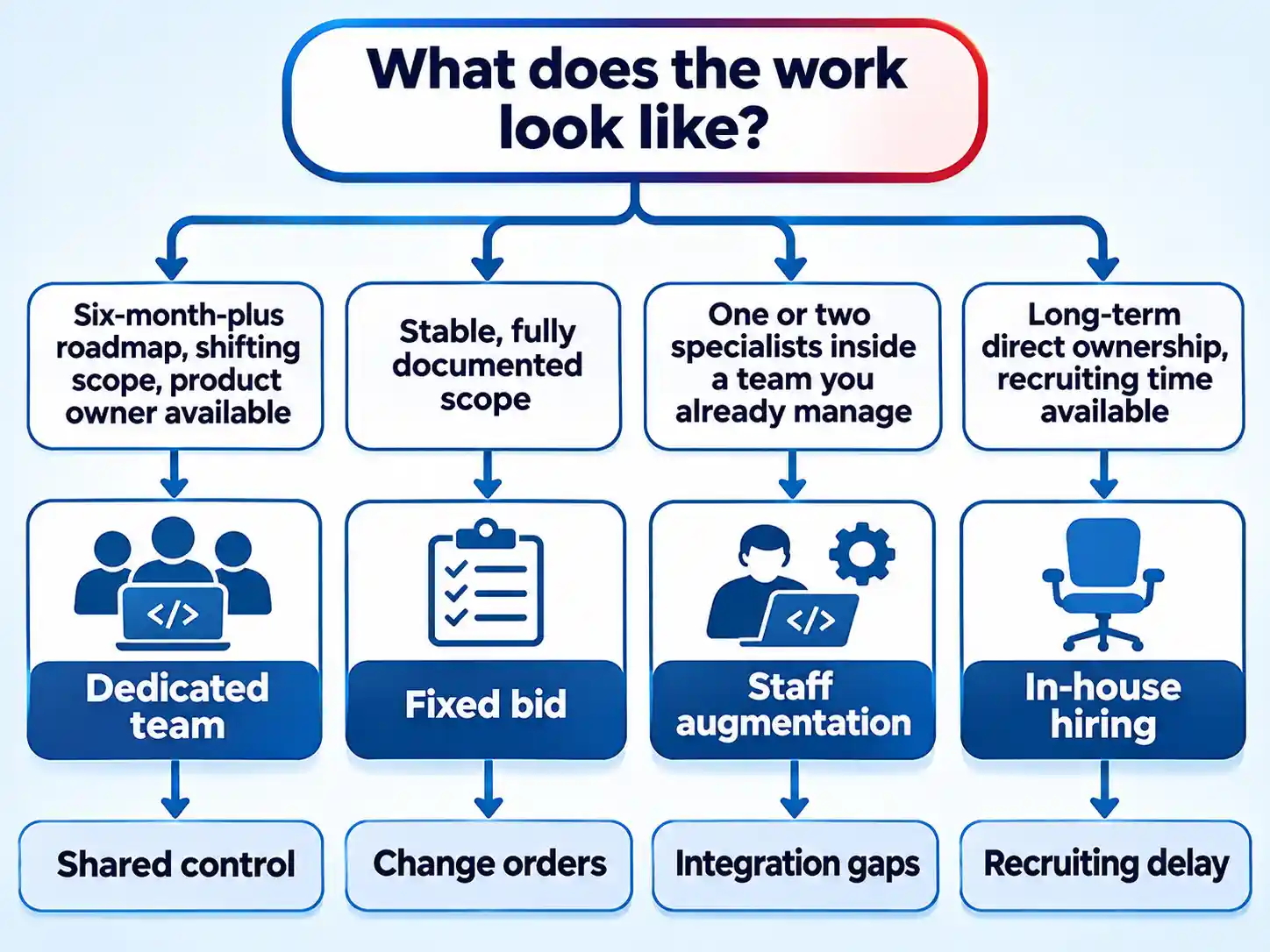
If a condition fails, another model usually fits better. Stable, fully documented scope belongs in a fixed bid. One or two specialists inside a team you already manage is staff augmentation. Long-term direct ownership with deep institutional control justifies in-house hiring, provided you have the recruiting runway. A fixed scope, an engagement under three months, or no internal bandwidth to manage an external team are all reasons to walk away from the dedicated model.
Hidden costs and guardrails
Warning
Apparent savings disappear through five doors: the vendor fee rising at renewal, onboarding eating the first month of the “faster start”, your product owner becoming a bottleneck, communication lag on decisions that need product input, and ramp-down terms that lock the team in after you no longer need it. Each one is priced in the contract, not in the rate card.
Security deserves a line of its own rather than an assumption. NIST’s DevSecOps guidance describes embedding security into every phase of the software lifecycle instead of bolting it on before release. A vendor’s internal practice does not transfer to your environment automatically, so the access model, code review requirements, dependency scanning and incident response expectations belong in the agreement.
Verify before you sign
- An escalation path and an architecture-approval owner are named on both sides
- Response-time expectations for product decisions are written into the agreement
- Notice period, minimum team size and ramp-down cost are stated in numbers
- Code, infrastructure and documentation ownership are assigned to you on termination
- Knowledge-transfer obligations are defined, with documentation and handover sessions in scope
- Your own technical screen has verified the skills you are paying a premium for
- Security controls, access reviews and scanning responsibilities have been agreed in writing
Evaluating total engagement cost over rate cards
Each of those is a cost lever with a described mechanism and a matching trade-off. None of them guarantees a lower bill. Under the right conditions, the model can beat the alternatives on total cost. Outside them, a fixed bid or a couple of augmented specialists is often cheaper and easier to run.
Run the six-line total for each option you are considering, then shortlist providers on their willingness to put those terms in writing. If the fit test passes, the practical next step is our guide to how to hire a dedicated software development team, with the cost model in hand. Hire a dedicated developer against the term sheet you just built when you are ready to approach providers, and hold them to the same questions the arithmetic forced you to answer.

💬 Comments