The right Shopify dropshipping app depends less on which tool has the longest feature list and more on how you plan to source products, keep inventory current, and get orders fulfilled. Start with your supplier model, then compare apps that solve the same operational problem.
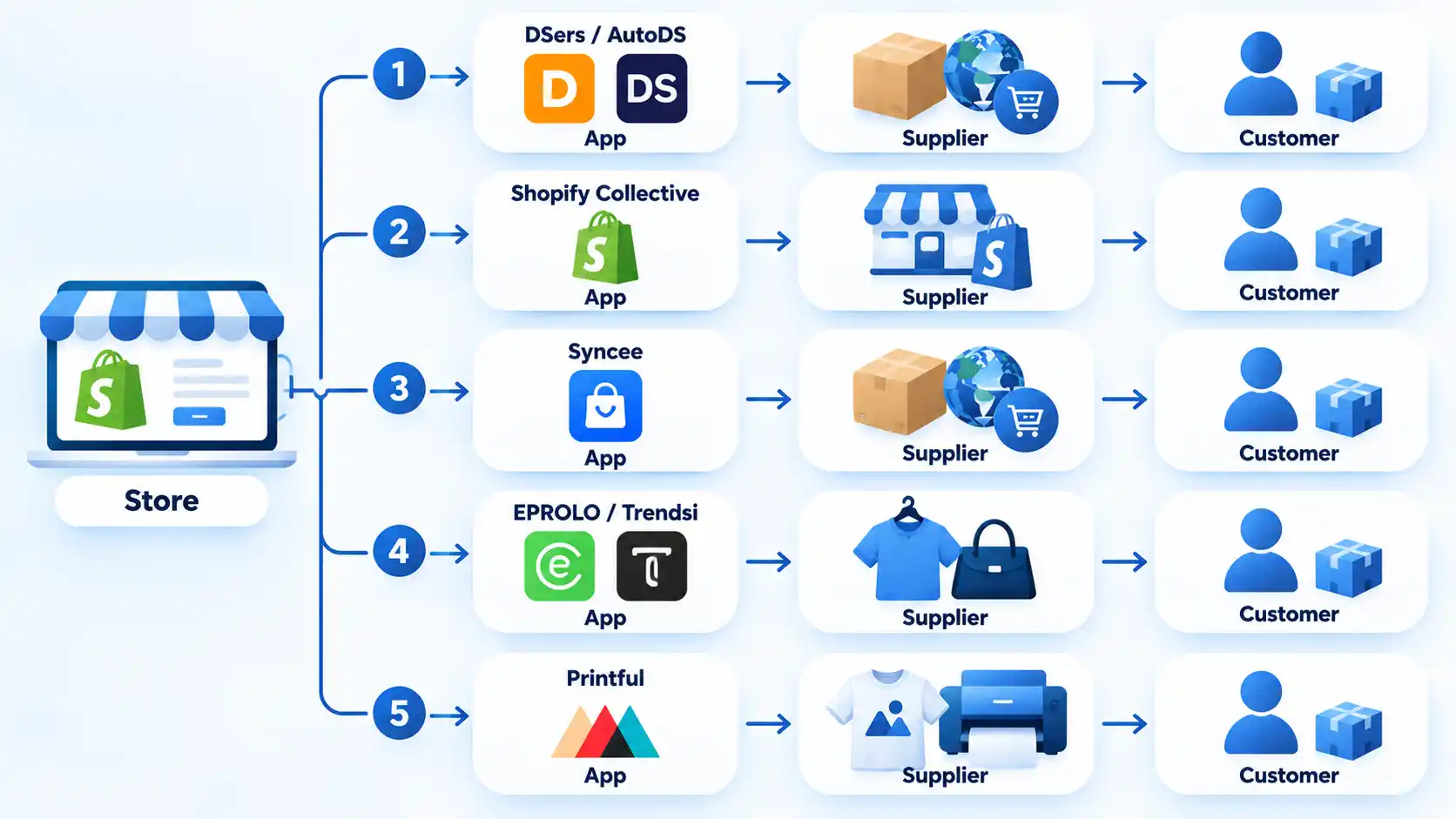
This guide compares seven current choices without forcing them into a best-to-worst ranking. DSers, AutoDS, Shopify Collective, Syncee, EPROLO, Trendsi, and Printful serve overlapping but meaningfully different kinds of stores.
Quick Take
Choose DSers when AliExpress-style sourcing is central to your workflow, AutoDS when broader automation is worth paying for, Shopify Collective when you want products from other Shopify brands, Syncee when supplier geography matters, EPROLO or Trendsi for fashion-oriented sourcing, and Printful when your business is built around print on demand.
What counts as a dropshipping app?
Dropshipping lets a store sell a product without keeping that product in its own inventory. After a customer buys, the supplier receives the order and ships it to the customer. Print on demand, or POD, uses a similar no-stock model but adds a production step: a customized product is made after the customer orders. Shopify currently treats dropshipping and print on demand as related but distinct sourcing models.
That distinction matters because not every useful Shopify app is a dropshipping app. Email tools, analytics platforms, session-replay software, general shipping utilities, and reporting dashboards may improve a store, but they do not necessarily solve the core sourcing-and-fulfillment problem covered here.
This article also assumes Shopify is already the ecommerce platform you intend to use. If that choice is still open, the operational differences between Shopify and WooCommerce deserve to be settled before you build an app stack around one platform.
Likewise, installing a sourcing app is not the same task as creating an online store. A merchant who does not yet have a functioning storefront has an earlier setup decision to finish first.
A sourcing or fulfillment app changes how products enter and move through an existing store; buying a prebuilt Shopify dropshipping store is a separate store-creation service rather than an alternative dropshipping app.
Choose the sourcing model before you choose an app
Two apps can both appear in Shopify’s dropshipping category while solving different problems. A merchant importing marketplace products through DSers is making a different supplier decision from a brand using Printful to produce designs after each order or a retailer using Shopify Collective to sell products carried by another Shopify merchant.
App popularity is not enough to settle the choice. Shopify recommends checking factors such as product quality, shipping performance, fulfillment reliability, and whether reviews appear trustworthy, while its current recommendations separate supplier-based dropshipping from print-on-demand apps.
Warning
Do not connect the same products to multiple systems that each expect to control sourcing, inventory, or fulfillment unless you have deliberately defined which system owns each part of the workflow. Overlapping automation can make stock, routing, and order status harder to reconcile.
Before installing anything, decide where the product comes from, who owns the inventory record, who receives the order, who ships it, and which system sends tracking information back to Shopify. Those answers narrow the field more reliably than comparing app-store ratings alone.
DSers for AliExpress-focused sourcing
If your product strategy starts with AliExpress or closely related marketplace sourcing, DSers is the most directly aligned option in this group. Its current listing supports product importing, bulk ordering, supplier management, and automatic updates across stock, prices, orders, and tracking, with AliExpress, 1688, and Alibaba among its supported sourcing connections.
The practical advantage is concentration: a merchant already committed to this sourcing ecosystem can manage more repetitive product and order work in one system. DSers currently offers a free plan, which also makes it possible to evaluate the workflow before committing to a paid tier.
The limitation is closely tied to that strength. If your strategy is moving toward direct brand relationships, made-to-order products, or a wider mix of supplier models, an AliExpress-centered workflow may no longer be the cleanest foundation. DSers and AutoDS become a more useful comparison when the real question is whether you want a marketplace-centered workflow or a broader automation layer.
AutoDS for broader sourcing and automation
AutoDS is aimed at merchants who want more of the product-import, monitoring, sourcing, and fulfillment workload brought into one automation platform. Its current Shopify listing describes product discovery and importing, order fulfillment, branding tools, and access to multiple dropshipping supplier sources.
That breadth comes with a software cost. As checked on October 4, 2026, AutoDS starts at $26.90 per month, with a free trial available. Treat that figure as a dated price rather than a permanent rate.
AutoDS can reduce the amount of manual work between finding a product, importing it, monitoring it, and processing the resulting order. It cannot remove the underlying supplier decision. Automating a supplier’s feed or fulfillment workflow does not by itself prove that the supplier’s stock accuracy, product quality, or delivery performance will meet your standard.
The strongest reason to choose AutoDS over a narrower app is operational breadth. If you only need a focused AliExpress workflow, the extra automation layer may be unnecessary. If you routinely work across several sources and want one control layer for more of that process, its wider scope becomes more relevant.
Shopify Collective for products from other Shopify brands
Shopify Collective takes a different approach from an open supplier marketplace. Eligible retailers can connect with other Shopify merchants, import their products, keep product information and inventory synchronized, and have customer orders forwarded to those suppliers for fulfillment. Tracking then syncs back to the retailer’s store through the Collective workflow. Collective is built around retailer-to-supplier relationships between Shopify stores.
This makes Collective useful when the commercial relationship is retailer-to-brand rather than retailer-to-marketplace-seller. For example, a home-goods store could add a complementary product line from another participating Shopify brand without buying and warehousing that inventory first.
Availability is more nuanced than a simple US-only rule. Shopify currently lists multiple supported countries and currencies, along with requirements involving an active Shopify plan, Shopify Payments, payout configuration, and other eligibility checks. A retailer connecting with a supplier also needs the stores to meet Shopify’s country and currency compatibility requirements.
Shopify says Collective is free for eligible stores, but eligibility and feature availability can change. That makes it a strong first check when you want direct Shopify-brand relationships, not an automatic substitute for supplier marketplaces that serve a different sourcing model.
Syncee for a multi-region supplier marketplace
Supplier geography can become the deciding factor when your customers are concentrated in a particular country or region. Syncee’s current Shopify listing says its marketplace connects retailers with suppliers in the United States, Canada, the European Union, the United Kingdom, Brazil, and other markets, while supporting product imports, inventory updates, and order synchronization.
That makes Syncee useful when you want to search across a geographically varied supplier pool instead of tying the catalog to a single marketplace. A free Syncee plan is currently available, and the app is marked Built for Shopify.
A marketplace label does not make every supplier equivalent. Product quality, wholesale terms, stock accuracy, processing time, shipping destination, and return handling can still vary from supplier to supplier. Treat Syncee as a way to widen and organize supplier discovery, then evaluate the actual supplier behind each product you intend to sell.
EPROLO for fashion sourcing and custom branding
A fashion merchant may care about something a general product importer does not emphasize: whether the sourcing partner can also support labels, packaging, and other brand presentation as the business matures. EPROLO’s current Shopify listing combines fashion-oriented product sourcing and fulfillment with custom-branding services.
EPROLO currently offers a free plan, and its listing advertises custom labels and packaging without a minimum order quantity. That combination can suit a store that wants supplier fulfillment now but also wants the option to make packaging and labeling feel more like its own brand later.
Be careful with performance language. The developer also advertises shipping-time, inspection, return, and catalog-size claims on the listing. Those statements describe what the vendor says it offers; they do not establish that every product and destination will produce the same result. Check the exact product, sourcing location, shipping method, and return terms before building a customer promise around a headline fulfillment claim.
Trendsi for fashion boutiques and private-label growth
Trendsi is another fashion-specialist option, but its appeal is particularly clear for boutiques that may want to move between dropshipping, wholesale purchasing, and private-label manufacturing instead of remaining in one fulfillment model indefinitely. Its current Shopify listing combines dropshipping, open-pack wholesale, and private-label manufacturing.
The app currently has a free plan. For a fashion store, the specialized catalog may be more relevant than adding a general marketplace with thousands of unrelated product categories because sizing, assortment turnover, inventory availability, and eventual brand development all affect the operating model.
The trade-off is that fashion inventory and supplier-side fulfillment can change quickly. Recent lower-rated Shopify App Store reviews include merchant reports of items becoming unavailable after orders were placed and of extended shipping delays. Those accounts are anecdotal rather than controlled performance measurements, but they identify failure modes worth testing before you depend on specific styles for campaigns or customer delivery promises. Recent one-star Trendsi reviews document both stock and fulfillment complaints.
A simple safeguard is to decide how you will respond when supplier inventory changes after a product has already attracted traffic or orders. Inventory-sync problems matter most when the storefront continues to promise an item the supplier can no longer fulfill.
Printful for print-on-demand products
Printful belongs in this comparison because print on demand solves a different sourcing problem. Instead of selecting a finished supplier product and reselling it, you create or upload a design and the product is printed, packed, and shipped after an order is placed.
Printful is currently free to install, with fulfillment and shipping charged when products are sold. Its Shopify listing covers customizable products such as apparel, bags, home items, and wall art, alongside design and mockup tools. Printful also lists packaging inserts and packing-slip customization among its branding options.
POD changes the economics as well as the creative workflow. The fulfillment provider is producing an item after the sale, so your relevant calculation is not simply the difference between a supplier’s catalog price and your retail price. Product base cost, printing or embroidery, shipping, taxes where applicable, returns, advertising, and Shopify operating costs all affect the remaining margin. Dropshipping margins and operating costs need to be evaluated at the product-and-destination level rather than assumed from the absence of upfront inventory.
How the apps compare
The table is most useful as a model comparison, not a scorecard. Start with the row whose sourcing method resembles the business you actually want to operate, then investigate the app’s current catalog, supplier terms, shipping options, and plan limits.
| Option | Sourcing model | Current cost/access | Strongest fit | Key boundary |
|---|---|---|---|---|
| DSers | AliExpress and related marketplace sourcing | Free plan available | Merchants centered on AliExpress-style product sourcing and order workflows | A marketplace-centered workflow may be too narrow for other supplier models |
| AutoDS | Multi-source automation | From $26.90/month when checked | Merchants who value broader importing, monitoring, and fulfillment automation | Automation adds cost and does not guarantee supplier quality |
| Shopify Collective | Products from other Shopify brands | Free for eligible stores | Retailers seeking direct Shopify-brand supplier relationships | Eligibility, country, currency, payment, and supplier conditions apply |
| Syncee | Multi-region supplier marketplace | Free plan available | Stores that want supplier discovery across several geographic markets | Individual supplier quality and terms still require evaluation |
| EPROLO | Fashion-oriented sourcing and branding | Free plan available | Fashion sellers that want sourcing plus custom-label or packaging options | Vendor shipping and quality claims should be checked per product and destination |
| Trendsi | Fashion dropshipping, wholesale, and private label | Free plan available | Boutiques that may move from dropshipping into wholesale or private label | Merchant reviews identify stock changes and fulfillment delays as risks to monitor |
| Printful | Print on demand | Free to install; fulfillment and shipping charged on orders | Stores selling their own printed or embroidered designs | POD unit economics differ from reselling finished catalog products |
Prices and plan structures are especially volatile, so use the cost column to understand the business model rather than as a permanent quote. Verify the current listing before budgeting around a paid tier.
Which option should you choose?
DSers
Avoid this if: you need a supplier model centered on direct brands, print on demand, or a broader mix of unrelated sourcing channels.
Main trade-off: focused marketplace workflow versus broader supplier flexibility.
AutoDS
Avoid this if: your sourcing workflow is simple enough that the extra paid automation would add more cost than operational value.
Main trade-off: broader automation in exchange for another recurring software dependency.
Shopify Collective
Avoid this if: the suppliers you need are outside its eligibility, country, currency, or connection requirements.
Main trade-off: a more native retailer-to-brand workflow with tighter eligibility boundaries.
Syncee
Avoid this if: you already have a direct supplier relationship or need a specialized POD or fashion-branding workflow instead.
Main trade-off: broad supplier discovery with supplier-by-supplier due diligence still required.
EPROLO
Avoid this if: you need independently measured shipping performance rather than vendor-stated fulfillment claims.
Main trade-off: integrated fashion and branding options with product-level fulfillment claims that still need verification.
Trendsi
Avoid this if: your customer promise cannot tolerate supplier stock changes or supplier-side fulfillment delays.
Main trade-off: fashion specialization with inventory and delivery risks that require active monitoring.
Printful
Avoid this if: you simply want to import ready-made supplier products without a customization or production step.
Main trade-off: creative control and made-to-order fulfillment with different per-unit economics from catalog dropshipping.
Bottom line
There is no single Shopify dropshipping app that wins across every sourcing model. DSers and AutoDS solve different versions of marketplace sourcing and automation; Shopify Collective centers on relationships with other Shopify brands; Syncee broadens supplier geography; EPROLO and Trendsi are more fashion-oriented; and Printful is fundamentally a print-on-demand production service.
The most reliable way to choose is to write down your intended supplier relationship, target customer geography, branding requirements, inventory owner, fulfillment owner, and acceptable software cost before installing an app. Then validate the current supplier terms and product-level economics. That approach keeps the app stack tied to an operating model instead of assembling tools because they happen to be popular.

💬 Comments