Quick Take
Holiday readiness is a capacity-and-visibility exercise. Forecast from your own last-year numbers, staff and brief for the spike, adjust hours to match real demand, keep every public listing accurate, and only promise shipping timelines you can legally and operationally keep. Do that in sequence and December stops being a scramble.
Most small-business owners treat the holiday season as a marketing problem and start solving it in November. By then the inventory is ordered, the seasonal hires are either trained or not, and the website either handles traffic or falls over. The businesses that finish the year strong treat it as a capacity problem instead: they line up stock, staff, hours, and public information against a demand spike they can partly predict from their own records.
The scale matters. In its 2023 FAQ, the SBA’s Office of Advocacy counted 33,185,550 small businesses in the United States, representing 99.9% of American businesses and employing 61.7 million people, or 46.4% of the private-sector workforce. Advocacy generally defines a small business as an independent firm with fewer than 500 employees. If you run one of them, you are competing for the same holiday attention as everyone else, with far less slack.
What Holiday Preparation Actually Means
Operationally, preparing for the holidays means aligning two things with a short, sharp demand spike: capacity (what you can stock, staff, and stay open for) and visibility (whether customers can find you, understand what you offer, and trust your delivery promises).
Capacity without visibility means full shelves nobody finds. Visibility without capacity means orders you cannot fill and customers you will not get back. The SBA’s holiday guidance frames the work as a set of concrete moves: adjusting hours, stocking up, hiring seasonal help, briefing staff, refreshing your digital profile, optimizing social, differentiating from big-box competitors, and hosting an event. The useful insight is that these are not a menu. They are a sequence, and each one depends on the one before it.
The lifecycle runs roughly like this: review last year’s data, forecast and stock, hire and brief, set hours, refresh listings, market, then set fulfillment and returns expectations. Miss the first step and every later step is guesswork.
Info
Your own prior-year orders are the most reliable forecast you have. The SBA’s holiday guidance specifically suggests checking last year’s orders as a baseline for what you will need, from shipping supplies to branded gift cards.
Work Backward From Peak Shopping Dates
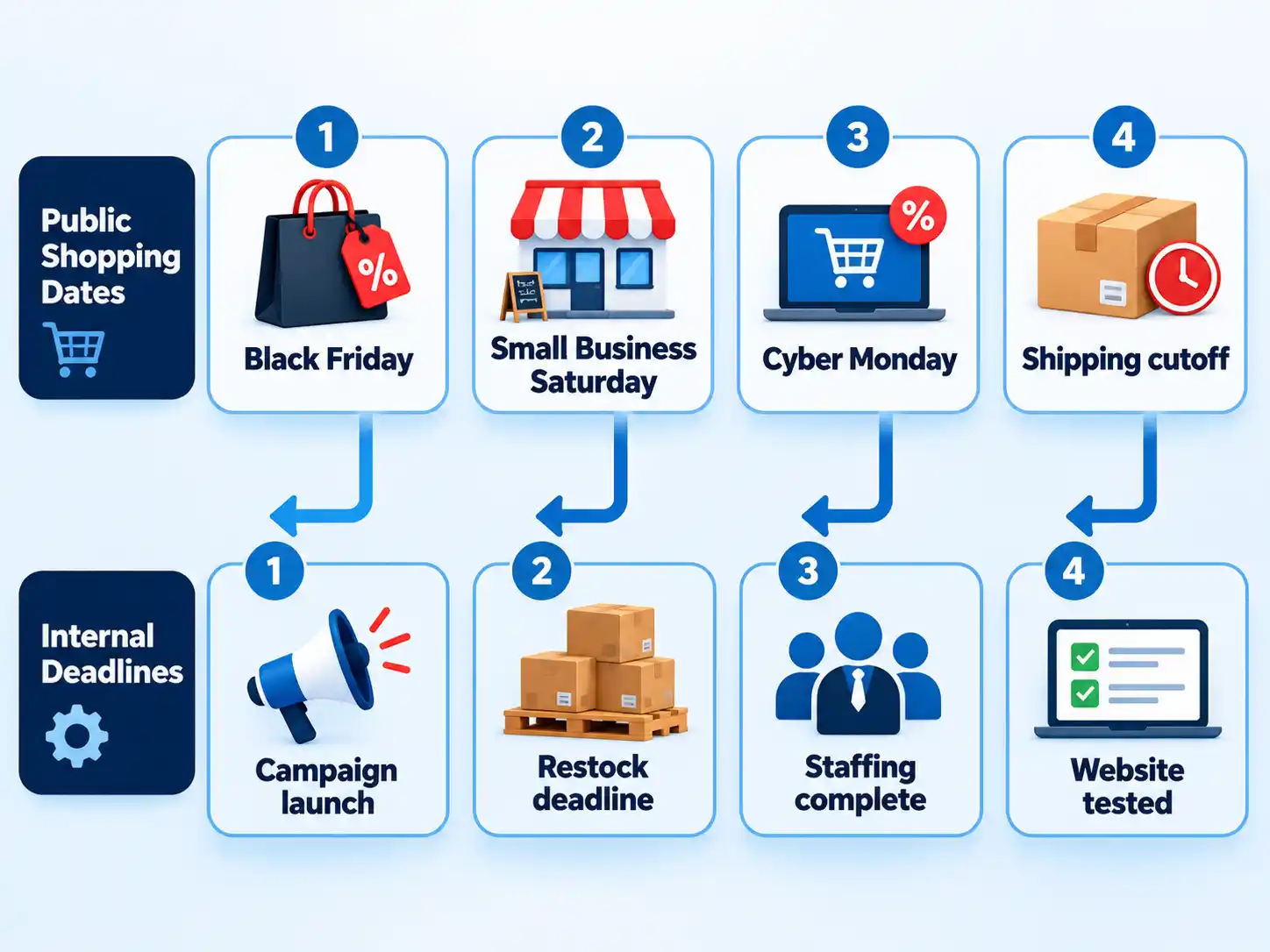
Run these steps in order. Each one feeds the next, and the calendar logic is to start from the key shopping dates and work backward to internal deadlines.
- Forecast from last year’s numbers. Pull last year’s sales data and identify best-sellers, peak hours, and slow periods. Use that baseline to size your inventory order and your supply order; packaging, gift wrap, and shipping supplies run out as fast as products do. Build a cushion of extra stock for your best-sellers if your budget allows.
- Mark the key dates and work backward. Put Black Friday, Small Business Saturday, Cyber Monday, and your shipping cutoffs on the calendar. From each one, set internal deadlines for restocks and campaign launches. The earlier you set milestones, the less the season runs you.
- Hire and brief seasonal staff. Seasonal employees can help absorb higher demand. Before the first shift, set up a basic payroll structure and confirm your state and federal labor-law obligations. Then hold a staff meeting: remind employees to greet every shopper on the way in and out, and thank them for the work.
- Adjust your hours for peak demand. The holiday season is likely your busiest stretch. Opening earlier and closing later can have a big impact on sales, so match the change to your actual peak hours from step one rather than to a competitor’s sign.
- Refresh every public listing. Your online information should be accurate about what you offer, where you are, and how to reach you. Update your website, social accounts, and review sites. Then test the website for speed, mobile-friendliness, and traffic capacity before the surge arrives.
- Market early and consistently. Build a promotional calendar with early-bird offers and reminders leading into the big shopping weekends. Use social channels to promote deals and show how you are preparing, and lean on your distinctive product, service, or space to stand apart from big-box competitors.
- Set fulfillment and returns promises you can keep. Decide your shipping timeline, state it clearly and unambiguously in your advertising, and make sure your operation can hit it. Publish your return policy where shoppers can find it before checkout.
The Stocking Trade-Off Nobody Escapes
Overstocking ties up cash you may need in January. Under-ordering means missed sales you cannot recover, because an out-of-stock product is one of the fastest ways to lose a holiday sale. There is no free option, so choose deliberately.
| Approach | What it protects | What it costs | Choose it when |
|---|---|---|---|
| Overstock best-sellers | Sales on proven items; no lost demand | Cash tied up in inventory; storage and markdown risk | You have last-year data showing strong, repeatable demand and the cash to carry it |
| Lean stocking | Cash flow and shelf space | Missed sales and disappointed customers on out-of-stock items | Demand is unproven, margins are thin, or you can restock quickly |
| Cushion on best-sellers only | Both, mostly | Some cash committed, but bounded | You want a middle path: extra stock where the data is strongest, lean everywhere else |
Do not forget the unglamorous inventory: packaging, gift wrap, and shipping supplies. They run out on the same schedule as your products and stop fulfillment just as effectively.
Staffing: Hire Early, Brief Before the First Shift
Seasonal hiring is the standard lever for a demand spike, but it comes with compliance work that is easy to defer and expensive to skip. Set up a basic payroll structure and understand your general state and federal labor-law obligations before the first seasonal employee starts.
Warning
Seasonal hires are still employees. The SBA’s hiring guidance points owners to payroll setup and state and federal labor-law compliance, and notes that employers report new employees to their state directory within 20 days of the hire date as required. Confirm your own state’s rules before the season starts.
The briefing matters as much as the hiring. A short pre-season meeting that covers greeting every shopper, thanking them, and showing appreciation for the team’s work gives each shift the same expectations. Small-business success is usually a team effort, and holiday crowds test that team. If your team is scattered across shifts or locations, the same principles in ways to step up communication in small business apply to keeping everyone aligned through December.
Hours and Online Listings: Keep the Public Record Accurate
Extending hours can capture demand that falls outside your usual schedule. But an hours change only helps if customers know about it. That is why hours and listings belong together: the moment you change your schedule, every place a customer might look should reflect it.
Refresh your digital profile across your website, social media accounts, and review sites so the basics are right: what you offer, where you are, and how to contact you. Then pressure-test the website itself. Test now that it loads quickly, works on a phone, and can handle more visitors than usual, because a slow site can waste the attention your promotion earns.
Marketing Early, and Differently
Holiday shoppers start browsing earlier than you think, which is why a promotional calendar beats a burst of posts in mid-December. Teasers, countdowns, and early-bird offers build momentum before the big shopping days, and consistency across channels matters more than volume.
Two moves fit small businesses especially well. First, use social media to promote deals and to show how you are preparing your store; that behind-the-scenes angle is something a big-box chain cannot copy. Second, host an event: an in-store activity that puts your products or services on display, or a holiday kickoff, spreads goodwill in your community and gives people a reason to walk in. Small Business Saturday is a natural anchor for both. For a fuller playbook beyond the season, see small business marketing: 8 practical tactics that work in 2026.
Differentiation is the other half. Matching every big-box discount can squeeze a small business quickly. Give shoppers a reason to choose you beyond price by showcasing a distinctive product, service, or store experience.
Fulfillment Promises You Can Actually Keep
This is the one part of holiday prep with a hard legal edge. The FTC’s Mail, Internet, or Telephone Order Merchandise Rule, commonly called the 30-day rule, applies to most goods a customer orders by mail, phone, fax, or online, regardless of how the merchandise is advertised or how the customer pays.
Warning
If you advertise a shipment time, you must have a reasonable basis for stating or implying it. If you make no shipment statement, you must have a reasonable basis for believing you can ship within 30 days. If you later learn you cannot meet the stated time or the 30-day window, you must seek the customer’s consent to the delay, and if you cannot get it, promptly refund all the money paid for the unshipped merchandise, without being asked. The FTC’s business guide to the Rule spells out each of these obligations.
Use this decision rule before you write any shipping copy:
- You state a ship date. You need a reasonable basis for that exact promise, and your advertising must be unambiguous about when you will ship.
- You state nothing, or state it vaguely. The FTC’s default shipment window applies, and you need a reasonable basis for believing you can ship within it.
- You discover you will miss the window. Seek the customer’s consent to the delay. If consent is refused or cannot be obtained, refund promptly and unprompted.
Pair that with a clear return policy listed where shoppers can see it before checkout, and multiple payment options. That transparency gives a December buyer fewer reasons to hesitate and a better reason to return.
Follow Up After December
The season does not end on the last shipping date. Holiday sales are only part of the story; the follow-up is where seasonal buyers become regulars.
Verify the result
- Every public listing (website, social, review sites) shows your current hours and contact details.
- Your website loads quickly and works on a phone under realistic holiday traffic.
- Every shipping promise in your advertising has a documented reasonable basis behind it.
- Seasonal staff have completed payroll setup and a pre-season briefing.
- A post-season follow-up plan exists for new customers acquired in November and December.
If your operation depends on working technology (a point-of-sale system, a booking tool, the back-office computer that runs your inventory), a failure in the middle of peak week is a capacity problem you did not plan for. Knowing where to find a ‘computer repair shop near me’ before you need one is a small piece of resilience that costs nothing to arrange in advance.
The Bottom Line
A calmer December starts with decisions made while the calendar still has slack in it. Every choice in this guide, from the stocking cushion to the shipping cutoff, is really a decision about when to decide.
So pick your moment. If you are reading this before the rush, the work is front-loaded and mostly quiet: pull last year’s numbers, book the seasonal help, write the shipping copy, and test the site. If you are reading it mid-season, triage instead. Fix the listings and the shipping promises first, because those are the two places where a small error costs you a customer you cannot win back. Either way, the goal is the same: a January where you are planning next year’s growth instead of cleaning up this year’s chaos.
Key Takeaways
- Treat holiday prep as capacity plus visibility, not a marketing sprint.
- Forecast from your own prior-year orders, and remember supplies and gift cards run out too.
- Seasonal hires bring payroll and labor-law obligations; handle them before the first shift.
- Change hours and update every listing in the same move so customers actually see it.
- The FTC 30-day rule makes shipping promises a legal commitment, not a marketing flourish.
- Plan the post-season follow-up before the season starts.

💬 Comments