Quick Take
The strongest tech business ideas for 2026 share one trait: a dated rule change or adoption milestone that created a recurring, paying problem. Six clear that bar — AI Act compliance, telehealth privacy, drone operations, cloud cost control, cloud-native platform work, and customer-discovery coaching. Each one is testable with interviews and a small prototype before you spend real money.
Most “tech business ideas” lists are long because padding is easy. A real idea needs three things at once: a dated change that creates urgency, a buyer who already feels the pain, and a way to test demand cheaply before you commit. Six opportunities clear that bar for 2026. The rest of this article is about how to check them without burning a year and a savings account.
What Makes a Tech Business Idea Worth Testing
A tech business idea is a repeatable way to sell software, technical services, or technical expertise to a specific buyer who has a recurring problem. That definition rules out a lot. “Build an AI app” is a tool looking for a problem. “Help mid-sized EU companies document their high-risk AI systems before the 2027 obligations land” names a buyer, a deadline, and a deliverable.
Three filters separate the six ideas below from the noise:
- A dated signal. A rule takes effect, a compliance grace period ends, or an adoption threshold gets crossed. The clock creates urgency that a forecast cannot.
- A recurring problem. The buyer pays more than once. One-off projects are consulting gigs; recurring pain is a business.
- A cheap test. You can find out whether the buyer will pay before you build the product.
Regulation cuts both ways here. It creates demand and it constrains how you deliver. That tension is the most useful thing to understand about this list, and the least covered in generic idea roundups.
Why 2026: The Signals That Changed
2026 matters because several clocks are running at once. The EU AI Act is phasing in obligations on a published schedule, and telehealth providers have been operating under full HIPAA rules since the COVID-era enforcement discretion ended. Commercial drone work has a settled certification path. Cloud cost discipline and cloud-native operations have their own adoption signals, though the freshest public survey data is a few years old.
| Signal | Date | What It Means for a Buyer |
|---|---|---|
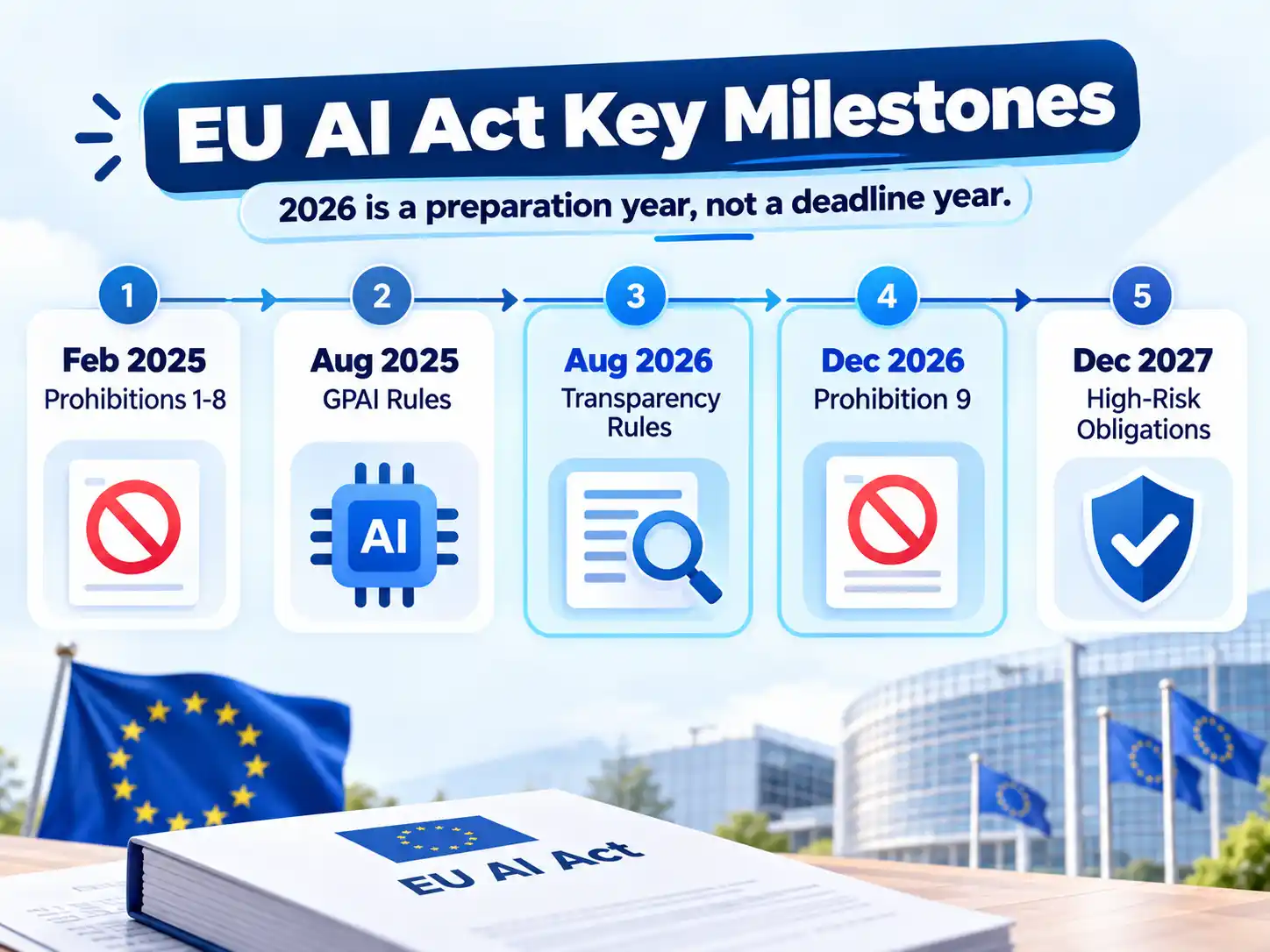
| AI Act prohibitions 1–8 effective | February 2025 | Banned practices are now off-limits; deployers need to know which side of the line they sit on. |
| AI Act GPAI rules effective | August 2025 | General-purpose model providers face new obligations. |
| AI Act transparency rules effective | August 2026 | Disclosure duties arrive for a wider set of systems. |
| AI Act prohibition 9 effective | December 2026 | Another prohibited practice joins the list. |
| AI Act high-risk obligations apply | 2 December 2027 | Strict pre-market obligations for high-risk systems; preparation work starts well before. |
| HIPAA telehealth enforcement discretion expired | 11:59 pm, 11 May 2023 (transition ended 9 August 2023) | Telehealth providers are back under full HIPAA rules, including audio-only guidance. |
| Kubernetes in production (consumers) | 2023 survey | 66% using in production, 18% evaluating; a large installed base that needs operational help. |
The AI Act is the first comprehensive legal framework on AI worldwide, built on four risk levels. That structure is what makes compliance work sellable: buyers need help deciding which tier they are in and what evidence they must keep. The phased dates above come straight from the Commission’s own timeline.
The Shortlist: 6 Tech Business Ideas and How to Validate Each
Each idea below follows the same shape: who buys and why, the dated signal, the delivery model with its trade-offs, and a lean test you can run before investing. None of these are ranked. Pick the one that matches your existing skills and network.
1. AI Act Compliance and Governance Services
Who buys and why. EU-based companies and non-EU firms selling into Europe that deploy AI in hiring, credit, education, or public services. They need someone to map their systems to the four risk levels, document decisions, and keep evidence that survives scrutiny.
Signal. The AI Act (Regulation (EU) 2024/1689) is phasing in obligations on a fixed calendar: prohibitions 1–8 from February 2025, GPAI rules from August 2025, transparency rules from August 2026, prohibition 9 from December 2026, and high-risk obligations from 2 December 2027. The Commission also runs a voluntary AI Pact for early movers.
Model and trade-offs. Start as a service: risk-tier assessments, documentation templates, and training. Productize later into a compliance-tracking tool. The downside is real: compliance sales are slow, trust-dependent, and buyers often wait until a deadline is close. You will spend months on relationships before revenue.
Validate. Interview 10–15 compliance leads at mid-sized EU firms. Ask what they have already done about the AI Act and who owns it internally. If nobody can name an owner, the pain is real but unowned, which changes your pitch.
2. Telehealth Privacy and Compliance Support
Who buys and why. Small clinics, therapy practices, and telehealth-first providers who adopted remote tools during the pandemic and never fully rebuilt their privacy posture. They need help choosing compliant communication tools and training staff.
Signal. HHS OCR’s COVID-era enforcement discretion expired at 11:59 pm on 11 May 2023, with a 90-day transition that ended 9 August 2023. Providers are back under full HIPAA rules, and OCR publishes guidance on audio-only telehealth plus patient and provider resources.
Model and trade-offs. A service model works best: privacy risk assessments, vendor review, staff training, and a written policy pack. The constraint is that you are advising on regulated health data, so you need real fluency in the HIPAA rules for telehealth or a partner who has it. Getting this wrong is worse than not offering it.
Validate. Talk to practice managers at small clinics. Ask how they chose their video platform and whether anyone reviewed it against the privacy and security guidance OCR publishes for telehealth. Most will describe a decision made quickly in 2020 and never revisited.
3. Drone Services Under Part 107
Who buys and why. Construction firms, insurers, agricultural operators, and inspection companies that need aerial imagery, mapping, or site surveys but do not want to run their own drone program.
Signal. Commercial drone work has a settled path. Under the FAA’s Part 107 rules, a small drone under 55 pounds can be flown for business by following three main steps, and certain operations require a waiver.
Model and trade-offs. This is an operations business, not a software business. You need a Remote Pilot Certificate (minimum age 16, able to read, write, speak, and understand English, and physically and mentally fit to fly), insurance, and equipment. Waiver-eligible operations include night flight, operations over people, flight beyond visual line of sight, and operations over moving vehicles. The trade-off is that revenue scales with your time and crew, not with code.
Validate. Before buying equipment, call ten potential clients in one vertical and ask what they currently pay for aerial data and what frustrates them about it. If they already have a vendor and are happy, walk away.
4. Cloud Cost Optimization (FinOps)
Who buys and why. Engineering and finance leaders at companies whose cloud bills grew faster than their revenue. They need someone to make cost visible, find waste, and build a repeatable process.
Signal. The FinOps Framework defines three phases — Inform, Optimize, Operate — cycled rapidly. The framework explicitly warns against analysis paralysis and recommends starting small and growing scope as the team matures.
Model and trade-offs. Start with a fixed-scope assessment, then move to a retainer for ongoing cost governance. Run the same rapid Inform–Optimize–Operate cycle on your own delivery: short engagements, small scope, and a growing remit as the client’s team matures. The trade-off is that savings are easy to promise and hard to attribute. Price on the work, not on a percentage of projected savings you cannot prove.
Validate. Ask five engineering managers whether they can tell you their cost per customer or per feature. If they cannot, the Inform phase is where your first engagement lives.
5. Cloud-Native and Platform Engineering Services
Who buys and why. Mid-sized companies running Kubernetes in production without a dedicated platform team. They need help with reliability, deployment pipelines, and developer experience.
Signal. The CNCF Annual Survey 2023 found 66% of potential and actual consumers using Kubernetes in production and 18% evaluating it, for 84% combined, with 15% of organizations that consume cloud computing services reporting no plans. Treat that as a 2023 snapshot, not a 2026 reading: the survey ran August to December 2023, 988 records were used for analysis, and it carries a margin of error of ±2.6% at 90% confidence.
Model and trade-offs. Project-based platform work plus retainers for ongoing support. The trade-off is competition: this space is crowded with consultancies. Your edge has to be a specific stack, a specific industry, or a faster delivery model.
Validate. Interview platform leads at companies of 100–500 engineers. Ask what breaks most often and who fixes it. If the answer is “the same two people,” you have found a buyer with a bus-factor problem.
6. Customer-Discovery Coaching for Technical Founders
Who buys and why. First-time technical founders and small startup teams who can build anything but cannot tell whether anyone wants it. They need structure and accountability for talking to customers.
Signal. The Lean LaunchPad method treats startups as organizations that search for a repeatable, scalable business model rather than execute a plan. In the 2026 Stanford class, eight teams spoke to 978 potential customers, beneficiaries, and regulators, and the explicit goal is 10–15 customer interviews a week alongside a continual series of minimum viable products.
Model and trade-offs. Cohort programs, office hours, and structured sprints. The trade-off is that coaching is a trust business with a long sales cycle, and results depend on the founder doing the work. You cannot do the interviews for them.
Validate. Run one free four-week cohort with five founders. Track how many interviews each one completes. If attendance drops after week two, your program needs a different accountability mechanism before you charge for it.
Validate a Tech Business Idea Before You Invest
Testing an idea is a discipline, not a gut check. The method below borrows from customer development and from FinOps’ habit of cycling quickly instead of planning exhaustively. Run it before you register a company or write a line of product code. Each step produces evidence you can act on, and you can stop at any point where the evidence says no.
Prerequisites
- A named buyer segment you can actually reach — a job title, an industry, and a way to get an introduction.
- A written hypothesis about the problem and what the buyer currently does about it.
- A calendar block of several hours a week for interviews, protected from other work.
- Write down the hypothesis. State the buyer, the recurring problem, what they do about it today, and what would make them switch. Keep it to a page. If you cannot name what they use now, you do not yet understand the problem.
- Run a steady weekly interview cadence. Talk to people who match the buyer segment, not to friends. Ask about past behavior and current spending, not about whether they like your idea. Keep a running log of exact phrases they use to describe the pain.
- Build a series of small prototypes. Each prototype tests one assumption — a landing page tests willingness to click, a mockup tests whether the workflow makes sense, a paid pilot tests willingness to pay. Replace the prototype as each assumption resolves rather than polishing one artifact.
- Cycle quickly and decide. Review the log weekly, adjust the hypothesis, and run the next round. Set a decision point in advance: if a set number of interviews produces no evidence of budget or urgency, change the segment or drop the idea.
Verify the result
- You can quote at least three buyers describing the same problem in their own words.
- At least one buyer has described a current budget or vendor relationship tied to the problem.
- Your prototype has produced a measurable response — a click, a booked call, or a paid pilot.
- You have written down what would make you stop, and you are willing to honor it.
The FinOps habit applies here too: work in short cycles, start small, and grow scope as you learn. Long planning phases feel productive and teach you nothing.
Common Misconceptions and Limitations
A rule existing does not mean easy revenue. Compliance buyers are cautious, slow to commit, and often defer spending until a deadline is close. Budget for a long sales cycle and build trust through references before you expect a signed contract.
Survey data ages fast. The Kubernetes adoption figures come from a 2023 survey with a self-reported sample. They tell you the installed base is large; they do not tell you what adoption looks like in 2026. Use them as context, not as a forecast.
“AI” is not a business model. A generic AI startup pitch competes with thousands of others and gives the buyer nothing to compare. The AI Act idea works because it names a specific buyer, a specific deadline, and a specific deliverable.
Warning
Do not treat a regulatory deadline as a guaranteed payday. Buyers can miss deadlines, hire in-house, or choose a larger firm. Validate demand with interviews before you build a service around any single rule.
Several of these ideas also require credibility in a regulated domain. If you lack that background, partner with someone who has it rather than learning on a client’s dime. And when your delivery model depends on back-office capacity — billing, scheduling, documentation — plan how business process outsourcing fits alongside your technical work before you staff up.
Next Steps
Pick one idea. Write the hypothesis. Book the first five interviews this week. The point of this list is to give you six starting points that have a dated reason to exist and a cheap way to find out if you are right.
If you want a broader set of starting points beyond tech, our guide to small business ideas to start covers lower-tech options with similar validation logic. And if you are still shaping the plan around your idea, these tech tools for smarter business planning are a practical next stop.
Key Takeaways
- The six ideas share one trait: a dated signal that creates a recurring buyer problem.
- Regulation is both a demand driver and a constraint; plan for slow, trust-dependent sales.
- Validate with interviews and small prototypes before you build anything substantial.
- Treat survey data as a snapshot, not a forecast, and never let “AI” stand in for a business model.
The best idea on this list is the one where you already know the buyer, understand the constraint, and can start interviews on Monday. Everything else is a distraction until that first conversation happens.

💬 Comments