A surge protector can help electronics last longer by limiting damaging transient voltage that would otherwise reach sensitive components. It reduces one cause of premature electrical failure, but it does not regulate everyday voltage, provide battery backup, or guarantee protection from every electrical problem.
A genuine surge protective device, or SPD, has a specific job: limit transient overvoltage by diverting or limiting surge current. The NEMA Surge Protection Institute defines SPDs around that transient-protection function, not as devices that continuously regulate an appliance’s normal supply voltage.
What a Power Surge Actually Is
A power surge is a short-lived increase in electrical voltage. It may be associated with lightning, utility switching, equipment switching, faults, or other changes in an electrical system. Because the event is transient, it is different from a voltage problem that lasts for seconds, minutes, or longer.
That distinction matters when choosing protection. A sag is a temporary drop below normal line voltage. A swell is a temporary rise above normal line voltage. An outage is a loss of power. Electrical noise is another disturbance again.
Choosing the right protection therefore starts with recognizing that sags, swells, outages, and surges are different power problems. A device designed mainly for transient surges should not be assumed to solve sustained low voltage, sustained high voltage, or loss of power.
For example, a switching event may create a very brief transient that threatens sensitive electronics. A several-minute low-voltage condition is a different event and may require different equipment or investigation. Calling both situations a “surge” can lead to the wrong protective device.
How a Surge Protector Limits Damage
An SPD does not simply switch the electricity off whenever voltage changes. During normal operation, power continues to serve the connected equipment. When a sufficiently large transient appears, the SPD limits the overvoltage by diverting or limiting surge current through the protective paths for which it was designed.
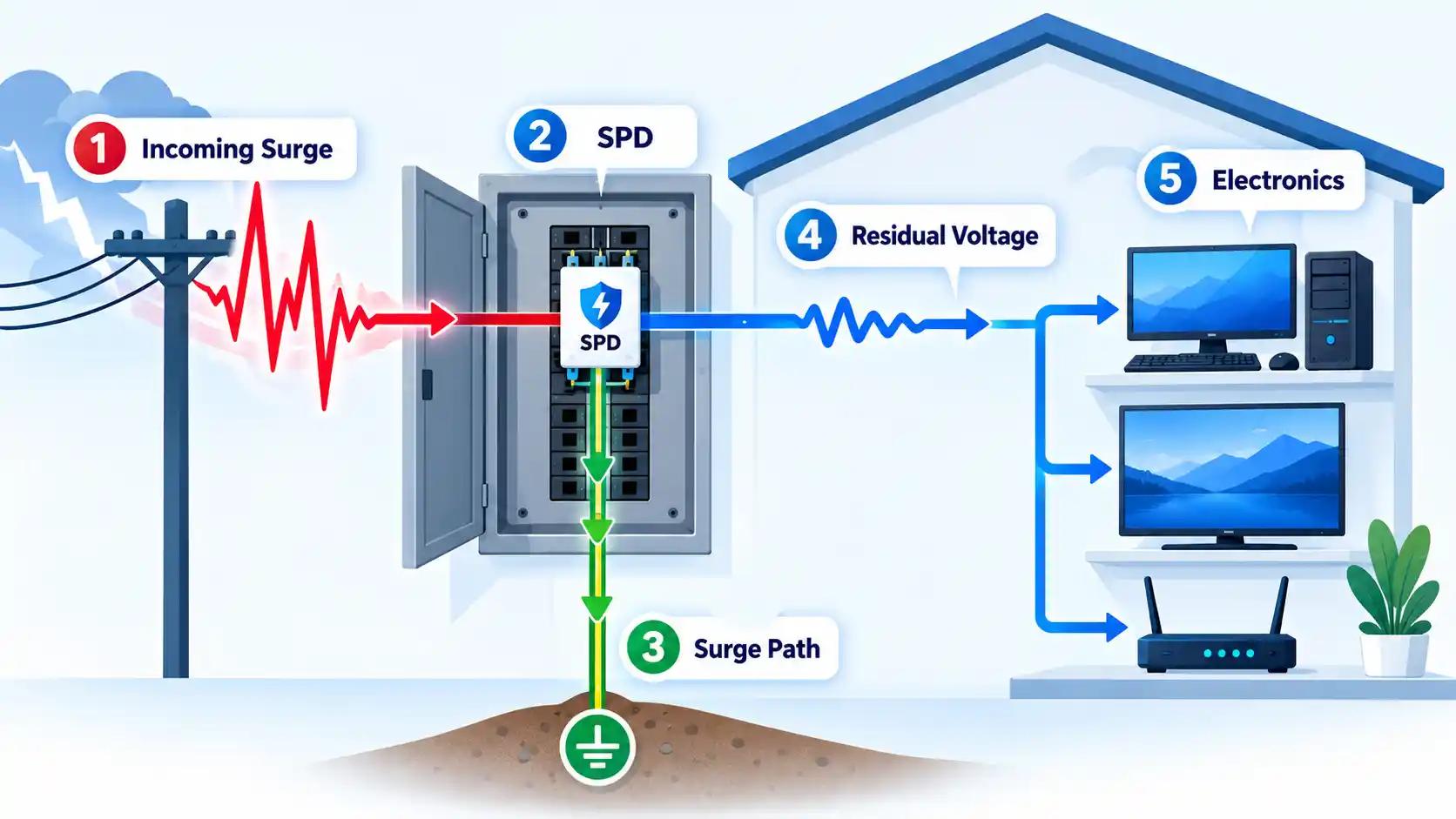
The result is not zero voltage. Some residual, or “let-through,” voltage remains after the SPD acts. This is why voltage-limiting ratings describe performance under standardized test conditions rather than promising complete isolation from every real-world surge.
Grounding, bonding, and conductor layout also matter in a building’s overall surge-protection scheme. The older but still useful NIST residential surge-protection guidance explains how poorly coordinated electrical and communications grounding can create damaging voltage differences, especially when one device connects to more than one incoming system.
Consider a desktop computer connected through an appropriate point-of-use SPD. If a transient reaches that circuit, the SPD is intended to reduce the transient that appears at the computer’s power input. That can prevent a surge from becoming the event that damages the power supply, motherboard, or other electronics. It does not mean the computer is protected from overheating, aging components, liquid damage, defective wiring, or every possible lightning event.
Surge Protector, Power Strip, UPS, and Voltage Regulator Are Not the Same Thing
Several devices used around electronics can look similar while solving different problems. A power strip may simply add outlets. A surge protector adds transient-voltage protection. An uninterruptible power supply, or UPS, provides battery-backed power for at least some period when incoming power fails. A voltage regulator or stabilizer is intended to address certain sustained voltage variations, depending on its design.
UL Solutions notes that ordinary power strips and surge protectors are commonly confused because their external appearance can be similar. Its consumer guidance explains that a basic power strip adds outlets while a surge protector contains surge-limiting circuitry.
A surge protector, UPS, and voltage regulator solve different problems, even though individual products sometimes combine more than one function.
What each type of device is mainly for
| Feature | Power Strip | Surge Protector | UPS | Voltage Regulator |
|---|---|---|---|---|
| Main job | Adds outlets | Limits transient overvoltage | Provides temporary battery-backed power | Controls certain sustained voltage variations |
| Surge protection | Not necessarily | Primary function | Model-dependent | Model-dependent |
| Power during an outage | No | No | Yes, within battery and load limits | Normally no |
| Sustained voltage regulation | No | No | Model-dependent | Its primary purpose in suitable designs |
| Typical use | Extra outlets for suitable loads | Transient protection for connected equipment | Equipment that needs short-term power continuity | Equipment exposed to sustained voltage variation where the regulator is correctly specified |
The table is deliberately general. A specific UPS may include automatic voltage regulation and surge protection, while another model may have a different feature set. The product manual and certification information should determine what an individual device actually does.
Whole-Home and Point-of-Use Protection Work at Different Levels
Surge protection can be installed at more than one point in an electrical system. Type 1, Type 2, and Type 3 describe permitted applications and installation positions rather than a simple quality ranking.
- Type 1 SPD: A permanently connected SPD permitted for service-side applications and, in listed configurations, on the load side of service equipment as well.
- Type 2 SPD: A permanently connected SPD intended for the load side of the service equipment overcurrent device, including panel locations.
- Type 3 SPD: A point-of-utilization SPD, such as an appropriate cord-connected, direct plug-in, or receptacle device, used under the installation conditions specified for that classification.
The NEMA Surge Protection Institute summarizes these SPD types and describes distributed, or layered, surge protection. A Type 3 plug-in protector is therefore not simply an inferior version of a Type 1 device. It is intended for a different position in the protection system.
Using protection at more than one level can address different exposure points. A service- or panel-level SPD can limit surges entering or propagating through the building’s electrical distribution system, while point-of-use protection adds another protective stage near selected equipment.
Some electronics also connect to more than the AC power system. A television may have coaxial cabling, while networking or communications equipment may connect to other external conductors. Those connections can provide additional surge paths or expose equipment to voltage differences between systems.
This is why a plug-in surge strip should not be assumed to protect every possible entry path to a device. Protection has to match the conductors and systems that are actually connected.
What to Look for When Choosing a Surge Protector
Start with suitability and certification before comparing marketing numbers. A high number on the package does not make a product appropriate for the circuit, installation point, or equipment you want to protect.
- Confirm that it is actually a surge-protection product. A multi-outlet strip is not automatically an SPD. Product labeling and certification should identify the intended protective function.
- Check the relevant certification. UL Solutions states that general-use surge protectors are typically certified under UL 1449, the Standard for Surge Protective Devices.
- Match the electrical rating to the circuit and load. UL advises checking a strip or protector’s electrical rating rather than assuming every available outlet can be loaded without regard to current demand.
- Choose the correct SPD type and installation location. A plug-in protector and a panel-mounted device do not have interchangeable installation roles.
- Compare standardized voltage-limiting performance on equivalent products. NEMA defines Voltage Protection Rating, or VPR, as a standardized measured-limiting-voltage rating and notes that it permits direct comparison between like SPDs of the same type and voltage.
- Look for protection-status information. Protection components can degrade after repeated electrical stress. A clear status indicator or a design that disconnects the load when protection is no longer available can make loss of protection easier to detect.
- Check whether other connected pathways need protection. Power-line protection alone does not necessarily address coaxial or other communications paths.
- Follow the manufacturer’s installation instructions. Correct wiring, location, grounding or bonding where applicable, and load limits are part of a safe installation.
The same NEMA selection guidance cautions that joule ratings can be misleading when products are compared in isolation. Device type, system voltage, VPR, electrical ratings, certification, installation conditions, and other applicable markings provide a more complete basis for comparison.
A protection-status indicator can help show when the suppression circuitry is no longer providing its intended protection. Eaton’s surge-protection explainer describes status LEDs and automatic shutoff circuits as features found on some products.
Schneider Electric sponsors the following surge protector link to its residential electrical-safety page. The commercial destination is not used as evidence for the technical selection criteria above.
When Surge Protection Can Help Electronics Last Longer, and When It Cannot
The most accurate way to connect an SPD with electronic lifespan is to say that it can reduce the risk of premature surge-related failure. If a damaging transient would otherwise destroy or degrade an electronic component, limiting that transient can prevent that particular failure mechanism.
That does not translate into a predictable number of extra months or years. Electronics age for many reasons, and the evidence reviewed for this article does not support a universal claim that installing an SPD extends every device’s life by a particular percentage or period.
Surge protection can reduce risk from some transient events associated with lightning coupling, utility switching, equipment switching, and other short electrical disturbances. It does not by itself solve:
- sustained overvoltage;
- low voltage or brownouts;
- power outages;
- overheating caused by poor ventilation;
- battery aging;
- liquid or physical damage;
- worn mechanical parts;
- defective building wiring;
- every possible direct or nearby lightning effect; or
- surges entering through an unprotected communications path.
For example, surge protection may keep a television from being the casualty of a transient on its power circuit. It cannot stop the same television from overheating because its ventilation openings are blocked. Both problems can shorten service life, but they require different preventive measures.
Surge protection should also not be treated as a guarantee against lightning damage. The severity and path of the event, the installation, the grounding and bonding arrangement, and the capability of the protective devices all affect the outcome. The practical goal is risk reduction, not electrical invulnerability.
Installation and Safety Boundaries
Plug-in protection and panel-level installation should not be treated as the same task. A cord-connected protector intended for point-of-use operation is used according to its product instructions. Installing or modifying equipment at a service panel involves greater electrical hazards and applicable electrical-code requirements.
Do not overload a strip simply because unused receptacles remain. UL’s power-strip guidance advises matching connected loads to the product’s electrical rating and replacing a strip if its cord or enclosure is damaged.
Panel-mounted Type 1 and Type 2 devices should be installed according to the manufacturer’s instructions, the electrical system design, and the code that applies in the jurisdiction. If the work requires opening or modifying service equipment and you are not qualified to perform it, use an appropriately qualified electrician.
NFPA’s published National Electrical Code development material reproduces Section 230.67 language requiring a listed SPD for services supplying specified occupancies, including dwelling units. NFPA publishes multiple NEC editions, and the edition or amendments adopted by a state or local authority can differ. Check the requirements enforced by the authority having jurisdiction before treating an NEC provision as a local legal requirement.
If a home’s protection depends on questionable grounding, damaged receptacles, repeated breaker trips, or unexplained voltage problems, adding another plug-in device is not a substitute for investigating the underlying electrical installation.
Bottom Line
A surge protector can help electronics last longer when it prevents a transient overvoltage from becoming the event that prematurely damages them. Its job is to limit surges, not to stabilize every voltage fluctuation, run equipment through a blackout, or guarantee protection against lightning.
For useful protection, choose equipment that is correctly rated and certified for its intended application, pay attention to status indication and installation requirements, and use service-level and point-of-use protection when the electrical system and connected equipment justify both. The defensible benefit is straightforward: reducing exposure to damaging surges can reduce one important cause of avoidable electronic failure.

💬 Comments