The business of pop culture merchandise converts audience intellectual property (IP) affinity into tangible consumer goods—spanning apparel, vinyl collectibles, accessories, and home decor—generating over $379 billion globally in 2026. Commercial success in this high-velocity sector requires balancing upfront licensing royalties and Minimum Guarantees (MGs) against agile production pipelines like Direct-to-Film (DTF) printing and custom unboxing experiences to monetize fleeting cultural trends without building costly deadstock.
Quick Take: Pop Culture Merchandise at a Glance
- Institutional Market Scale: Projected to reach $379.9 billion in 2026 and expand past $613 billion by 2033, with licensed apparel alone commanding over 37% of total revenue.
- Licensing Unit Economics: Standard contracts stipulate 8% to 15% net wholesale royalties backed by non-refundable Minimum Guarantees (MG) recoupable against performance thresholds.
- Agile Production Over Bulk Import: The migration from 16-week ocean freight imports to 48-hour Direct-to-Film (DTF) print pipelines minimizes inventory obsolescence across short-lived viral media spikes.
- Fulfillment as Acquisition: Tailored DTC packaging and serialized authentication tags transform delivery logistics into organic, shareable brand equity.
The Economics of Fandom: Market Dynamics and Licensing Mechanics
The commercial market for fandom-driven merchandise has matured from a promotional novelty into an institutional asset class. According to Grand View Research’s licensed merchandise market report, the global licensed merchandise market reached $355.4 billion in 2025 and is tracking toward $379.9 billion in 2026, driven by an annual compound growth rate of 7.1% through 2033. Data published by Licensing International’s global industry study reveals that character and entertainment intellectual properties generate more than 40% of all worldwide licensing royalties, consistently outperforming corporate trademarks, sports leagues, and fashion labels.
Capturing a share of this market requires navigating the structural economics of commercial IP licensing rather than relying solely on organic social momentum.
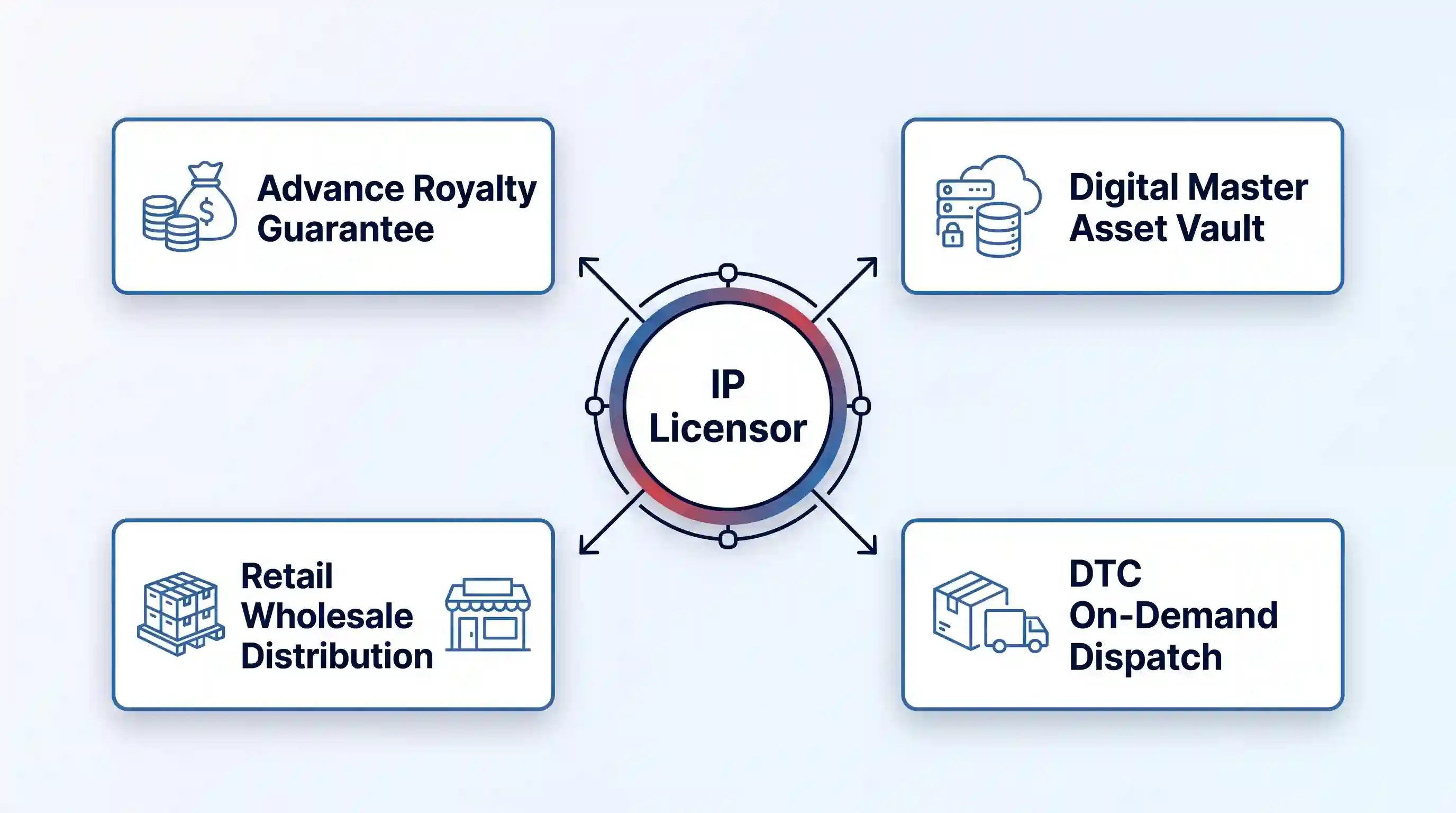
IP Licensing Agreements: Royalty Rates, MGs, and Rights Clearance
Securing legitimate commercial rights to entertainment IP requires negotiating structured licensing contracts governed by international frameworks defined by the World Intellectual Property Organization (WIPO). Prospective licensees must structure their balance sheets to accommodate three primary deal variables:
- Royalty Rates: Licensors typically command between 8% and 12% of net wholesale sales for mass-market apparel and accessories, escalating to 12% to 16% for limited-run specialty collectibles and high-detail figurines. Net wholesale is strictly defined as gross billings minus documented freight allowances, standard trade discounts, and returned defective inventory.
- Minimum Guarantees (MG): Licensors require a contractual Minimum Guarantee—an upfront, non-refundable cash deposit that protects the IP holder against licensee underperformance. The licensee must pay 20% to 33% of the total projected contract royalties upon signing, which is then recouped against ongoing sales throughout the contract term.
- Territory, Channel, and Category Exclusivity: Rights agreements define whether a licensee can sell through direct-to-consumer (DTC) digital storefronts, mass-market big-box retail, or specialty hobby shops. Unrestricted global rights demand significantly larger advances than single-country, DTC-exclusive agreements.
Contracts also enforce rigid approval protocols. Every graphic asset, fabric swatch, packaging mock-up, and production sample must receive licensor approval before commercial stamping. Bypassing these checkpoints voids contractual indemnification, rendering the licensee vulnerable to inventory confiscation and intellectual property litigation.
Demographics and the Rise of “Kidult” & Transmedia IP
The consumer base fueling merchandise expansion has shifted decisively. Adult collectors aged 18 to 45 (frequently categorized in retail analytics as “kidults”) now account for more than 28% of total toy and collectible revenue. Unlike younger demographics reliant on parental allowances, kidults possess substantial disposable income and actively seek out premium, screen-accurate replicas, numbered vinyl toys, and heavyweight apparel capsules.
Simultaneously, transmedia storytelling has expanded the definition of licensable IP. Dedicated fan bases no longer emerge solely from multi-million-dollar cinematic releases; they coalesce around webcomics, serialized graphic novels, and digital-first narrative lore. In transmedia storytelling and educational narrative IP, even specialized physiological and scientific concepts are translated into character-driven graphic franchises. For example, narrative comic universes dramatize biological battles where the detailed cellular mechanisms of how fibroblasts impact wound healing become hero abilities and visual lore. This narrative framing anchors dedicated fan communities, demonstrating that technical and scientific themes can generate profitable collectible lines when supported by compelling worldbuilding.
Capitalizing on these passionate subcultures requires an operational understanding of the psychology behind developing brand loyalty, ensuring that product lines honor canon details, source artwork, and narrative lore rather than presenting generic logo treatments.
Technology and Agility: Shifting from Mass Import to Micro-Drops
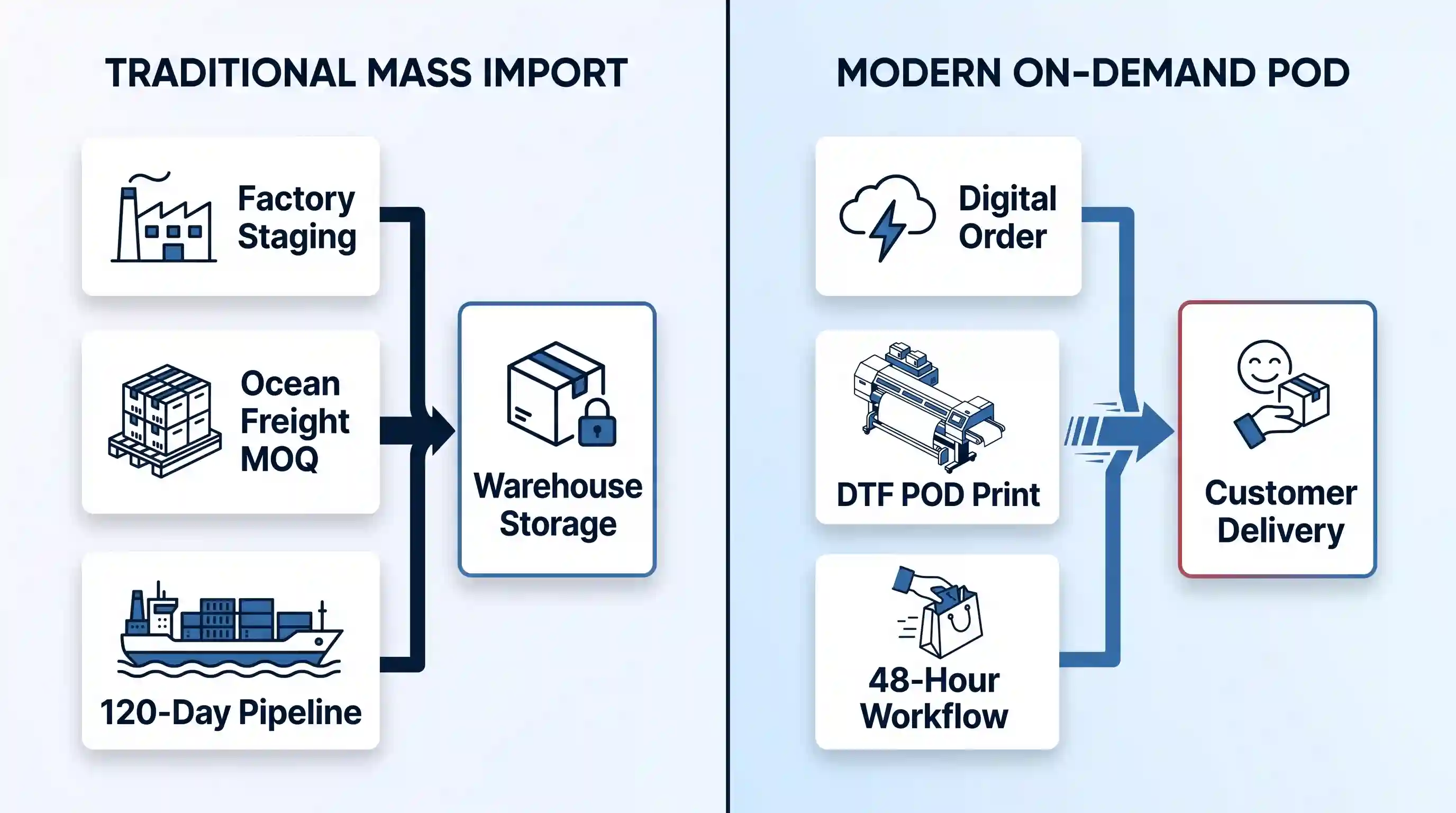
The traditional merchandising playbook relied on placing massive production runs with overseas manufacturers 16 to 24 weeks before an anticipated media launch. In a culture driven by instantaneous social dissemination, this operational lag creates unsustainable inventory risk. If an entertainment franchise fails to resonate, the brand holds warehouses of unsellable stock; if an obscure side-character unexpectedly goes viral, the brand misses the monetization window entirely.
On-Demand Production: Direct-to-Film (DTF) vs. Traditional Screen Printing
To eliminate this mismatch, modern e-commerce merchandising brands have restructured their fulfillment backbones around agile, decentralized print pipelines. Direct-to-Film (DTF) technology has emerged as the definitive standard for agile apparel drops, systematically replacing older Direct-to-Garment (DTG) systems and high-MOQ traditional screen printing.
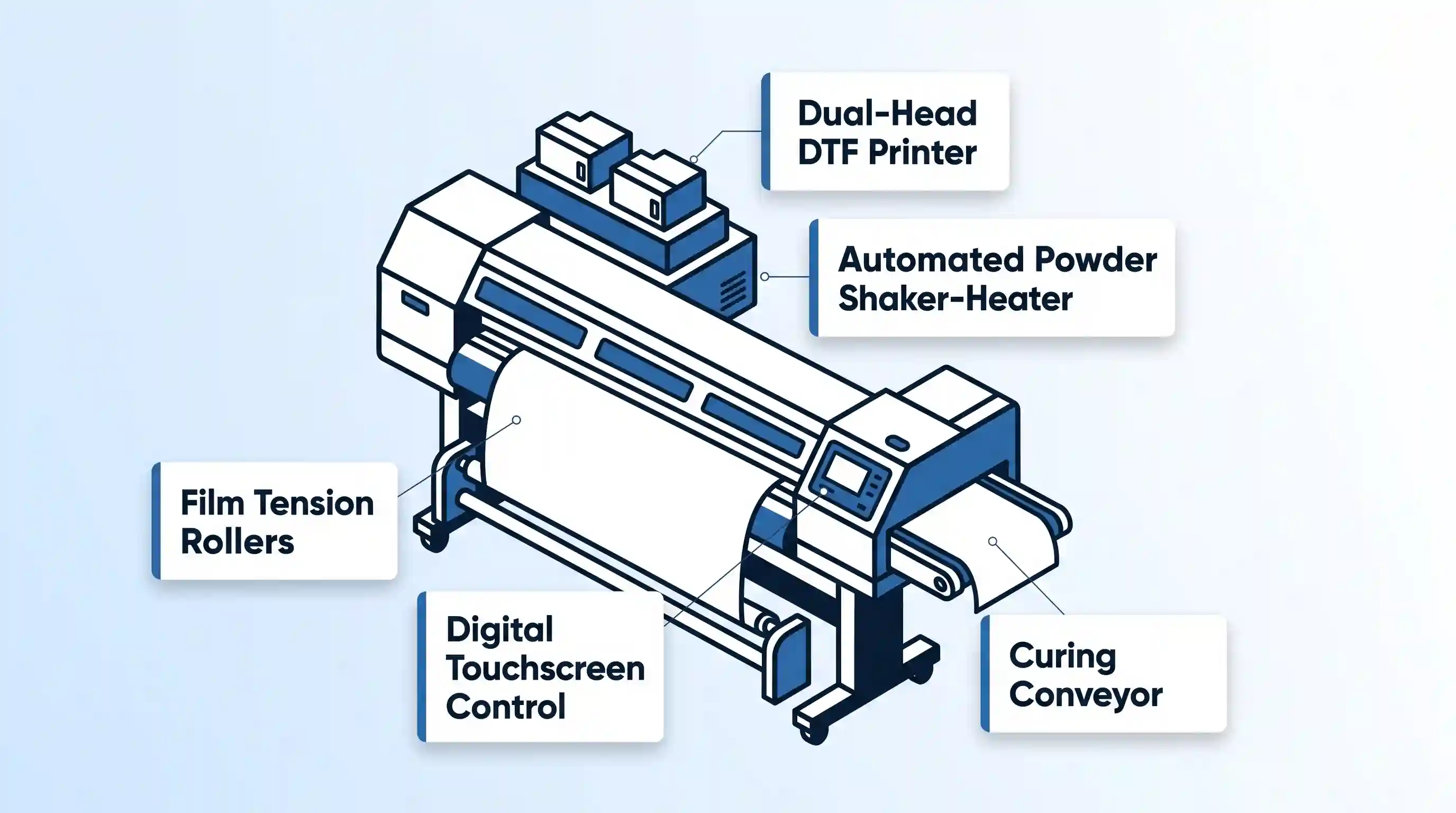
Unlike screen printing (which requires separate color separations, screen burning, and machine setups that make runs under 250 units economically impractical) DTF prints pigment-based CMYK and high-density white inks directly onto a clear polyethene terephthalate (PET) transfer film. The transfer is automatically coated with a thermoplastic polyurethane (TPU) adhesive powder, passed through an integrated heating tunnel at 160°C (320°F), and heat-pressed onto garments in under 15 seconds.
Commercial merchandise operations increasingly deploy high-throughput hardware such as the Prestige L2 DTF printer, which integrates dual-head roll-to-roll printing with an automated powder shaker and dryer unit. This setup allows production teams to output high-resolution, full-color designs at commercial speeds with zero screen-burning costs, enabling brands to fulfill on-demand drops within 48 to 72 hours of customer purchase.
This technical agility changes the unit economics of testing new IP. Retailers can list fifty unique graphic variants on a customized e-commerce storefront, run a flash sale, and print only the units that convert. When choosing the digital commerce layer, operators frequently weigh Shopify vs. WooCommerce to determine which platform offers the most resilient webhook integrations with automated roll-to-roll print-production queues.
Campaign Orchestration: Social Teasers, Visual Assets, and Drop Engines
Physical production speed must be matched by promotional agility. A viral cultural moment on TikTok, Twitch, or Instagram maintains a peak commercial half-life of just 7 to 21 days before engagement metrics decay. Merchandising operators cannot afford to spend two weeks designing marketing collateral.
When an unexpected media moment sparks viral audience demand, speed-to-market is the primary determinant of revenue capture. Merchandising teams use pre-formatted social media templates to immediately publish styled product mockups, sizing guides, and countdown announcements across Instagram and TikTok, cutting graphic production time from days to minutes and synchronizing digital buzz with checkout availability.
By connecting standardized visual asset kits with paid acquisition systems, marketing teams scale promotional campaigns alongside live inventory signals. Structuring digital campaigns using proven methods for maximizing ROI with smart advertising technology ensures that algorithmic bidding engines automatically pause paid traffic the moment a limited physical run crosses its operational inventory threshold.
The Unboxing Experience: Sustainable Packaging as a Retention Channel
In direct-to-consumer pop culture merchandise, customer acquisition costs (CAC) continue to climb across paid digital channels. Consequently, retention and organic advocacy serve as the primary drivers of sustainable operating margin. The parcel delivery experience represents the single physical touchpoint with a 100% open rate.
Brand Equity in Direct-to-Consumer (DTC) Fulfillment
Fandom purchases are deeply emotional transactions. When an enthusiast orders a premium collectible or limited graphic hoodie, receiving an unbranded, flimsy plastic poly-mailer breaks the narrative immersion and degrades the perceived monetary value of the goods.
To elevate fulfillment into an organic marketing channel, leading DTC merchandise creators rely on personalized and customized shipping boxes featuring franchise artwork, interior print reveals, and dedicated compartments for certificates of authenticity. A tailored unboxing ritual elevates perceived product value and inspires social media unboxing shares, reducing customer acquisition costs for future releases.
Engineering these physical touchpoints aligns directly with established principles on how to enhance customer experience throughout the post-purchase cycle. When customers film unboxing videos for TikTok and YouTube, they generate organic user-generated content (UGC) that acts as high-converting social proof for the next drop cycle.
Material Circularity and Regulatory Packaging Compliance
The modern collector demographic actively scrutinizes packaging waste. Forward-thinking merchandise brands have phased out non-recyclable expanded polystyrene (EPS) foam, plastic shrinkwrap, and single-use polyethylene mailers in favor of circular materials:
- FSC-Certified Corrugated Board: Sourced from sustainably managed forests, providing structural rigidity to protect fragile figurines during transit while ensuring complete curbside recyclability.
- Water-Activated Kraft Tape & Soy Inks: Petroleum-based glossy adhesives contaminate cardboard recycling streams; switching to starched paper tape and algae- or soy-based inks maintains zero-waste compliance.
- DIM Weight Optimization: Right-sizing shipping boxes eliminates air space, preventing excess dimensional (DIM) weight surcharges from shipping carriers while cutting domestic transit carbon output by up to 22%.
Strategic Comparison: Merchandising Production Models
Merchandise operators must evaluate the structural trade-offs between unit cost, cash commitment, and supply chain responsiveness. The decision matrix below details the performance characteristics of the three primary production workflows utilized in 2026.
| Production Model | Upfront Capital & MOQ | Production Lead Time | Gross Margin / Unit | Inventory Obsolescence Risk | Best Applied To |
|---|---|---|---|---|---|
| Mass Bulk Overseas Import | High ($25,000–$100,000+) MOQ: 2,500–10,000 units | 12 to 18 Weeks (Ocean freight included) | High (65% to 80%) | Extreme (Susceptible to trend decay and deadstock write-downs) | Evergreen core IP, national retail distribution, multi-year theatrical franchises. |
| Agile Direct-to-Film (DTF) POD | Minimal ($0 with partner; $8k–$15k in-house) MOQ: 1 unit | 48 to 72 Hours (Domestic parcel ship) | Moderate (40% to 55%) | Zero (Units are produced strictly post-payment) | Viral internet memes, niche streaming episodes, catalog long-tail testing. |
| Numbered Collector Drops | Moderate ($5,000–$20,000) MOQ: 250–1,000 units | 3 to 6 Weeks (Domestic / nearshore) | Very High (70% to 85%) | Controlled (Hard quantity cap aligned with pre-orders) | Kidult premium apparel, transmedia statues, anniversary milestones. |
Operational Pitfalls and Mitigation Strategies
Operating in the pop culture merchandise sector involves navigating intense market volatility, strict intellectual property enforcement, and severe trend decay curves. Operators who fail to account for these failure points risk solvency issues.
Managing the Trend Decay Curve and Inventory Obsolescence
The primary failure mode for merchandise retailers is miscalculating the cultural half-life of digital entertainment. Blockbuster theatrical releases historically sustained product sales across a six-month window; today, full-season streaming releases often see audience conversation collapse within four weeks of release.
To mitigate the risk of deadstock write-downs, agile operators implement a staged inventory model:
- Phase 1 (Signal Testing): Launch designs exclusively as digital pre-orders or on-demand DTF transfers. Measure conversion rates, site search volume, and social engagement over a 7-day window.
- Phase 2 (Calculated Scaling): If conversion velocity demonstrates sustained traction, order a targeted short-run bulk batch (500–1,500 units) to capture improved unit margins during peak interest.
- Phase 3 (Long-Tail Taper): As weekly sales dip below baseline velocity, immediately transition the SKU back to pure print-on-demand fulfillment. This ensures zero units remain unsold when public interest terminates.
Counterfeiting, Gray Market Leakage, and Brand Protection
Intellectual property theft erodes revenue and brand equity across every tier of pop culture commerce. According to operational seizure reports from U.S. Customs and Border Protection, unauthorized apparel, footwear, and consumer accessories consistently rank among the most frequently confiscated categories entering domestic ports.
Illicit operators deploy scraping bots to monitor trending designs on commercial storefronts, mirror the artwork, and list counterfeit garments on unvetted third-party marketplaces within hours. To protect brand equity and licensing standing, brands must enforce defensive measures:
- Cryptographic Digital Twins & NFC Tagging: Luxury streetwear capsules and high-end collectibles increasingly integrate near-field communication (NFC) microchips embedded beneath woven garment labels or plastic baseplates. Tapping a smartphone against the item queries a secure decentralized ledger to verify provenance. Merchandisers evaluating these architectures often reference enterprise deployment on top blockchain platforms to ensure anti-tamper security.
- Automated DMCA Enforcement: Deploy continuous image-recognition web crawlers that scan major e-commerce platforms and search engines for proprietary art and registered character likenesses, automatically issuing statutory takedown notices.
- Tamper-Evident Holographic Seals: Affix serialized, tamper-evident holographic stickers to outer packaging. Licensors routinely require serialized seals to track distributor allocation and prevent gray-market wholesale diversion.
Strategic Playbook: 5 High-Leverage Merchandising Opportunities
For independent brands, e-commerce founders, and creative licensors seeking to capitalize on pop culture commerce, the following five vectors represent the highest-margin commercial opportunities:
- Micro-Licensing and Indie Creator Alliances: While securing global rights from top-tier entertainment conglomerates requires seven-figure guarantees, independent comic book illustrators, gaming streamers, and indie animators welcome revenue-sharing partnerships. These micro-properties boast fan engagement rates that regularly outperform broad corporate IPs.
- Physical-to-Digital (“Phygital”) Utility: Bridge physical merchandise with digital community status. Providing physical apparel that includes a serialized redemption code for exclusive in-game cosmetics or private community access drives higher average order value (AOV) and deters return rates.
- Hyper-Localized Regional Variants: Adapt merchandise to regional cultural nuances and localized design styles. Launching city-specific colorways, regional convention exclusives, or culturally translated typography creates artificial regional scarcity that drives global collector trading.
- Curated Vault and Archival Drops: Emulate the sneaker industry’s scarcity mechanics by establishing “vault” release calendars. Retiring a popular design after a limited 72-hour window and re-releasing it two years later as an “Archival Edition” commands premium pricing while keeping customer lifetime value (LTV) elevated.
- Cross-Category Collaborative Mashups: Move beyond basic printed t-shirts by engineering unexpected cross-category product collaborations. High-margin crossovers—such as anime-themed specialty coffee roasts, esports mechanical keyboard artisan keycaps, or cinematic culinary accessories—bypass saturated apparel racks and command premium retail shelf placement.
Frequently Asked Questions (FAQ)
What is a standard Minimum Guarantee (MG) in entertainment licensing agreements?
A Minimum Guarantee (MG) is an upfront, non-refundable monetary advance paid by a licensee to an intellectual property holder upon executing a merchandise contract. In commercial pop culture licensing, the MG typically represents 20% to 33% of the total royalties forecasted for the initial contractual term (commonly one to three years). The licensee recoups this advance against earned royalties as products sell. If the merchandise fails to generate enough sales to meet the guarantee, the licensor retains the entire advance, and the licensee remains responsible for any outstanding contract commitments.
How do merchandise creators legally license independent fan art without infringing copyright?
To commercialize fan art without infringing copyright, merchandise creators must operate through official licensor affiliate portals or negotiate direct commercial sub-licensing agreements. Many major entertainment studios now partner with commercial print-on-demand networks through curated community programs that approve independent fan art submissions, enforce style-guide parameters, and automatically remit required royalties back to the primary IP holder. Operating outside these formal frameworks—even when labeling items as “tribute” or “parody” art—leaves creators exposed to statutory damages and platform shop closures.
Why has Direct-to-Film (DTF) printing largely displaced traditional Direct-to-Garment (DTG) for pop culture apparel?
Direct-to-Film (DTF) printing has superseded DTG due to superior substrate versatility, reduced garment pretreat requirements, and greater color vibrancy on dark synthetic materials. While DTG requires pre-treating shirts with chemical liquids that can stain delicate fabrics and is largely restricted to 100% ring-spun cotton, DTF transfers apply flawlessly to cotton, polyester, nylon, canvas, and poly-blends. Furthermore, DTF prints produce higher opacity and elasticity, ensuring graphics stretch across activewear and heavyweight hoodies without cracking or washing out over repeated laundry cycles.
How can e-commerce brands mitigate deadstock when capitalizing on short-lived viral media trends?
E-commerce brands mitigate deadstock by utilizing digital-only drops, responsive print-on-demand fulfillment pipelines, and strict cut-off timers. Rather than manufacturing bulk garments upfront, brands list the product as a timed 48-to-72-hour pre-order window, using photorealistic 3D digital mockups to validate customer demand. Once the window closes, production volume exactly mirrors paid orders via domestic DTF or POD machinery. Any residual production capacity is directed toward pre-ordered inventory, completely insulating the brand’s balance sheet from obsolete physical stock when public interest shifts.

💬 Comments