A high-quality essay comes down to three things: a thesis you can actually defend, evidence that supports it without padding, and a structure the grader can follow without re-reading a paragraph twice. Everything below is the process for getting from a blank page to that essay without burning your entire week on it.
Quick Take
Figure out your essay type before you write a single sentence, because an argumentative essay and a compare-and-contrast essay are built differently. Plan the week before you draft, not during it. Write to argue a point, not to summarize what you read. Then edit in separate passes instead of one exhausted read-through the night before it’s due. Do those four things reasonably well and you’ll outperform most of the papers your professor grades that semester. None of them require talent so much as they require not skipping the unglamorous steps under deadline pressure, which is exactly what most weak essays have in common.
Before You Start: What You Need
Three things need to exist before you open a blank document. First, the actual assignment sheet or rubric, not your memory of what your professor said in class. Second, a confirmed essay type, since a cause and effect essay prompt like “write about the causes of the French Revolution” could mean an expository essay or an argumentative one depending on how your professor phrased it, and those two are not interchangeable. Third, a deadline broken into phases rather than one date circled on a calendar.
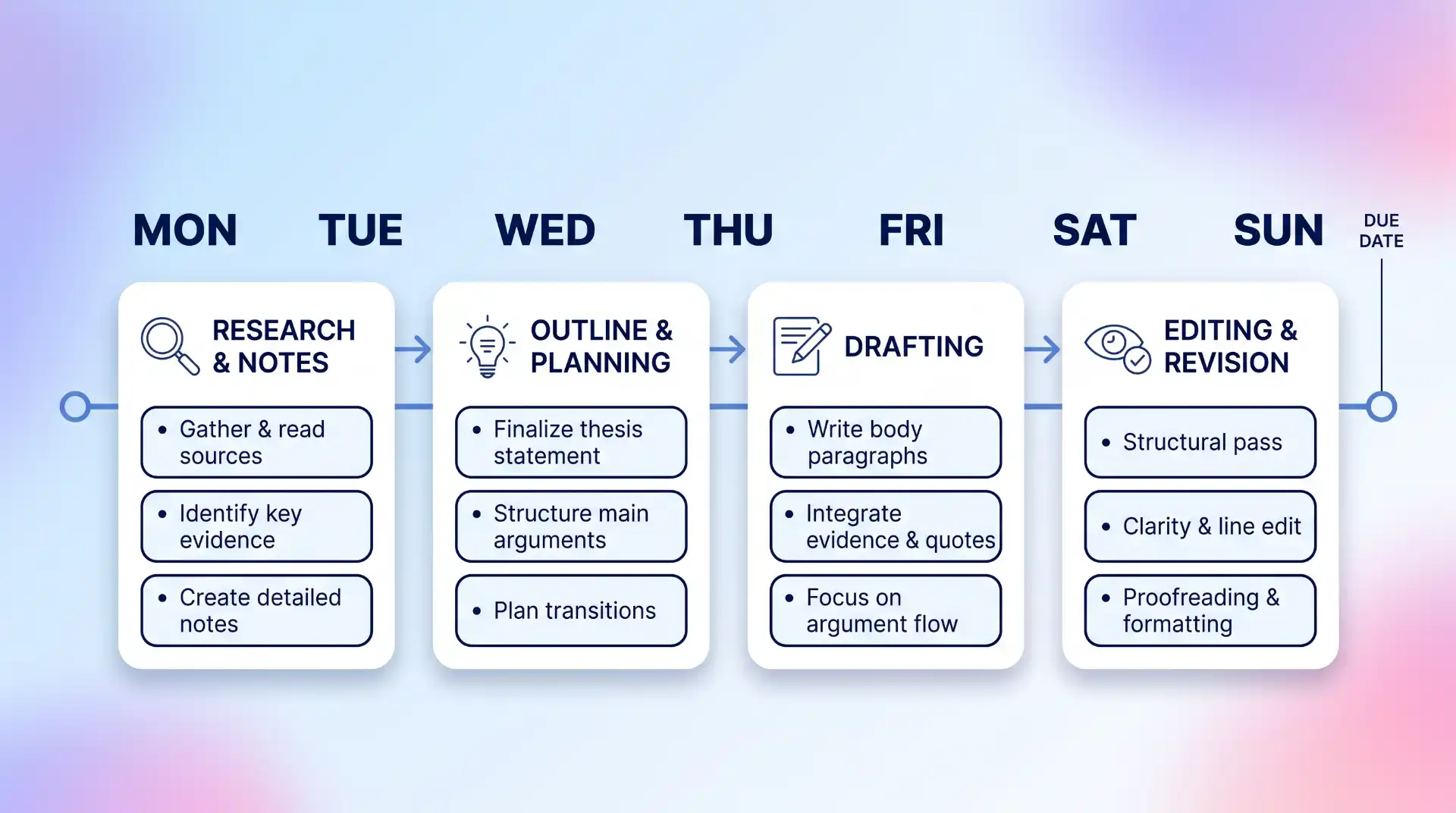
That third point matters more than it sounds. Students who treat the due date as the only milestone tend to spend 80% of their available time on research and 20% on writing and editing combined, which is backwards for a graded paper. Blocking out days for research, drafting, and editing separately, using an assignment planning app if a paper calendar isn’t cutting it, keeps that ratio from collapsing. For a one-week runway, that might mean two days for research and rough notes, three for drafting, and two for editing and a final proofread. For a two-week runway on a heavier paper, stretch the research phase first, not the editing phase, since a thin editing pass on a well-researched draft still beats a rushed edit trying to patch a thin argument.
If you’re managing several papers at once and the math genuinely doesn’t work, that’s a workload problem, not a writing problem, and it’s worth naming as one. Some students use a paper writing service to take a portion of an overloaded semester off their plate so the essays they do write themselves get proper attention instead of being rushed. That’s a workload decision for you to make, not something this guide is telling you to do by default.
Know Your Essay Type First
This is the branch point everything else in this guide depends on. Essay types aren’t interchangeable, and Purdue’s guide to essay types is worth skimming once if your assignment sheet doesn’t spell out which one you’re writing. The four you’ll run into most in undergraduate coursework:
| Essay type | What the thesis does | Main evidence | Most common pitfall |
|---|---|---|---|
| Argumentative / persuasive | Stakes a debatable position | Data, expert sources, counterargument rebuttal | Picking a thesis nobody could reasonably disagree with |
| Analytical / literary | Makes a claim about how a text works | Close reading, textual quotes | Summarizing the plot instead of analyzing it |
| Compare-and-contrast | Claims something meaningful about the relationship between two subjects | Parallel points across both subjects | Alternating description with no actual comparison |
| Expository / informative | States what will be explained | Facts, process steps, examples | Sneaking in unsupported opinion where explanation was asked for |
Everything from here forward applies to all four types, but a few steps below call out where the type changes what you’re actually doing. Take the earlier example: “the causes of the French Revolution” as an expository essay means explaining the major causes clearly and in order, with no obligation to rank them. The same topic as an argumentative essay means picking the cause you think mattered most and building a case for it against the others, which changes your outline, your thesis, and which sources you actually need before you’re even at the drafting stage.
The Process, Step by Step
These seven steps run roughly in order, though steps 2 and 3 can overlap if your outline changes once you start researching in earnest.
Step 1: Read the Prompt Like a Rubric
Read the assignment twice before you do anything else. The first pass is for the topic. The second pass is for the mechanics: word count, required number of sources, citation style, and whether your professor listed specific sections or subheadings they expect to see. Professors who hand out a rubric are telling you exactly what earns points, and most students skim it once and never look at it again until the grade comes back. If a rubric lists “critical analysis” as 30% of the grade and “grammar and mechanics” as 10%, that ratio should show up in how you spend your time too, not just in how the paper reads. Keep the rubric open in a tab while you draft, not just while you plan.
Step 2: Build a Real Timeline
Split your available days across research, drafting, and editing instead of leaving editing to whatever time is left. A rough starting split for a standard undergraduate essay is 30% research, 40% drafting, 30% editing and revision, adjusted for how research-heavy the assignment actually is.
Purdue OWL’s writing process overview frames writing as staged work rather than one continuous sitting, which is the underlying reason phased scheduling outperforms a single all-nighter. If focus is the bottleneck rather than time, the Pomodoro Technique is worth trying for the drafting block specifically, since sustained essay writing is exactly the kind of long, unstructured task it’s built for.
Step 3: Outline Before You Draft
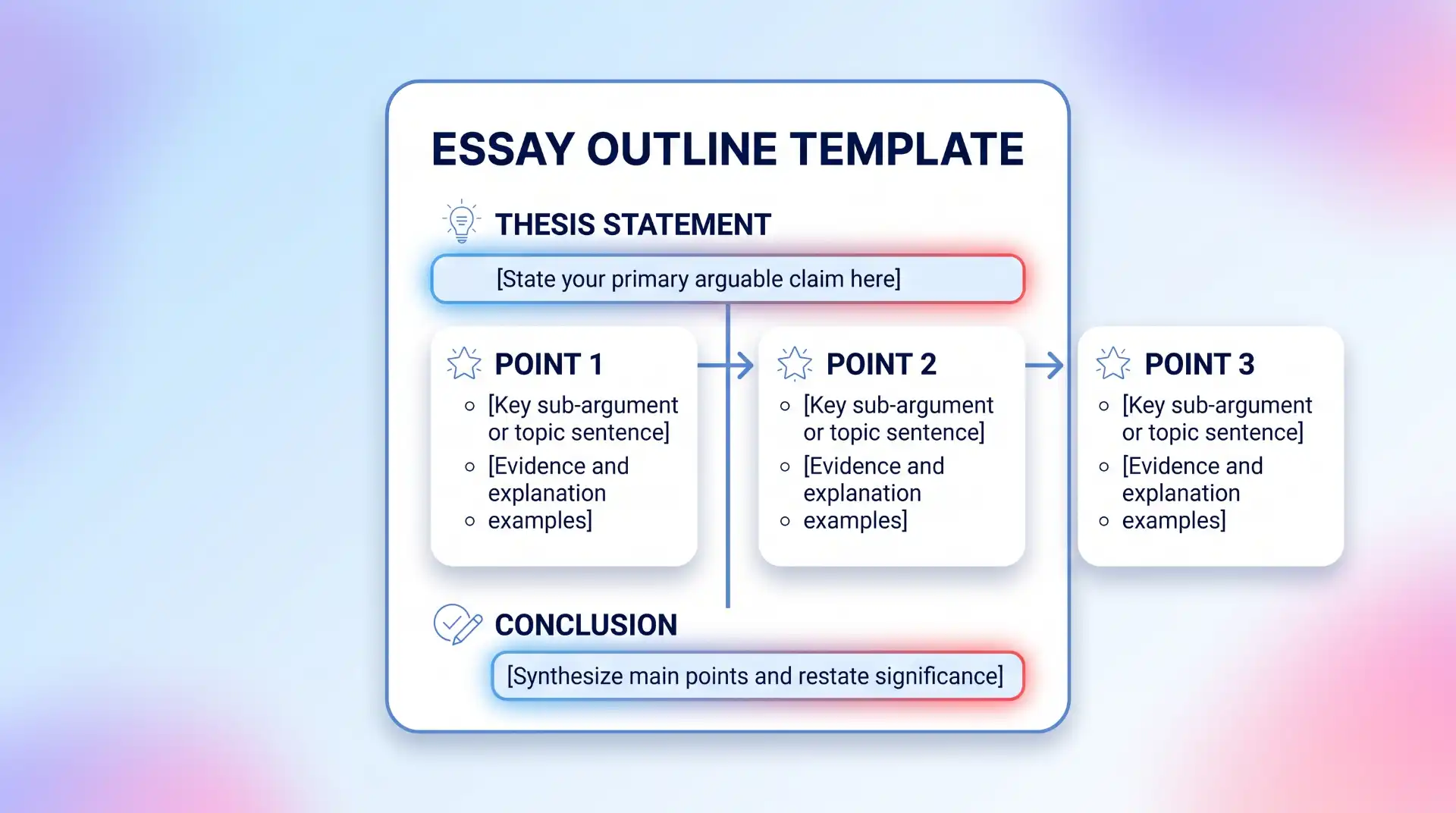
Write a working outline before your first full paragraph, even a rough one: thesis, then one line per supporting point, then your planned conclusion. This is the step students skip most often because it feels like it’s delaying the “real” writing, but it’s the fastest way to catch a thesis that doesn’t actually hold up before you’ve sunk two hours into defending it. George Mason’s writing center covers outlining as a distinct stage of the writing process for exactly this reason. If you’re not sure your thesis is strong enough to build an outline around, it’s worth reviewing writing a strong thesis statement before you go further, since a weak thesis makes every later step harder, not easier.
Step 4: Read Like a Writer, Not Just a Student
Read published examples in the genre you’re assigned, not for the content but for how the writer builds an argument, transitions between points, and opens and closes paragraphs. A 2024 study on reading and writing development found that exposure to varied writing genres measurably improves a writer’s vocabulary, organizational sense, and stylistic control, which is a fancier way of saying the habit actually transfers to your own drafts. You can read that 2024 reading-writing study directly if you want the underlying research rather than the summary. This is also a good point to revisit general writing skills fundamentals like sentence variety and paragraph transitions if your drafts have felt flat lately.
Step 5: Argue, Don’t Just Summarize
Every paragraph should be doing work toward proving your thesis, not just reporting what a source said. The test is simple: if you deleted your own sentence and left only the quote or the fact, would the paragraph still make your point? If not, you’re summarizing instead of arguing, which is the single most common reason a technically well-written essay still reads as weak. This matters differently by essay type. In an analytical essay it means connecting your textual evidence back to your claim about the text. In a compare-and-contrast essay it means stating what the comparison actually reveals, not just listing similarities and differences side by side.
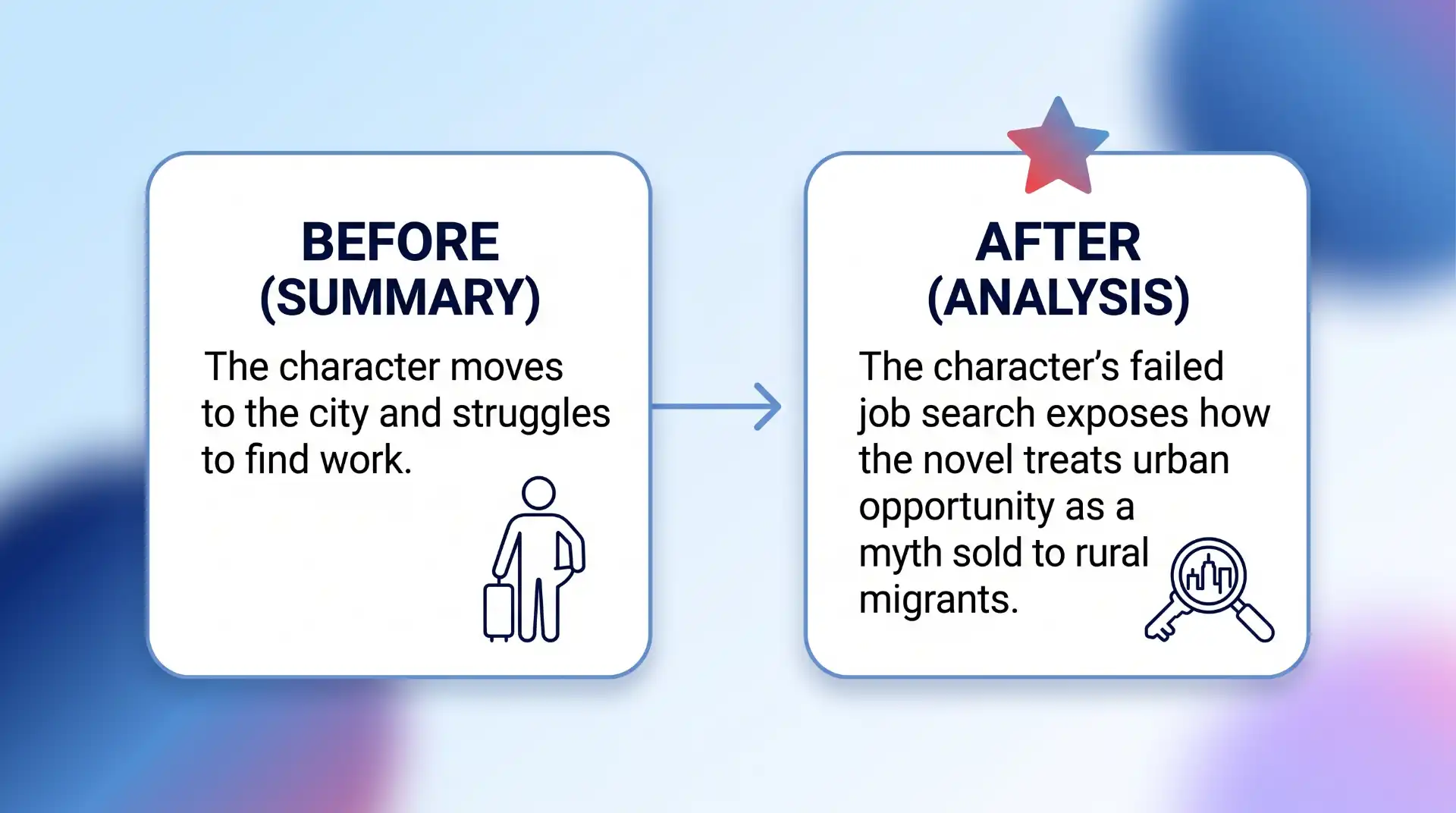
The difference is usually visible at the sentence level. “The character moves to the city and struggles to find work” is summary. “The character’s failed job search exposes how the novel treats urban opportunity as a myth sold to rural migrants” is analysis, because it’s making a claim the reader has to be convinced of, not just reporting an event. If most of your paragraph reads like the first sentence, it needs another pass.
Step 6: Cite as You Go
Add your citation the moment you use a source, not at the end when you’re trying to remember where a fact came from. This does double duty: it keeps your paper accurate, and it protects you from plagiarism flags that usually come from sloppy tracking rather than actual dishonesty. It’s worth understanding how Turnitin flags similarity before you submit, since it measures text overlap against its database, not intent, which means an unattributed quote or a paraphrase that stays too close to the original wording can flag even when nothing dishonest happened. When you do paraphrase, run it through a paraphrasing tool as a sanity check rather than a final answer. Double-check that your citation format actually matches what the assignment calls for while you’re at it, since fixing a whole paper’s formatting after the fact is tedious and easy to get wrong under deadline pressure. Getting MLA and APA citation styles right the first time saves that cleanup pass entirely.
Step 7: Edit in Passes, Not One Read-Through
Split editing into at least three separate passes instead of one: a structural pass (does the argument hold together and does every paragraph earn its place), a line pass (sentence clarity and tone consistency), and a proofreading pass (grammar, typos, formatting). Trying to catch all three at once is how obvious typos survive into a final submission, because your attention during a structural read is on the argument, not on whether “their” should be “there.” Doing the passes in that order also means you’re not polishing sentences you might cut entirely once you spot a structural problem.
Grammarly’s tone detector is useful for catching tone drift across a long draft, and it’s worth pairing with a second reader if you have one, since a friend catching an unclear sentence is worth more than another automated pass. For the drafting side specifically, some students also use AI essay writing tools to speed up structural editing, though leaning on them for the actual arguing is a shortcut that tends to show.
Self-Check Before You Submit
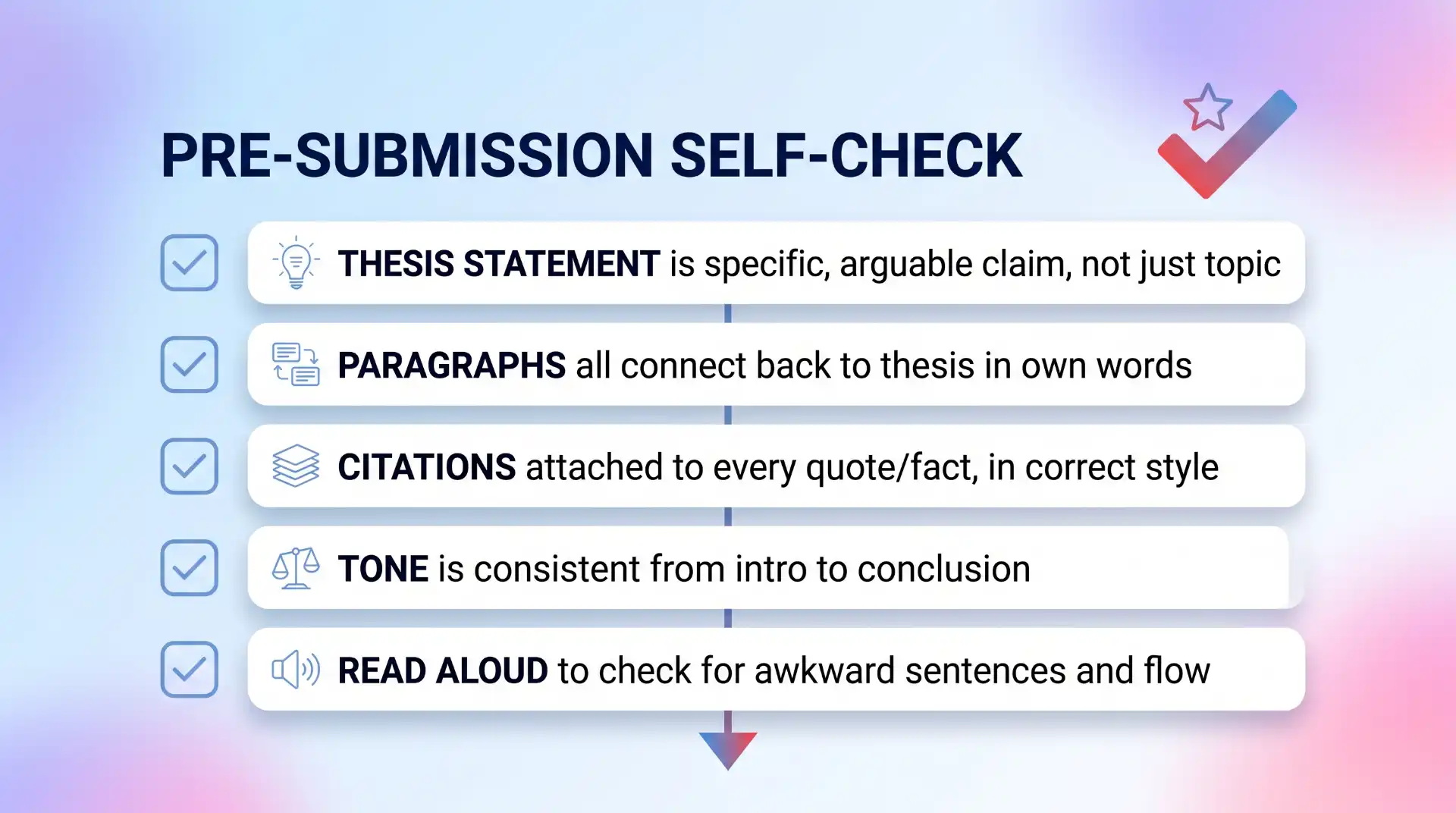
Run through this before you turn the paper in:
- Your thesis is a specific, arguable claim, not a topic restated as a sentence.
- Every paragraph connects back to that thesis in its own words, not just by proximity.
- Every quote or fact has a citation attached, in the correct style.
- The tone stays consistent from your introduction to your conclusion.
- You’ve read it once out loud. Sentences that are hard to say out loud are usually hard to read too.
Where Essays Actually Lose Points
Most of the damage happens in a handful of predictable places.
A thesis that isn’t actually arguable
“Social media has positive and negative effects” isn’t a thesis, it’s a topic. Nobody could disagree with it, which means there’s nothing for the rest of the essay to prove. The fix is to force a specific position: which effect, on whom, and why it outweighs the alternative.
Summary mistaken for analysis
This shows up most in analytical and literary essays, where a paragraph restates what happened in a scene instead of explaining what that scene proves about the essay’s claim. A quick check: does the paragraph tell your reader something they couldn’t get from just reading the source themselves? If not, it’s summary.
Over-quoting that trips similarity checkers
Stringing together long quotes with brief connecting sentences is a common way to hit a word count without doing much original writing, and it’s also what tends to produce a high similarity score even when every quote is properly cited. Paraphrase more, quote less, and reserve direct quotes for language that’s genuinely worth preserving exactly.
Tone drift across a long draft
An essay that opens formal and drifts casual by the conclusion reads as unfinished, even if every individual sentence is fine. This is almost always a symptom of writing the draft across multiple sessions without rereading the earlier sections before continuing.
Answering a different question than the one asked
This happens more than professors admit: a student writes a genuinely strong essay that argues a related but different point than what the prompt actually asked for. It usually traces back to skipping the second read-through of the prompt described in Step 1, where the mechanics and scope live, not just the general topic. Before you submit, reread the original prompt one more time next to your thesis and check that they still match.
Where This Approach Has Limits
This process assumes you have days, not minutes. A timed, in-class essay exam compresses steps 2 and 3 into a five-minute scratch outline, and that’s the right call under those conditions, not a shortcut you’re being lazy about. Group essays also break the process differently, since dividing sections among writers tends to produce exactly the tone-drift problem described above unless someone owns a final unifying edit pass.
Non-native English writers may find the editing phase takes longer than the drafting phase, which is normal and worth budgeting extra time for rather than treating as a sign something’s wrong. Very short essays, like a 300-word scholarship prompt, compress differently again: there’s no room for a multi-paragraph outline, so the planning step shrinks to a single sentence stating your angle before you draft, and editing shifts almost entirely to cutting rather than adding. And for genuinely research-heavy assignments where the research phase alone would eat your entire available timeline, a research paper writing service can offload part of that research burden, though it works best as a supplement to your own drafting and analysis rather than a replacement for it.
Key Takeaways
Identify your essay type before you write anything, since it changes what “good” actually looks like. Plan in phases instead of relying on the due date alone. Argue your thesis in every paragraph instead of summarizing your sources. Cite as you go rather than reconstructing sources afterward. And edit in separate passes, because trying to catch structure, clarity, and typos in one read-through is how all three slip through.
FAQ
How long should a college-level essay actually take to write, start to finish?
For a standard 1,500 to 2,500 word undergraduate essay, budgeting somewhere around a week with the 30/40/30 research-draft-edit split described above is realistic for most students. Shorter essays compress proportionally; research papers with a heavier source count need more of that time in the research phase specifically.
Does essay quality depend on hitting a specific word count?
No. Word count is usually a constraint your professor sets, not a quality signal. An essay that makes its argument clearly in fewer words than the maximum is not weaker for it, and padding to hit a number is one of the fastest ways to introduce the summary-instead-of-analysis problem described above.
Will Grammarly catch plagiarism the way Turnitin does?
No, and this is a common mix-up. Grammarly checks grammar, clarity, and tone; its plagiarism feature (where available on paid tiers) checks text similarity, but it’s a different tool built for a different purpose than Turnitin’s similarity scoring, which most institutions use specifically for academic submissions. Don’t treat a clean Grammarly pass as confirmation your citations are safe.
What if my professor doesn’t give an essay type or a rubric?
Ask directly if you can. If that’s not possible before the deadline, default to treating it as an argumentative essay unless the prompt is purely explanatory (“describe,” “summarize,” “explain how”), in which case treat it as expository. State your interpretation of the assignment in your introduction so the grader can see the lens you’re using, since that alone can be the difference between a grader marking you down for missing the point and one who simply disagrees with your framing.
Can AI writing tools write a high-quality essay for me?
They can generate text that looks like an essay, but they can’t stake out and defend a position that’s actually yours, and most institutions treat AI-generated argumentation as an academic integrity violation rather than a gray area. Using them for structural editing or brainstorming, as described in Step 7, is a different thing entirely from having one write the argument itself.
How many sources does a high-quality essay actually need?
Follow the assignment sheet first if it specifies a number. Absent that, a rough guideline for a standard undergraduate essay is one credible source per major supporting point, which for a typical five-paragraph structure lands around three to five sources. More isn’t automatically better: an essay citing ten sources shallowly usually reads weaker than one that engages deeply with four.

💬 Comments