A turnkey crash game script can save your team months of boilerplate. Those three layers decide whether you ship a game or an incident.
This is a buyer’s audit for engineers. If you are comparing feature lists, you are comparing the wrong things.
Quick Take
A crash game script is a pre-built package covering the game engine, admin dashboard, fairness algorithm, payment integration, and user management. The demo proves none of the hard parts. Audit three risk areas before you buy: the real-time tick engine under concurrent load, a fairness implementation with a public verification path, and server-side cashout settlement that is atomic and authoritative. Server-side cashout validation is the one non-negotiable: any client-side cashout logic is a manipulation surface.
What You Are Actually Buying
A crash game is a shared multiplier that climbs from 1.00x until it crashes at a point set before the round began. Players bet before the round starts and must cash out before the crash.
A crash game script is the packaged software that runs that loop: the game engine, an admin dashboard, a provably fair algorithm, payment gateway integration, and user management tools. You are buying a working starting point, not a finished product. The vendor’s job ends at handover; the load behavior, settlement integrity, and verification tooling become yours.
Delivery models differ in ways that matter more than the feature list:
| Model | Source code | Customization | Typical timeline | Revenue share |
|---|---|---|---|---|
| Turnkey | Usually not included | Limited (branding, themes, UI) | Weeks | Low |
| Custom | Full transfer | Full | Months | None |
| White-label | Not included | Not customizable | Ready to deploy | Higher than turnkey |
That taxonomy comes from vendor comparisons of the three models, and it holds up: the axis that actually separates them is who owns the code. If you cannot read the settlement logic, you cannot audit it. That single fact should drive your model choice more than any feature checklist.
Why Teams Buy Instead of Build
The trade-off is straightforward. A custom build gives you control over the round lifecycle, wallet integration, fairness logic, and admin system, but your team must design and validate each layer. A turnkey script gives you a working base sooner because those systems already exist, but it shifts the job from initial construction to source-code auditing and integration.
A good package ships more than a multiplier animation. Look for a real-time multiplayer engine, auto-bet and auto-cashout controls, multi-currency payment support across fiat and crypto, a provably fair system with cryptographic verification, SSL and anti-fraud protection, DDoS mitigation, and an admin dashboard covering users, transactions, and platform analytics. Those are table stakes, and most vendors list them.
The problem is that a feature list is a claim, not a test result. “Handles thousands of concurrent users” appears on pages that have never published a load test. “Provably fair” appears on packages with no player-facing verifier. Treat every line as something to verify in the source, and the buying decision gets much simpler.
Frontend Simplicity vs. Backend Concurrency
The client is a canvas drawing a curve and a button that says cash out. The server is a synchronized event for every player in the lobby at once. That asymmetry is the whole engineering story.
Ordinary REST polling is poorly suited to this shared live state. The server must confirm a cashout at the multiplier value it held when the request arrived, not the value the browser happened to render. A vendor technical guide to crash-game backends recommends sub-100ms cashout handling; treat that as an engineering target to test under your own expected concurrency, not as a universal guarantee.
| Property | Slot / table game | Crash game |
|---|---|---|
| Round model | Single-player, asynchronous | Multiplayer, synchronous |
| Outcome timing | Generated per spin, after bet | Pre-committed before betting opens |
| Latency tolerance | More tolerant because each spin resolves separately | Highly sensitive because every player shares the round clock |
| Concurrency risk | Low (session isolation) | High (shared round state) |
This is where buyers often misplace their attention. The fairness mathematics are easier to inspect than the behavior of a multiplayer backend under load. A team without real-time infrastructure experience can build a convincing demo that degrades as concurrent player counts climb. When you audit a package, spend serious time on the concurrency layer.
The Real-Time Tick Engine
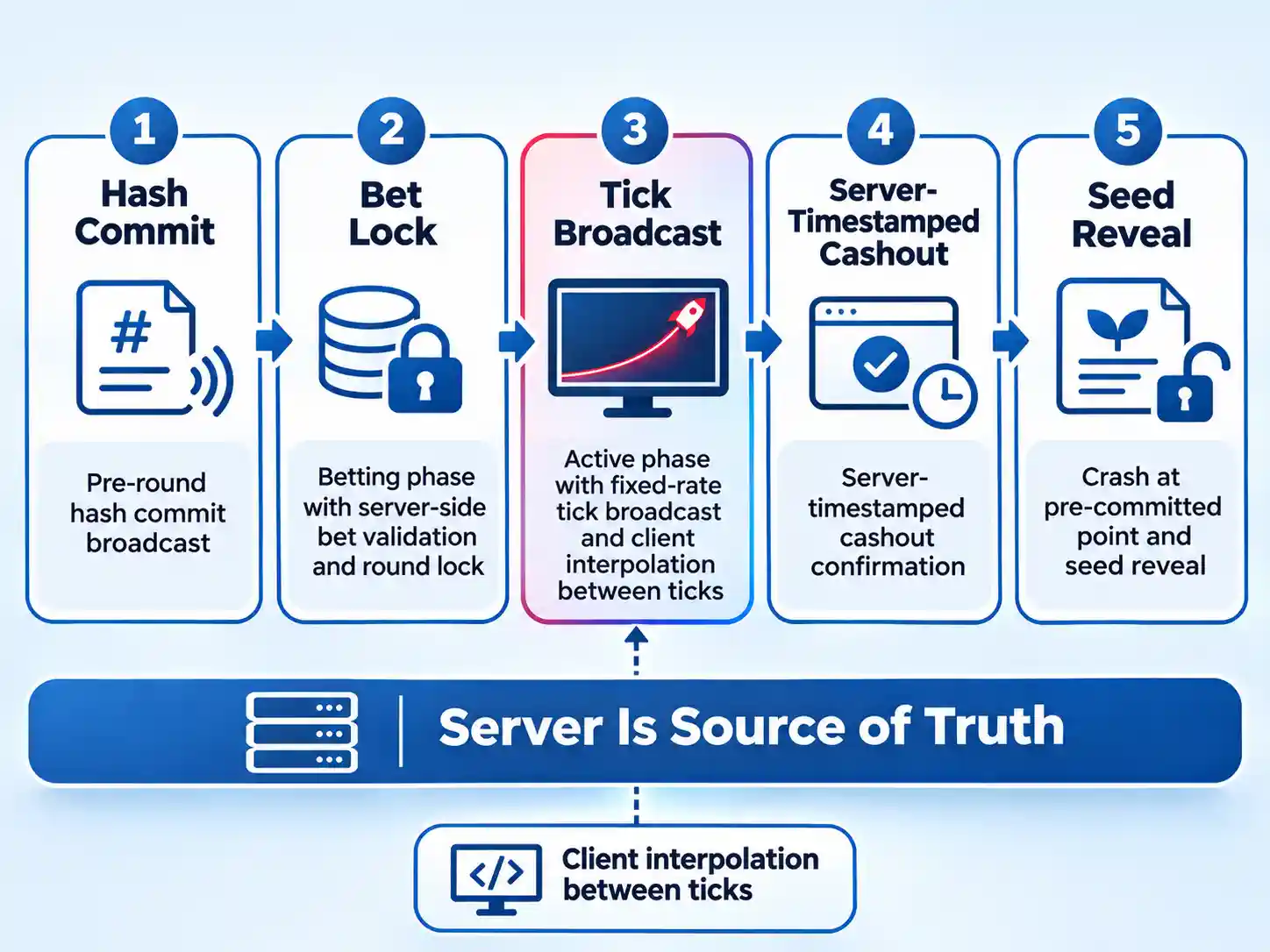
The server is the single source of truth for every round. The standard architecture is a WebSocket-based pub/sub model, and the round lifecycle runs in a fixed sequence:
- Pre-round commit. The server generates the crash point, hashes it, and broadcasts the hash to every connected client before betting opens.
- Betting phase. Players submit bets. The server validates each one server-side and locks the round when the countdown ends.
- Active phase. The server broadcasts multiplier updates at a fixed tick rate. Clients interpolate the curve locally between ticks so the animation stays smooth.
- Cashout handling. Cashout requests are validated server-side in real time. The server timestamps the request and confirms at the multiplier value at the moment of receipt.
- Crash and reveal. The round ends at the pre-committed crash point. The server reveals the seed, and players verify the outcome independently.
Redis Pub/Sub is a common fan-out mechanism: publishers and subscribers are decoupled by channels, and messages are pushed to subscribers. That decoupling keeps the tick broadcaster independent of the WebSocket layer. But Redis documents Pub/Sub as at-most-once delivery: if a subscriber disconnects before receiving a message, that message is gone. That can work for transient tick broadcasts, where a later state update supersedes an earlier one. It is the wrong transport for money movement. Settlement needs durable, idempotent handling, which means a persistent stream or transactional store rather than fire-and-forget pub/sub.
Reconnection is the other half of the engine. A client that drops mid-round must resync to the authoritative state, not replay a local animation. Check that the package’s WebSocket layer handles reconnect with a state snapshot, and that the server, not the client, decides where the multiplier is when the socket comes back.
Provably Fair: What the Code Must Actually Do
“Provably fair” is a mechanism, not a badge. If the package does not ship a public verification path, the label is marketing. Here is the mechanism the code must implement.
One implementation pattern for multiplayer crash games is a SHA-256 reverse hash chain. A master seed is generated with a cryptographically secure random number generator, hashed repeatedly, and consumed in reverse across successive rounds. The terminating hash is published before play begins. Because each link is the SHA-256 pre-image of the next, that published value commits the operator to the chain it will later reveal. SHA-256 itself is specified in NIST’s Secure Hash Standard, which defines hash algorithms used to create message digests.
The crash multiplier is then derived from HMAC-SHA256(gameSeed, salt), where the salt is external entropy that did not exist when the terminating hash was published: on crypto platforms, typically the hash of a future Bitcoin block. That removes operator foreknowledge of the outcome.
Verification is the part buyers forget to check. The workflow a player must be able to run:
How to verify a crash round yourself
Run this against any package you are evaluating. If any step is impossible with the shipped tooling, the fairness claim is unverifiable.
- Confirm the pre-round commitment exists.Before betting opens, the server should broadcast a hash of the round’s outcome. Capture it from the client or the round history API.
If the package only reveals a seed after the round with no prior commitment, there is nothing to verify against: the commitment is what proves the outcome was fixed in advance.
The round history should show a hash published with a timestamp earlier than the betting window.
- Record the seed inputs.Note the server seed, your client seed, and the nonce for the round. The client seed should be visible to you and, ideally, editable.
The nonce is a counter that increments per round in a session. All three inputs must be exposed, or the derivation cannot be reproduced.
Your client seed should appear in the round record exactly as you set it.
- Recompute the crash point.Hash the revealed server seed and confirm it matches the pre-round commitment. Then compute HMAC-SHA256 over the seed inputs and apply the published crash-point formula.
The formula must be documented. A provider that hides the crash-point derivation behind a black box has given you a certificate, not a verification path.
Your recomputed crash point should match the multiplier the round actually ended at.
- Check the chain link across rounds.Hash a round’s revealed seed and confirm it produces the committed value of the previous round in the chain.
This is what ties individual rounds to the single terminating hash published before play began.
Each round’s seed should hash forward to the next commitment in the sequence.
One boundary worth stating plainly: player-side verification proves the outcome was not manipulated after the fact. It does not replace licensed RNG certification on the operator side, and most regulated frameworks expect both. Certification is jurisdiction-specific: testing labs and the exact entropy-source requirements vary by market, so confirm the applicable rule for wherever you intend to operate rather than assuming one standard.
Concurrency and Race Condition Defense
The cashout moment is where money and timing collide. Many players may cash out within the same tick, and the server must settle each request at the correct multiplier without double-spending a balance.
The defenses are well understood, and you should be able to find all of them in the source:
- Server-side cashout validation. The server timestamps each request and confirms at the multiplier value at the moment of receipt. Client-side cashout logic creates a manipulation surface and may conflict with certification requirements.
- Atomic settlement. Balance debits and credits happen inside a database transaction or an atomic operation. A read-then-write pattern without a lock is a double-spend waiting to happen.
- Idempotent settlement. Each cashout carries a unique identifier so a retried request (from a flaky network or a client retry loop) cannot settle twice. A single API with idempotent settlement is the pattern serious providers publish.
- Authoritative timestamps. The server’s clock decides the exit multiplier. Client-reported timing is advisory at best.
No architecture makes double-spend impossible. These mechanisms reduce the risk to a level where a determined attacker has to beat a transaction boundary rather than a millisecond of network lag. That is the honest standard, and it is the one to hold vendors to.
The Audit Checklist
This is the part that decides the purchase. Work through it against the actual source, not the sales deck.
Audit the package before you pay
- Modular structure. The engine, fairness module, wallet integration, and admin layer should be separable. A single tangled codebase means every customization risks the settlement logic.
- Fairness verifiability. Pre-round hash commitment, post-round seed reveal, documented derivation, and a player-facing verification tool. Ask for the formula in writing.
- Server-side cashout path. Trace a cashout request from WebSocket receipt to ledger entry. Confirm the multiplier is read server-side at receipt time.
- Idempotent settlement. Find the transaction boundary and the idempotency key. If either is missing, stop.
- Admin telemetry. The dashboard should cover players, betting activity, payments, game performance, and suspicious-activity detection: not just a revenue counter.
- Payment and currency support. Confirm fiat and crypto coverage, multi-currency wallets, and how the wallet integration handles settlement callbacks.
- Load evidence. Ask for load test reports against a stated concurrency target. “Deploy in days” describes installation, not production readiness under load.
- Demo sandbox and audit logs. A testable sandbox and full audit logs let you verify behavior before launch and investigate after it.
If you want a reference point for what a commercial package looks like when you request it for inspection, providers such as Uber Clone App’s crash game source code publish their feature set and delivery model. Use that as a checklist to test against, not as proof of quality: the audit above is what separates a package that demos well from one that settles correctly.
For a worked example of the same architecture applied to a themed variant, our guide on how to build a CS:GO crash game script walks through the feature set and integration points.
Security and Deployment Checklist
Deployment failures in crash games are usually boring and preventable. Verify these before launch:
Security and deployment checks
- Reverse proxy WebSocket config. nginx does not pass the hop-by-hop Upgrade and Connection headers by default. They must be set explicitly so the proxied server sees the protocol switch and returns 101 Switching Protocols. Its default read timeout closes an idle connection after 60 seconds; raise proxy_read_timeout or have the server send periodic ping frames.
- Rate limiting. Cap bet and cashout request rates per session and per IP. The cashout endpoint is the one an attacker will hammer.
- Bot protection. Automated betting and cashout timing are the obvious abuse vectors. Confirm the package ships anti-bot controls and that the admin dashboard surfaces suspicious activity.
- Crash-point validation. The server must reject any client-supplied crash point or multiplier. The outcome comes from the committed seed, full stop.
- Transport and DDoS. SSL everywhere, plus DDoS mitigation at the edge. WebSocket connections are long-lived and easy to exhaust.
- Audit logs and responsible-gaming tools. Full audit logs and built-in limits, reality checks, and self-exclusion should be standard, not add-ons.
Which Model Fits Your Team
The delivery model should follow your team’s capability, not the vendor’s sales pitch.
| Your situation | Best fit | What you accept |
|---|---|---|
| Indie studio or technical founder wanting fast launch | Turnkey with full source if available | Limited customization; you own the audit of the three risk areas |
| Team needing brand differentiation or custom math | Custom development with source transfer | Months of timeline and six-figure budget |
| Operator without engineering capacity | White-label | No source access, no customization, higher revenue share |
For engineering-led teams, turnkey with source access is the pragmatic path. You get the round lifecycle and admin back office for free, and you spend your effort on the parts that decide whether the game holds up: the tick engine, the fairness verifier, and settlement.
What Turnkey Packages Get Wrong
The recurring failures are predictable, and they cluster in the same places.
Deploy-in-days claims. Installation is fast. Production readiness under concurrent load is a separate project, and the marketing page does not distinguish between them. Ask for load test reports and treat their absence as a finding.
Certificates without verifiers. A fairness certificate you have to take on faith is worth less than a documented formula and a working verification tool. If the only assurance is a badge, keep looking.
Feature lists that skip the hard parts. A page that lists auto-cashout and themes but says nothing about settlement, idempotency, or reconnect behavior is telling you where the engineering effort went.
Concurrency as an afterthought. The multiplayer backend is where projects fail, and it is the layer least visible in a demo. A package that was sized for a demo lobby will degrade as your player count climbs.
None of this makes turnkey packages a bad buy. It makes them a buy that requires an audit. The vendors who ship source access and documented fairness are the ones who expect you to look.
The Decision Rule
Match the delivery model to your team’s capability first. If you can read and maintain the code, buy turnkey with source access and budget engineering time for the audit. If you need differentiation or custom math, commission a custom build with source transfer. If you have no engineering capacity, white-label and accept the trade-offs.
Then audit before you sign. Trace a cashout from WebSocket receipt to ledger entry. Run the verification workflow against a real round. Ask for load test reports against a stated concurrency target. The demo shows you a curve rising; the audit shows you whether the system behind it settles correctly under a crowded round.

💬 Comments