A virtual card number is a substitute payment number linked to an eligible underlying card account. You can use it for supported online or in-app purchases without giving the merchant the number printed on your physical card, which can reduce the usefulness of exposed payment credentials if a merchant is later compromised.
It does not usually create a separate account or credit line, make an unsafe merchant trustworthy, or add new dispute rights by itself. Its main benefit is isolating the credential used at checkout from the number on the physical card.
How Virtual Card Numbers Work
A virtual card number replaces the card number you would normally type at checkout with a different number generated for an eligible account. Capital One describes its virtual card numbers as unique numbers linked to the underlying credit-card account, allowing eligible users to make online purchases without sharing the physical card number.
The number associated with the actual card account is commonly called the Primary Account Number, or PAN. A virtual-card system leaves the underlying account in place while presenting a substitute credential to the merchant.
In practical terms, the process usually works like this:
- An issuer or supported payment service generates a virtual card number for an eligible account.
- You use the substitute number at an online or in-app checkout instead of the number printed on the physical card.
- The merchant submits the virtual credential for authorization through the normal card-payment process.
- The virtual credential remains associated with the underlying account so the issuer can authorize and post the purchase there.
- The transaction appears on the underlying account rather than creating a separate balance or credit line.
Implementations differ. Capital One currently offers both general-use virtual numbers and eligible merchant-specific numbers. Its general-use number can work with multiple online merchants, while a merchant-specific number is restricted to one merchant. Capital One also notes that not every customer or card is eligible.
Google describes its virtual cards as digital versions of eligible cards that use randomly generated numbers instead of the actual card number. Google also says availability depends on participating banks or networks, supported countries or regions, and merchant acceptance.
A simple example is a physical card whose account number ends in 1234. A supported virtual-card service can provide a different number for checkout while the resulting purchase still belongs to the original account.
Virtual Card Number vs Tokenized Wallet: They Are Related, but Not Identical
Virtual card numbers and tokenized digital wallets can both reduce exposure of the underlying card number, but they are not necessarily the same technical implementation or checkout experience.
A virtual card number may look like an ordinary card number that you or a browser autofill tool enters into an online checkout. A digital wallet can instead use a payment token associated with a device, merchant, or payment context.
EMVCo describes payment tokenization as replacing a Primary Account Number with an alternative value that can be constrained to a particular merchant, device, or payment scenario. That explains the broader security principle, but not every product marketed as a virtual card should automatically be described as an EMV payment token.
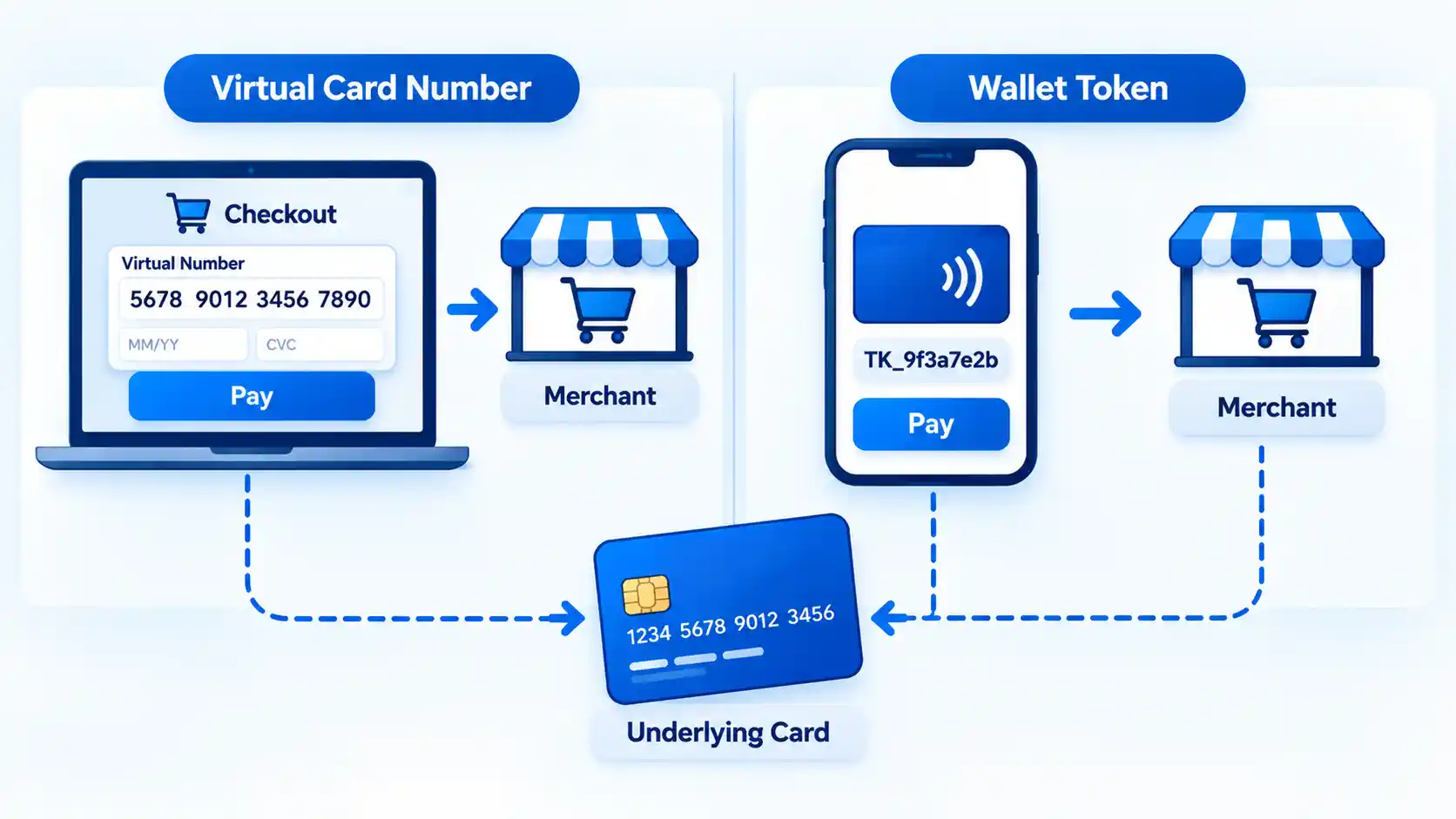
The distinction matters because different products support different controls. Some virtual numbers stay the same across many purchases, others are tied to one merchant, and wallet tokens can be restricted to a device or payment environment.
A virtual card vs digital wallet comparison matters when choosing between a manually entered substitute card number and a wallet-based payment token.
Our Recommendations
When Buying From a New but Legitimate Online Store
Best for: reducing exposure of your physical card number when trying a retailer you have independently checked but have not used before.
A virtual number can be useful when you trust a merchant enough to make a purchase but would rather not give it the reusable number printed on your card.
Where the issuer supports merchant-specific numbers, the containment can be stronger. Capital One states that its merchant-specific virtual numbers are valid only with the assigned merchant, so that credential cannot simply be reused at another store through the same feature.
The benefit is credential containment, not merchant verification. A virtual number can still successfully authorize a payment to a dishonest seller if you approve the transaction.
The Federal Trade Commission recommends checking unfamiliar online sellers independently and warns that an encrypted website alone does not prove that the seller is legitimate.
Important limitation: a virtual card number can reduce exposure of your physical card number, but it cannot establish whether a merchant is legitimate or whether an order will be fulfilled.
When a Merchant Stores Your Card for Future Purchases
Best for: isolating one merchant from the number on your physical card when the issuer supports merchant-specific virtual credentials.
Saved-card checkout is convenient, but it means a merchant or its payment provider retains a payment credential associated with your account. A merchant-specific virtual number can give that merchant a dedicated substitute credential rather than the number printed on your physical card.
Capital One currently lets eligible users create multiple merchant-specific virtual numbers, each intended for one merchant, and manage those credentials separately.
This can be useful if you shop repeatedly at one website and want the stored credential for that retailer separated from the card number you use elsewhere.
Important limitation: merchant-specific numbers are implementation-dependent. Other virtual-card services may provide one substitute number that works across multiple merchants.
For Subscriptions You Want to Isolate
Best for: recurring payments when the issuer supports a persistent virtual number that can be managed separately.
A persistent virtual number can be useful for subscriptions because the merchant can keep charging the substitute credential without receiving the physical card number.
Capital One states that eligible virtual cards can be used for recurring payments and subscriptions. Its current management tools also let eligible users lock, replace, or delete virtual numbers separately from ordinary purchases made with the physical card number.
That can isolate one recurring merchant from unrelated card activity. For example, a merchant-specific credential used only for one subscription is easier to identify and manage than one physical card number shared across many merchants.
There is an operational consequence. Capital One explicitly states that recurring payments associated with a deleted virtual number will be declined, so legitimate payment details may need to be updated afterward.
Deleting a payment credential is not the same as canceling a contract or subscription. If the service has a cancellation process, follow it rather than relying on failed future charges.
Important limitation: deleting or replacing a virtual number can interrupt legitimate recurring payments, and issuer behavior varies.
When You Want Online Purchases Separated From Your Physical Card Number
Best for: routine e-commerce when you want merchants to receive a substitute credential instead of the number printed on your card.
This is the broadest everyday use case. Instead of entering the physical card number at each supported checkout, a virtual-card system can provide a different credential while keeping the same underlying account.
American Express says its eligible virtual-card implementation does not share the physical card details with the merchant and dynamically supplies the security code used at checkout. Purchases still appear as regular transactions on the underlying Amex account.
This illustrates the central trade-off: the credential shown to the merchant changes, but the underlying account remains. Spending still posts to that account and remains subject to its credit limit, balance, issuer rules, and other account terms.
Capital One likewise states that its virtual cards are tied to the associated physical-card account. If the physical card is locked, transactions on its virtual cards will not go through.
Important limitation: a virtual number does not separate you from the underlying account’s balance, credit limit, fees, interest, or repayment obligations.
For Controlled Business or Vendor Payments
Best for: organizations that need payment credentials with transaction or policy controls.
Commercial virtual cards can do more than conceal a broader funding-account number. Business systems can generate credentials for specific transactions, suppliers, or workflows and apply controls to their use.
Mastercard’s current commercial virtual-card material describes unique virtual numbers, workflow approvals, and controls defining how, where, and when a virtual number may be used. Its commercial platform also supports spending limits and restrictions.
This can let a business provide a constrained payment credential for a supplier or purchase without exposing the broader funding-account number.
These are commercial virtual-card capabilities. They should not be assumed to exist on an ordinary consumer virtual card merely because both products use the same general terminology.
Important limitation: amount restrictions, approval workflows, merchant controls, and similar features are commercial product capabilities, not universal consumer virtual-card features.
When a Virtual Card Number Is a Poor Fit
A substitute credential is useful only when the merchant and the later transaction lifecycle can support it. In some cases, the physical card number or another payment method is more practical.
- The merchant does not accept virtual cards. Google says certain merchant sites and apps opt out of virtual-card acceptance, while Capital One also notes that some merchants may reject virtual numbers.
- You may need to show the original card later. Capital One warns that a virtual number may be unsuitable when a travel reservation, hotel, event, or similar transaction requires the customer to present or swipe the card used for booking because the virtual and physical numbers do not match.
- Your account is not eligible. Availability can depend on the issuer, card, account status, network, country or region, browser, device, and payment platform.
- A changing credential would interfere with repeat billing. Persistent virtual numbers can support subscriptions, but short-lived or replaced credentials can cause later charges to fail.
- You are treating it as protection from a fraudulent seller. A virtual number can still authorize a transaction that you willingly approve.
If an eligible virtual card unexpectedly fails, a virtual card decline can result from merchant acceptance, an expired credential, a billing-address mismatch, insufficient available credit, or issuer restrictions.
How to Get a Virtual Card Number
There is no universal setup process because availability is controlled by the issuer, network, or supported payment platform. Common access methods include an issuer’s website or mobile app and supported browser or Android autofill features.
For example, Capital One currently lets eligible cardholders access virtual numbers through its website and mobile app. Google supports virtual-card enrollment for eligible cards from participating banks or networks in supported regions. American Express lets eligible U.S. cardholders enroll supported cards for its Google-based virtual-card feature.
Before relying on a virtual number, check:
- whether your exact card or account is eligible;
- whether identity verification or enrollment is required;
- whether the credential works only online or in supported apps;
- whether it is general-use, merchant-specific, persistent, or temporary;
- whether recurring payments are supported;
- how the issuer lets you lock, replace, or delete it; and
- what happens when the underlying card is locked, replaced, or closed.
Do not assume two issuers implement virtual cards the same way. Capital One, American Express, Google-supported issuers, and commercial Mastercard systems expose different eligibility rules, controls, and checkout behavior.
What a Virtual Card Does Not Protect You From
A virtual card number addresses one main problem: exposing the number associated with the underlying physical card. It does not eliminate the other ways online payments can fail.
- Fraudulent merchants: a substitute number can still authorize a purchase from a scam seller.
- Account takeover: an attacker who gains access to your issuer account or authentication method may present a different problem from stolen merchant-side card data.
- Underlying debt: a virtual credit-card number is still connected to the underlying credit account, so balances, interest, fees, and repayment obligations remain.
- Merchant disputes: using a virtual number does not automatically create stronger refund, chargeback, or statutory rights than the underlying account already provides.
- Compatibility problems: the feature may not be available for the card, platform, region, or merchant involved in the transaction.
If the goal is broader than concealing a physical card number, compare alternatives to credit cards for online payments by credential exposure, reachable funds, dispute options, and debt risk.
A virtual card number is most useful when you already intend to make a legitimate online purchase and want the merchant to receive a substitute credential instead of your physical card number. Used in that role, it can reduce credential-reuse risk without changing the account that ultimately pays for the transaction.

💬 Comments