Good social media marketing is not about posting as often as possible or chasing every new trend. It starts with a clear business goal, the people you want to reach, the platforms that make sense for them, useful content, genuine interaction, and measurements that tell you what to improve.
For a beginner, that is a more useful starting point than trying to master every social network at once. Goals, audience, channel choice, content, and measurement work together as parts of one strategy rather than as separate tricks.
What Social Media Marketing Should Do for Your Business
Social media marketing means using social platforms to support a business goal. That goal might be helping more people discover your brand, bringing visitors to your website, generating inquiries, strengthening customer relationships, or supporting sales.
The important distinction is between activity and purpose. Publishing three posts this week is an activity. Increasing qualified website visits from people interested in a service is a purpose. The second gives you something meaningful to plan and measure.
Social media also works differently from a one-way advertisement. People can reply, ask questions, share experiences, complain, recommend your business, or ignore what you publish. Modern social marketing therefore includes publishing, listening, responding, and reviewing results. A useful strategy connects social activity to specific business objectives instead of simply keeping an account active.
This does not mean every business must pursue awareness, leads, sales, customer service, and community building at the same time. Beginners usually get a clearer picture when they choose one primary result for a campaign or period and use that result to guide the next decisions.
Start With a Clear Business Goal
Before deciding what to post, decide what you want the activity to accomplish. A local service business trying to generate inquiries needs a different plan from a new brand that mainly wants more people in its area to recognize its name.
A useful goal also tells you what to measure. A key performance indicator, or KPI, is simply a measurement you use to judge progress toward an important result. The table below shows why the same metric should not be used for every goal.
| Goal | Useful signal | What the signal does not prove by itself |
|---|---|---|
| Increase awareness | Reach, impressions, profile visits | That people will buy from you |
| Drive website interest | Link clicks, landing-page visits | That visitors became customers |
| Generate inquiries | Messages, calls, lead-form submissions | That every inquiry is qualified |
| Encourage sales | Tracked purchases or conversions | That social media caused every sale without other influences |
For example, a post may reach thousands of people but produce very few website visits. That can still be useful for an awareness campaign, but it would be a weak result if the goal was generating quote requests.
This is why strategy planning should begin with the intended outcome. Clear social media goals can be tied to relevant metrics, which is more useful than tracking every number simply because a platform displays it.
Define the Audience You Want to Reach
You cannot make good content decisions without knowing who the content is for. You do not need an elaborate customer profile to begin, but you should be able to describe the type of person most likely to need your product, service, or information.
Start with practical questions. What problem does this person have? What would make them pay attention? What information might they need before buying? Are they a consumer, a business owner, a parent, a student, a professional, or another identifiable group? Where are they located if location matters?
Consider two businesses. A local home-repair company might need to reach homeowners within a limited service area. A software company selling to IT managers may need to reach professionals across a much wider market. Their topics, tone, examples, platforms, and calls to action should not look identical.
Audience knowledge also improves content planning. If people repeatedly ask the same question before buying, that question is a useful content idea. If certain topics attract people who are unlikely to become customers, high engagement on those topics may be less valuable than it first appears.
Choose Platforms Based on Audience and Resources
Trying to maintain every major social account can spread a small team too thin. A better starting point is to identify where your intended audience is active and whether you have the time and content needed to maintain a useful presence there.
There is no universally best social network for marketing. Platform choice depends on audience behavior, the kind of content you can produce, and your business goal. Beginner strategy planning therefore works better when you focus on platforms that fit the audience and strategy instead of distributing limited resources everywhere.
If Instagram fits your customers and product, the next question is not simply whether to open an account. You need to connect the profile, content, engagement, and measurement to a business goal. A more detailed Instagram marketing strategy is useful when that platform becomes one of your priorities.
Resource limits also affect whether marketing work stays in-house. A law firm coordinating social activity with search, website content, and paid campaigns may use a law firm digital marketing agency when some of that broader work requires specialist support.
The main lesson is to choose deliberately. One well-maintained channel that reaches suitable people can be more useful than several neglected accounts created simply because other businesses have them.
Make Your Profiles Easy to Understand and Act On
When someone reaches one of your profiles, they should quickly understand who you are, what you offer, and what they can do next. Confusing or outdated information creates friction before the person even sees your recent posts.
Review the basics: business name, profile image, description, contact information, website or action link, and any important location or service information the platform allows you to display. Keep the core identity consistent enough that a person moving from one platform to another can recognize the same business.
A profile audit should also catch outdated details and inconsistencies between accounts. Current strategy guidance recommends reviewing existing profiles as part of the broader social planning process, including whether each account still fits the intended audience and goals.
A profile should not try to explain everything about the business. It should give a new visitor enough information to decide whether the account is relevant and where to go next.
Build a Focused Content Plan
Random posting makes it difficult to stay consistent and even harder to learn what your audience values. A simple content plan gives you a few repeatable subjects to work from.
These recurring subjects are often called content pillars. A content pillar is simply a topic or purpose that your account returns to regularly. For a local fitness studio, the pillars might include exercise education, answers to common member questions, class information, and selected promotions.
The value is not in the label. It is in removing the pressure to invent an unrelated idea every time you need to post. You can ask whether a new post fits one of the useful subjects your audience already cares about.
Your content also does not need to sell something every time. Helpful explanations, demonstrations, answers, stories, customer questions, product information, and occasional promotional material can all have a place. The right mix depends on what the audience needs and what the account is trying to accomplish.
A good plan should still leave room to change direction. If one subject repeatedly attracts the wrong audience or produces little useful response, you can reduce it. If another consistently brings qualified questions, that is evidence to explore it further.
Use Video and Visual Formats When They Fit the Message
Video is useful when movement, demonstration, personality, or explanation benefits from being seen. It is not automatically the right format for every message, and live video is not automatically better than a recorded clip, image, carousel, or text post.
Choose the format after deciding what the audience needs to understand. A short product demonstration may make more sense as video. A comparison of several specifications may be clearer as a table or graphic. A quick announcement might need only a concise text post.
Then look at how people respond. On YouTube, for example, audience-retention data shows where viewers start and stop watching. Average view duration and watch time provide additional context about how people consume the video. If viewers regularly leave before the main point appears, that gives you a concrete reason to reconsider the opening or structure.
Audience information can answer a different question: who keeps coming back? YouTube divides its monthly audience into new, casual, and regular viewers based on viewing behavior. Those audience groups can help show how active viewership develops over time.
The broader principle applies beyond YouTube: choose formats because they help communicate the message, then review how people actually respond.
Set a Posting Rhythm You Can Sustain
A beginner often asks, “How many times should I post each day?” There is no single number that works for every business, platform, audience, and content type.
Start with a schedule you can maintain without sacrificing usefulness. A small business that can produce three thoughtful posts consistently may learn more than one forcing out several weak posts every day just to satisfy an arbitrary quota.
Consistency matters because it gives you enough activity to review, but volume alone is not a strategy. Current posting guidance recommends treating frequency as a starting point and adjusting the cadence using your own analytics rather than assuming one permanent schedule fits every account.
This also helps avoid common social media marketing misconceptions, including the idea that more posts, more followers, or a presence on every network automatically produces better business results.
Review your rhythm periodically. If the schedule is difficult to maintain, reduce it. If you can publish more without reducing quality and the extra content contributes to your goal, test the change and compare the results.
Treat Replies and Feedback as Part of Marketing
Social media is not only a publishing channel. It is also a place where customers and potential customers can respond to the business directly.
Comments and messages may reveal questions people repeatedly have before buying. Complaints can expose confusion in your product information or service process. Positive responses may show which benefits customers understand most clearly.
That makes replies useful beyond basic courtesy. A question answered in a comment today might become the topic of tomorrow’s post. Repeated confusion about a service might show that your profile description or website needs clearer wording.
Two-way interaction is one reason social media differs from many traditional advertising formats. Social media management commonly combines publishing with listening and audience engagement rather than treating responses as unrelated work.
You do not need to turn every conversation into a sales pitch. The immediate goal is to understand the person, answer appropriately, and notice patterns that can improve future content and communication.
Use Hashtags and Trends for Context, Not Shortcuts
Hashtags can help label a topic, connect a post to a relevant conversation, or support discovery in places where the platform still uses them that way. They should not be treated as a guaranteed distribution system.
A useful tag should make sense for the actual post and intended audience. Adding a large collection of popular but unrelated hashtags can make the content less focused without bringing the right people to it.
The same principle applies to trends. A trend is useful when there is a natural connection between the conversation, your audience, and what your business can contribute. Joining every popular topic simply because it is receiving attention can make a brand look disconnected from its own purpose.
Platform behavior changes, so detailed rules belong in current platform-specific coverage. The practical distinction between relevant tags and shortcut thinking is covered in more depth in this guide to using hashtags on social media.
Measure the Results That Match Your Goal
Measurement closes the loop between what you planned and what actually happened. The first question is not “Did the numbers go up?” It is “Did the numbers connected to my goal improve?”
Reach generally tells you how many distinct people or accounts were exposed to content under a platform’s measurement rules. Impressions count displays or views according to the platform’s own definition. Engagement covers interactions such as clicks, reactions, comments, or shares, depending on the platform. A conversion is a desired action you have chosen to track, such as a purchase or completed lead form.
These measurements answer different questions. LinkedIn, for example, separates Page analytics into areas such as content, followers, visitors, search appearances, and competitors. Those analytics categories serve different performance questions.
Within LinkedIn’s content analytics, impressions, members reached, clicks, reactions, comments, reposts, and engagement rate are reported separately. That distinction matters because seeing a post and acting on it are not the same outcome.
Imagine two posts. One receives 20,000 impressions and 40 website clicks. Another receives 5,000 impressions and 150 clicks from people interested in your offer. If the goal is qualified website traffic, the second post may be more useful even though its visible reach is smaller.
Follower growth has value when those followers are relevant and continue engaging, but it should not automatically outrank inquiries, website actions, sales, retention, or other outcomes that are closer to the business goal.
Review the result, identify what may have contributed to it, and decide what to test next. Measurement is useful when it changes a decision.
Putting Your Social Media Strategy Together
A beginner does not need an enormous strategy document to use social media more deliberately. The essential decisions form a simple loop: decide what the business wants to achieve, identify the audience, choose suitable channels, create useful content, interact with people, review the relevant results, and adjust.
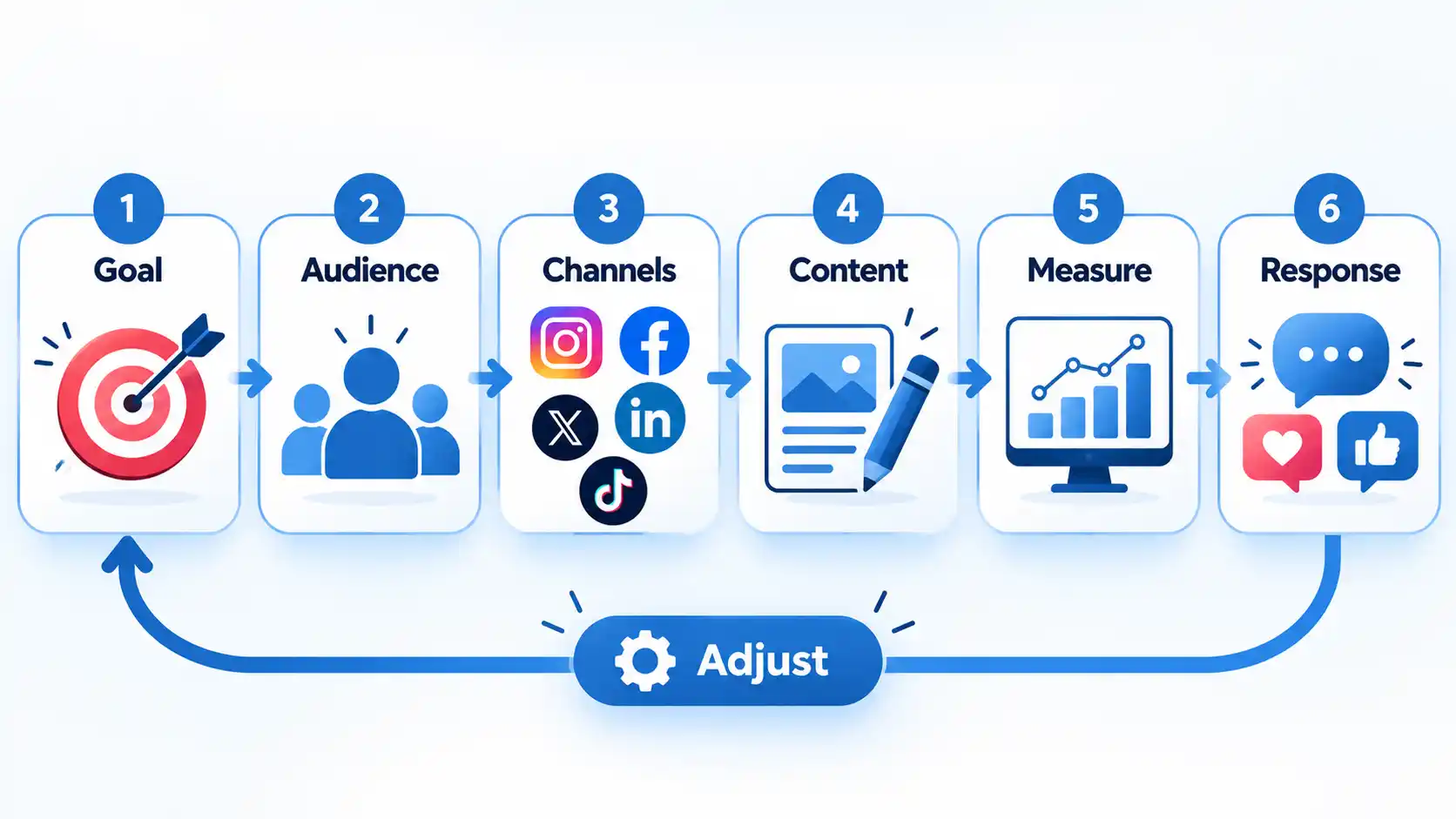
The loop matters because no first plan is perfect. Audience behavior changes, platforms change, business priorities change, and your own results give you better information over time. A strategy should therefore be stable enough to guide decisions but flexible enough to respond to evidence.
When deciding what to change, return to the original goal. If the goal is awareness, investigate whether the right people are seeing the content. If the goal is inquiries, look beyond views and ask whether interested people are taking the next step. If a platform repeatedly consumes time without contributing to the intended result, reconsider how much effort it deserves.
That approach is less exciting than chasing a new hack every week, but it produces something more useful: a social media process in which each activity has a reason, each measurement has a purpose, and each adjustment is based on what you have learned.

💬 Comments