In California, asking for sole custody may make sense when evidence shows that shared custody would not adequately protect a child’s safety, welfare, stability, or workable decision-making. No single circumstance automatically guarantees sole custody, and a judge must decide what arrangement serves the child’s best interests.
This article provides general information about California custody law, not legal advice for a specific case. Custody disputes are fact-sensitive, and additional rules can apply when domestic violence, an existing custody order, relocation, or another state’s jurisdiction is involved.
What “Sole Custody” Actually Means in California
Sole custody does not necessarily mean that one parent receives every parenting right while the other parent has no contact with the child. California separates custody into two questions: who makes major decisions for the child and where the child primarily lives.
Under California Family Code section 3006, sole legal custody gives one parent the right and responsibility to make decisions about the child’s health, education, and welfare. Under section 3007, sole physical custody means the child resides with and is supervised by one parent, subject to the court’s power to order visitation.
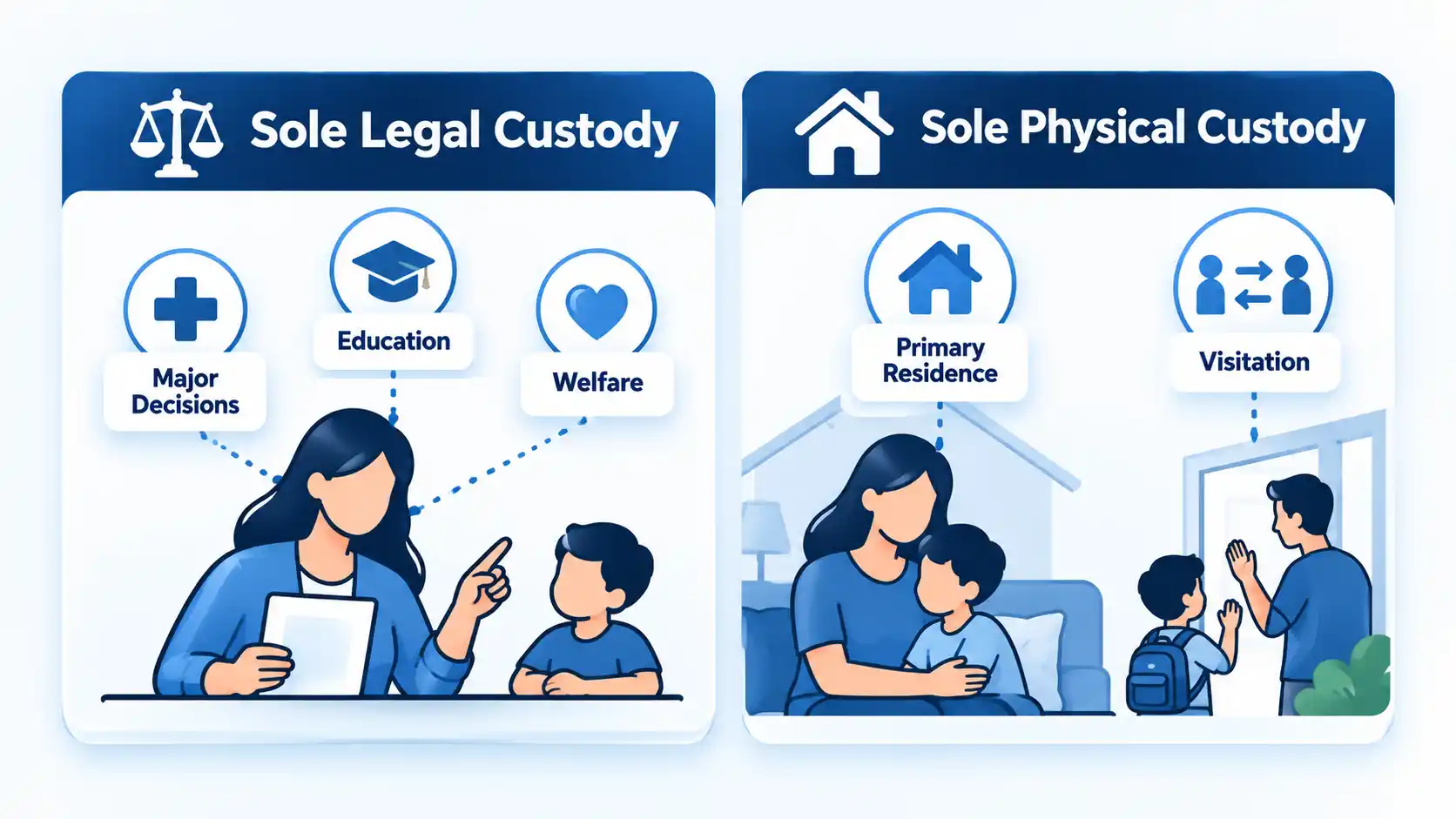
| Feature | Legal custody | Physical custody |
|---|---|---|
| Main question | Who makes important decisions about the child? | Where does the child live and who supervises the child? |
| Sole form | One parent has responsibility for decisions about the child’s health, education, and welfare. | The child resides with and is supervised by one parent. |
| Joint form | Both parents share responsibility for major decisions. | Both parents have significant periods of physical custody. |
| What it does not automatically decide | Sole legal custody does not by itself determine that the other parent can never spend time with the child. | Sole physical custody does not automatically eliminate visitation or terminate the other parent’s parental rights. |
California Courts also explains that legal and physical custody can each be sole or joint. The distinction matters because facts supporting sole decision-making authority may not be identical to facts supporting a request for the child to live primarily with one parent.
Custody terminology is not always used consistently across jurisdictions. For example, a resource discussing different types of physical custody uses terminology in the context of an Oklahoma family-law practice. California readers should rely on California statutes and California Courts for the definitions that govern a California case.
It is also useful to understand the broader differences between sole and joint custody in California. The practical consequences depend on whether the dispute involves major decisions, the child’s residence, parenting time, or more than one of those issues.
What California Courts Look At Before Ordering Sole Custody
A custody case is not decided simply by applying a label such as “unfit parent” or checking one item from a list. The court looks at the circumstances affecting the child and decides what custody arrangement serves the child’s best interests.
California Courts identifies factors including the child’s age and health, emotional ties with the parents, ties to home, school, and community, each parent’s ability to care for the child, family violence, and regular and ongoing substance abuse. The judge considers those circumstances in deciding what is best for the child.
The seven circumstances below are therefore reasons that may support considering a sole-custody request, not seven automatic legal grounds. The importance of each one depends on what happened, what reliable evidence supports it, how it affects the child, and what custody order is actually being requested.
7 Circumstances That May Support Asking for Sole Custody
Each circumstance below can affect child safety, caregiving, stability, parental contact, or the ability to make important decisions. They do not all carry the same legal effect. Domestic violence is subject to a specific California statute, while the other circumstances are generally assessed within the broader best-interest analysis.
1. Domestic Violence or Abuse Creates a Safety Concern
Domestic violence receives specific treatment under California custody law. The court must look beyond ordinary parental conflict and determine whether legally qualifying domestic violence occurred and how the custody rules that follow from that finding apply.
A rebuttable presumption is a legal starting rule that applies after a required finding has been made but can still be overcome with sufficient evidence. California Family Code section 3044 uses that type of presumption in qualifying domestic-violence cases.
If a court finds that a person seeking custody committed qualifying domestic violence within the previous five years, Family Code section 3044 creates a rebuttable presumption that awarding that person sole or joint legal or physical custody would be detrimental to the child’s best interests. An allegation alone does not automatically trigger the presumption; the statute requires a court finding.
The current California Family Code section 3044, operative January 1, 2026, states that the presumption may be overcome only by a preponderance of the evidence. In plain English, the person subject to the presumption must persuade the court, under the statute’s requirements, that the evidence is sufficient to overcome that starting rule.
California Courts explains the practical custody consequences of domestic violence and notes that the parent who committed abuse may still receive visitation, depending on what the court determines is safest and best for the child. Visitation can be supervised, and the court may order no visitation when even supervised contact would physically or emotionally harm the child.
If immediate safety is an issue, custody may also intersect with restraining orders, temporary orders, or supervised visitation in California. Those remedies answer different legal questions from the basic decision between sole and joint custody.
2. Serious Neglect or Unsafe Care Threatens the Child’s Welfare
Neglect can matter when specific failures in care or supervision affect the child’s health, safety, or welfare. The important question is not whether one parent considers the other irresponsible. It is what actually happened and how the conduct affects the child.
For example, repeated failures to provide necessary supervision or respond to a child’s essential needs can raise a more serious custody concern than a one-time disagreement about parenting style. California’s best-interest framework directs the judge to consider the child’s health and safety and each parent’s ability to care for the child.
A past problem should not automatically be treated as proof of what will happen in the future. A stronger factual presentation identifies the conduct, its effect on the child, whether the problem was isolated or repeated, and why the requested custody arrangement would address the concern.
3. Habitual Substance Abuse Interferes With Safe Parenting
Substance use becomes relevant to custody when it is regular or ongoing and affects the parent’s ability to care safely for the child. California Courts expressly lists regular and ongoing substance abuse by either parent among the matters a judge may consider.
That does not mean an allegation of alcohol or drug use automatically supports sole custody. The practical issue is whether reliable evidence connects the substance use to caregiving, supervision, judgment, transportation, or another responsibility affecting the child.
For example, evidence that a parent repeatedly becomes intoxicated while responsible for a child presents a different issue from an unsupported claim that the parent occasionally consumes alcohol. The focus should remain on provable conduct and its effect on parenting rather than on labels or moral judgments.
4. Abandonment or Prolonged Lack of Contact Leaves One Parent Functionally Absent
A long absence can matter when a parent has little or no meaningful contact with the child and has not been participating in caregiving or major decisions. The amount and nature of existing parent-child contact can be relevant to the court’s best-interest analysis.
The California Supreme Court’s decision in Bianka M. v. Superior Court involved unusual facts in which a child sought an order placing her in her mother’s sole legal and physical custody while alleging abandonment by her father. The decision confirms an important distinction: granting one parent sole legal and physical custody does not itself terminate the other parent’s parental rights.
That distinction matters in more ordinary custody disputes too. A sole-custody order determines custody. Termination of parental rights is a separate legal matter, and an absent parent should not be described as automatically losing all parental status merely because the other parent receives sole custody.
5. A Parent Cannot Reliably Exercise Custody or Major Decision-Making
Some custody disputes involve a demonstrated inability to supervise a child safely or make necessary decisions rather than deliberate abuse or misconduct. The legally relevant concern is how the circumstances affect parenting and the child’s welfare.
A mental-health diagnosis by itself does not establish that a parent is unsafe or incapable of parenting. The useful question is whether reliable evidence shows that the parent’s actual condition or conduct interferes with supervision, important decisions, or the child’s health, safety, or welfare.
For example, repeated episodes that leave a child without adequate supervision may matter because of their effect on caregiving. The analysis should remain tied to observable parenting consequences rather than assuming incapacity from a diagnosis alone.
6. Severe, Persistent Conflict Makes Joint Legal Decision-Making Unworkable
Parents do not need to agree about everything for shared parenting to work. Conflict becomes more significant when it repeatedly prevents important decisions about the child’s health, education, or welfare.
Because legal custody concerns major decision-making, the practical question is whether shared authority can function in the child’s interests. One disagreement about a school activity is different from an ongoing pattern in which necessary medical care, school enrollment, therapy, or another major matter cannot be resolved.
California Courts illustrates the importance of workable communication in its explanation of open-ended “reasonable” visitation: that arrangement works when parents can communicate and be flexible, but frequent disagreement can create problems. That guidance does not establish an automatic rule that poor communication requires sole legal custody. It does show why the ability to cooperate can matter when an arrangement depends on continuing coordination.
A custody argument based on conflict is therefore stronger when it identifies the concrete effect on the child rather than merely showing that the parents have a difficult relationship.
7. A Major Relocation Creates a Genuine Custody Conflict
A move to another city, state, or country does not automatically mean that either parent should receive sole custody. Relocation cases depend heavily on the existing custody order, the actual parenting arrangement, the proposed distance, and the effect of the move on the child.
California Courts explains that a move may require a court order when it would interfere with an existing custody and parenting-time order. The court first considers whether the parent seeking to move has sole or joint physical custody and whether the existing custody order is permanent.
California Courts states that, with a permanent sole physical custody order, a judge will typically allow the custodial parent to move unless the other parent shows that the move would harm the child. With joint physical custody, the parent seeking to move generally must show that relocation is in the child’s best interests. If there is no permanent custody order, the judge decides the issue based on the child’s best interests without an assumption based on sole or joint physical custody.
The court can also consider factors such as the distance of the move, the current custody arrangement, the child’s relationship with each parent, the parents’ relationship, and the child’s age. Relocation is therefore a reason to reassess custody when the move creates a real conflict, not an automatic route to sole custody for either parent.
What Evidence Matters When You Ask for Sole Custody
Courts decide custody from facts and evidence, not from the strength of a label. A useful request identifies the order being requested, explains why it serves the child’s best interests, and connects the supporting evidence to the facts that matter.
California Courts explains that a parent using a Request for Order, form FL-300, can tell the judge what custody orders they want and why those orders are in the child’s best interests. The form also provides space for the facts supporting the request.
Potential evidence depends on the dispute. California Courts states that a party may submit documents or other evidence, including witness statements, to support a Request for Order or a response. Its guidance on submitting evidence for a family-law hearing also explains that documents and declarations generally need to be filed and served before the hearing for the judge to consider them.
The important point is relevance. A message, document, or witness statement is useful only if it helps establish a fact that matters to the requested order. Filing rules, evidentiary rules, and the weight given to particular evidence can vary with the circumstances.
For another general discussion of preparing a sole-custody case, this resource on how to get sole custody in California discusses gathering evidence and working with counsel. Its legal claims should not replace current California statutes or California Courts guidance.
Deciding whether to request sole custody is also different from completing the filing process. The California sole-custody request process can involve court forms, supporting facts, service, mediation or child custody recommending counseling, and a hearing depending on the case.
Sole Custody Does Not Necessarily Mean No Contact
One of the most important limits to understand is that sole custody and no contact are not the same thing. A court can award one parent sole legal custody, sole physical custody, or both while still ordering parenting time for the other parent.
California’s statutory definition of sole physical custody expressly leaves the court with power to order visitation. California Courts also describes scheduled, reasonable, supervised, and no-visitation orders, with the choice depending on what is appropriate for the child.
The California Supreme Court made the distinction clear in Bianka M.: awarding sole legal and sole physical custody to one parent does not itself terminate the other parent’s parental rights. Custody orders also can be modified when the governing legal requirements for modification are met.
This distinction affects what a parent may need to request. If the concern is unsafe unsupervised contact, for example, supervised visitation or another safety-focused order may address a different part of the problem than the legal or physical custody designation itself.
The Bottom Line
A request for sole custody in California is strongest when it is tied to the child’s best interests rather than simply to conflict between the parents. The relevant question is whether sole legal custody, sole physical custody, or both would better address a demonstrated issue involving safety, welfare, caregiving, stability, contact, or important decision-making.
Domestic violence can trigger a specific statutory presumption. Neglect, habitual substance abuse, prolonged absence, demonstrated inability to exercise custody safely, severe decision-making conflict, and relocation can also matter when the evidence connects them to the child’s circumstances. None of those labels substitutes for the underlying facts.
Before requesting a particular order, identify which type of custody is actually at issue, what problem the order is intended to address, and what reliable evidence supports that connection. For case-specific advice, especially when domestic violence, interstate relocation, existing orders, or urgent safety concerns are involved, a qualified California family-law attorney or a California court self-help center can explain how the rules apply to the particular case.






💬 Comments