Fintech is changing money management by making financial information easier to see, money faster to move, and routine decisions easier to automate. Those benefits come with an important trade-off: you may also depend on more software, data connections and companies between you and the institution that actually holds or manages your money.
Quick Take
The biggest change is not simply that banking moved onto phones. Fintech changes the speed, visibility, automation, access and intermediary structure of personal finance, so the useful question is not only what an app can do, but also what data it uses, who holds the money and what protections apply when something goes wrong.
What Fintech Means for Everyday Money Management
Financial technology, usually shortened to fintech, is the broad category of financial products and services that use digital technology to deliver, automate or reshape financial activity. That includes far more than mobile banking. Federal research on fintech covers products such as digital deposit services, technology-enabled credit and other digitally delivered financial products and services.
In practice, fintech now spans consumer apps, payment systems, digital lending, investment tools and the wider financial technology ecosystem. The useful way to understand the change is to look past the individual app and ask what part of money management has become faster, more visible, more automated or accessible through a different intermediary.
A banking app, for example, may let you view a balance and transfer money without visiting a branch. A budgeting service may combine transactions from several institutions. An investment service may turn questionnaire answers into an automatically managed portfolio. A lending service may move an application and repayment schedule into an online checkout flow. These products solve different problems, but they all shift some part of financial activity into software.
The table below shows the main changes at a glance. The later sections explain why each change matters and where the trade-offs appear.
| Money-management area | What fintech changes | Practical benefit | Important constraint |
|---|---|---|---|
| Banking and payments | Access and transaction speed | Accounts and some transfers can be managed digitally at any time | Speed can leave less time to catch a mistaken or fraudulent payment |
| Budgeting and cash flow | Visibility across accounts | One service can organize data from multiple financial accounts | The service may require continuing access to sensitive financial data |
| Saving and investing | Automation | Rules and algorithms can handle recurring tasks or portfolio management | Automated decisions are limited by the information and assumptions used |
| Credit and financial access | Application and delivery friction | Some services become easier to apply for or use online | Easier access does not remove repayment obligations, fees or product risk |
| Financial-service relationships | Intermediation | A specialized app can provide a simpler interface to financial services | The company operating the interface may not be the institution holding the funds |
This distinction becomes important because convenience at the interface does not necessarily change the underlying financial product. A loan is still debt. An investment can still lose value. A deposit still depends on where it is actually held. Fintech changes how those products are reached and managed more often than it changes those basic facts.
How Fintech Changes Everyday Banking and Payments
The most visible fintech change is that many banking tasks no longer depend on branch hours. Account balances, transfers, card controls, deposits and bill payments can often be handled through a website or mobile app. The deeper change is that some payment infrastructure now supports money movement on a much shorter timetable.
The Federal Reserve’s FedNow Service is one example. Participating banks and credit unions can use the system to support payments that can reach recipients within seconds at any time of day. FedNow is infrastructure for financial institutions, not a Federal Reserve consumer app. Whether a customer can use a FedNow-enabled payment service depends on what their bank or credit union offers.
That distinction matters because a slick payment interface and the network moving the money are different layers. A person may tap one button in an app while several institutions or systems handle the authorization, transfer and account update behind it.
Faster payments can reduce the inconvenience of waiting for funds, particularly when timing matters for bills, payroll or transfers between people. Speed also changes the error window. If you type the wrong recipient or respond to an impersonation scam, a fast digital payment may leave little time to recognize the problem before the money moves.
Before sending money through a payment app, confirm the recipient independently when a request is unexpected. The Federal Trade Commission recommends double-checking the recipient before submitting a payment and verifying surprising requests with the person they supposedly came from.
The practical shift is therefore broader than “payments are more convenient.” Fintech can compress the time between deciding to move money and completing the transaction. That makes verification before the final tap more important, not less.
How Connected Financial Data Changes Budgeting and Cash Flow
A second change is visibility. Money is often spread across a checking account, savings account, credit card, loan and investment account. A financial app can be more useful when it can organize information from several of those places instead of making you check each account separately.
An application programming interface, or API, is one common way software systems exchange information under defined rules. In a financial setting, a consumer may authorize one service to obtain eligible information from another provider so that transactions, balances or other account details can appear in a consolidated dashboard.
That can turn budgeting from a manual reconstruction exercise into an ongoing view of cash flow. A tool may categorize spending, identify recurring charges or show how several accounts affect the same monthly budget. The benefit comes from reducing fragmentation, not from making the underlying accounts disappear.
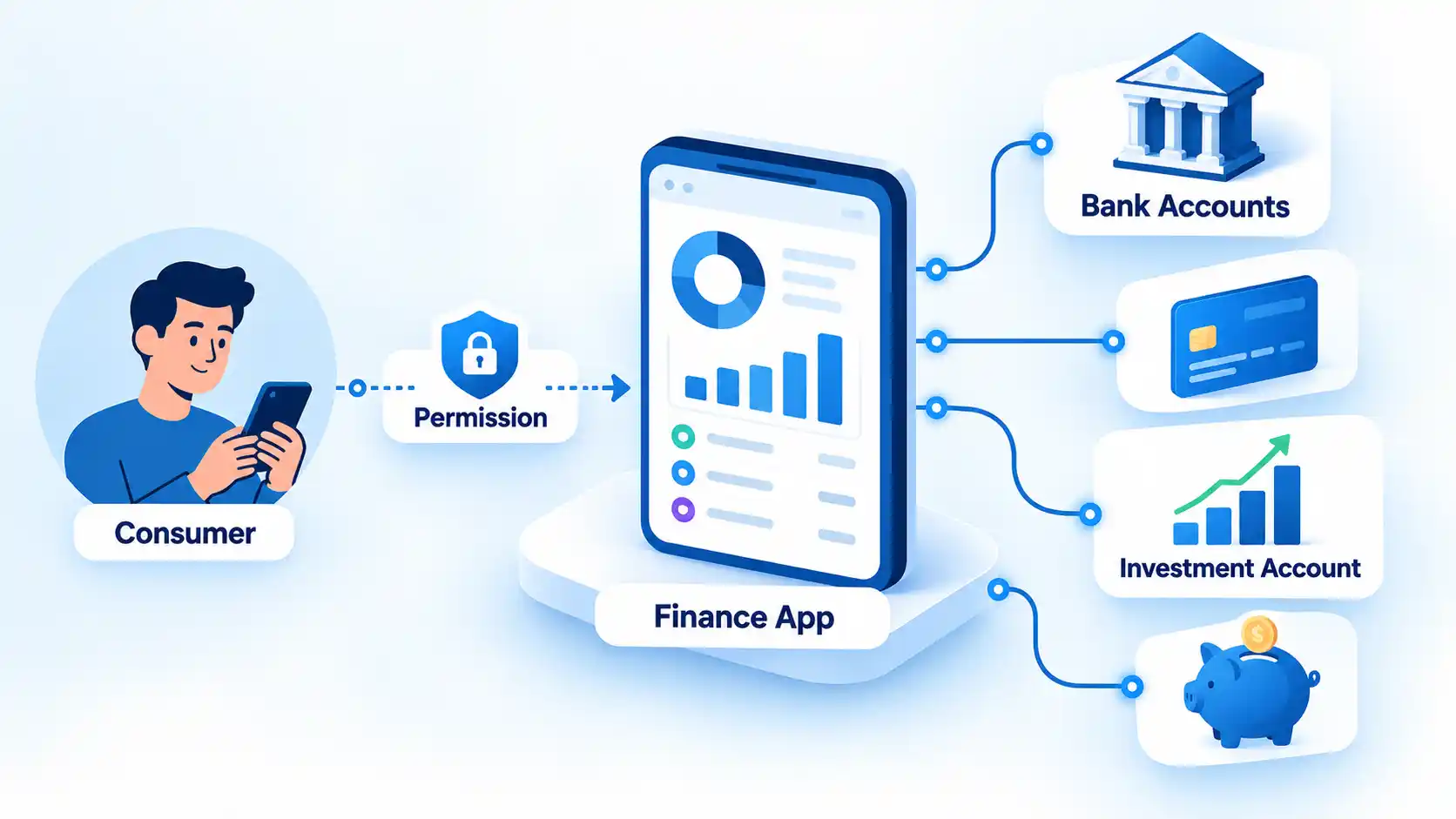
Permission is part of the financial decision. Before connecting an account, it is worth knowing what information the service requests, what it needs that information for, how long access lasts and whether you can revoke the connection. Consolidating information can improve visibility while also concentrating sensitive financial data in another service.
In the United States, open banking and Section 1033 are closely related to the broader question of consumer-authorized financial data access. The Consumer Financial Protection Bureau’s Personal Financial Data Rights Rule implements Section 1033, but its compliance dates were stayed by a federal court on October 29, 2025. The CFPB has also been reconsidering aspects of the rule.
That means an older implementation schedule should not be treated as a current deadline. The stable idea is that consumer-authorized data portability can make financial information more usable across services; the precise U.S. regulatory timetable remains a moving part.
How Automation Changes Saving and Investing
Fintech can do more than display information. It can act on rules or recommendations with less manual work from the user. Simple examples include categorizing transactions, scheduling recurring transfers or moving a chosen amount into savings on a regular basis.
Robo-advisers move much of the investment-advice workflow into software. A typical service asks about factors such as financial goals, investment time horizon, income, other assets and tolerance for risk, then uses those inputs to create or manage an investment portfolio. Services are not interchangeable: their investing approaches and access to human professionals can differ.
This creates a useful boundary for automation. A repetitive task with clear rules, such as transferring a fixed amount after payday, is different from a recommendation that depends on a complete picture of your finances. If an automated adviser has not asked about an important debt, outside account or financial goal, it cannot incorporate information it never received.
The same issue applies when using AI for personal finance. AI can help sort information or explain concepts, but generated answers can be incomplete or wrong. Current consumer-finance guidance recommends verifying AI-generated financial information before acting on it, particularly when the decision affects investments or other consequential choices.
Automation therefore changes the amount of effort required, not the importance of the decision. A useful system can handle repetitive work while still leaving the user responsible for checking the assumptions behind higher-stakes recommendations.
How Fintech Changes Access to Credit and Financial Services
Digital delivery can also reduce some of the friction involved in obtaining financial products. An application that once required a branch visit or paper form may be completed online, and services designed around smartphones can reach people who prefer digital access or who have limited access to traditional branches.
This is one reason fintech is often discussed in connection with financial inclusion. The GAO has found that technology-based financial products can offer benefits to consumers who face barriers to traditional accounts or credit, while also warning that those products can introduce costs, disclosure problems and other risks. In other words, expanded access and consumer risk can exist at the same time.
Buy now, pay later, or BNPL, is a useful example because the checkout experience can make borrowing feel almost like another payment method. A typical BNPL arrangement is a short retail loan repaid in four payments without interest. The CFPB’s latest market report found that the large-provider BNPL market it studied continued to expand between 2019 and 2023.
The lower-friction interface does not change the basic decision: the customer is taking on an obligation to repay. Someone comparing a digital credit product still needs to understand the repayment schedule, fees or penalties where applicable, what happens after a missed payment, and how the obligation fits alongside other debt.
That principle applies beyond BNPL. Fintech may simplify applications, identity checks, account opening or disbursement, but simpler access should not be confused with a guarantee that the product is inexpensive, appropriate or risk-free.
Where Fintech Creates New Risks
Fintech adds risk when the service introduces another company, data connection or software dependency between you and the underlying financial product. The most important question is often not whether an app looks trustworthy, but what legal and operational role the company behind it actually plays.
A fintech company can provide an account-like interface without itself being a bank. It may arrange for customer funds to be placed at one or more banks. That distinction affects what deposit insurance can and cannot protect.
Warning
A nonbank fintech company is not FDIC-insured simply because it works with an insured bank. FDIC deposit insurance protects eligible deposits when the applicable conditions are satisfied; it does not insure you against the insolvency or bankruptcy of the nonbank fintech itself.
For money sent through a nonbank service, eligibility for pass-through deposit insurance can depend on where the funds are placed and whether required ownership records and other conditions are met. The FDIC therefore recommends identifying the specific insured bank behind a fintech’s deposit arrangement and makes clear that nonbank companies themselves are never FDIC-insured.
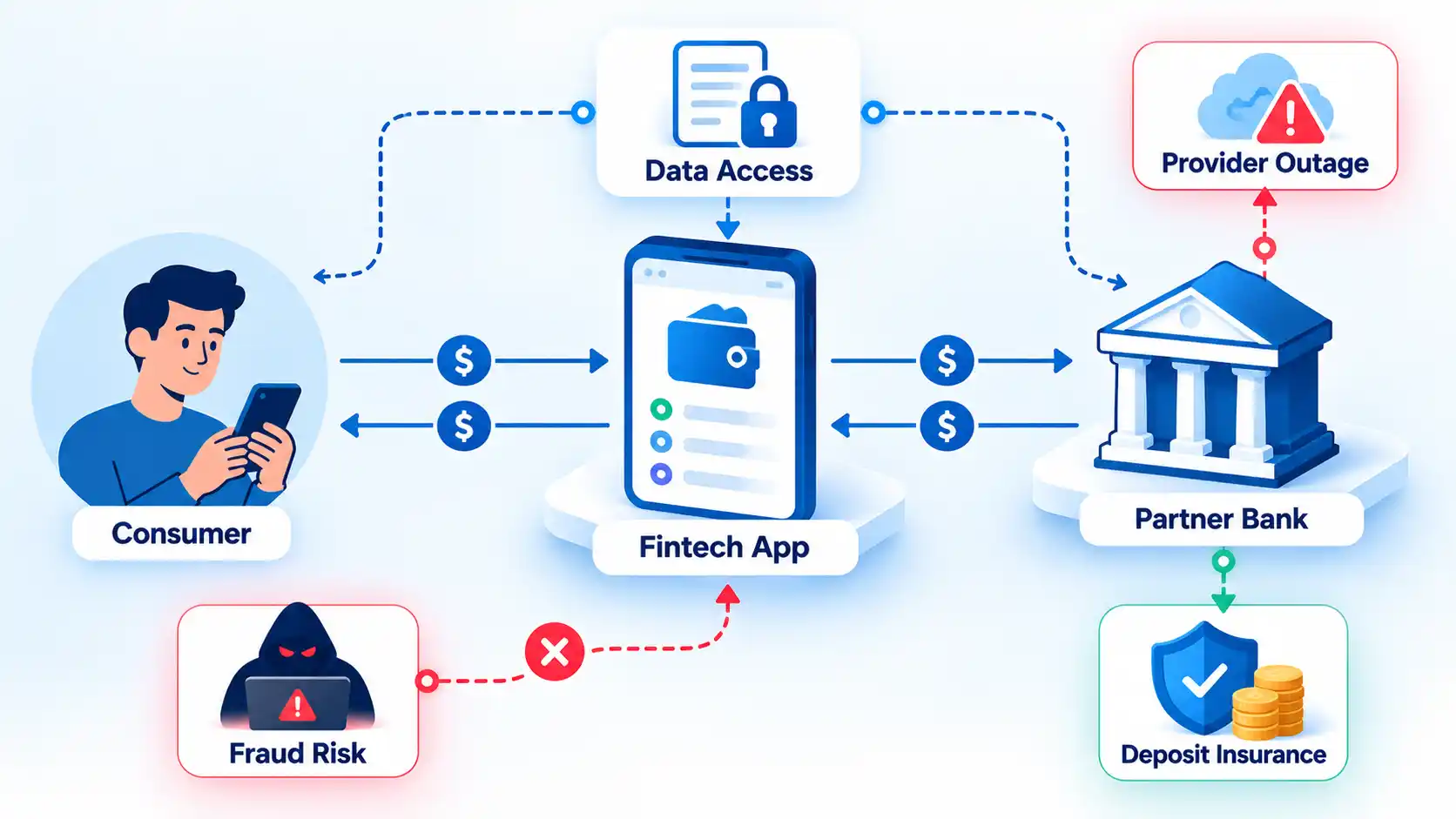
Before leaving important day-to-day funds with a nonbank service, check whether funds routed through a fintech app may qualify for FDIC insurance by identifying the bank that is supposed to receive the deposit and reading the account terms carefully. The fintech brand shown in the app is not enough by itself to establish deposit-insurance status.
Data access creates another dependency. A budgeting or financial-assistant service may need transaction histories and account information to perform its job. The more sensitive the information, the more important it is to know what is being shared, how the service secures it and how access can be withdrawn.
Operational failures matter too. An app outage can temporarily block access to an interface even when the underlying bank is functioning. A broken data connection can make a budgeting dashboard incomplete. A bad automated classification can distort a spending picture. These are not arguments against fintech; they are reminders that software reliability becomes part of the financial experience.
Digital financial services also place more responsibility on the consumer to recognize scams and misleading interfaces. A 2024 GAO forum found that the growth of digital financial products has changed both consumers’ opportunities and risks, increasing the importance of digital financial literacy for informed decisions.
A Practical Trust Checklist for Fintech Tools
A useful fintech service should make an existing financial task clearer, faster or easier without making the important parts of the arrangement impossible to understand. Before connecting accounts, moving significant money or accepting automated financial recommendations, work through the questions that fit the product.
- Who is providing the financial product? Identify whether you are dealing with a bank, credit union, registered investment adviser, lender or nonbank technology company, and do not assume the app’s brand name tells you who holds the money.
- Where will your money actually be held? If a nonbank fintech says funds are placed at an insured bank, identify that bank and read how the deposit arrangement works.
- What data are you authorizing the service to access? Look for the categories of information requested, why they are needed and whether access can be revoked.
- What happens if the software fails? Consider how you would access funds, records or support during an outage or broken account connection.
- How final is a payment? For fast person-to-person transfers, verify the recipient before sending rather than treating reversal as the safety mechanism.
- What financial obligation are you accepting? For loans or BNPL products, read the repayment schedule and applicable costs instead of judging the product by how quickly checkout is completed.
- What information drives an automated recommendation? For investment or financial-planning tools, check what the system asks about and whether important parts of your financial situation fall outside that input.
- When should a person review the decision? The more the outcome depends on taxes, debt, investing, legal rights or unusual personal circumstances, the less sensible it is to rely on automation without checking the result.
These questions are intentionally broader than a security checklist. Encryption and account authentication matter, but trust also depends on the financial structure behind the software: custody, permissions, obligations, recovery options and accountability.
What Fintech Changes—and What It Does Not
Fintech has changed personal money management most clearly by reducing friction. Accounts can be monitored from a phone, some payments can move within seconds, financial data can be brought into one view, repetitive tasks can be automated, and products can be delivered without a traditional branch interaction.
What fintech does not remove are the underlying financial consequences. Debt still has to be repaid. Investments still involve risk. Deposit protection still depends on the actual banking arrangement. Data access still creates privacy and security decisions. Automated advice is still limited by the information and assumptions behind it.
The most useful way to evaluate a fintech tool is therefore to look at two layers at once: what the software makes easier, and what remains true underneath the interface. A service is easier to judge when you can identify both.

💬 Comments