Most store owners treat branding as a design task. Pick a logo, choose two colors, buy a font, done. That approach explains why so many online stores look interchangeable, and why so many of them compete on price alone. E-commerce branding is the deliberate shaping of how customers perceive your business across every touchpoint: your storefront, your product pages, your emails, your packaging, and the tone of your support replies. BigCommerce defines it as the work of shaping customer perception through visuals, voice, values, and experience. The logo is one small artifact of that work.
Quick Take
Treat your brand as the reputation layer of the store and marketing as the machinery that delivers people to it. Nail down who you serve and why you win before you touch a typeface, then run the six-step build in order and audit every channel against it on a schedule. The reward is trust that shortens the first purchase and lets you hold a higher price.
What E-Commerce Branding Actually Is
A brand is what other people think of your business. The Retail Exec puts it with a borrowed line from a famous founder: a brand for a company is like a reputation for a person. You earn it by doing hard things well, repeatedly, in public. E-commerce branding is the work of getting people to think about you in the first place, and then to think well of you.
That definition has a useful consequence. If branding is reputation, then it lives in the customer’s head, not in your design file. A logo, a color palette, and a typeface can contribute to perception, but they are not the thing itself. What actually forms the bond is how the customer feels each time they interact with you: the clarity of a product page, the speed of a reply, the surprise of a well-designed unboxing.
Info
Branding is often mistaken for a logo, a color palette, or typography. Those elements support perception, but the brand itself is the accumulated feeling a customer carries away from every interaction with your store.
The concept has also shifted over time, which explains why modern branding feels so intangible. Early twentieth-century brands like Coca-Cola and Procter & Gamble sold functional benefits: quality, reliability, efficacy. From the 1960s onward, branding moved toward social and status meaning, the feeling a product conferred on the person holding it. Today’s e-commerce brands inherit both layers. Shoppers still want to know the product works, but they also want to know what buying it says about them.
Why Branding Pays Off
Branding is easy to dismiss as soft until you look at what it does to the economics of a store. BigCommerce reports that 68% of shoppers will pay more for products from brands they trust. The same vendor-published research breaks trust down into drivers: 67% of shoppers cite product quality and value, 63% point to brand reputation, and 54% highlight customer experience. Shoppers in some markets, including Australia, say they will pay an average of 25% more for their favorite brands. And 64% of Americans say they would pay more for brands that reflect their values, a figure that rises to 79% among Gen Z.
Read those figures as directional. They come from a commerce platform with an interest in selling branding as a growth lever, and survey intent does not always survive contact with a checkout page. The direction still matches how stores behave in practice: trust reduces the friction of a first purchase, which lowers what you have to spend to acquire a customer, which in turn makes loyalty programs and repeat-purchase economics work.
Success
The practical payoff chain: consistent brand → faster trust → lower acquisition cost → room to charge a premium → margin to reinvest in product and retention. Break any link and the whole chain weakens.
There is a market-scale reason to care now, too. BigCommerce notes that global internet users rose from 5.3 billion in 2023 to 5.5 billion in 2024, and that global retail e-commerce revenue is expected to grow from $4.12 trillion in 2024 to $6.49 trillion by 2029. More buyers, more stores, more noise. In a market that large, being forgettable is the expensive option.
The Core Elements of an E-Commerce Brand
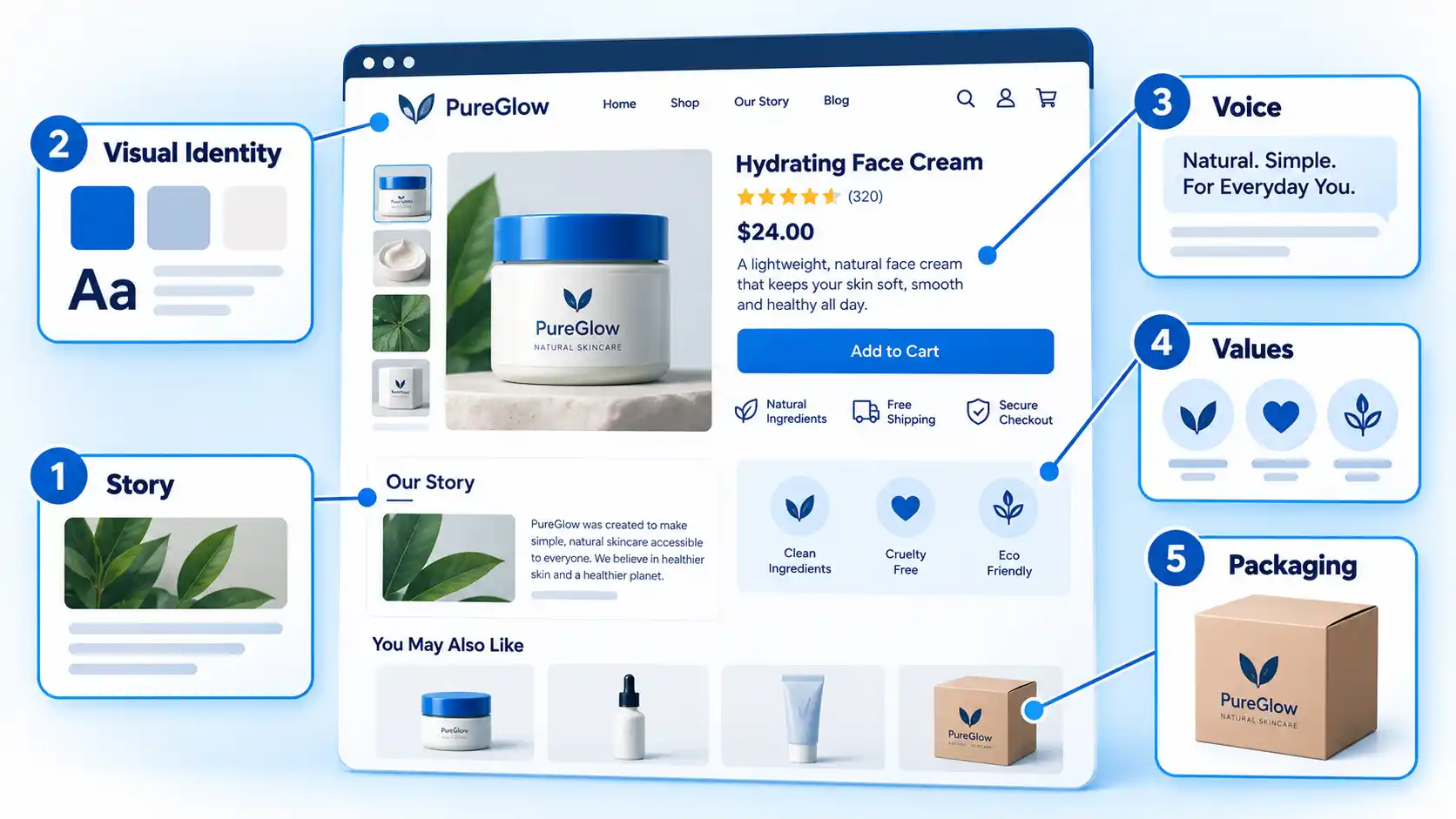
BigCommerce identifies five core elements that make up an e-commerce brand. Treat them as a checklist rather than a menu, because most weak brands are missing at least two of them.
| Element | What it covers | Where it shows up |
|---|---|---|
| Purpose and values | Why the business exists beyond selling; the principles that guide decisions | About page, sourcing claims, cause messaging, hiring |
| Visual identity | Logo, color palette, typography, photography style, layout system | Storefront, product pages, ads, social, packaging |
| Brand voice | Tone, vocabulary, and personality in written communication | Product copy, emails, support replies, social captions |
| Brand story | The narrative of origin, mission, and customer transformation | Homepage, About page, launch emails, press |
| Packaging | Unboxing experience, inserts, materials, and physical touchpoints | Delivery, returns, gifting, social unboxing content |
Only one of the five is purely visual. The other four are about meaning, language, and experience, which is why a redesign alone rarely fixes a brand that customers do not trust.
Build a brand that stands out online, in order
The sequence matters. Positioning decided before research is guesswork, and a style guide written before positioning locks in the wrong look. Work through these six steps in order and verify each one before moving on.
- Conduct thorough market research. Map your competitors, your category conventions, and your customer’s actual language. Read reviews of competing products, scan support forums, and pull search terms people use to describe the problem you solve. Checkpoint: you can name three things every competitor does and at least two conventions you could credibly break.
- Define your positioning. Write one sentence that states who you serve, what you offer, and why it beats the alternative. Positioning is a decision, not a slogan, and it should force you to decline some customers. Checkpoint: a stranger can repeat your positioning back to you after hearing it once.
- Document a brand style guide. Capture the logo usage rules, color values, type scale, photography direction, and voice principles in a single document your team and any freelancer can follow. Checkpoint: a new contractor can produce an on-brand asset without asking you a question.
- Tell your story. Write the origin, the mission, and the customer transformation in plain language. Put it on the homepage and the About page, and reuse it in launch emails. Checkpoint: a first-time visitor can explain what you stand for after thirty seconds on the homepage.
- Invest in visuals. Commission or shoot product photography, lifestyle imagery, and packaging that match the style guide. Consistency across the catalog matters more than any single hero shot. Checkpoint: a grid of twelve product images looks like it came from one store.
- Stay consistent. Audit every channel (storefront, email, social, support, packaging) against the style guide on a fixed schedule. Consistency is the step most brands abandon first, and it is the one that compounds. Checkpoint: the tone of a support reply is recognizably the same brand as the homepage headline.
Verify the result
- A stranger can describe your brand in one sentence after browsing your store for a minute.
- Your homepage, product pages, emails, and social posts share a recognizable voice and visual system.
- Your style guide exists as a document, not as tribal knowledge in one person’s head.
- Packaging and post-purchase communication carry the same brand as the storefront.
- You can point to at least one category convention you deliberately break.
Making It Consistent: Brand Voice and Knowing Your Audience
Consistency is where most brands leak value. Firework’s branding playbook puts establishing a strong brand voice first among its strategies, and the mechanics are unglamorous: define your tone and style, write brand guidelines that include on-brand phrases and words to avoid, and maintain uniformity across your website, social media, emails, and customer support. Then tailor the delivery to your audience using surveys, analytics, and customer feedback.
That last part matters more than it sounds. Firework’s tenth strategy is simply to speak your customers’ language, since connecting with your audience is the foundation of a strong e-commerce brand. The practical version: build buyer personas from real data. Demographics, psychographics, and online behavior pulled from past purchases, website analytics, and customer surveys will tell you which words your customers use and which channels they actually live on. Then use those words back at them.
- Write the tone decision down (formal, casual, friendly, or professional) and defend it in the style guide.
- Keep a running list of on-brand phrases and a banned-words list; both are more useful than abstract adjectives.
- Apply the same voice to support replies, because that is where trust is won or lost fastest.
- Review customer reviews and comments monthly and feed the language back into product copy.
If you are running an e-commerce business across several channels, the voice guide is the single document that keeps a paid ad, an abandoned-cart email, and a returns policy sounding like the same company. If the numbers side of the operation is where your attention keeps slipping, a specialist Fully Accountable can take bookkeeping and cash-flow reporting off your plate so the brand work gets your actual focus.
And when you need to pitch the brand to a retailer, an investor, or a wholesale partner, a presentation company can turn the style guide into a deck that looks like the store rather than a generic template.
Common Misconceptions and Real Constraints
The most expensive misconception is that branding is a one-time design project. It is an operating discipline. A rebrand that is not followed by consistent execution across product pages, emails, and support will decay within a quarter.
The second is that branding guarantees sales. It does not. Branding is slow, hard to measure directly, and it does not substitute for product quality, competitive pricing, or traffic. A store with a beautiful identity and no visitors sells nothing. A store with mediocre design, a great product, and loyal customers can thrive for years. Branding amplifies a working business; it does not rescue a broken one.
Warning
Do not treat vendor-published statistics as independent research, and do not chase trends at the expense of consistency. A brand that changes its look every season trains customers to stop recognizing it.
Customers say the store looks “generic” or “like every other shop.”
This is usually a positioning failure, not a design failure. Return to step two: if your one-sentence positioning could describe three competitors, the visual system has nothing distinctive to express. Fix positioning first, then revisit typography, color, and photography.
The brand looks consistent on the homepage but falls apart in email and support.
The style guide is incomplete or unenforced. Add voice examples, a banned-words list, and email templates to the guide, then audit support macros against it. Consistency breaks at the edges of the organization, not the center.
Traffic is rising but conversion and repeat purchase are flat.
You may be attracting unqualified visitors. BigCommerce notes the goal is highly relevant visitors likely to convert, not raw volume. Tighten targeting and check whether first-time visitors can understand what you stand for within seconds of landing.
Where Branding Meets Traffic and Marketing
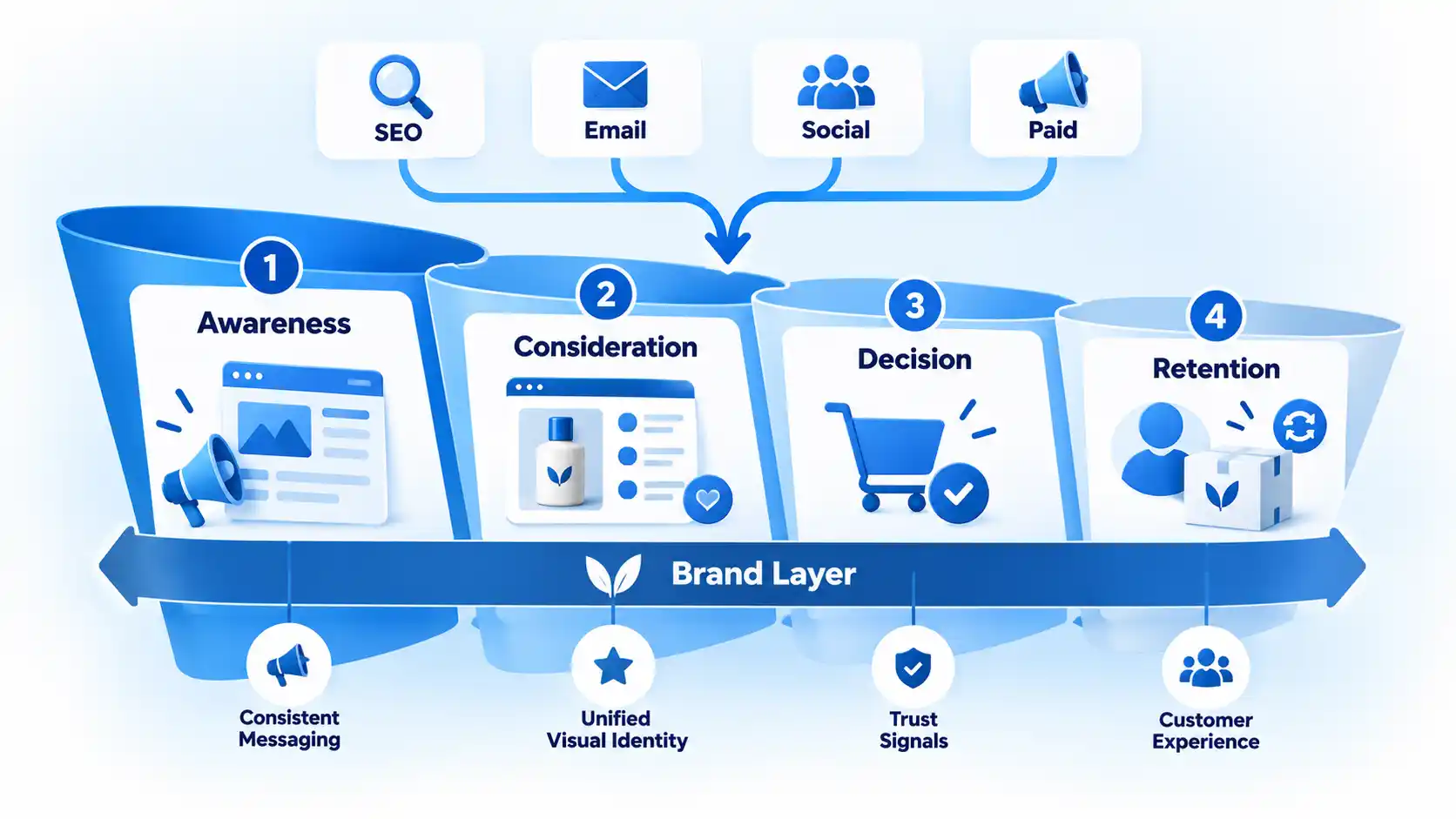
Branding and marketing are different jobs that share a customer. WordStream frames e-commerce marketing as a system of paid and unpaid strategies that attract shoppers, convert them, retain them, and optimize with data and testing. Branding is the perception layer that makes each of those stages cheaper and more effective. Marketing puts people in front of your store; branding decides whether they trust it when they arrive.
The channel list is where the two meet. BigCommerce identifies the branded storefront, SEO, content, social media, and email as the channels that carry a brand to customers. Each one is also a traffic source, which is why brand work and acquisition work should be planned together rather than by separate teams. The traffic numbers make the stakes concrete: 54.4% of all clicks go to the top three Google results, and smartphones accounted for 77% of retail website traffic globally in the third quarter of 2024. If your brand is not recognizable in a mobile search result, you are competing on price against everyone else in the top three.
The market context reinforces the point. Dash’s e-commerce experts observe that brands in 2026 face higher acquisition costs, a crowded marketplace, and more selective shoppers, with a shift toward retention and lifetime value over pure acquisition, and toward owned relationships like email, loyalty, and communities over rented platforms. They also note that shoppers rarely buy on a first visit; they need time to build trust and do their own research across the awareness, consideration, and later stages. A consistent brand is what makes that multi-touch journey cohere.
If you are assembling the operational side of this, our guide to tools for e-commerce businesses covers the stack that supports storefront, email, and analytics work. And if you are still deciding how much of your budget belongs to brand-building versus direct response, the comparison in traditional vs digital marketing is a useful frame for where each channel fits.
The Bottom Line
E-commerce branding is reputation management at storefront speed. It is built from purpose, visuals, voice, story, and packaging, assembled through a six-step process that starts with research and ends with the discipline of consistency. The payoff is real but indirect: trust that lowers acquisition costs, supports premium pricing, and earns repeat purchase. The constraint is equally real. Branding is slow, hard to measure, and useless without a product worth recommending and traffic worth converting.
Start with the definition correction. If your current brand plan is a logo and a color palette, you have a design system, not a brand. Go back to step one, write down who you serve and why you beat the alternative, and let the visuals follow. Then audit every touchpoint against that decision once a quarter. That is the whole job, and it is the one most competitors will not do.
Key Takeaways
- Branding is customer perception across every touchpoint; a logo is one artifact of it, not the whole.
- The payoff chain runs from trust to lower acquisition cost to premium pricing, with vendor statistics treated as directional.
- Five core elements: purpose and values, visual identity, brand voice, brand story, and packaging.
- The six-step build process is sequential: research, positioning, style guide, story, visuals, consistency.
- Consistency across storefront, email, social, and support is where most brands leak value.
- Branding amplifies a working business; it does not substitute for product quality or traffic.