Digital marketing usually gives businesses more precise targeting, faster campaign adjustments, and more detailed measurement, while traditional marketing can be stronger when physical presence, local visibility, or offline audience habits matter. The better choice depends on your audience, objective, geography, budget structure, and how closely you need to measure individual responses.
Traditional vs Digital Marketing at a Glance
Traditional marketing primarily reaches people through offline media such as direct mail, print, radio, television, signs, billboards, and physical promotional materials. Digital marketing reaches people through internet-connected channels such as search engines, websites, email, social platforms, display advertising, and online video.
The distinction is useful, but neither category works in exactly the same way across every channel. A neighborhood mail campaign behaves differently from national television advertising, just as an email newsletter behaves differently from paid search. The table below highlights the broad differences businesses usually need to consider.
| Factor | Traditional Marketing | Digital Marketing |
|---|---|---|
| Common channels | Direct mail, print, radio, television, billboards, signage, events | Search, websites, email, social media, online video, display ads, content |
| Audience targeting | Often based on geography, publication, station, event, mailing list, or audience profile | Can use keywords, audience segments, interests, behavior, demographics, and prior interaction |
| Geographic control | Can be highly local or broad depending on the medium | Can usually be configured from local areas to national or international campaigns |
| Interaction | Often requires a second action such as calling, visiting, scanning, or searching | Users can often click, sign up, buy, message, or download directly |
| Measurement | Often relies on response codes, surveys, calls, geographic comparisons, or sales changes | Can record impressions, clicks, conversions, engagement, and other defined events |
| Campaign changes | Can be difficult after printing, distribution, production, or media booking | Budgets, creative, bids, targeting, and landing pages can often be changed while campaigns run |
| Attribution | May be difficult to connect an individual exposure directly to a sale | Usually offers more granular attribution, although tracking gaps still exist |
| Physical presence | Strong for signage, mail, events, packaging, and other tangible exposure | Primarily screen-based, although it can lead customers to physical locations |
| Best fit | Local visibility, physical environments, offline audiences, broad awareness | Search demand, e-commerce, lead generation, testing, segmentation, measurable actions |
The main lesson is that these are tendencies rather than fixed rules. Traditional media can be carefully targeted, and digital campaigns can still waste money when targeting, creative, tracking, or landing pages are poorly configured.
How Traditional Marketing Works
Traditional marketing places a message in an offline environment where the intended audience is expected to encounter it. A restaurant might distribute menus within nearby ZIP codes, a local contractor might advertise on regional radio, and a retailer might use storefront signs or printed flyers to promote a seasonal offer.
Direct mail is one of the clearest examples because distribution can be narrowed by address, neighborhood, customer list, or other mailing criteria. Businesses considering printed outreach can also review different promotional materials for businesses when deciding which physical format suits the message.
The operational cost of traditional marketing is not simply “higher” than digital marketing. Cost depends on the medium. Printing, design, distribution, broadcast production, event space, and booked media inventory can create significant commitments, but a small local print campaign may still cost less than an aggressive digital advertising campaign.
Measurement also varies. A business can assign a dedicated phone number, QR code, coupon, response code, or landing page to a campaign and compare the responses with sales or lead data. Marketers assessing the economics of a mailing program may also consult direct-mail ROI planning resources while calculating performance from their own campaign data.
How Digital Marketing Works
Digital marketing uses internet-connected systems to distribute content, attract an audience, and encourage measurable actions. Common channels include paid search, search engine optimization (SEO), social media, email, online video, display advertising, websites, and content marketing.
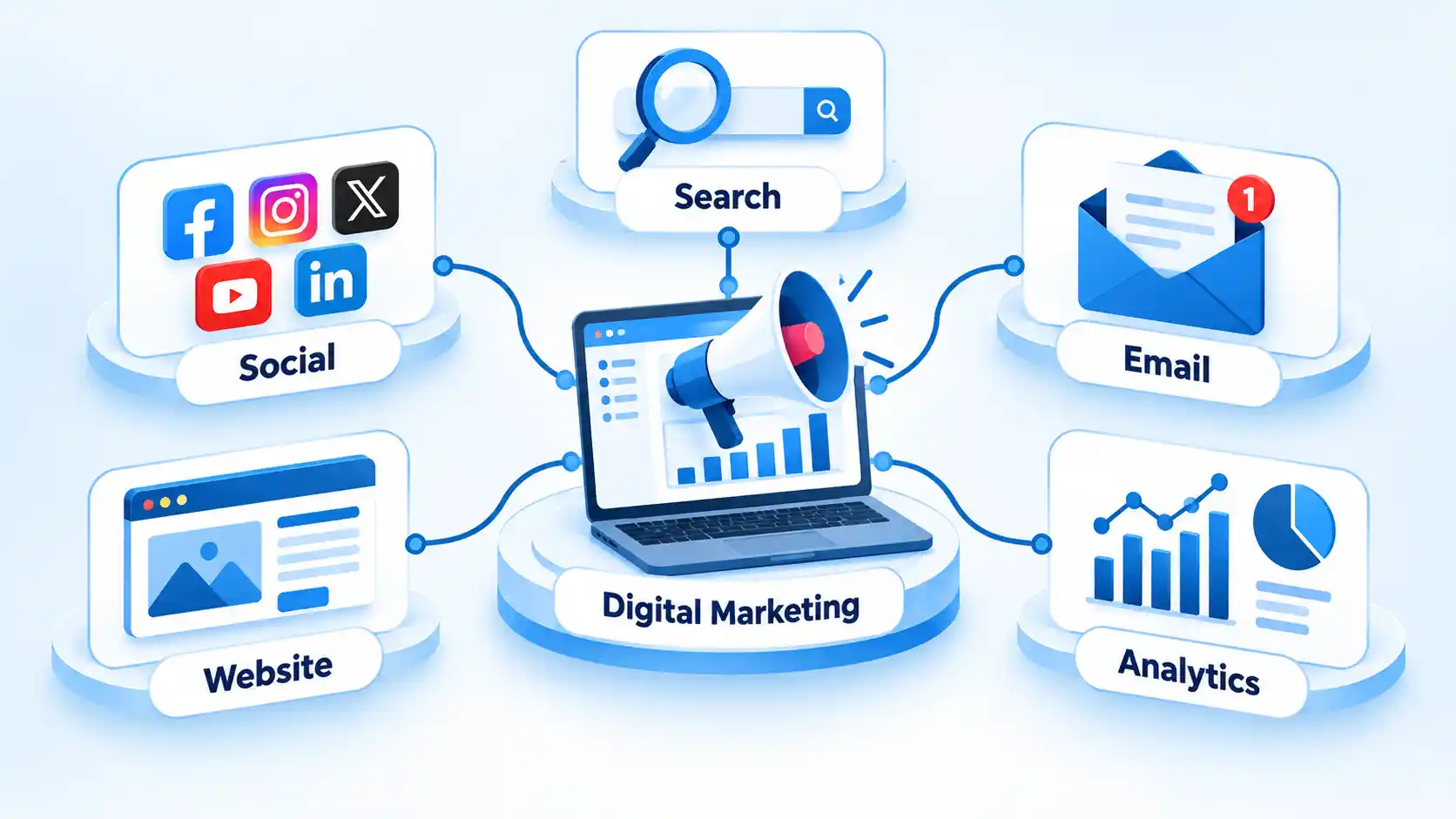
One important difference is the number of targeting signals available in many digital advertising systems. According to Google’s current advertising targeting documentation, advertisers can reach audiences based on factors such as who they are, their interests and habits, what they are actively researching, and whether they previously interacted with a website, app, or advertisement.
Consider an online furniture retailer. Instead of buying a general newspaper placement, it could run search ads when people look for terms related to dining tables, create social campaigns for relevant audience groups, send offers to subscribers, and publish buying guides that attract search traffic. Each channel addresses a different stage of the buying process.
Digital marketing also shortens the path between exposure and action. Someone can see an ad, click it, view a product, subscribe, request a quote, or complete a purchase without moving to another medium.
Traditional Marketing vs Digital Marketing: Key Differences
Audience Reach and Targeting
Traditional marketing can target audiences through geography, publication readership, program selection, mailing lists, event attendance, or physical location. A neighborhood service business may care more about reaching households within five miles than identifying hundreds of behavioral attributes.
Digital marketing adds more audience-selection options. Search advertising can respond to expressed intent, while social and display platforms may use demographic, behavioral, interest, or contextual signals.
That does not mean every digital platform reaches the same audience. Pew Research Center’s 2025 social media survey found that 84% of U.S. adults reported using YouTube, 71% used Facebook, and 50% used Instagram. Usage also varied considerably by age. For example, Instagram use was much higher among adults ages 18 to 29 than among people ages 65 and older.
The practical implication is that channel selection should begin with the intended audience rather than a general assumption that social media, print, radio, or another medium is universally best.
Measurement and Attribution
Digital marketing generally produces more detailed event data. A conversion is a business-defined action such as a purchase, signup, call, or app action. Google’s conversion tracking options include website actions, app conversions, phone calls, and certain offline conversions.
This makes it easier to compare campaigns against specific objectives. An e-commerce advertiser, for example, can examine which ads generated purchases rather than judging performance only by how many people might have seen a message.
More measurable does not mean perfectly attributable. Browser settings, unavailable cookies, device changes, consent requirements, incorrect tag implementation, and journeys across multiple channels can create gaps. Google notes in its website conversion documentation that cookies used to record an advertising interaction may not always be available because of factors including browser settings.
Traditional campaigns have attribution challenges too, but they are not inherently unmeasurable. Unique URLs, QR codes, coupon codes, call tracking, point-of-sale questions, geographic tests, and campaign-specific offers can provide useful response data.
Cost and Budget Control
It is misleading to say that digital marketing is always cheaper. A business can spend very little or very large amounts in either category.
The more useful difference is how costs are structured. Traditional campaigns may involve fixed production, printing, distribution, or placement commitments. Once 20,000 flyers have been printed, correcting the offer means producing new material. A billboard or broadcast slot may also be booked for a defined period.
Many digital campaigns allow more continuous control. Advertisers can adjust daily budgets, bids, targeting, creative, or landing pages while campaigns are active. That flexibility can make experimentation easier, but it does not guarantee lower acquisition costs.
The size of the digital advertising economy shows how central these channels have become. The IAB/PwC 2025 revenue report put U.S. internet advertising revenue at $294.6 billion, up 13.9% from 2024. That figure demonstrates market scale, not that digital advertising produces a positive return for every advertiser.
Speed and Flexibility
Digital campaigns are often easier to revise after launch. A marketer can pause an advertisement, replace creative, change a landing page, exclude an audience segment, or shift budget toward a stronger-performing campaign.
Physical media usually has a longer correction cycle. A printing mistake cannot be edited after delivery, and an already-produced radio or television advertisement may require another production step before a new version can run.

This difference matters most when offers, inventory, prices, or market conditions change frequently. A stable branding campaign may not need daily adjustments, while a retailer advertising rapidly changing stock may value that flexibility much more.
Where Traditional Marketing Still Makes Sense
Traditional marketing remains useful when the customer journey has a strong physical or local component. Storefront signs, trade-show materials, flyers, direct mail, local publications, sponsorship materials, and out-of-home advertising can place a brand directly in the environment where a purchase decision occurs.
A home-services company, for example, may want to reach households within selected neighborhoods rather than generate nationwide traffic. Direct mail, vehicle branding, local signage, community events, and digital local search can all contribute to that objective.
Offline media can also reach people at times when they are not actively browsing. A roadside sign, package insert, printed catalog, or mail piece does not depend on a person opening a social app or typing a query.
Businesses evaluating physical mailing alongside online channels can review additional direct-mail use cases, while judging suitability from their own audience, geography, offer, costs, and measurement plan rather than assuming a particular medium will produce a fixed return.
Where Digital Marketing Has the Advantage
Digital marketing becomes especially useful when a business needs to respond to observable intent or measure a clearly defined online action.
- Search demand: Ads and SEO can reach people who are actively researching a problem, product, or service.
- E-commerce: The advertisement, product page, checkout, and conversion measurement can exist within the same digital journey.
- Lead generation: Forms, calls, bookings, and signups can be linked to campaigns.
- Audience segmentation: Different messages can be shown to different audiences rather than using one creative for everyone.
- Rapid testing: Creative, landing pages, audiences, and offers can often be changed without reproducing physical material.
- Performance analysis: Advertisers can compare campaigns against selected conversion objectives and other measurable outcomes.
None of those capabilities automatically produces a positive return. Poor targeting, weak creative, slow pages, confusing checkout flows, inaccurate tracking, or an unattractive offer can still undermine performance. Technologies that improve targeting, landing pages, automation, and measurement are covered in more depth in this guide to improving digital advertising ROI.
Why a Combined Strategy Can Work Better
Traditional and digital channels do not need to compete for the same role. One channel can create awareness while another captures demand, explains the offer, or records the eventual conversion.

Imagine a local furniture store running a billboard campaign. The billboard introduces the store and a seasonal offer. Some viewers later search the business name, open its website, compare products, and visit the showroom. Others may scan a QR code that leads to a dedicated landing page.
A direct-mail campaign can work similarly. A postcard can contain a unique discount code or campaign URL. When someone uses that code online or in a store, the business gains a clearer signal connecting the physical campaign with the response.
These methods improve measurement, but they still do not prove that every customer response came from one exposure. Someone may see a billboard, hear a recommendation, find an organic search result, and later click a paid advertisement before buying. Practitioners should therefore distinguish observable attribution from the broader question of what actually influenced the decision.
How to Choose Between Traditional and Digital Marketing
The right choice starts with the customer and the objective, not with a preferred channel. Work through the following questions before assigning a budget.
- Identify where the audience spends attention. Determine which websites, search engines, platforms, publications, locations, events, or offline media are actually relevant to the people you need to reach.
- Define the business outcome. Brand awareness, store visits, quote requests, email signups, online purchases, and event attendance require different campaign designs.
- Consider geography. A neighborhood restaurant has different reach requirements from a software company selling nationally.
- Decide how quickly the campaign must change. Digital channels are generally more suitable when prices, inventory, creative, or offers must be adjusted frequently.
- Set the measurement requirement. If management needs conversion-level reporting, build the campaign around trackable actions rather than assuming exposure alone is enough.
- Account for production resources. Print, video, radio, landing pages, email, photography, analytics, and paid media all require different skills and workflows.
- Map the full customer journey. Determine whether customers move between offline and online touchpoints before making a decision.
For example, a neighborhood restaurant could combine signs, local events, direct mail, local search, map listings, and social advertising. A software-as-a-service company selling nationwide would normally rely much more heavily on search, content, email, online demonstrations, digital advertising, and conversion measurement.
Businesses focused on a specific geographic market can also compare additional local marketing strategies rather than treating online and offline channels as separate plans.
Privacy, Advertising Rules, and Platform Limits
Greater targeting capability also creates privacy and policy responsibilities. Digital advertising platforms do not allow unrestricted use of every possible audience characteristic. Google’s current personalized advertising guidance, for example, provides controls for personalized ads and restricts the use of sensitive categories for personalization.
Businesses also need to consider applicable privacy laws, consent requirements, platform policies, and their own data-handling practices when collecting or using customer information. Requirements vary by jurisdiction and campaign type.
Advertising standards apply beyond digital channels. The U.S. Federal Trade Commission states in its advertising guidance that claims must be truthful, non-deceptive, and supported by evidence. Endorsements, testimonials, reviews, and influencer relationships can create additional disclosure responsibilities.
The practical point is simple: better targeting technology does not remove the need for accurate claims, responsible data use, and clear disclosure.
Key Takeaways
- Digital marketing is generally stronger for detailed targeting, rapid adjustment, online conversion paths, and granular measurement.
- Traditional marketing remains useful for physical visibility, local exposure, events, direct mail, signage, and audiences reached effectively offline.
- Digital marketing is not automatically cheaper, and traditional marketing is not automatically less effective.
- Digital attribution is more detailed but still imperfect because tracking and customer journeys can span browsers, devices, platforms, and offline interactions.
- The best channel depends on audience behavior, campaign objective, geography, production requirements, and the level of measurement required.
- Many businesses can use traditional and digital channels together, with each channel performing a different part of the customer journey.
Frequently Asked Questions
Is traditional marketing still effective in 2026?
It can be. Traditional marketing remains relevant when physical location, geographic exposure, events, direct mail, print, signage, radio, television, or other offline environments align with the audience and campaign objective. Effectiveness depends on the specific channel, offer, audience, creative, frequency, and measurement method rather than whether the medium is classified as traditional.
Can a small business use traditional and digital marketing together?
Yes. A small business might use signs, flyers, mail, or local events for offline awareness while using search, social media, email, and its website to capture demand and measure responses. A combined campaign is most useful when each channel has a defined role rather than repeating the same message everywhere without a measurement plan.
How do you measure whether offline advertising caused online sales?
You can use dedicated landing pages, QR codes, campaign URLs, promo codes, unique phone numbers, geographic comparisons, customer surveys, and sales data. These methods improve attribution but may not capture every influence because a customer can encounter several online and offline touchpoints before purchasing.
Is digital marketing always cheaper than traditional marketing?
No. Costs depend on the channel, audience, competition, production requirements, campaign size, and duration. Digital advertising can offer more flexible budget controls, while some traditional campaigns require larger production or distribution commitments, but either approach can become expensive at scale.
Which type of marketing is better for a local business?
A local business often benefits from a combination. Digital channels such as local search, maps, social media, email, and targeted advertising can capture nearby demand, while signs, events, direct mail, local print, and other physical channels can create visibility within the same geographic area. The best mix depends on how local customers discover and choose the business.

💬 Comments