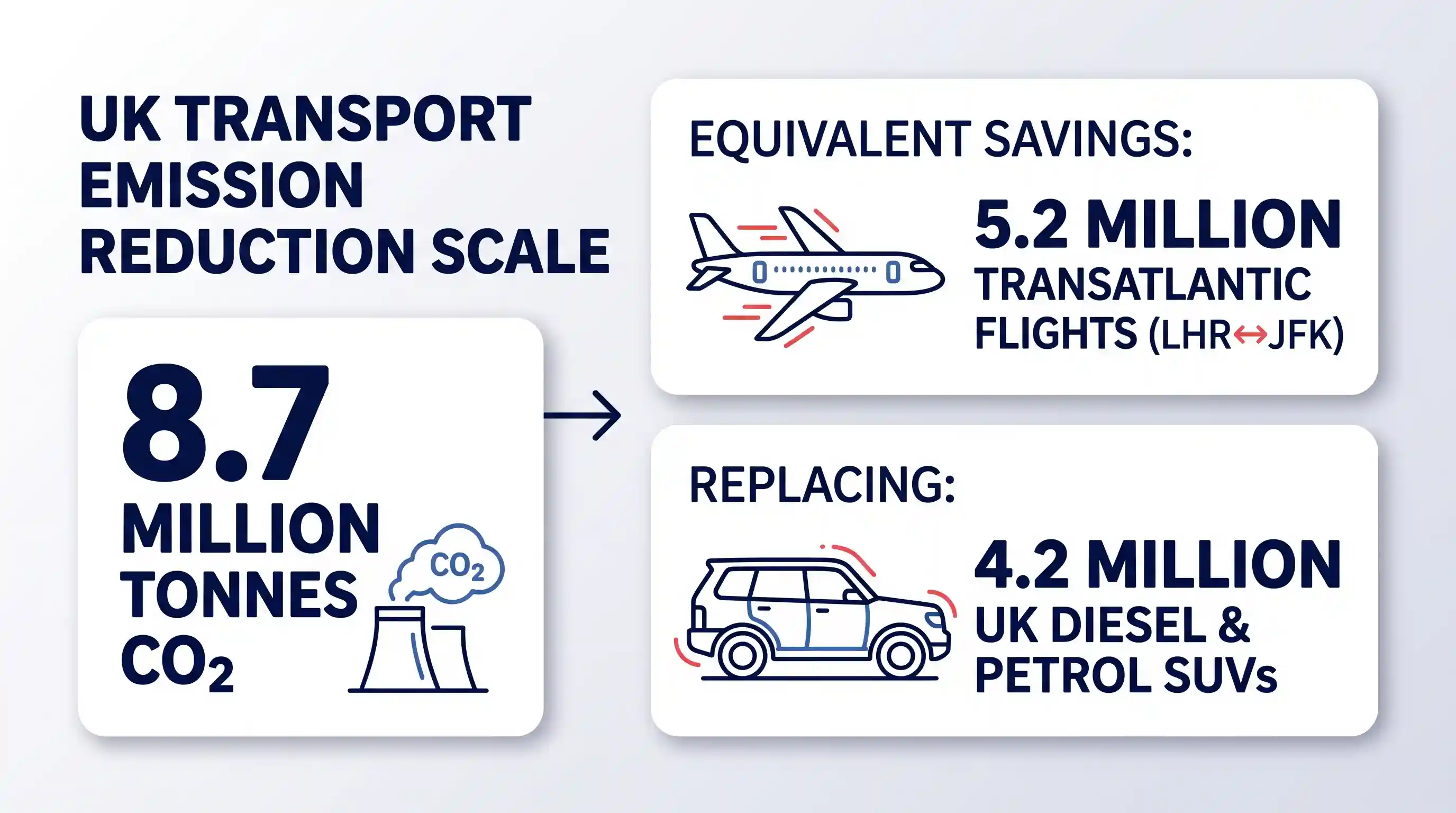
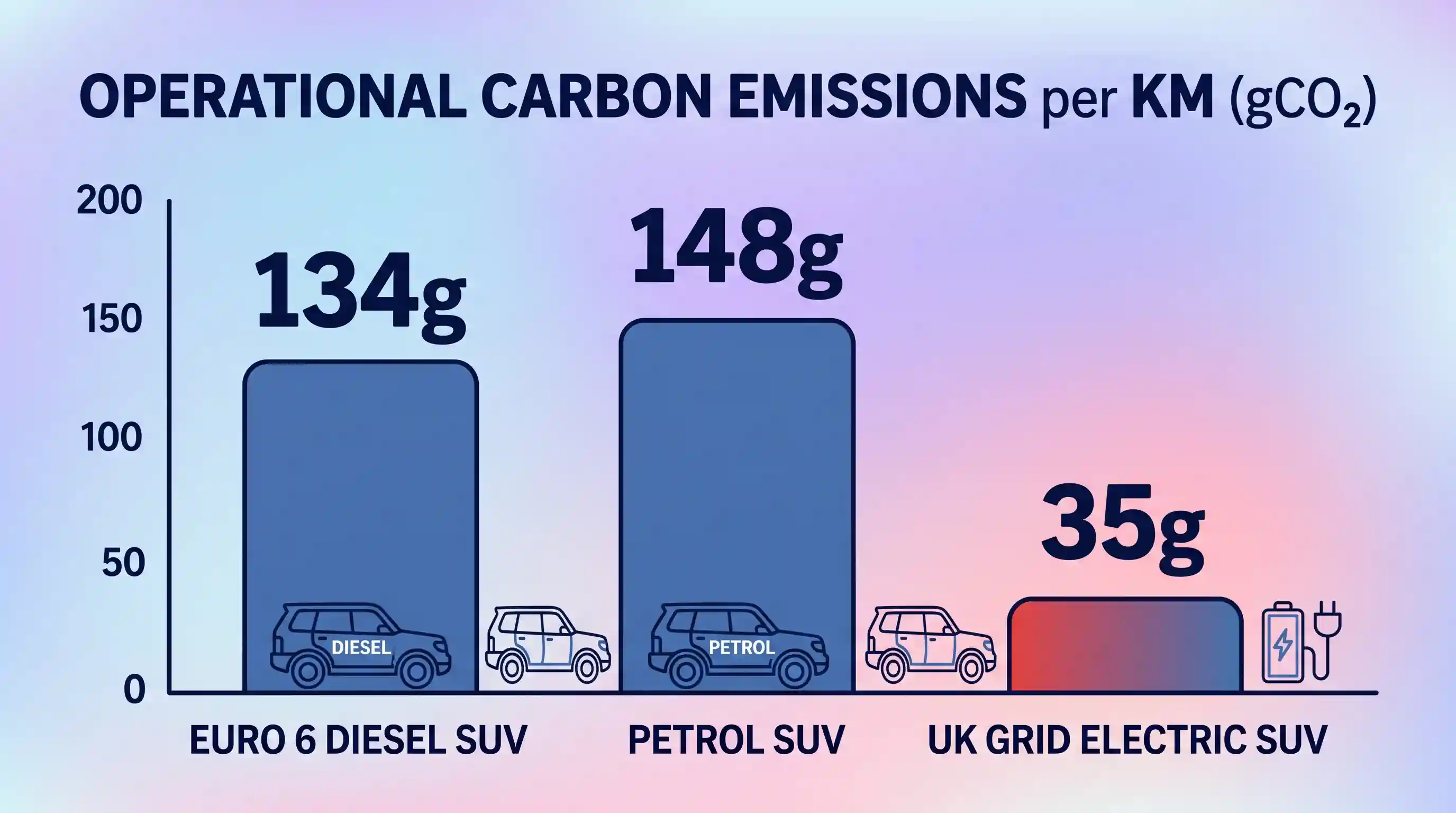
Replacing the UK’s 4.2 million petrol and diesel sport utility vehicles (SUVs) with battery electric models would cut direct national carbon dioxide ($CO_2$) emissions by 8.7 million tonnes every year. This reduction represents approximately 7.8% of total UK domestic transport emissions, driven by the reality that internal combustion SUVs emit an average of 134 grams of $CO_2$ per kilometer—roughly 10% more than standard passenger saloons or hatchbacks.
Deconstructing the 8.7 Million Tonne Fleet Metric
The headline figure originates from fleet decarbonization modeling conducted by EDF Energy fleet emission analysis, which evaluated the carbon footprint of the UK’s growing SUV population. According to the research, 4.2 million internal combustion engine (ICE) SUVs drive an annual average of 7,400 miles (11,909 kilometers) per vehicle. At an average carbon intensity of 134 g/km $CO_2$, each conventional SUV releases approximately 1.6 tonnes of tailpipe carbon dioxide into the atmosphere annually.
When well-to-wheel extraction, refining, and fuel transport overheads are added to direct exhaust emissions, the total carbon burden of the UK fossil-fuel SUV fleet reaches 8.7 million tonnes per year. To put this volume into perspective, removing 8.7 million tonnes of $CO_2$ is equivalent to canceling 5.2 million individual return passenger flights between London Heathrow and New York JFK, or shutting down two full-scale gas-fired power stations permanently.
The core reason SUVs generate a disproportionate carbon footprint comes down to vehicle physics. The increased frontal surface area creates higher aerodynamic drag at highway speeds, while curb weights typically range 200kg to 450kg heavier than equivalent saloons built on the same architecture. This added mass demands greater energy during urban acceleration, compounding emissions in stop-start city driving. Transitioning these specific high-impact vehicles to zero-tailpipe electric powertrains provides a high-leverage opportunity for national UK transport decarbonization targets.
From Dieselgate to Electrification: Legal Accountability and Market Shift
The widespread migration toward electric vehicles is deeply intertwined with the erosion of consumer trust in diesel technology following the 2015 “Dieselgate” scandal. For over two decades, European car manufacturers marketed diesel passenger cars—particularly heavy SUVs—as environmentally responsible choices due to lower official fuel consumption figures. However, real-world emissions testing revealed that defeat devices and thermal window software deliberately muted emission controls outside laboratory test cycles.
While public debate initially focused on harmful nitrogen oxide ($NO_x$) air pollution in urban centers, legal actions quickly highlighted that actual fuel consumption and real-world $CO_2$ output significantly exceeded homologated figures. In the UK High Court, consolidated claims against major vehicle manufacturers have reached unprecedented scale. On November 2, 2023, the High Court issued a formal Group Litigation Order (GLO) allowing over 100,000 BMW and MINI owners to proceed in joint legal proceedings over alleged emissions defeat software, as documented by lead litigation updates on the High Court Group Litigation Order judgment.
Parallel legal frameworks continue to process claims across multiple vehicle brands. Owners seeking legal recourse for affected vehicles frequently turn to specialized legal groups, such as those prosecuting MINI diesel emissions claims, to secure compensation for lost vehicle value and inflated fuel expenses. This judicial scrutiny permanently altered consumer purchasing behavior and forced regulatory policy away from fossil diesel.
In response, policy tools such as urban Clean Air Zones (CAZ), London’s expanded Ultra Low Emission Zone (ULEZ), and the UK Zero Emission Vehicle (ZEV) Mandate were established. The ZEV Mandate legally compels manufacturers to ensure battery electric vehicles account for an escalating percentage of their new UK car sales—starting at 22% in 2024 and rising progressively toward 80% by 2030—effectively ensuring that diesel SUVs are phased out of the UK fleet.
Tailpipe vs. Grid Intensity: The Net Lifecycle Carbon Balance
A frequent objection to electric vehicle adoption centers on the origin of electricity used for battery charging. Skeptics argue that shifting from diesel to electricity merely relocates emissions from vehicle tailpipes to industrial power station chimneys. However, evaluating this argument requires examining current energy generation data and full life-cycle carbon accounting.
The UK electricity grid has undergone rapid decarbonization over the past decade. According to power generation analyses published by Carbon Brief UK grid decarbonization report data based on DESNZ statistics, UK grid carbon intensity averaged 126 grams of $CO_2$ per kilowatt-hour (kWh) in 2025. Coal-fired power generation recorded zero hours of operation across the entire year, while renewable sources—predominantly offshore wind, solar, and biomass—supplied 47% of national electricity demand.
Official transport data from the Department for Transport greenhouse gas statistics confirms that total domestic transport accounts for 110.4 million tonnes of $CO_2$ equivalent ($MtCO_2e$) annually. Because an average electric SUV operates at an efficiency of roughly 3.3 to 3.8 miles per kWh, charging on the 126g $CO_2$/kWh UK grid results in an operational footprint of just 33g to 38g of $CO_2$ per kilometer. This represents a direct 72% to 75% reduction in carbon emissions per kilometer driven compared to a modern Euro 6 diesel SUV.
Even when accounting for the upfront carbon footprint embedded during vehicle manufacturing—primarily during lithium-ion cell fabrication and raw material refining—electric vehicles maintain a decisive lifetime advantage. The initial “carbon debt” incurred during battery manufacturing is typically offset within 12,000 to 22,000 miles of real-world driving on the UK power grid. Beyond this payback threshold, every mile driven generates net carbon savings for the remainder of the vehicle’s operational lifecycle.
| Powertrain Architecture | Average Efficiency | Direct Tailpipe $CO_2$ | Grid Charging $CO_2$ (126g/kWh) | Upfront Manufacturing Carbon Debt | Lifetime Carbon Payback Distance |
|---|---|---|---|---|---|
| Diesel SUV (2.0L Turbo) | 42.5 MPG (6.6 L/100km) | 134 g/km | N/A (Fossil Fuel) | ~5.5 Tonnes $CO_2$ | Baseline (No Payback) |
| Petrol SUV (1.5L Turbo) | 37.2 MPG (7.6 L/100km) | 148 g/km | N/A (Fossil Fuel) | ~5.1 Tonnes $CO_2$ | Baseline (No Payback) |
| Battery Electric SUV (75 kWh) | 3.5 Miles/kWh (17.8 kWh/100km) | 0 g/km | 36 g/km | ~9.2 Tonnes $CO_2$ | 14,500 Miles (~1.2 Years) |
As detailed in EV battery manufacturing lifecycle analysis, as global supply chains shift toward renewable-powered gigafactories and recycled battery materials, the upfront carbon debt of electric SUVs will continue to shrink, accelerating the payback point even further.
Consumer Economics, Tariffs, and Charging Infrastructure
While environmental benefits provide a macro-level justification for transport policy, individual consumer purchasing decisions depend heavily on total cost of ownership (TCO) and daily practical usability. Electric SUVs carry an upfront retail price premium over equivalent combustion models, but operational economics favor electric drive under UK market conditions.
The financial advantage is strongest for motorists who can charge at home using dynamic off-peak electricity tariffs. Dedicated EV tariffs offer overnight charging rates between 6p and 8p per kWh. An electric SUV covering 7,400 miles per year at 3.5 miles per kWh requires 2,114 kWh of electricity. At an off-peak rate of 7p/kWh, annual charging costs equal £148.00—or roughly 2p per mile.
By contrast, driving a diesel SUV 7,400 miles at 42.5 MPG consumes 790 liters of diesel fuel. At an average retail price of £1.50 per liter, annual fuel expenditure totals £1,185.00—or nearly 16p per mile. Drivers utilizing overnight domestic charging save over £1,000 per year in fuel costs alone. For further details on optimizing domestic charging setups, consult guide on smart EV home charging tariffs.
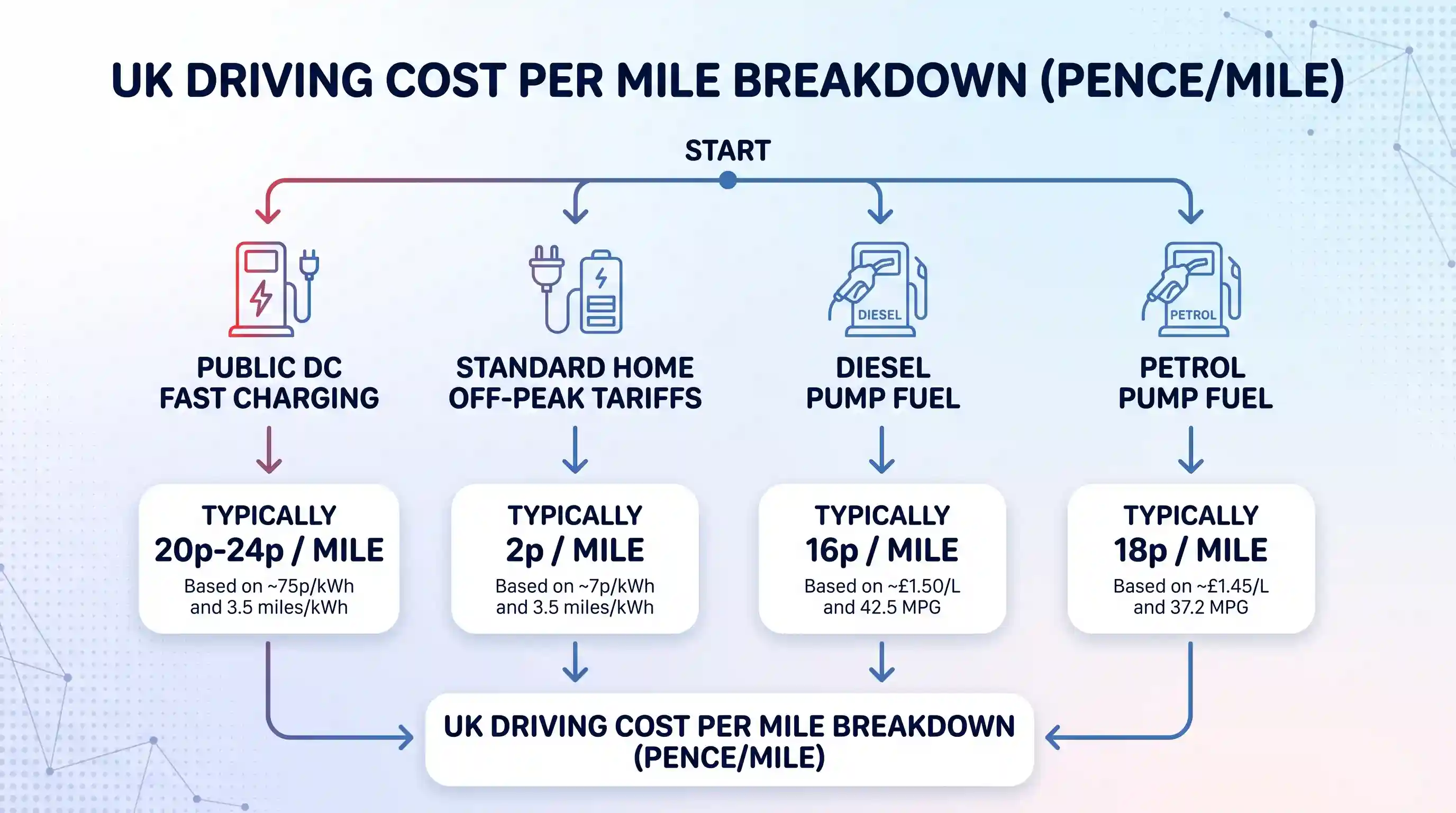
Infrastructure availability remains a central consideration for motorists without off-street parking. Latest UK EV market metrics published by Zapmap EV market statistics report that over 2.15 million fully electric vehicles are active on UK roads, supported by a public charging network exceeding 92,000 commercial charge points. While high-power public rapid chargers (150kW–350kW) carry higher unit prices (typically 65p to 85p per kWh), they allow long-distance travel without significant route disruption. Readers evaluating charger reliability across regional highways can review our analysis of UK public charging point reliability.
Key Takeaways
- 8.7 Million Tonne Potential: Converting the UK’s 4.2 million petrol and diesel SUVs to battery electric models would reduce national $CO_2$ emissions by 8.7 million tonnes annually—removing 7.8% of domestic transport emissions.
- Higher SUV Impact: Due to weight and aerodynamic drag, fossil-fuel SUVs emit an average of 134g $CO_2$/km, making them the highest-yielding target for carbon reduction in the passenger car fleet.
- Decarbonized Grid Efficiency: With UK electricity grid carbon intensity dropping to 126g $CO_2$/kWh, an electric SUV generates less than 38g $CO_2$/km in total operational emissions—a 75% reduction versus diesel.
- Manufacturing Debt Offset: The initial manufacturing carbon footprint of a 75 kWh electric SUV is fully paid back within 12,000 to 22,000 miles of driving on the UK grid.
- Legal Catalysts: Historical litigation, including the BMW and MINI High Court Group Litigation Order, accelerated consumer abandonment of diesel vehicles and spurred zero-emission mandates.
Frequently Asked Questions
How does the 8.7 million tonne saving compare to total UK carbon emissions?
Removing 8.7 million tonnes of $CO_2$ annually eliminates approximately 7.8% of total UK domestic transport emissions (110.4 $MtCO_2e$). This reduction matches the total combined annual carbon footprint generated by over two million average UK households.
Does an electric SUV still cut carbon if charged during periods of low renewable generation?
Yes. Even during peak fossil-gas generation on the UK grid (when grid intensity rises to 220g $CO_2$/kWh), an electric SUV operating at 3.5 miles per kWh generates approximately 39g $CO_2$/km. This is still vastly lower than the 134g $CO_2$/km direct tailpipe emissions of an equivalent Euro 6 diesel SUV.
Can UK drivers still join group litigation actions for diesel emissions?
UK High Court litigation remains active against multiple vehicle manufacturers under formal Group Litigation Orders (GLOs). However, legal join dates and eligibility rules vary by vehicle brand, model year, and lead legal firm. Affected vehicle owners must verify their eligibility directly with court-appointed legal representatives before specific claim deadlines close.

💬 Comments